
The Language of Banking
A NEW BANK ACCOUNT ~40 min
Look at this advertisement. It is for a bank that would like to find new customers. Look at the words that are highlighted in the advertisement. Without using a dictionary decide if each word is a verb, a noun or an adjective.
For all eligible applicants
■ Free everyday banking on your GOLD current account. Pay no charges in England to issue cheques, to withdraw cash using the ATM network, to make automated payments or to receive a monthly
statement.
■ Free Telephone Banking.
■ Quick and straightforward system to deposit cash and cheques — no queueing necessary.
■ 24/7 Internet Banking. Do your banking how you want to when you want to. Transfer your cash, check your balance, look at your statements or pay your bills any time you like.
■ No arrangement fee on an overdraft up to £5000 (subject to status).
■ Chip and PIN technology for your safety.
Here are the definitions of the words in Exercise 1. Put the correct word into each sentence to complete the definition.
a Yourbalanceis the amount of money that you have got in your bank account.
b Todepositmoney means to put it into a bank account.
c Acurrentaccount is a bank account that you can use at any time. It is called a checking account in the USA.
d If youissuea cheque it means you give a cheque to someone and you validate it by signing it.
e Anoverdraftis the amount of money you can take out of the bank even though your account does not have that much money in it.
f Abillis a demand for payment for goods or services you have received.
g Afeeis a payment that you have to make to a professional person to do something for you.
h Towithdrawmoney means to take money out of a bank account.
i If youtransfercash you move it electronically from one bank account to another.
j If you areeligiblefor something it means that you are the right kind of person to have something, for example, because you are the right age or you have enough money.
k Bankchargesare payments that you have to make to the bank for using your bank account.
l A bankstatementis a document that your bank sends to you. It tells you when you deposited money, when you withdrew money and how much you have in the account at the moment.
Help desk
What do these words mean?
an applicant — a person who wants to ask for something like a job or a bank account.
an ATM machine/the ATM network — the machines that give money to bank customers (Automated Telling Machines). In the UK an ATM is called a cashpoint.
an automated payment — a payment that your bank will make every week or every month without needing your permission to do it each time.
straightforward — simple and easy to understand.
subject to status — depending on your age or how much money you have, for example.
chip and PIN — the system of security for using cards which contain a microchip. You have to put your card into a machine and then enter your secret Personal Identification Number (PIN).
to validate something — to make something legally acceptable.
Alison Goldsmith wants to open an account with the bank. Here is part of a conversation she has on the telephone with one of the bank’s employees. Put the conversation in the correct order. There is an example which is the start of the conversation.
a ‘I might be interested in that. What benefits does the GOLD account have?’
b ‘Hi. My name is Alison Goldsmith and I’m interested in opening a current account.’
c ‘Well, you can check your balance online 24 hours a day. And it has free telephone banking. Another good thing is you will pay no charges to issue cheques or withdraw cash.’
d ‘Hello, Royal Chatsworth Bank. Carla speaking, how may I help you?’
e ‘That sounds very good. I’m busy, so it would be very handy to be able to do my banking on the Internet. I don’t issue many cheques these days but I withdraw cash almost every day so doing that for free will save me quite a lot in bank charges.’
f ‘Certainly madam. We have a few different types of current account. Shall I give you some details about our GOLD account? And then we can check to see if you are eligible for it.’
g ‘OK Ms Goldsmith. I need to ask you some questions. It won’t take too long…’
Jumbled words. Look at the definitions below. The letters of the words that belong with each definition are mixed up. Put the letters in the correct order to spell the words. The first letter of each word is there for you.
Example: An amount of money paid into a bank account. CREDIT (DRICET)
a An amount of money that goes out of a bank account. DDEBIT(TEBDI)
b A word for all the money that you receive from your salary or from other things. It could be every month or every year. IINCOME(MIENOC)
c A word for all of the money you spend. It could be every month or every year.
OOUTGOINGS(GSONGUIOT)
d A verb which means that you give something (often money) to someone else for a period of time.
They must give it back to you. LLEND(DELN)
e A verb which means that you take something (often money) from someone else for a period of time. You must give it back to them. BBORROW(ROBWOR)
f To have to pay some money to someone else. OOWE(WOE)
g A general word for money which you owe to someone else. DDEBT(BETD)
h The colour we say your bank account is in if you spend more money from your account than you have in it. RRED(EDR)
i The colour we say your bank account is in if it has some money in it. BBLACK(CLKBA)
Put the correct word from Exercise 4 into these sentences.
a I have an overdraft facility of £200 on my bank account. It means I can go £200 into thered.
b My account shows twodebitsfor yesterday. One is for a pair of shoes that I bought when I was shopping in London and the other one is for paying for a repair to my car. A total of £445 went out of my account.
c I need toborrowsome money because I want to buy a new computer and I don’t have enough money of my own.
d I will ask the bank to me £2000 so I can buy that computer.
e I havedebtswhich add up to £500, because I have to pay back £200 to my parents and £300 to the bank.
f Iowe£500 in total, £200 to my parents and £300 to the bank.
g I receive a salary of £975 each month. I also teach a French evening class twice a week, for £20 every class.
My total monthlyincomeis £1135.
h There are just twocreditsshowing on my bank statement. One is my salary and the other is some money that my mum paid into my account for my birthday.
i I did some extra work last month and yesterday they paid me for it. My bank account is finally in the. I’m very pleased that I don’t have an overdraft any more.
j To own a car is very expensive as you have to pay for petrol, insurance and road tax. I am trying to reduce my totaloutgoingsso I decided to sell my car.
Alison Goldsmith opened an account yesterday with the Royal Chatsworth Bank. This morning she received this letter from the bank. Read the letter and decide which is the correct preposition from the two possibilities. Write your answers in the spaces below.
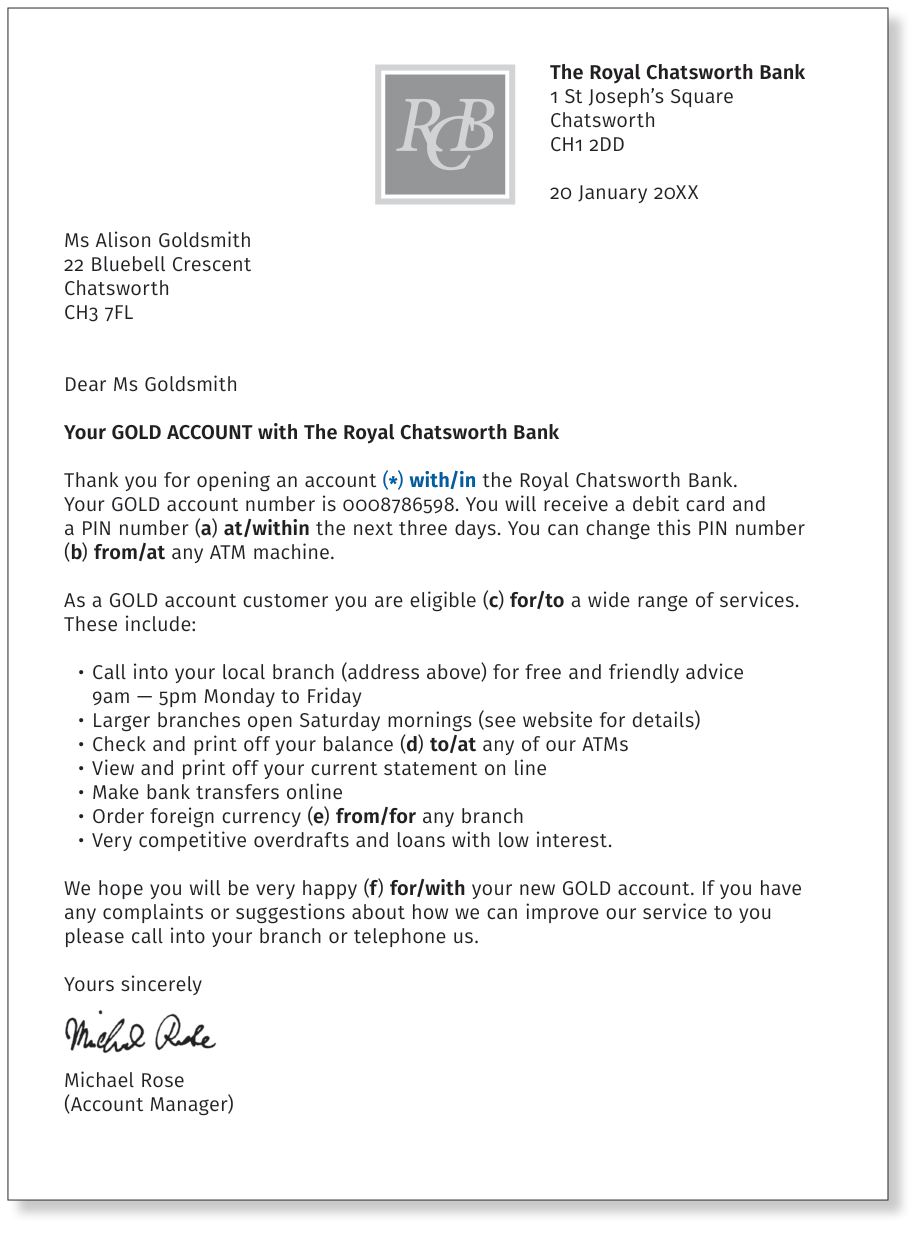
Ms Alison Goldsmith 22 Bluebell Crescent Chatsworth CH3 7FL Dear Ms Goldsmith The Royal Chatsworth Bank 1 St Joseph’s Square Chatsworth CH1 2DD 20 January 20XX Your GOLD ACCOUNT with The Royal Chatsworth Bank Thank you for opening an account (*) with/in the Royal Chatsworth Bank. Your GOLD account number is 0008786598. You will receive a debit card and awithinPIN number (a) at/within the next three days. You can change this PIN number (b) from/at any ATM machine.
As a GOLD account customer you are eligible (c) for/to a wide range of services. These include:
• Call into your local branch (address above) for free and friendly advice 9am — 5pm Monday to Friday • Larger branches open Saturday mornings (see website for details) • Check and print off your balance (d) to/at any of our ATMs • View and print off your current statement on line • Make bank transfers online • Order foreign currency (e) from/for any branch • Very competitive overdrafts and loans with low interest.
We hope you will be very happy (f) for/with your new GOLD account. If you have any complaints or suggestions about how we can improve our service to you please call into your branch or telephone us.
Yours sincerely
Michael Rose (Account Manager)
Answers Example (*) with awithinbatcfordatefromf
After Alison read the letter she had the following questions. Match each question with the bank’s answers.
Alison’s questions
| # | Phrase | Definition |
|---|---|---|
| e | What is an account number? (*) | What is a loan? (6) |
What is a branch of a bank? (1) What does ‘print off your balance’ mean? (7)
What is foreign currency? (2) What does ‘make bank transfers’ mean? (8)
What is an ATM machine? (3) What is interest? (9)
What is a debit card? (4) What is a PIN number? (10)
What is an overdraft? (5)
Bank’s answers
a ‘It is an amount of money that you owe to the bank because you withdraw more from your current account than you have in it.’
b ‘It is a card that allows you to withdraw cash from your current account or pay for goods or services electronically by taking money out of your current account.’
c ‘It is an amount of money that you borrow from the bank for an agreed period of time.’
g ‘It means to look at how much money you have in your bank account and receive a piece of paper showing that amount. You can do this at the bank’s ATM machines.’
h. ‘It is a local office or bureau of your bank.’ i j ‘It is a machine that is often outside a bank. It will give you money from your current account if you put in your debit card and then enter your PIN number.’ d ‘It means to move money electronically from one bank account into another bank account.’ ‘It is the amount of money that a bank charges you for a loan or overdraft. We also pay this to you on any money you save at our bank.’ e ‘It is a personal number that identifies your bank account. No one else has the same number.’ k ‘It is your personal identification number. This allows you to use your debit card at any ATM, or to pay for things with your debit card. You must never tell anyone else this number.’ f ‘Each country has its own. It is the money in coins and notes that people use in that country.’
Speaking & Writing for this topic
Two short tasks scored against TOEFL rubrics. The prompt is generated for this topic — use the vocabulary you have just studied.
Suggested structureclick to expand
- The last time I…
- I clearly remember when…
- A few weeks ago, I…
- The situation was…
- What was happening is that…
- It all began because…
- This is similar to what we just studied because…
- What we learned about eligible applies here, since…
- I noticed that charges mattered a lot in that moment.
- Looking back, I think…
- What I learned is that…
- Next time, I would…
- Use at least 3 keywords from the prompt list.
- Keep sentences short and clear — don't try to be poetic.
- Pause briefly between the four sections so the listener can follow.
Suggested structureclick to expand
- The main idea here is …
- What stands out about fee is …
- For example, eligible shows that …
- This works because charges …
- As a result, …
- This is why …
- Use at least 3 keywords from the prompt list.
- End with a full stop. No bullet points.
WORKING IN A BANK ~18 min
Read the following text about working in a bank. The most important words are in the key vocabulary below. Then complete the exercises that follow.
‘My name is Michael Rose and I am an account manager for the Royal Chatsworth Bank. This means that I am not the general manager of the bank but that I have responsibility for looking after the bank accounts of certain customers.
We like to have new customers at the bank. New customers make money for the bank. When people have a current account with us we can then offer them other things from our range of services.
We can offer them other bank accounts, for example. If customers have a business we can open a business account for them. Or, if they want to save money for the future or for their children, we can offer them a savings account. We offer good interest rates on all our savings accounts. For example, the interest rate on our SmartSave account is 4.3%. This means for every £100 that someone saves we pay interest of £4.30 each year.
The bank also offers a credit card to customers who are eligible. A credit card allows people to buy things and pay for them later. It doesn’t take their money out of their bank account immediately in the same way as a debit card. This means that we have to be very careful before we issue a credit card to someone.
Answer the following questions using a full sentence.
People can create big debts quite quickly! One of the things we do is to check a customer’s credit history. If they have a good history of paying for things on time we are happy to give them a credit card. If they defaulted on loans or credit agreements in the past then we will refuse them a credit card. If someone defaults on a loan it means that they don’t pay the money back and the bank might have to go to court to try to get its money.
One of the biggest problems we have with credit and debit cards these days is identity theft. Have you heard about it? If someone has your address and your credit card or debit card details they can use your money to buy things or even to take money out of your account. We have to tell all of our new customers to be careful. In fact, we give our new business customers a free shredder when they open their account. A shredder is a machine that cuts documents into tiny pieces so that no one can read them. We recommend that all of our customers destroy or shred old bank statements and credit card receipts rather than throw them away. A credit card receipt is the piece of paper that proves that you have paid for something with your card. It is very dangerous to lose it or throw it away because it might fall into the wrong hands.’
Example question: What is Michael Rose’s job? Example answer: Michael Rose is an account manager for the Royal Chatsworth Bank.
a Why does the bank like to have new customers?
Answer:
b What can the bank do for customers who have a business?
Answer:
c What interest rate does the bank offer on its SmartSave account?
Answer:
d When does a debit card take money out of someone’s account?
Answer:
e What does to default on a loan mean?
Answer:
f If a stranger has your address and your credit card details what can they do?
Answer:
Decide if these statements are true or false.
a Michael Rose is responsible for the accounts of all of the bank’s customers.
b Every customer of the bank is offered a credit card.
c People who have a bad record of paying back their debts won’t be allowed to have a credit card from this bank.
d The bank offers to shred old bank statements for its customers.
e A receipt is the same thing as a bill.
Speaking & Writing for this topic
Two short tasks scored against TOEFL rubrics. The prompt is generated for this topic — use the vocabulary you have just studied.
Suggested structureclick to expand
- The last time I…
- I clearly remember when…
- A few weeks ago, I…
- The situation was…
- What was happening is that…
- It all began because…
- This is similar to what we just studied because…
- What we learned about account manager applies here, since…
- I noticed that interest rates mattered a lot in that moment.
- Looking back, I think…
- What I learned is that…
- Next time, I would…
- Use at least 3 keywords from the prompt list.
- Keep sentences short and clear — don't try to be poetic.
- Pause briefly between the four sections so the listener can follow.
Suggested structureclick to expand
- The main idea here is …
- What stands out about identity theft is …
- For example, account manager shows that …
- This works because interest rates …
- As a result, …
- This is why …
- Use at least 3 keywords from the prompt list.
- End with a full stop. No bullet points.
LOANS ~18 min
The application. Alison Goldsmith decides to take out a loan. She has to give the following information on the application form. Read the information in the box and answer the questions.
Alison Goldsmith is 28 years old. She is single. She is a photographer. She moved to Chatsworth six months ago. She bought a house. She bought 22 Bluebell Crescent, Chatsworth. She would like to take out a loan. She would like to borrow £5000 from the Royal Chatsworth Bank. She wants to apply for the loan by posting her application to the bank because her home computer is broken at the moment so she can’t do it online. She knows that the loan agreement requires her to give the bank a guarantee that they will have their money back. This guarantee is her house. Alison wants to pay the money back in equal monthly parts.
a What is the name of the borrower?
b What is the name of the lender?
c What security is the borrower giving the lender?
d What is the address of the property offered as security?
e What is the marital status of the borrower?
f What sum of money does the borrower wish to have?
g Does the borrower wish to email her application to the bank?
h Does the borrower wish to pay the loan back in a single payment or does she want to pay by instalments?
The decision. The bank must look at Alison’s loan application and decide whether to lend her the money that she wants. Read the information in the box and answer the questions.
The Royal Chatsworth Bank looked at Alison’s loan application yesterday. They looked at the information she gave to them and they had to decide if she is a good customer and that it is safe to lend money to her. To do this they had to check her credit history. Alison gave the bank permission to look at her credit history when she completed her application form. The information Alison gave to the bank is confidential. The bank promised not to tell anyone her personal details, for example, her address or her income.
The bank said ‘yes’ to Alison’s loan application. She received a letter from the bank this morning to tell her this, together with a loan agreement. The loan is for 36 months. The letter tells Alison that she must sign and return the loan agreement and then they will put the money into her current account. She cannot change her mind after the money is in her account.
a When did the bank process Alison’s loan application?
b When did Alison authorise the bank to check her credit history?
c What did the bank promise not to disclose to anyone?
d Did the bank approve Alison’s loan or refuse it?
e How did the bank notify Alison about their decision?
f What did the bank enclose with their letter?
g How long does Alison have to repay the loan?
h Can Alison cancel the loan after the bank credit the money to her account?
Complete the following sentences with the correct preposition.
a I want to buy a new car, but I don’t have enough money. I need to borrow £3000fromthe bank.
b I need to applyfora loan of £2000.
c I am very pleased as the bank agreed to lend £1000tome so that I can buy a computer.
d It’s the end of the month and I only have £12.36inmy account. I’m glad it’s pay day tomorrow.
Problems in paying back a loan. There are two very important words connected with repayment problems. These are:
arrears (noun)
Arrears means money that someone owes to someone and they promised to pay it back by a certain date but didn’t. For example, in January, Harry took out a loan and agreed to pay it back in monthly instalments. Each instalment must be paid on the first day of every month. Each instalment is £100. If Harry doesn’t pay on 1 February he has arrears of £100. If he doesn’t pay again on 1 March, he has arrears of £200.
How are arrears different from debt?
Debt is not necessarily a bad thing. Most people have debt. Arrears are always a bad thing. It means you are not paying back your debt on the agreed date.
to accrue (verb)
Accrue means to grow or accumulate. We use the word accrue to talk about accumulating interest. In our example, if Harry did not pay his monthly instalments in February or March he now has arrears of £200. For example, interest is accruing on the arrears at a rate of 15%.
Put the correct word from the box below into the following sentences. You can use each word more than once.
a I owe money on two credit cards, I have a loan and I have an overdraft. I have a lot ofdebtbut I always make all of my payments on time.
b I couldn’t make the repayment on my car purchase agreement last month as I didn’t have enough money.
The car company sent me a letter yesterday to say that my account is £147 inarrears.
c If your loan account falls intoarrearsthe bank will write a letter to you and ask you to make the missing payment immediately.
d If you don’t make a payment immediately, interest willaccrueon the arrears at a rate of 10%.
e English people have a lot ofdebtbecause everyone borrows a lot to have holidays or to improve their houses.
f Interest isaccruingon your debt at the rate of 18%.
Speaking & Writing for this topic
Two short tasks scored against TOEFL rubrics. The prompt is generated for this topic — use the vocabulary you have just studied.
Suggested structureclick to expand
- The last time I…
- I clearly remember when…
- A few weeks ago, I…
- The situation was…
- What was happening is that…
- It all began because…
- This is similar to what we just studied because…
- What we learned about arrears applies here, since…
- I noticed that accrue mattered a lot in that moment.
- Looking back, I think…
- What I learned is that…
- Next time, I would…
- Use at least 3 keywords from the prompt list.
- Keep sentences short and clear — don't try to be poetic.
- Pause briefly between the four sections so the listener can follow.
Suggested structureclick to expand
- The main idea here is …
- What stands out about this concept is …
- For example, arrears shows that …
- This works because accrue …
- As a result, …
- This is why …
- Use at least 3 keywords from the prompt list.
- End with a full stop. No bullet points.
UNIT 2 VOCABULARY CHECK ~2 min
- account
- account manager
- accrue
- applicant
- apply
- approve a loan
- arrears
- ATM
- authorise
- automated payment
- balance
- bank account
- bank statement
- bank transfer
- bill
- in the black
- borrow
- borrower
- branch
- business account
- cancel
- charges
- cheque
- chip and PIN
- competitive
- a credit
- credit card
- credit check
- credit history
- currency
- current account
- debit
- debit card
- debt
- default
- deposit
- disclose
- eligible
- enclose
- fee
- identity theft
- income
- instalments
- interest
- interest rate
- internet banking
- issue
- lend
- lender
- loan
- loan rate
- marital status
- notify
- open an account
- outgoings
- overdraft
- owe
- pay
- PIN number
- process
- property (house)
- queue
- receipt
- in the red
- repay
- savings account
- security
- statement
- subject to
- sum
- telephone banking
- transfer
- validate
- withdraw
FOUNDATION LEVEL PRACTICE ~22 min
Look at the groups of words below. In each group, three of the words belong to the same subject area but there is one word that does not belong. Put a circle around the word that is the odd one out. Do not circle more than one answer for each sentence. There is an example at the beginning (*).
| # | Phrase | Definition |
|---|---|---|
| (*) | A cash B cheque | C invoice D credit card |
| (1) | A overdraft B loan | C balance D goods |
| (2) | A borrower B litigation | C balance D account |
| (3) | A branch B manager | C statement D tort |
| (4) | A credit B owe | C interest D grounds |
| (5) | A landlord B savings | C outgoings D money |
Read the following pairs of sentences. For each pair of sentences there are two possibilities, A or B. Decide which sentence uses the correct preposition. Write your answers in the box below. There is an example at the beginning (*).
Example (*) (A) Your balance is the amount of money that you have in your bank account.
(B) Your balance is the amount of money that you have at your bank account.
1 (A) I’m interested for opening a new bank account.
(B) I’m interested in opening a new bank account.
2 (A) There is no arrangement fee for overdrafts over to £5000.
(B) There is no arrangement fee for overdrafts up to £5000.
3 (A) Is my client eligible for a loan?
(B) Is my client eligible with a loan?
4 (A) I have an overdraft facility of £1000 on my bank account.
(B) I have an overdraft facility to £1000 on my bank account.
5 (A) We charge interest on loans at a rate of 4.3% a year.
(B) We charge interest in loans at a rate of 4.3% a year.
(*) A (1) (2) (3) (4) (5)
Read this newspaper article about a case in court and answer the questions that follow. Answer each question using a full sentence. There is an example at the beginning.
A woman from Chatsworth won a case in court yesterday against her bank. Ella Moran (aged 35) took her bank to court claiming that the financial charges the bank makes to customers for unauthorised overdrafts is not fair. Ella’s account is with the Glen Royal Bank, which has its head office in Edinburgh. The bank has a small branch in Talbot Road, Chatsworth, which opened in 1988.
Last year a government department called the Office of Fair Trading began an investigation of all UK banks following thousands of complaints from customers. People complained that some UK banks were charging their customers more than £100 for going over their agreed overdraft limit. The Office of Fair Trading will publish its report later this year, but Ella Moran decided to take legal action before this report is available. Ella Moran, who works for a Chatsworth travel agency, spoke to us outside the courtroom yesterday. She said, ‘I hope the Office of Fair Trading supports many other people. But I was too angry to wait for them to help me’.
Ella Moran’s agreed overdraft limit with the Glen Royal Bank was £500. However, in March of this year Ella’s pay arrived at her bank three days later than usual. This meant Ella’s overdraft accidentally reached £560,
Example question: How old is Ella Moran? Example answer: Ella Moran is 35 years old.
a Where is the head office of the Glen Royal Bank?
as she didn’t know her pay was late and withdrew money from her account. The bank charged her a penalty of £118.
Ms Moran told us ‘I was very angry indeed. I think the amount the bank charges people is very unfair. I got out all of my old bank statements and it has happened before. Last year the bank charged me £50 for going over my overdraft limit by just £1.75. I decided to see a lawyer’.
Ms Moran was represented in court by Chatsworth solicitor, Barry Henshall. He told us ‘This is a great victory for the consumer. It was not difficult, as the bank didn’t file a defence. The bank has two weeks to pay my client £565. That pays back the unfair charges to Ms Moran as well as covering legal costs. We are delighted with today’s result’.
Legal experts say that other unhappy customers should do the same as Ms Moran and take legal action against their banks for unfair overdraft charges. Consumer law says that penalty charges must only cover the real administrative cost to the bank and must not be used to make a profit. Banks are profiting from unauthorised overdraft fees by an amazing £4.7 billion a year. This amount will reduce very quickly if more customers follow the example of Ella Moran.
A spokesman for the Glen Royal Bank refused to comment on the judgment.
b When did the Chatsworth branch of the Glen Royal Bank open?
c Why did thousands of bank customers in the UK complain to the Office of Fair Trading last year?
d Why did Ella Moran take legal action before the Office of Fair Trading made its report?
e What was Ella Moran’s agreed overdraft limit with the Glen Royal Bank?
f Why did Ella Moran’s overdraft accidentally reach £560?
g Who acted for Ella Moran in court?
h Why did Ella Moran win her case very easily?
i Why did the bank have to pay £565 to Ella Moran?
j What does consumer law say that banks must not use penalty charges for?
Speaking & Writing for this topic
Two short tasks scored against TOEFL rubrics. The prompt is generated for this topic — use the vocabulary you have just studied.
Suggested structureclick to expand
- The last time I…
- I clearly remember when…
- A few weeks ago, I…
- The situation was…
- What was happening is that…
- It all began because…
- This is similar to what we just studied because…
- What we learned about foundation applies here, since…
- I noticed that level mattered a lot in that moment.
- Looking back, I think…
- What I learned is that…
- Next time, I would…
- Use at least 3 keywords from the prompt list.
- Keep sentences short and clear — don't try to be poetic.
- Pause briefly between the four sections so the listener can follow.
Suggested structureclick to expand
- The main idea here is …
- What stands out about this concept is …
- For example, foundation shows that …
- This works because level …
- As a result, …
- This is why …
- Use at least 3 keywords from the prompt list.
- End with a full stop. No bullet points.