
The Language of Business Law
SOLE TRADERS ~32 min
Marie Stephens works for a local magazine in Chatsworth. The name of the magazine is Business Today. Marie is writing an article about the different ways in which people can start a new business. Marie went to the local advice centre to get some information about being a sole trader. The advice centre gave her this leaflet, which explains the main points. Look at the words that are highlighted in the leaflet. Without using a dictionary decide if each word or phrase is a verb/phrasal verb, a noun/compound noun or an adjective.
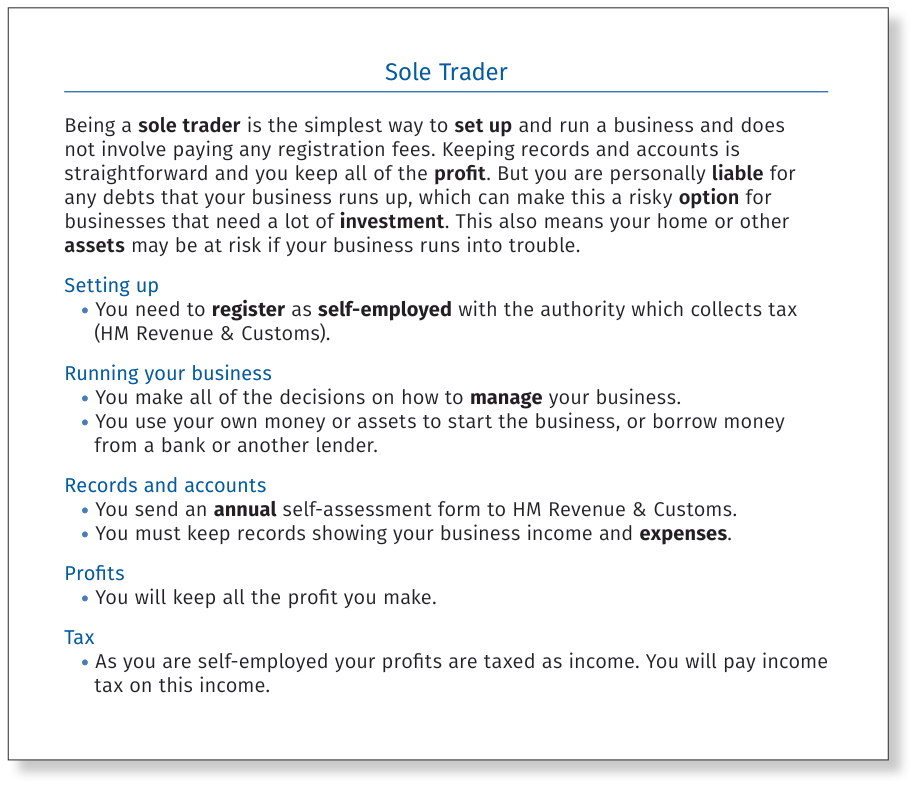
Sole Trader Being a sole trader is the simplest way to set up and run a business and does not involve paying any registration fees. Keeping records and accounts is straightforward and you keep all of the profit. But you are personally liable for any debts that your business runs up, which can make this a risky option for businesses that need a lot of investment. This also means your home or other assets may be at risk if your business runs into trouble.
Setting up
• You need to register as self-employed with the authority which collects tax (HM Revenue & Customs).
Running your business
• You make all of the decisions on how to manage your business. • You use your own money or assets to start the business, or borrow money from a bank or another lender.
Records and accounts
• You send an annual self-assessment form to HM Revenue & Customs. • You must keep records showing your business income and expenses.
Profits
• You will keep all the profit you make.
Tax
• As you are self-employed your profits are taxed as income. You will pay income tax on this income.
Verb/phrasal verb Noun/compound noun Adjective
Help desk
What do these words mean?
to run a business — to have control of a business and decide how you manage it.
a self-assessment form — a form that you complete and send to the tax authority. You give all of your financial details and calculate the amount of tax that you must pay. You do this yourself.
to run up a debt — to create a debt because you borrowed money or bought something on credit.
risky — a word to describe an activity or action that is dangerous or that may fail.
records and accounts — written details of all your business activities, especially the financial details of the income and outgoings of the business.
at risk — this means to be in a situation where something unpleasant may happen.
to run into trouble — to experience difficulties (often financial) that you did not expect.
income tax — the amount of your income that you have to pay to the government in tax.
Here are the definitions of the words in Exercise 1. Fill each gap with the correct word from the box to complete the definitions.
a An is one of the available choices from several possibilities.
b Your are the money that you must spend on the day-to-day costs of the business.
c An is the amount of money that someone puts into a business with the aim of making that business successful and getting more money back.
d To something means to start something or to create something, especially a business.
e A is a person who owns and runs an unregistered business by himself or herself.
f To be means not to have a boss. You organise your own work and people pay you for the goods or services that you provide. You are responsible for paying tax on the money you receive.
g Your is the amount of money you get from selling something or providing a service to someone, after you deduct the costs of making that thing or providing that service.
h Your are things that you own and which have a financial value, for example your house, your car or the money that you have in the bank.
i To be for something means that you are legally responsible for that thing.
j To as something means to put your name on an official list for a particular purpose.
k To a business means to have control of how you run that business.
l An event is something that happens once every year.
Marie Stephens talks to Eddie Anning, who is a car mechanic. Marie wants some information about working as a sole trader. Match Marie’s questions with Eddie’s answers to complete the conversation between Marie and Eddie. The first one is done for you as an example.
• How did you finance your business when you set it up? (1)
Is the business profitable? (2)
• Did you have to register your business anywhere? (3)
• Can you tell me about your background?
• Did you get any professional advice from anyone? (4)
• What sort of business did you form? (5)
Example: Can you tell me about your background?
I did my apprenticeship with Bugler Cars. An apprenticeship is a period of training. After that I worked for Bugler for four years to get some experience. Then I decided that I could do the job on my own, so I set up my own business.
| # | Phrase | Definition |
|---|---|---|
| a | I’m a sole trader. I wanted a business that I could manage myself without a lot of complicated rules and regulations. That’s why I chose to be a sole trader. | ? |
| b | No. I didn’t want to use lawyers or accountants because they cost so much. But I went to the local advice centre and they gave me some help at the beginning. | ? |
| c | No. But I had to tell the tax authorities what I was doing, of course. I have to send them an annual self-assessment form. | ? |
| d | I invested all of my savings and I took out a loan from the bank. | ? |
| e | The first year was really hard. I ran up a big overdraft because I had to pay the rent and other expenses. I didn’t get much work in the first year. But I continued with it and things got better during the second year. This is my third year and finally my income is more than my expenses. | ? |
Speaking & Writing for this topic
Two short tasks scored against TOEFL rubrics. The prompt is generated for this topic — use the vocabulary you have just studied.
Suggested structureclick to expand
- The last time I…
- I clearly remember when…
- A few weeks ago, I…
- The situation was…
- What was happening is that…
- It all began because…
- This is similar to what we just studied because…
- What we learned about sole trader applies here, since…
- I noticed that liable mattered a lot in that moment.
- Looking back, I think…
- What I learned is that…
- Next time, I would…
- Use at least 3 keywords from the prompt list.
- Keep sentences short and clear — don't try to be poetic.
- Pause briefly between the four sections so the listener can follow.
Suggested structureclick to expand
- The main idea here is …
- What stands out about option is …
- For example, sole trader shows that …
- This works because liable …
- As a result, …
- This is why …
- Use at least 3 keywords from the prompt list.
- End with a full stop. No bullet points.
PARTNERSHIPS ~35 min
Marie Stephens wants to write about partnerships in her magazine article. She found an Internet site called WorkforYourself.com and printed out the information she found on this site about partnerships. Read the information that Marie has printed out and decide in each case which is the correct preposition from the two possibilities. There is an example at the beginning (*).
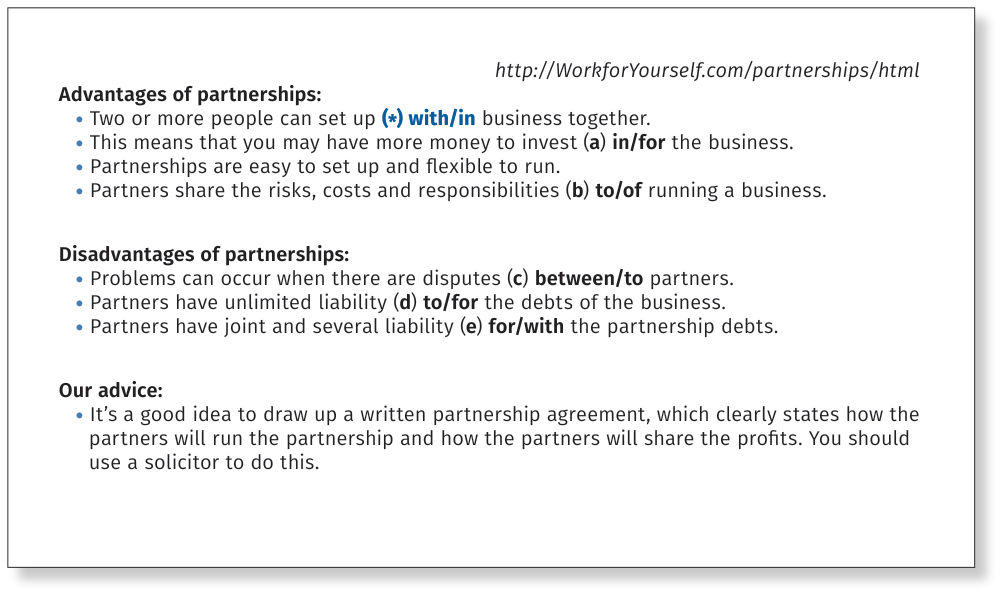
http://WorkforYourself.com/partnerships/html Advantages of partnerships:
• Two or more people can set up (*) with/in business together. • This means that you may have more money to invest (a) in/for the business. • Partnerships are easy to set up and flexible to run. • Partners share the risks, costs and responsibilities (b) to/of running a business.
Disadvantages of partnerships:
• Problems can occur when there are disputes (c) between/to partners. • Partners have unlimited liability (d) to/for the debts of the business. • Partners have joint and several liability (e) for/with the partnership debts.
Our advice:
• It’s a good idea to draw up a written partnership agreement, which clearly states how the partners will run the partnership and how the partners will share the profits. You should use a solicitor to do this.
Example (*) in ainbofcbetweendfore
Match each of the following questions with the correct answer.
What does to invest mean? (1) What does unlimited liability mean? (4)
What does flexible mean? (2) What does joint and several liability mean? (5)
What does a dispute mean? (3) What does to draw up mean? (6)
a It is another word that means a disagreement.
b It means to write. Another verb that lawyers often use is to draft.
c This means there is no restriction to your responsibility. You might lose your home or other personal assets if things go wrong.
d It means that something can change easily to adapt to different situations. Not fixed.
e It means to put money into a business, because you hope that you will get more money back in the future.
f This means that partners are responsible both individually and together as a group. In a situation where the partnership owes money to someone, that person can demand repayment of all that money from any of the partners individually, or he or she can ask each partner to pay a part of that money.
Marie went to visit a lawyer who specialises in setting up partnerships. The lawyer explained a little more about partnerships. The most important words are in the key vocabulary below. Read the text and answer the questions that follow using a full sentence.
‘My name is Francesca Rodd and I draw up lots of partnership agreements for new businesses. It’s not compulsory to have a partnership agreement but I always advise my clients to have one. I meet my clients and I ask them lots of questions about the partnership. First I need information about the partners and what name the partnership will trade under. That means the name that the partnership will use for its business. I also need details of the capital of the partnership. The capital is all the money, property and assets that the partnership has. Each partner has to decide how much money he or she is going to contribute to the partnership. Contribute means the same as invest.
Then I ask my clients about the profits of the partnership. Often the partners share the profits of the partnership equally, but sometimes partners get different shares of the profits depending on how much of the capital they contributed or how much work they do in the partnership. If the partnership makes a loss, which is the opposite of a profit, the losses are usually divided in the same proportion as the profits. Also, I need to know what amount of drawings each partner can have. Drawings is an advance payment of a partner’s share of the profits. Each partner usually takes, or to use the correct term ‘draws’, this money out of the partnership bank account for his or her own use each month, rather than having to wait until the end of the year before receiving a share of the profits.
I have to know about the duties of each partner and any special responsibilities they have. I also ask about the management of the business, which is the way the partnership is run on a day-to-day basis. Partners must decide who has the authority to sign cheques for the partnership, pay bills, buy things for the partnership, etc.
My clients and I also talk about what will happen when partners leave the partnership, either because they retire or resign. In general, retirement is when a partner leaves the partnership because he or she reaches a certain age, for example 65 years old. Resignation is when a partner decides to leave for some other reason. The partners must decide on the notice period for resignation, in other words how many weeks’ or months’ warning a partner has to give to the other partners before he or she actually leaves the partnership.
I know it’s horrible to think about things going wrong, but partners have to think about the reasons to expel a partner. To expel someone means to force that person to leave the partnership because he or she has done something really bad. Last, it’s sensible to state the circumstances in which the partnership can be dissolved, or in other words, the partnership can end. Having a partnership agreement helps the partners to think carefully about the partnership from the beginning.’
a If people want to set up a partnership, what does Francesca Rodd advise them to have?
b What does to contribute money to the partnership mean?
c How do partners usually divide losses?
d How often do partners usually draw money out of the partnership bank account for their own use?
e Francesca mentions two ways that a partner can voluntarily leave the partnership. One is retirement. What is the other?
f What is a notice period?
g What does to expel someone mean?
h What does to dissolve a partnership mean?
Read the text again and decide if these statements are true or false.
a Every partnership must have a partnership agreement.
b All of the partners always have to contribute the same amount of money to set up the partnership.
c The partners usually share losses in the same proportion as they receive the profits.
d The partners should decide who is responsible for the management of the partnership.
e Retire is the same thing as resign.
f Expel is the same thing as resign.
Complete the following sentences with the correct words from the key vocabulary in Exercise 3.
a The partners agreed that they can each take out £600 every month asdrawings.
b When they set up the partnership, Mr Hicks decided tocontribute£5000 and Mrs Pearson agreed to invest £3500.
c I prepared your accounts and you will see that the partnership did not perform well last year. It made alossof £15,000.
d I want to leave the partnership. Whatnotice periodmust I give to the other partners?
e My birthday is in September and I will be 65 years old. I will thenretirefrom the partnership.
f One of the partners often takes cocaine and other illegal drugs. This is a breach of the partnership agreement and provides clear grounds for the other partners toexpelhim from the partnership.
g I must tell my partners that I want toresignfrom the partnership. I went on holiday to Spain and met a man I wish to marry. I will move to Spain and join him in his business.
h The totalcapitalof the partnership is £405,000.
i Each partner has definite duties. For example, I am responsible for the computer system and Mr Brown is the partner responsible for the day-to-daymanagementof the business.
j The business was unsuccessful and the partnersdissolvedthe partnership last year.
k The partnership willtrade underthe name of Fast Flowers.
l As each partner contributed different amounts of money to the business, the partners agreed to share the profits in the sameproportionas the amounts that they invested.
It is possible to have different types of partner. Look at the definitions of three types of partner below. The letters of the words that match each definition are mixed up. Put the letters in the correct order to spell the words. The first letter of each word is there for you.
a A partner who receives a share of the partnership profits and has the right to take part in the management of the partnership.
An EEQUITY(TIQUEY) partner
b A partner who receives a fixed amount of money each year, called a salary, paid in monthly instalments. This partner does not receive any more of the profits.
A SSALARIED(DRASALIE) partner
c A partner who contributes capital to the partnership but does not take part in the management of the business. He or she receives a share of the partnership profits. This partner is also known as a dormant partner or a silent partner.
A SSLEEPING(GEESPILN) partner
For each for the following people, decide which type of partner he or she is.
a Sarah: ‘I’m asalariedpartner. I specialise in employment law. The law firm offered me this position as this is the area of law that the firm wants to develop, but they want to see how good my work really is. I’m happy with that as I’m earning good money each month.’
b Ken: ‘I am asleeping/dormant/silentpartner. I do not work full-time or make decisions for the partnership, but I expect to receive a large share of the profits. This is because I contributed most of the capital when we started this law firm.’
c Bovin: ‘I am anequitypartner. I set up the partnership with two other people. We have full control of the management of the business and we share all the profits of the business.’
Speaking & Writing for this topic
Two short tasks scored against TOEFL rubrics. The prompt is generated for this topic — use the vocabulary you have just studied.
Suggested structureclick to expand
- The last time I…
- I clearly remember when…
- A few weeks ago, I…
- The situation was…
- What was happening is that…
- It all began because…
- This is similar to what we just studied because…
- What we learned about trade under applies here, since…
- I noticed that loss mattered a lot in that moment.
- Looking back, I think…
- What I learned is that…
- Next time, I would…
- Use at least 3 keywords from the prompt list.
- Keep sentences short and clear — don't try to be poetic.
- Pause briefly between the four sections so the listener can follow.
Suggested structureclick to expand
- The main idea here is …
- What stands out about proportion is …
- For example, trade under shows that …
- This works because loss …
- As a result, …
- This is why …
- Use at least 3 keywords from the prompt list.
- End with a full stop. No bullet points.
A PARTNERSHIP AGREEMENT ~14 min
Francesca Rodd has a detailed checklist to remind her about what she has to discuss with her clients when drawing up a new partnership agreement. Here are some of the points on the checklist:
These are some of the questions that Francesca asks her clients. The missing words are below each question. Put the words in the correct place to complete the question.
a What the of partner?
c How will each contribute the partnership?
d How the partners profits or the ?
e How each partner’s be?
f Who have partnership cheques?
g How notice for resignation be?
Francesca meets two new clients who want to set up a partnership. Read what they say and then complete Francesca’s checklist below.
‘I’m Samantha Sully and this is my friend Kate Mace. We’re both beauty therapists. We went to college together in Shoredon and worked together at Faces Beauty Salon, so we know each other well. We want to set up our own beauty salon in Chatsworth, called Revitalise. We want to make a lot of money and give up work when we are 55. Of course, I suppose one of us may meet the man of our dreams and go to live in Australia, so we may need to leave the partnership before we reach our retirement age — you never know! We agree that it’s OK to leave the partnership if you tell the other partner three months in advance. We’ll share everything 50:50. We’ll both put £2500 in the partnership so we can buy some equipment but we don’t need much more than that. We each want to be able to take £500 each month from the partnership account. Either of us can sign cheques, otherwise it will be difficult if one of us is away on holiday when we have to pay a bill.’
Checklist for a new partnership
a Names of partners:
b Partnership name:
c Capital contribution of each partner:
d Share of profits/losses:
e Drawings:
f Cheque signing arrangements:
g Period of notice for resignation:
h Retirement age:
Help desk
What do these words mean?
a beauty therapist — a person who is qualified to do beauty work, usually in a salon.
give up — to stop doing something.
put in — contribute, invest.
50:50 — equally, half for each person.
otherwise — if not. This word is often used when there will be a bad result if something happens, or you do not do something. ‘Go now, otherwise you will miss your train’.
Speaking & Writing for this topic
Two short tasks scored against TOEFL rubrics. The prompt is generated for this topic — use the vocabulary you have just studied.
Suggested structureclick to expand
- The last time I…
- I clearly remember when…
- A few weeks ago, I…
- The situation was…
- What was happening is that…
- It all began because…
- This is similar to what we just studied because…
- What we learned about Names of partners applies here, since…
- I noticed that Partnership name mattered a lot in that moment.
- Looking back, I think…
- What I learned is that…
- Next time, I would…
- Use at least 3 keywords from the prompt list.
- Keep sentences short and clear — don't try to be poetic.
- Pause briefly between the four sections so the listener can follow.
Suggested structureclick to expand
- The main idea here is …
- What stands out about Cheque signing arrangements is …
- For example, Names of partners shows that …
- This works because Partnership name …
- As a result, …
- This is why …
- Use at least 3 keywords from the prompt list.
- End with a full stop. No bullet points.
LIMITED LIABILITY PARTNERSHIPS ~14 min
Marie Stephens then talked to Francesca Rodd about Francesca’s law firm, Hedgsons. Marie asked if Hedgsons law firm is a partnership. Read what Francesca says. The most important words are in the key vocabulary below. Put the correct word or expression from the key vocabulary into the sentences that follow.
partnership • personal assets • member ‘Hedgsons law firm is a partnership, but it is different from the partnership that I told you about earlier. Our law firm is what is called a limited liability partnership. In a traditional partnership each partner has unlimited liability for the partnership debts. But in a limited liability partnership that is not true. As the name suggests, the partners have limited liability for the debts of the business. That means that if the partnership owes a lot of money to someone but cannot pay, a partner will not have to use his or her own money to pay that debt. In other words, a partner’s personal assets are not at risk. Personal assets are the things that someone owns, for example, a car, a house, and the money that he or she has in the bank. A limited liability partnership uses the capital of the partnership to pay the debts of the partnership.
When people want to set up a limited liability partnership, they must register it with our central registry of companies. The name of a limited liabilty partnership must end with the abbreviation LLP. When someone registers a limited liability partnership, it becomes what is known as an incorporated business. This means that the business is registered in its own name and has its own legal personality. We say that it is a legal entity. In other words, a limited liability partnership is a legal person.
business A limited liability partnership has to supply its financial details and certain information about its partners to the registry of companies. Anyone can look at this information. In this way a limited liability partnership is different from a traditional partnership. Information about a traditional partnership is secret, but information about a limited liability partnership is not. A limited liability partnership must also follow more rules and regulations than a traditional partnership.
A limited liability partnership is taxed in the same way as a traditional partnership. Each partner, or member as we call them, must pay income tax on his or her share of the profits.
A limited liability partnership usually has a deed of partnership, which is similar to the partnership agreement in a traditional partnership. The deed of partnership contains details of the amount of money that each member will contribute to the partnership, each member’s duties and what happens if a partner leaves the business.
A limited liability partnership is becoming a popular choice in situations where two or more people wish to set up a business together. This business structure is very popular at the moment, especially with people who set up a new law firm.’
a My name is Grace Harmen. I am a partner of Finneson & Edge LLP. LLP is the abbreviation forLimited liability partnership.
b I own a house, a car, and some jewellery. These things that belong to me are formally known as mypersonal assets.
c If things go wrong with the partnership, I won’t lose any of my own money or belongings because I have the protection oflimited liability.
d A limited liability partnership is anincorporated business. Its name appears on the central register of companies and it exists as a separate legal person.
e A limited liability partnership is a legal person. Another name for this is alegal entity.
f In a limited liability partnership, a partner is also called amemberof the partnership.
Complete the following sentences with the correct preposition. You can find the prepositions in Exercise 1.
a The members have limited liabilityforthe debts of the business.
b If you have limited liability, it means that your personal assets are notatrisk.
c Every year the partnership has to supply financial detailstothe central registry of companies.
d I have to pay income taxonmy share of the profits of the business.
e In many ways a limited liability partnership is similartoa traditional partnership.
f The members each contributed £6000tothe partnership.
Speaking & Writing for this topic
Two short tasks scored against TOEFL rubrics. The prompt is generated for this topic — use the vocabulary you have just studied.
Suggested structureclick to expand
- The last time I…
- I clearly remember when…
- A few weeks ago, I…
- The situation was…
- What was happening is that…
- It all began because…
- This is similar to what we just studied because…
- What we learned about limited liability applies here, since…
- I noticed that legal entity mattered a lot in that moment.
- Looking back, I think…
- What I learned is that…
- Next time, I would…
- Use at least 3 keywords from the prompt list.
- Keep sentences short and clear — don't try to be poetic.
- Pause briefly between the four sections so the listener can follow.
Suggested structureclick to expand
- The main idea here is …
- What stands out about this concept is …
- For example, limited liability shows that …
- This works because legal entity …
- As a result, …
- This is why …
- Use at least 3 keywords from the prompt list.
- End with a full stop. No bullet points.
COMPANIES ~34 min
Marie Stephens wants some information about companies. She went to a seminar at a law firm called Taylor Wallis. A solicitor called Greg Harrison is talking about companies. Read what Greg says. The most important words are in the key vocabulary below. Complete the definitions of the words contained in the key vocabulary by matching the first half of each sentence with the correct ending.
‘When a person starts a new company, he or she must be very careful to comply with the rules. When lawyers talk about setting up a new company they use the expression ‘to incorporate a company’. That means to set up and register a new company in the proper way. If you want to incorporate a company in England, you must register the company with Companies House, which is the central registry of companies. You cannot start to trade in the company’s name until the company appears on the official register of companies. Every company has its own file at Companies House and anyone can look at the file to find out information about the company.
The people who set up a company are often called the founders of the company. When the founders set up a company and register it with Companies House, the company is known as an incorporated business. This means that the company has its own separate legal personality. Another name that means the same as legal personality is ‘legal entity’. Sole traders and traditional partnerships are unincorporated businesses and do not have their own legal personality. If someone wants to sue a company, perhaps because it did not fulfil its obligations, the claimant names the company as the defendant, because a company is a legal entity. On the other hand, if someone wants to sue a sole trader, the claimant names the owner of the business as the defendant.
The owners of a company are called the members. Another name for members is shareholders. Shareholders can be people or companies. They own, or ‘hold’ a share or shares in the company. A share is a part of the company’s share capital. When we talk about share capital, we mean the amount and value of shares that the members hold. Let’s say that a company has a share capital of £1000 and that this is divided into 1000 shares. In this example, each share has the value of £1. We call this the nominal value of each share. All the shares in a particular company have the same nominal value. When the founders set up a company, they decide upon the nominal value of the shares for that company.
When someone buys shares in a company, the company will issue the shares to him or her. To issue a share means to officially give that share to a person and register his or her name in the company’s register of shareholders. The shareholder receives a share certificate from the company giving details of the share or shares that he or she owns.
Why do people want to invest their money in a company and buy shares? The answer is that they hope to get some money back in return for allowing the company to use their money. We call this ‘a return on an investment’. If the company performs well during a year and makes a profit, then the company may decide to pay a part of that profit to the shareholders. This payment is called a dividend. If the company performs badly and makes a loss, the company will not pay a dividend to its shareholders.
If a company does really badly and becomes insolvent, that company may have to stop trading. But the shareholders will not have to pay the debts of the company, because the shareholders have the protection of limited liability. This means the shareholders may lose the money that they invested in the company, but their personal assets are not at risk.’
a To incorporate a business means… …to own a share. (1)
b The founders of a company are… …the people or companies which own shares in the company. (2)
c The members are… …a payment of the company’s profits to its shareholders. (3)
d The shareholders are… …the people who create the company. (4)
e A share is… …to put money into a company by buying shares in the company. (5)
f To hold a share means… …the same as the members. They are the owners of the company. (6)
g Share capital refers to… …to set up the business and register it as a company. (7)
h The nominal value of a share is… …to officially give that share to someone so that he or she becomes the owner of that share. (8)
i To issue a share to someone means… …the value of shares that the shareholders own. (9)
j To invest money in a company means… …one of the equal parts of the company’s capital. (10)
k A return on an investment is… …the money that someone receives from their investment. (11)
l A dividend is… …the fixed value of each share. (12)
Read what Greg Harrison says again and answer the following questions using a full sentence.
a What does to incorporate a company mean?
Answer:
b Where are all companies in England registered?
Answer: continued
c When can a new company begin to trade in the company’s name?
Answer:
d What is another name for a legal personality?
Answer:
e What are the people called who own a company?
Answer:
f What is a dividend?
Answer:
g In general, why won’t a shareholder have to use his or her own money to pay the debts of the company?
Answer:
Decide if the following statements are true or false.
a All of the information about a company at Companies House is available to the public.
b Each company has its own legal personality.
c A traditional partnership is a legal entity.
d If you want to sue a company, you must name the shareholders as the defendants.
e A company issues share certificates to its members.
f Shareholders always receive a dividend each year.
Help desk
What do these words mean?
to comply with — to follow (the rules), to obey, to abide by.
to trade — to do business with another person or company.
to name someone — to write that person’s or company’s name on a document.
to become insolvent — to be unable to pay your debts at the time when you must pay them.
Greg Harrison now talks in more detail about the different sorts of share values and share capital values. Read what Greg says and match each of the questions in the blue box with the correct answer below.
shares at a later date. The issued share capital is the value of the shares that the company has issued to shareholders. The issued share capital and any authorised share capital are expressed in the nominal value of the shares, and not the actual value of those shares. Let’s say that a company has an issued share capital of £1000. There are 1000 shares, each having a value of £1. Now let’s say that the company issues 500 of these shares. In this case, the nominal value of each share is £1 and the issued share capital is £500. I want to buy some shares in the company. I pay £5 for each of my shares. The nominal value of each share is £1, but the actual amount that I pay is £5. This is called the market value of the share. The market value in this example is higher than the nominal value. The difference between the market value and the nominal value is called the premium. In this example, the premium is £4’.
‘When you set up a company, you decide on what the nominal value of each share is. The nominal value is a fixed price that doesn’t change. The nominal value is the minimum price for which the company can sell the share when it first issues that share. The nominal value has two other names. These are the par value and the face value. All three names have the same meaning.
A company incorporated before October 2009 decided on the maximum amount of share capital it could issue. This was called its authorised share capital. The Companies Act 2006 abolished this requirement for any company incorporated on or after 1 October 2009.
When a company is incorporated it issues shares to the first shareholders. These shareholders are called subscribers. The company can then issue more What is the market value? (1) What is authorised share capital? (4)
What is the nominal value? (2) What is issued share capital? (5)
What is the premium? (3)
a This is the amount of money that someone must pay to the company when he or she buys a share.
b This is the amount of money that someone pays in excess of the nominal value.
d This is the value of shares, expressed in nominal terms, that the company has actually issued to its shareholders.
e This is the value that the people who set up the company decided to fix for all of the shares of the company. It is easier to understand if you think of it as the official value, not the actual value.
c This is the maximum total value of shares, expressed in nominal terms, that the company is allowed to issue.
Kevin Hooper buys some shares in a company called Onephone plc. The share certificate says that the shares are £1 each. Kevin pays £4 for each share to Onephone plc. Complete the following sentences by writing the correct figure in each gap.
a The market value of each share is
b The nominal value of each share is
c The premium on each share is
Speaking & Writing for this topic
Two short tasks scored against TOEFL rubrics. The prompt is generated for this topic — use the vocabulary you have just studied.
Suggested structureclick to expand
- The last time I…
- I clearly remember when…
- A few weeks ago, I…
- The situation was…
- What was happening is that…
- It all began because…
- This is similar to what we just studied because…
- What we learned about incorporate applies here, since…
- I noticed that shareholders mattered a lot in that moment.
- Looking back, I think…
- What I learned is that…
- Next time, I would…
- Use at least 3 keywords from the prompt list.
- Keep sentences short and clear — don't try to be poetic.
- Pause briefly between the four sections so the listener can follow.
Suggested structureclick to expand
- The main idea here is …
- What stands out about hold is …
- For example, incorporate shows that …
- This works because shareholders …
- As a result, …
- This is why …
- Use at least 3 keywords from the prompt list.
- End with a full stop. No bullet points.
PUBLIC AND PRIVATE LIMITED COMPANIES ~21 min
Marie Stephens wants to include some information about companies in her magazine article. She looks at the website of law firm, Taylor Wallis. She prints off the following information about private limited companies and public limited companies. The most important words are in the key vocabulary below. Read the information and decide if the statements that follow are true or false.
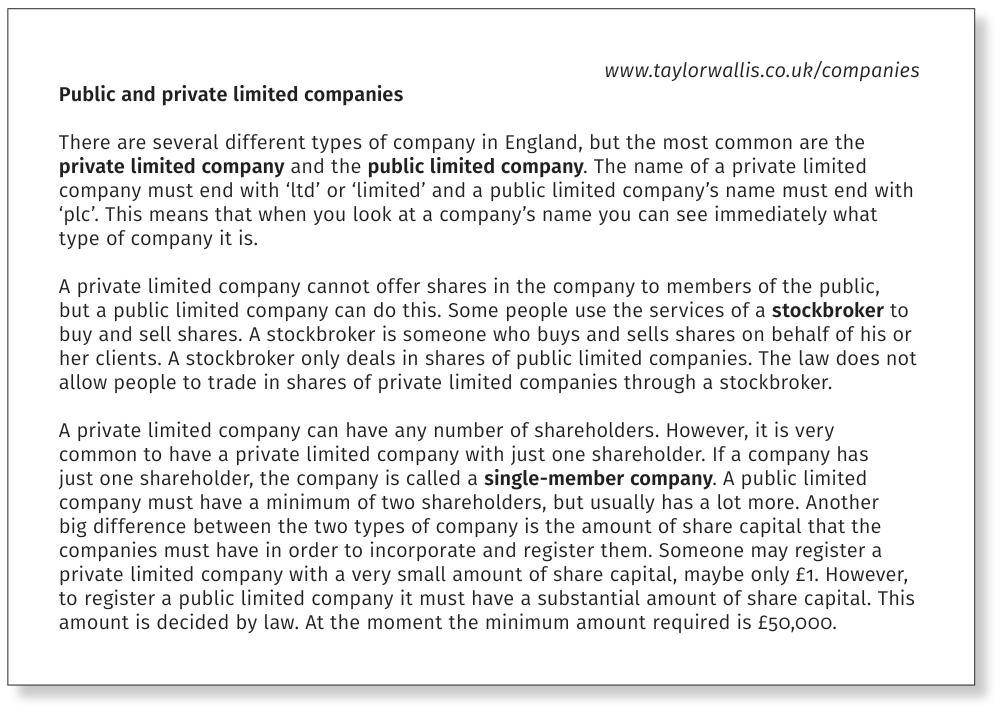
www.taylorwallis.co.uk/companies Public and private limited companies There are several different types of company in England, but the most common are the private limited company and the public limited company. The name of a private limited company must end with ‘ltd’ or ‘limited’ and a public limited company’s name must end with ‘plc’. This means that when you look at a company’s name you can see immediately what type of company it is.
A private limited company cannot offer shares in the company to members of the public, but a public limited company can do this. Some people use the services of a stockbroker to buy and sell shares. A stockbroker is someone who buys and sells shares on behalf of his or her clients. A stockbroker only deals in shares of public limited companies. The law does not allow people to trade in shares of private limited companies through a stockbroker.
A private limited company can have any number of shareholders. However, it is very common to have a private limited company with just one shareholder. If a company has just one shareholder, the company is called a single-member company. A public limited company must have a minimum of two shareholders, but usually has a lot more. Another big difference between the two types of company is the amount of share capital that the companies must have in order to incorporate and register them. Someone may register a private limited company with a very small amount of share capital, maybe only £1. However, to register a public limited company it must have a substantial amount of share capital. This amount is decided by law. At the moment the minimum amount required is £50,000.
a There are only two types of company in England.
b A company which has the name of Lexton Metals Ltd is a private limited company.
c A stockbroker buys and sells shares in private limited companies on behalf of his or her clients.
d A single-member company has just one shareholder.
e A public limited company can be a single-member company.
f A public limited company must have a share capital of at least £50,000 at the time when someone registers it.
Help desk
What do these words mean?
common — usual, happens frequently.
to offer shares — to invite people to buy shares in the company.
to deal — to trade, to buy and sell.
to trade — to do business, to buy and sell.
to incorporate a company — to form a registered company.
substantial — significant, large.
A new client named Mr Patel telephoned Greg Harrison, the solicitor from Taylor Wallis. Mr Patel wants some advice about setting up a new business. However, Greg was not in his office and so Mr Patel left Greg a voicemail message. When Greg returned he listened to the message and made the following notes. Read the notes and from your knowledge of the different types of business structure, decide which of them Mr Patel can choose to set up.
Telephone attendance:
Date: 16 March 20XX Name: Raj Patel (RP)
Address: 2 Cherryholt Road, Chatsworth, CH3 6GH Telephone: 0771 669624 Mobile: 047987 5463471 Details RP wants to set up a business. At the moment RP is working alone, but his brother will probably want to join the business at some time in the future. The business supplies computers and software to small businesses and advises the businesses on operating the systems. RP has capital of £25,000 to start the business. RP owns his house, but wants to make sure that if everything goes wrong, he will not lose the house. RP is married and has three children.
RP wants advice on what sort of business he should set up.
a Sole trader Yes No
b Partnership Yes No
c Limited liability partnership Yes No
d Private limited company Yes No
e Public limited company Yes No The next exercise gives you the answer to what type of business RP should set up.
Greg is writing to Mr Patel. Put the parts of the letter in the right order by writing your answers in the boxes numbered 2-10 below. There is an example at the beginning, which is the start of the letter.
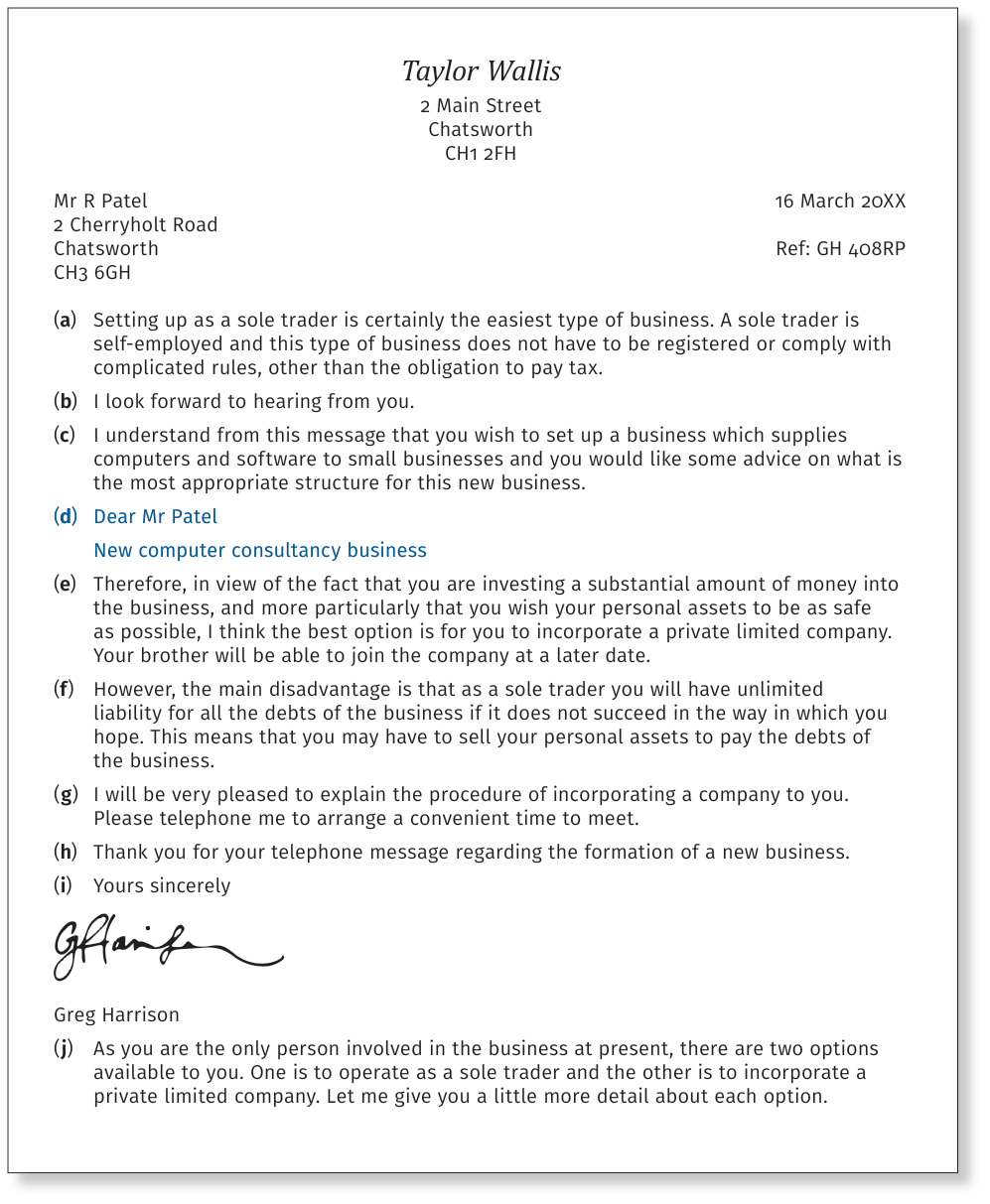
Taylor Wallis 2 Main Street Chatsworth CH1 2FH Mr R Patel 16 March 20XX 2 Cherryholt Road Chatsworth Ref: GH 408RP CH3 6GH
(a) Setting up as a sole trader is certainly the easiest type of business. A sole trader is self-employed and this type of business does not have to be registered or comply with complicated rules, other than the obligation to pay tax.
(b) I look forward to hearing from you.
(c) I understand from this message that you wish to set up a business which supplies computers and software to small businesses and you would like some advice on what is the most appropriate structure for this new business.
(d) Dear Mr Patel New computer consultancy business
(e) Therefore, in view of the fact that you are investing a substantial amount of money into the business, and more particularly that you wish your personal assets to be as safe as possible, I think the best option is for you to incorporate a private limited company. Your brother will be able to join the company at a later date.
(f) However, the main disadvantage is that as a sole trader you will have unlimited liability for all the debts of the business if it does not succeed in the way in which you hope. This means that you may have to sell your personal assets to pay the debts of the business.
(g) I will be very pleased to explain the procedure of incorporating a company to you.
Please telephone me to arrange a convenient time to meet.
(h) Thank you for your telephone message regarding the formation of a new business.
(i) Yours sincerely Greg Harrison
(j) As you are the only person involved in the business at present, there are two options available to you. One is to operate as a sole trader and the other is to incorporate a private limited company. Let me give you a little more detail about each option.
(1) d (2) (3) (4) (5)
| # | Phrase | Definition |
|---|---|---|
| (6) | (7) (8) | (9) (10) |
Speaking & Writing for this topic
Two short tasks scored against TOEFL rubrics. The prompt is generated for this topic — use the vocabulary you have just studied.
Suggested structureclick to expand
- The last time I…
- I clearly remember when…
- A few weeks ago, I…
- The situation was…
- What was happening is that…
- It all began because…
- This is similar to what we just studied because…
- What we learned about private limited company applies here, since…
- I noticed that stockbroker mattered a lot in that moment.
- Looking back, I think…
- What I learned is that…
- Next time, I would…
- Use at least 3 keywords from the prompt list.
- Keep sentences short and clear — don't try to be poetic.
- Pause briefly between the four sections so the listener can follow.
Suggested structureclick to expand
- The main idea here is …
- What stands out about this concept is …
- For example, private limited company shows that …
- This works because stockbroker …
- As a result, …
- This is why …
- Use at least 3 keywords from the prompt list.
- End with a full stop. No bullet points.
INCORPORATING A COMPANY ~20 min
Marie Stephens is finishing her magazine article. She wants to know how to set up a company. She found the following information about this on Taylor Wallis’s website. The most important phrases are in the key vocabulary below. Put the correct phrases from the key vocabulary into the sentences on the next page.
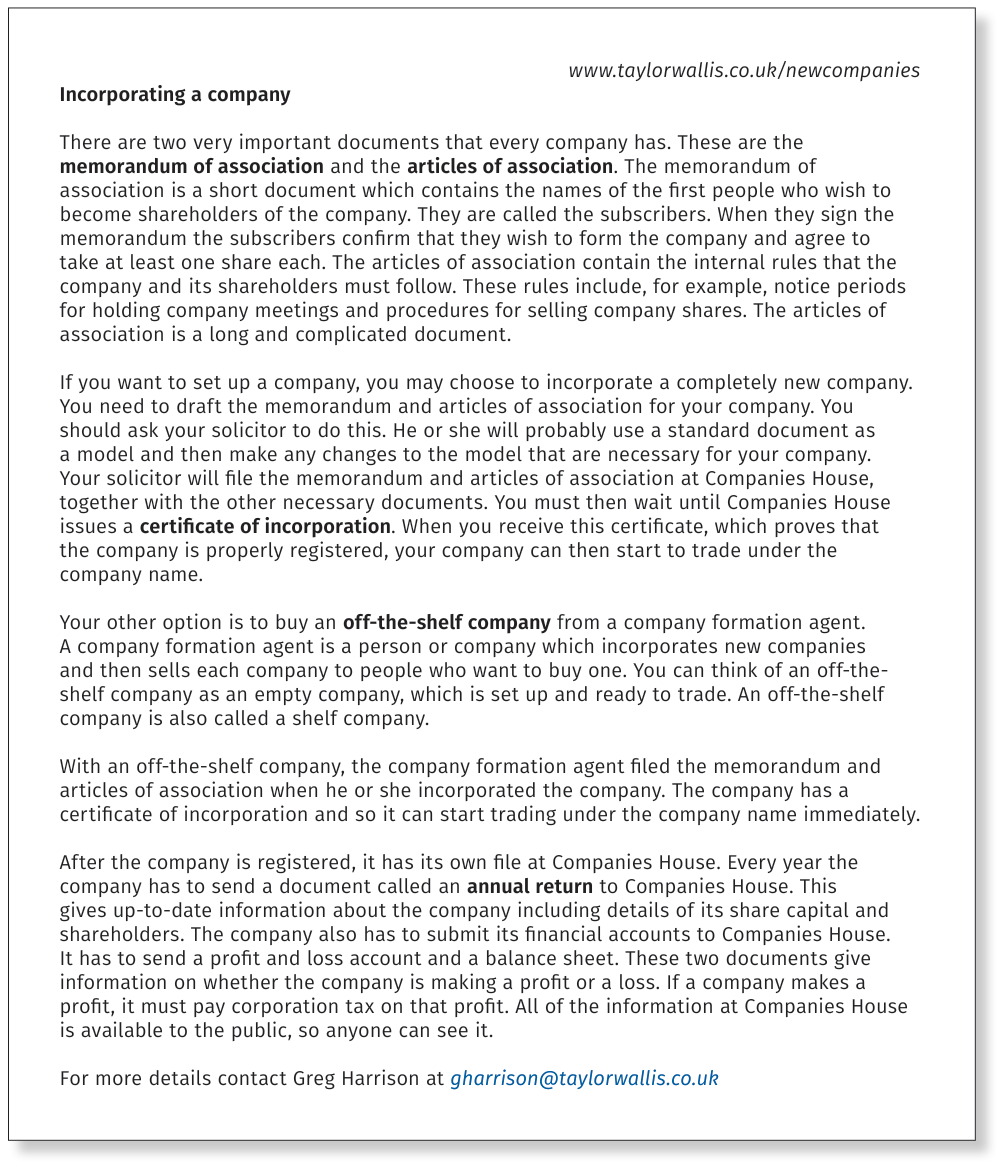
www.taylorwallis.co.uk/newcompanies Incorporating a company There are two very important documents that every company has. These are the memorandum of association and the articles of association. The memorandum of association is a short document which contains the names of the first people who wish to become shareholders of the company. They are called the subscribers. When they sign the memorandum the subscribers confirm that they wish to form the company and agree to take at least one share each. The articles of association contain the internal rules that the company and its shareholders must follow. These rules include, for example, notice periods for holding company meetings and procedures for selling company shares. The articles of association is a long and complicated document.
If you want to set up a company, you may choose to incorporate a completely new company. You need to draft the memorandum and articles of association for your company. You should ask your solicitor to do this. He or she will probably use a standard document as a model and then make any changes to the model that are necessary for your company. Your solicitor will file the memorandum and articles of association at Companies House, together with the other necessary documents. You must then wait until Companies House issues a certificate of incorporation. When you receive this certificate, which proves that the company is properly registered, your company can then start to trade under the company name.
Your other option is to buy an off-the-shelf company from a company formation agent. A company formation agent is a person or company which incorporates new companies and then sells each company to people who want to buy one. You can think of an off-the- shelf company as an empty company, which is set up and ready to trade. An off-the-shelf company is also called a shelf company.
With an off-the-shelf company, the company formation agent filed the memorandum and articles of association when he or she incorporated the company. The company has a certificate of incorporation and so it can start trading under the company name immediately.
After the company is registered, it has its own file at Companies House. Every year the company has to send a document called an annual return to Companies House. This gives up-to-date information about the company including details of its share capital and shareholders. The company also has to submit its financial accounts to Companies House. It has to send a profit and loss account and a balance sheet. These two documents give information on whether the company is making a profit or a loss. If a company makes a profit, it must pay corporation tax on that profit. All of the information at Companies House is available to the public, so anyone can see it.
For more details contact Greg Harrison at gharrison@taylorwallis.co.uk
a We want to start trading as quickly as possible so we decided to buy anoff-the-shelfcompany.
b If you want to see the rules of the company you must look at thearticles of association.
c This is the company’scertificate of incorporation. You must keep it safe as this shows that the company is properly set up and can trade in the company’s name.
d Thememorandum of associationis one of the documents that every company has. This document contains the names of the subscribers and includes their agreement to take at least one share each in the company.
e To find the most recent information about the company, you should look at the lastannual returnthat the company sent to Companies House.
Help desk
What do these words mean?
to submit — to present, to send or provide something (usually a document or some information) that is required.
profit and loss account — this document shows the income and expenses of the business, usually for the period of one year.
essential — fundamental, necessary.
balance sheet — a statement of a company’s financial position on a certain date. It shows the assets of the company and its liabilities (debts).
corporation tax — when a company makes a profit, the company has to pay part of that profit to the government in tax.
Jumbled words. The incorporation documents of a company always contain the following information. Look at the explanations below. The letters of the words that match each explanation are mixed up. Put the letters in the correct order to spell the words. The first letter of each word is there for you.
a The title of the company. CCOMPANY NAMENREGISTERED OFFICE(ANYPCOM MENA)
b The place where people will send all official letters and legal notices to. Lots of people think of it as the legal seat of the company. RREGISTERED OFFICEOCOMPANY NAME(RISTREEDGE COFFIE)
c A declaration by the first shareholders to say that the registration of the company complies with the requirements of Companies Act 2006. SSTATEMENT OF COMPLIANCEOCOMPANY NAMECREGISTERED OFFICE(MENTETATS FO ANCEILPCOM)
d The nominal value of the shares that the company has issued. SSHARE CAPITALCCOMPANY NAME(HERAS PITCALA)
e The first shareholders of the company. SSUBSCRIBERS(SCRIBSUBERS)
Put the correct word or expression from Exercise 2 into the sentences below.
a Rose Ferries and Sara Bell are the people who are taking the first shares in Herlink Ltd. They are called thesubscribers.
b I want to issue a claim against Pearsons Ltd. I will serve the claim form on the company at the company’s.
c Thecompany nameand the address of the company’s registered office must appear on all invoices that the company sends to people.
d Theshare capitalof the company is £10,000 divided into 10,000 shares of £1 each.
e The subscribers must sign astatement of complianceto confirm that the company registration is in accordance with the registration requirements of Companies Act 2006.
Speaking & Writing for this topic
Two short tasks scored against TOEFL rubrics. The prompt is generated for this topic — use the vocabulary you have just studied.
Suggested structureclick to expand
- The last time I…
- I clearly remember when…
- A few weeks ago, I…
- The situation was…
- What was happening is that…
- It all began because…
- This is similar to what we just studied because…
- What we learned about memorandum of association applies here, since…
- I noticed that off-the-shelf company mattered a lot in that moment.
- Looking back, I think…
- What I learned is that…
- Next time, I would…
- Use at least 3 keywords from the prompt list.
- Keep sentences short and clear — don't try to be poetic.
- Pause briefly between the four sections so the listener can follow.
Suggested structureclick to expand
- The main idea here is …
- What stands out about this concept is …
- For example, memorandum of association shows that …
- This works because off-the-shelf company …
- As a result, …
- This is why …
- Use at least 3 keywords from the prompt list.
- End with a full stop. No bullet points.
UNIT 7 VOCABULARY CHECK ~2 min
- annual
- annual return
- articles of association
- assets
- at risk
- authorised share capital
- balance sheet
- capital
- certificate of incorporation
- contribute
- corporation tax
- dispute
- dissolved
- dividend
- dormant partner
- draw
- draw up
- drawings
- equity partner
- expel
- expenses
- flexible
- founder
- income tax
- incorporate
- incorporated business
- invest
- investment
- issue
- issued share capital
- joint and several liability
- legal entity
- legal personality
- liable
- limited liability
- limited liability partnership
- loss
- manage
- management
- market value
- member
- memorandum of association
- nominal value
- notice period
- off-the-shelf company
- option
- partner
- partnership
- personal assets
- premium
- private limited company
- profit
- profit and loss account
- proportion
- public limited company
- records and accounts
- register
- registered office
- resign
- retire
- return
- risky
- rules and regulations
- run a business
- run into trouble
- run up a debt
- salaried partner
- self-assessment form
- self-employed
- set up
- share
- share capital
- shareholder
- single-member company
- sleeping partner
- sole trader
- stockbroker
- submit
- subscriber
- substantial
- trade
- trade under
- unlimited liability
FOUNDATION LEVEL PRACTICE ~14 min
Look at this list of words. They are all nouns. Put the correct word into the following sentences. Write your answers in the boxes numbered 1-10 below. There is an example at the beginning (*).
(AA) office (C) profit (F) stockbroker (I) partner
| # | Phrase | Definition |
|---|---|---|
| (A) | assets (D) dividend | (G) capital (J) liability |
| (B) | subscribers (E) drawings | (H) shareholders |
Example (*) Every company has a registered (*)(J), which is the company’s ‘legal seat’.
1 A sole trader has unlimited (1)(J)for the debts of his or her business.
2 The (2)(H)of a company are the owners of the company. They can be individual people or other companies.
3 The aim of every commercial business is to make a (3)(C).
4 I own a lot of shares in different companies. I don’t deal with the process of buying and selling the shares myself. I prefer to use the services of a (4)(F).
5 Sara Jones and I are in business together. It is not an incorporated business. Sara is my business
(5)(I).
6 Translate Ltd is a small company that provides translation services for people who move to the UK, but who don’t speak much English. The company doesn’t have many (6)(A), just a computer and office furniture, some books, and cash at the bank.
7 Fenlake and Griffiths is a partnership. The partners do not receive a salary but they are each allowed to take £500 each month from the partnership account for personal use. The formal word for this money is (7)(E).
8 The shareholders are delighted because the company performed very well this year. The company announced that it will pay the shareholders a (8)(D)in June.
9 The issued share (9)(G)of a company is the total nominal value of the shares that the shareholders own.
10 The formal name for the first shareholders of a company is the (10)(B).
(*) AA (1) (2) (3) (4) (5)
(6) (7) (8) (9) (10)
Look at the groups of words below. In each group, three of the words belong to the same subject area but there is one word that does not belong. Put a circle around the word that is the odd one out. Do not circle more than one answer for each sentence. There is an example at the beginning (*).
| # | Phrase | Definition |
|---|---|---|
| (*) | A retire B resign | C join D expel |
| (1) | A set up B start | C form D dissolve |
| (2) | A sleeping B shareholder | C equity D salaried |
| (3) | A capital B sole trader | C partnership D company |
| (4) | A market value B premium | C asset D nominal value |
| (5) | A issued B joint and several | C unlimited D limited |
Look at the following article. Read it and decide if the statements under it are true or false. Write your answers in the box below. There is an example at the beginning (*).
Tom is a director of a private limited company called Fixit Ltd. He is the sole shareholder of that company. Tom incorporated his company in April 2009. The company has an authorised share capital of £1000. Each share has a nominal value of £1. Tom owns 50 shares. The rest of the shares are unissued. Tom qualified as an accountant six years ago. He worked for a big firm of accountants as an auditor. Then he decided to start up his own business. Fixit Ltd provides a consultancy service for other businesses. Tom advises businesses on the best way to operate their accounts systems. He also gives businesses a lot of advice about tax.
Fixit Ltd is a successful company which has a lot of clients. Tom lives in Birmingham but he spends a lot of time at his clients’ offices. Most of his clients are based in London.
Example (*) Fixit Ltd is a public limited company.
1 Fixit Ltd is a single-member company.
2 The issued share capital of Fixit Ltd is £1000.
3 Tom is a qualified accountant.
4 Fixit Ltd collects tax from other businesses.
5 Tom spends a lot of his time in London.
Speaking & Writing for this topic
Two short tasks scored against TOEFL rubrics. The prompt is generated for this topic — use the vocabulary you have just studied.
Suggested structureclick to expand
- The last time I…
- I clearly remember when…
- A few weeks ago, I…
- The situation was…
- What was happening is that…
- It all began because…
- This is similar to what we just studied because…
- What we learned about foundation applies here, since…
- I noticed that level mattered a lot in that moment.
- Looking back, I think…
- What I learned is that…
- Next time, I would…
- Use at least 3 keywords from the prompt list.
- Keep sentences short and clear — don't try to be poetic.
- Pause briefly between the four sections so the listener can follow.
Suggested structureclick to expand
- The main idea here is …
- What stands out about this concept is …
- For example, foundation shows that …
- This works because level …
- As a result, …
- This is why …
- Use at least 3 keywords from the prompt list.
- End with a full stop. No bullet points.