
The Language of Contract Law
A CONTRACT CASE ~16 min
Diana Williams is a lawyer. Today she has a new client. Diana’s notes from the meeting with her new client are below. Look at the headings in the blue box below. Read Diana’s notes and give each paragraph the correct heading.
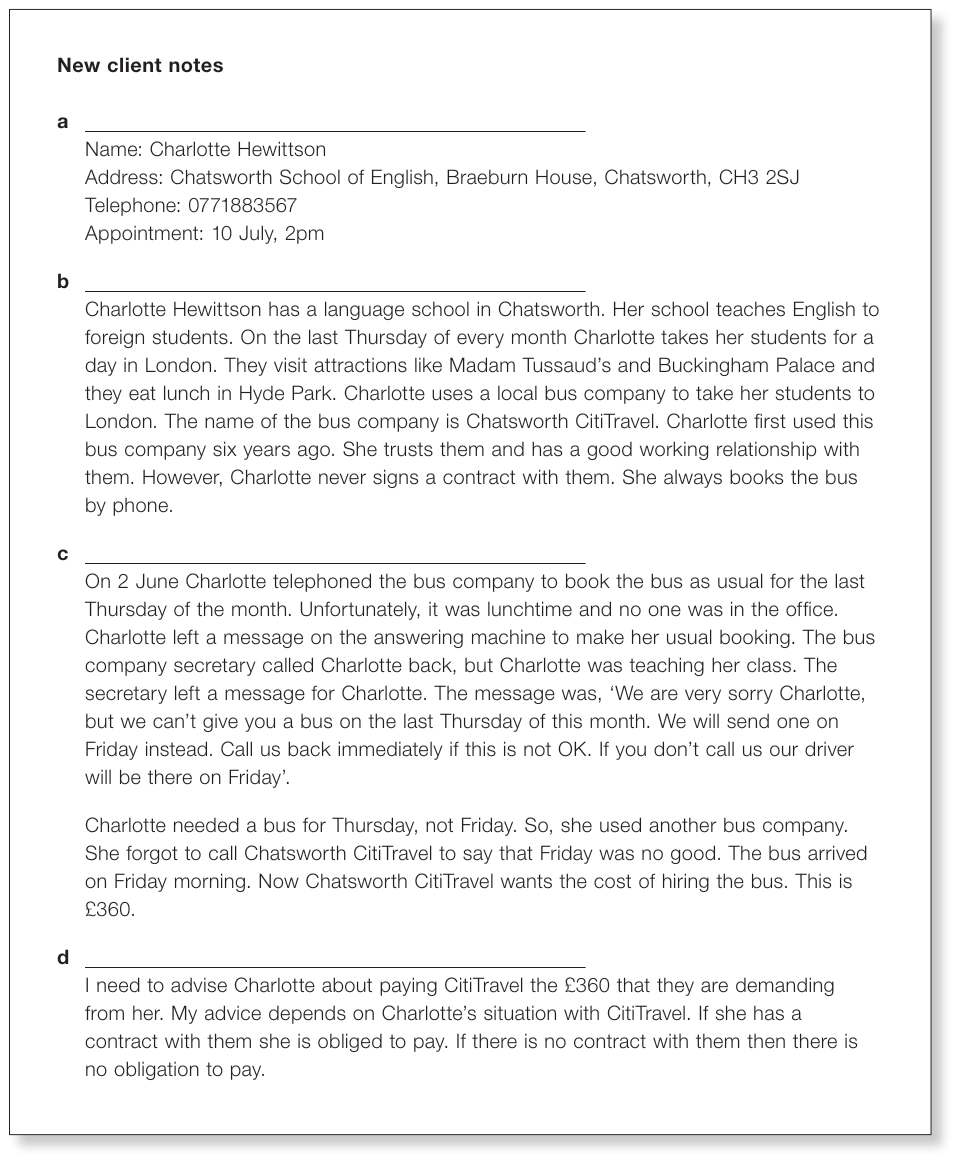
New client notes a. Name: Charlotte Hewittson Address: Chatsworth School of English, Braeburn House, Chatsworth, CH3 2SJ Telephone: 0771883567 Appointment: 10 July, 2pm b Charlotte Hewittson has a language school in Chatsworth. Her school teaches English to foreign students. On the last Thursday of every month Charlotte takes her students for a day in London. They visit attractions like Madam Tussaud’s and Buckingham Palace and they eat lunch in Hyde Park. Charlotte uses a local bus company to take her students to London. The name of the bus company is Chatsworth CitiTravel. Charlotte first used this bus company six years ago. She trusts them and has a good working relationship with them. However, Charlotte never signs a contract with them. She always books the bus by phone. c On 2 June Charlotte telephoned the bus company to book the bus as usual for the last Thursday of the month. Unfortunately, it was lunchtime and no one was in the office. Charlotte left a message on the answering machine to make her usual booking. The bus company secretary called Charlotte back, but Charlotte was teaching her class. The secretary left a message for Charlotte. The message was, ‘We are very sorry Charlotte, but we can’t give you a bus on the last Thursday of this month. We will send one on Friday instead. Call us back immediately if this is not OK. If you don’t call us our driver will be there on Friday’. Charlotte needed a bus for Thursday, not Friday. So, she used another bus company. She forgot to call Chatsworth CitiTravel to say that Friday was no good. The bus arrived on Friday morning. Now Chatsworth CitiTravel wants the cost of hiring the bus. This is £360. d I need to advise Charlotte about paying CitiTravel the £360 that they are demanding from her. My advice depends on Charlotte’s situation with CitiTravel. If she has a contract with them she is obliged to pay. If there is no contract with them then there is no obligation to pay.
Read the information in Exercise 1 again and decide if the following statements are true or false.
a Charlotte takes her students to London every Thursday.
b Charlotte’s students are not English.
c Charlotte signed a contract with the bus company six years ago.
d Charlotte agreed to use a CitiTravel bus on Friday instead of Thursday.
e The cost of hiring the CitiTravel bus is £360. Before you look at the next exercise decide if Charlotte has made a contract with Chatsworth CitiTravel.
Diana Williams’ opinion about Charlotte’s legal problem is in the box in Exercise 4. You will need the following words to complete the text. Match each word with the definition provided.
(*) Offer means… …a person who makes an offer. (1)
a Acceptance means… …a decision of a judge in an earlier case that other judges must follow if the circumstances of the situation are the same or similar. (2)
b Offeror means… …a proposal, the terms of which are certain.
c Precedent means… …that you must do something. It is necessary to do it. (3)
d Case means… …a legal agreement made between two or more parties. (4)
e Contract means… …an unconditional agreement to what is proposed by the other party. (5)
f Obliged means… …a set of arguments in a situation that might become legal or is already legal in nature. (6)
Help desk
What do these words mean?
unconditional — absolute, without any doubts or suggestions of change.
no good — an informal way of saying not suitable or not acceptable parties — the people who have entered into a contract or the people involved in a dispute.
Here is what Diana thinks about Charlotte’s legal problem. Complete the text using the highlighted words from Exercise 3.
Diana’s opinion
Does Charlotte have a (a) contractwith Chatsworth CitiTravel?
In some legal systems around the world the answer is ‘Yes’ and in some it is ‘No’. Many lawyers will say it is difficult to reach a definite conclusion.
According to English law, Charlotte probably does not have a contract with the bus company. Because she has no contract with the bus company she is not (b) obligedto pay the £360.
What are my grounds for concluding that Charlotte has probably not made a contract with CitiTravel?
Because there is a (c) precedentin English law that says (d) acceptanceof an (e) offercannot be made by silence. Acceptance must be actively communicated to the (f) offeror. In this (g) caseCharlotte did not accept the bus company’s offer. Therefore there is no contract.
Speaking & Writing for this topic
Two short tasks scored against TOEFL rubrics. The prompt is generated for this topic — use the vocabulary you have just studied.
Suggested structureclick to expand
- The last time I…
- I clearly remember when…
- A few weeks ago, I…
- The situation was…
- What was happening is that…
- It all began because…
- This is similar to what we just studied because…
- What we learned about General information applies here, since…
- I noticed that What I need to do mattered a lot in that moment.
- Looking back, I think…
- What I learned is that…
- Next time, I would…
- Use at least 3 keywords from the prompt list.
- Keep sentences short and clear — don't try to be poetic.
- Pause briefly between the four sections so the listener can follow.
Suggested structureclick to expand
- The main idea here is …
- What stands out about this concept is …
- For example, General information shows that …
- This works because What I need to do …
- As a result, …
- This is why …
- Use at least 3 keywords from the prompt list.
- End with a full stop. No bullet points.
MORE ABOUT PRECEDENT ~19 min
We can say that Charlotte does not have a contract because there is a precedent case in English law that says that acceptance of an offer cannot be made by silence. To make a contract Charlotte needed to call CitiTravel and accept their offer.
You are now going to read more about precedent. The most important words are in the key vocabulary. Read the text below. Decide if the statements on the next page are true or false.
Precedent comes from what is called the common law. The common law is one of the main sources of law in England and the USA. The common law developed after the year 1066, when the whole of England developed the same body of laws instead of each area having its own local laws — that is why it is called ‘common’. The common law covers both criminal and civil court decisions.
As judges’ decisions were written down, often described as ‘recorded’, in law reports that were common to the whole country, the idea of precedent developed. This means that when a judge decides the result of a particular case he or she must pay attention to the principles of law that come from an earlier case dealing with the same or similar points. In this way, a statement of law can become binding upon later judges and can become the law for everyone to follow. When does a particular decision, or pronouncement, by a judge become binding upon later judges? There are two important deciding factors:
1. Judges in courts at the lowest level of decision- making, often called courts of first instance, do not normally create binding precedents. It is the higher courts that issue binding rulings and the lower courts must follow them.
2. The pronouncement must form what is called the ratio decidendi of the case. This is Latin for ‘the reasoning behind the decision’. This is the part of the judge’s words that provides the legal reasoning for his or her decision. Everything else the judge says is called obiter dictum. Obiter dictum is something that is not really necessary for the legal basis for the decision. Only the ratio decidendi is binding.
A later judge dealing with a similar case must decide which precedents are binding. He or she may decide that a precedent suggested by a lawyer is either:
• relevant to the case before him or her, or • distinguishable from the present case, which means that the case is so different that the precedent does not apply in this particular situation.
Many countries use a codified system. However, many people believe that the common law is more practical than a codified system because it was developed from real life situations that were presented to the courts.
a Common law and civil law mean exactly the same thing.
b Recorded can mean written as well as recorded on disk.
c All judges can make new precedents.
d Everything a judge says forms part of the precedent.
e Sometimes a judge will say that a precedent suggested by a lawyer is not relevant.
Help desk
What do these words mean?
a source of law — a place where law comes from, for example, a civil code.
a body of laws — a collection of laws. All of them together.
a pronouncement — an old-fashioned word meaning a judge’s words at the end of a case giving his or her decision.
a principle of law — an accepted idea that forms part of the law.
a factor — something that is important to consider when making a decision.
relevant — of significance or importance to a particular situation.
Choose one of the words or phrases from the key vocabulary in Exercise 1 to complete these sentences.
a In England and the USA much of the law is based on the decisions made by judges. This source of law is called thecommonlaw.
b A judge’s decision that forms the law for future cases is known as aprecedent.
c The important part of a judge’s pronouncement when he or she gives a decision in a precedent case is not the obiter dictum but theratio decidendi.
d Once a precedent is established it forms part of the law and isbindingupon lower courts.
e The lower courts in the English system are called courts of firstinstance.
Diana Williams is sending a short letter to Charlotte Hewittson about her case. The letter is in the wrong order. Put the parts of the letter into the correct order. There is an example at the beginning, which is the start of the letter.
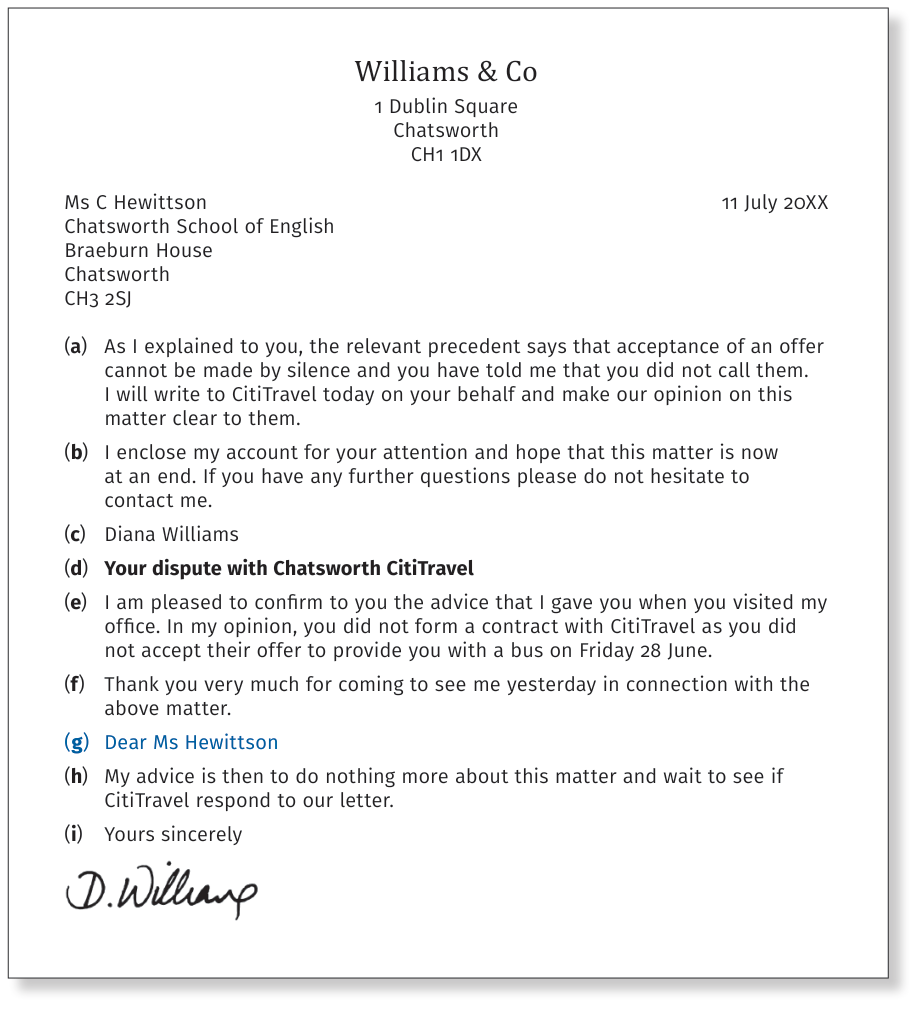
Williams & Co 1 Dublin Square Chatsworth CH1 1DX Ms C Hewittson 11 July 20XX Chatsworth School of English Braeburn House Chatsworth CH3 2SJ
(a) As I explained to you, the relevant precedent says that acceptance of an offer cannot be made by silence and you have told me that you did not call them. I will write to CitiTravel today on your behalf and make our opinion on this matter clear to them.
(b) I enclose my account for your attention and hope that this matter is now at an end. If you have any further questions please do not hesitate to contact me.
(c) Diana Williams
(d) Your dispute with Chatsworth CitiTravel
(e) I am pleased to confirm to you the advice that I gave you when you visited my office. In my opinion, you did not form a contract with CitiTravel as you did not accept their offer to provide you with a bus on Friday 28 June.
(f) Thank you very much for coming to see me yesterday in connection with the above matter.
(g) Dear Ms Hewittson
(h) My advice is then to do nothing more about this matter and wait to see if CitiTravel respond to our letter.
(i) Yours sincerely
(1) g (2) (3) (4) (5) (6) (7) (8) (9)
Help desk
What do these words mean?
account — when the word is used in this way it means a bill or an invoice that someone must pay.
Speaking & Writing for this topic
Two short tasks scored against TOEFL rubrics. The prompt is generated for this topic — use the vocabulary you have just studied.
Suggested structureclick to expand
- The last time I…
- I clearly remember when…
- A few weeks ago, I…
- The situation was…
- What was happening is that…
- It all began because…
- This is similar to what we just studied because…
- What we learned about precedent applies here, since…
- I noticed that common law mattered a lot in that moment.
- Looking back, I think…
- What I learned is that…
- Next time, I would…
- Use at least 3 keywords from the prompt list.
- Keep sentences short and clear — don't try to be poetic.
- Pause briefly between the four sections so the listener can follow.
Suggested structureclick to expand
- The main idea here is …
- What stands out about ratio decidendi is …
- For example, precedent shows that …
- This works because common law …
- As a result, …
- This is why …
- Use at least 3 keywords from the prompt list.
- End with a full stop. No bullet points.
THE ELEMENTS OF A CONTRACT ~15 min
It is a general principle of English and American contract law that all of the necessary elements must be present to make a contract. An element is a fundamental part of something. This is true of all contracts, both written and unwritten.
Read the story below and decide if you think the two people concerned, Charles and Maria, have a contract. In the space provided, write why you think this situation is contractual/non-contractual. Think about the elements of a contract in your country.
Maria is Charles’s girlfriend. The relationship started eight months ago. Charles asks Maria if she would like to go to Italy with him for a skiing holiday. Maria agrees. Charles pays for the holiday on his credit card. The cost is £2500 in total. However, a week before the holiday Maria meets Will. She calls Charles and explains that she is now Will’s girlfriend and she doesn’t want the holiday. Charles is very angry. He demands £1250 from Maria and says she has to pay. She says she thinks the holiday was a present from him. Charles says the holiday was not a present because Maria has a great job and makes more money than him.
Do they have a contract? Why/Why not?
My reasons:Client detailsWe will return to this question later to check your conclusion. First, we need to look at the vocabulary that you need to be able to talk about the elements of a contract according to English and American law.
The English courts have an objective test to decide if a contract exists in a particular situation or not. The court looks for a list of things that are the necessary elements of a contract. Look at the words in the box and circle those that you think might be one of the elements according to English law. Then look at the explanation below to see if you are correct.
The elements of an English contract are from the common law. They might be different from the elements of a contract in other countries. The elements of an English contract are:
The other words in the blue box are not elements of a contract according to the common law. However, they are all words that lawyers from civil code systems sometimes use. If you use the other words in the box you may have to explain what you mean to a lawyer from the common law system.
Read the information below about the elements of a contract. Complete the text below by writing the correct element of a contract after its description.
To form a binding contract according to English law, four elements must be present.
• The first of these is where one of the parties makes a proposal to the other party. The proposal is on absolutely certain terms. For example, ‘I will sell you my car cleaning business on 1 January for £20,000’. This proposal is called an (a) offer.
• In order to make the contract valid, the parties must exchange something. Each of them must give something to the other, such as money, work or goods. In the above example one party exchanges a car cleaning business in return for £20,000. Each gives something to the other. If one party promises the other a gift (in return for nothing) then in a situation like this the parties do not usually have a contract. So, another element of a contract is (b) consideration.
• The courts look at the relationship between the two parties. The courts decide if the parties really want to make things legally binding in this particular situation or not. If I agree to do some work for my mother or my father did I really mean to make the agreement legal? Did I have (c) intention?
• It is absolutely necessary that a person accepting an offer does not change the terms of the original offer.
For example, if I say, ‘I will buy your car cleaning business. But not for £20,000 as you ask. I will give you £15,000’, then there is no binding contract because there was no (d) acceptance.
Go back to your reasons for deciding whether or not Charles and Maria have a contract. Can you see all four elements? What do you think a judge from your country would say? It is one of those cases where it is difficult to give a definite answer.
My notes:
Speaking & Writing for this topic
Two short tasks scored against TOEFL rubrics. The prompt is generated for this topic — use the vocabulary you have just studied.
Suggested structureclick to expand
- The last time I…
- I clearly remember when…
- A few weeks ago, I…
- The situation was…
- What was happening is that…
- It all began because…
- This is similar to what we just studied because…
- What we learned about subject applies here, since…
- I noticed that offer mattered a lot in that moment.
- Looking back, I think…
- What I learned is that…
- Next time, I would…
- Use at least 3 keywords from the prompt list.
- Keep sentences short and clear — don't try to be poetic.
- Pause briefly between the four sections so the listener can follow.
Suggested structureclick to expand
- The main idea here is …
- What stands out about topic is …
- For example, subject shows that …
- This works because offer …
- As a result, …
- This is why …
- Use at least 3 keywords from the prompt list.
- End with a full stop. No bullet points.
THE END OF AN OFFER ~8 min
Sometimes a contract cannot be made because the offer comes to an end before it can be accepted. In other words, the offer is no longer open to acceptance. Lawyers refer to the people who make and receive the offer as follows:
• The person who makes an offer is called the offeror. • The person who receives the offer is called the offeree.
Jumbled words. In each of the situations described below the letters of one of the words are mixed up. Put the letters in the correct order to spell the words. The first letter of each word is there for you. Then give the name of the offeror and the offeree in each situation.
a David Jackson has a new job. When he starts work the company, DDS Furniture Ltd, offers him shares in the company at a special, cheap price. A year after he starts the job he decides to accept the offer to buy the shares. His employer tells him he cannot accept the offer. This is because the offer has Lintention(ELPDAS). It means too much time has passed.
The offeror isintentionThe offeree isprovide---------------------------------------------------------------------------------------------------------------------------------------
b Julie Smith buys a new computer. She advertises her old one for sale for £50. Alex Harrison calls and suggests paying Julie £30. Julie refuses. Alex then suggests £40 but Julie refuses. Julie says the reason is that Alex made a Cprovide(TREUNOC-ORFFE). The legal effect is to cancel the original offer.
The offeror isprovideThe offeree isintention---------------------------------------------------------------------------------------------------------------------------------------
c Jamie Hammond decides to sell his car to Ben Wardle. Ben says, ‘No thank you’. The offer was
Rprecedent(s)(CJEDETER). The legal effect is to cancel the offer.
The offeror isprecedent(s)The offeree isintention---------------------------------------------------------------------------------------------------------------------------------------
d Mia Thomas decides to sell her house. She offers the house for sale at a price of £190,000. Andrea Stewart decides to buy it. However, before Andrea can accept the offer, Mia changes her mind and decides to keep the house. The offer is Rforbearance(KVDREEO) or in other words, Mia withdraws the offer.
The offeror isforbearanceThe offeree isintention
Speaking & Writing for this topic
Two short tasks scored against TOEFL rubrics. The prompt is generated for this topic — use the vocabulary you have just studied.
Suggested structureclick to expand
- The last time I…
- I clearly remember when…
- A few weeks ago, I…
- The situation was…
- What was happening is that…
- It all began because…
- This is similar to what we just studied because…
- What we learned about offer applies here, since…
- I noticed that this concept mattered a lot in that moment.
- Looking back, I think…
- What I learned is that…
- Next time, I would…
- Use at least 3 keywords from the prompt list.
- Keep sentences short and clear — don't try to be poetic.
- Pause briefly between the four sections so the listener can follow.
Suggested structureclick to expand
- The main idea here is …
- What stands out about this concept is …
- For example, offer shows that …
- This works because this concept …
- As a result, …
- This is why …
- Use at least 3 keywords from the prompt list.
- End with a full stop. No bullet points.
WHAT IS CONSIDERATION? ~23 min
Read the following text. It is about consideration in contract law. Choose the correct word from the text to complete the sentences below.
Offer and acceptance are not enough to make a contract. There also needs to be two other elements. They are:
• intention to create a legal relationship, and • consideration.
What is consideration? Consideration is what one party promises to give to, or promises to do for, the other party. Both parties need to provide consideration to make a contract valid. There are many precedents in English law where judges decide what is good consideration and what is not.
Consideration is usually one of the following things:
• a promise to do something • a promise not to do something in the future (sometimes called forbearance) • goods • services • money.
A promise of a gift or of a free service does not usually create a contractual situation according to English law. This is because one of the parties has not provided consideration. To make a contract both parties must give something or do something for the other in a kind of exchange. A lawyer describes this by saying that consideration must be reciprocal. It must travel in both directions. If consideration is a good thing for a party and is positive in nature, we say that he or she has gained a benefit. Receiving a payment of money would be an example of this. However, sometimes the consideration provided is negative in nature. Let’s imagine an employee agrees in his or her employment contract not to start a business for two years after the contract terminates. He or she has promised not to do something in the future. We say that this party has suffered a detriment.
I promise to tidy a friend’s garden because she is ill. I don’t want to be paid. However, I am busy and I don’t tidy the garden for her. Is our agreement a contract? No, it isn’t. Why not? It is not a contract because one of the parties to the agreement has not provided consideration.
Consideration is a fundamental principle of English contract law.
a As well as offer, acceptance and consideration, the parties to a contract need to have to create a legal relationship.
b To make a legally binding contract both parties must consideration.
c To find out what is good consideration for a contract I need to check the relevant to see what judges say about it.
d A promise not to do something in the future can be good consideration for a contract. Lawyers usually call this .
e Both parties to the contract must provide consideration, in other words it must be .
f If I receive something positive under the contract I gain a .
g If I lose something under the contract I suffer a .
Contract wordsearch. Look in the grid below and find the following words. The words can be found in any direction.
| # | Phrase | Definition |
|---|---|---|
| I | N T E N D R | B F P E A A F L |
| L | X P I N T E | I P R O T C A F |
| A | C C E P T A | N C E E K T A A |
| P | A F O F E N | D R C L V C C X |
| S | S F F N R F | I E E T B O T T |
| E | E C F A T L | N C D U E B K R |
| D | T O E C W R | G Q E F N I J E |
| L | A S R K A C | A O N M E T O B |
| H | S I O B I T | E C T D F E F I |
| O | D E T R I M | E N T E I R F N |
| R | A T C L I R | H F A T T A E D |
| D | E T R P N B | O R V R A T R A |
| S | O C O N S I | D E R A T I O N |
| F | S O U R C E | I N T L A S R R |
| F | A R A T I O | Z S L A B I T E |
Speaking & Writing for this topic
Two short tasks scored against TOEFL rubrics. The prompt is generated for this topic — use the vocabulary you have just studied.
Suggested structureclick to expand
- The last time I…
- I clearly remember when…
- A few weeks ago, I…
- The situation was…
- What was happening is that…
- It all began because…
- This is similar to what we just studied because…
- What we learned about acceptance applies here, since…
- I noticed that offeror mattered a lot in that moment.
- Looking back, I think…
- What I learned is that…
- Next time, I would…
- Use at least 3 keywords from the prompt list.
- Keep sentences short and clear — don't try to be poetic.
- Pause briefly between the four sections so the listener can follow.
Suggested structureclick to expand
- The main idea here is …
- What stands out about case is …
- For example, acceptance shows that …
- This works because offeror …
- As a result, …
- This is why …
- Use at least 3 keywords from the prompt list.
- End with a full stop. No bullet points.
CONTRACT AND STATUTE ~32 min
Much modern contract law comes from statute. You are going to read about statute. Read the text and write the highlighted words in the text next to the meanings given on the next page.
The common law is one source of contract law. Another is statute.
A statute is a law made by Parliament. We can say that judges make the common law but Parliament creates statutes.
A statute passes through three stages:
The House of Commons This is the most powerful of Parliament’s two chambers. These chambers are usually known as Houses. The House of Commons has 650 members, who are elected when the whole country votes in a general election. These members of the House are called MPs. A statute begins in this House. The House of Commons has only 427 seats. When it is full a lot of people have to stand!
The House of Lords This is Parliament’s second chamber. Its main function is to check new laws, which were proposed in the House of Commons. The House of Lords has 786 members who come from a variety of backgrounds. This House has limited power to stop a proposed statute from becoming law, but it can slow it down. Members of this House are not elected. Most members get their seats from the monarch (the King or Queen) on the advice of the Prime Minister. • The Monarchy The monarch has to give permission before a new statute becomes law. This is because the King or Queen is the Head of State. This permission is called giving the ‘Royal Assent’. However, the monarch always accepts the advice of his or her government. In fact, the monarch does not even have the full text of the proposed statute, only the title of it. The last monarch to reject a proposed statute was Queen Anne, who died in 1715.
There are three words for the law made by Parliament. They refer to the same thing. They are:
• Statute. This is often called statutory law • Acts of Parliament • Legislation. This is the collective word for all the laws Parliament creates.
Example: The law that comes from the decisions of judges and is based on precedent. Common law
a The main law-making body in England.
b Members of Parliament.
c A law made in Parliament.
d Chosen by the people to be a political representative.
e A word meaning all of the laws made by Parliament.
f A system of choosing new Members of Parliament. All of the people have a vote.
Read the text about statute carefully and decide if the following statements are true or false.
a A statute is the same thing as an Act of Parliament.
b A statute always starts in the House of Lords.
c Members of the House of Commons are elected but members of the House of Lords are not.
d The King or Queen often stops a new statute if they disagree with it.
e Legislation is another word for a single statute.
Look at this very short text. It is about a statute. Look at the words that are highlighted in the text. Without using a dictionary decide if each word is a verb or a noun.
The Unfair Contract Terms Act (UCTA) 1977 is an example of a statute that deals with contract law. It covers transactions between people.
This statute places some restrictions upon the contract terms people can agree to. One particular part of it deals with the ways in which people that are selling something can limit their liability for negligence.
Here are the definitions of the highlighted words in Exercise 3. Put the correct word into each sentence to complete the definition.
a A is a piece of business, such as buying or selling something.
b To something is to deal with, or include something.
c A is a limit that is put on something.
d If you have for something it means that you have legal responsibility for it.
e The of a contract are its contents. It means the conditions and duties that you agree to perform when you enter into the contract.
f To a restriction upon someone is to put limits upon what they are allowed to do.
Using the words ‘term’ and ‘terms’. These can be confusing words because they can have more than one meaning when lawyers use them.
Read the explanation about the meaning of these words. In the following sentences, decide which of the four options you need to complete the sentence. Then identify which meaning of the word is the correct one.
Terms 1 terms: All of the duties and conditions contained in a contract. Example sentence: She explained the terms of the contract to her client.
2 terms: Words and expressions. Example sentence: A lawyer sometimes uses legal terms that his client might not understand.
Term 1 term: A single duty or condition contained in a contract. It is sometimes called a provision. Example sentence: There is a term in this contract that forbids you to sell goods in Australia or New Zealand.
2 term: The duration of a contract. Example sentence: The term of this contract is one year from the date of signing.
Example: The term of this contract is one year, commencing on the date of signature. ( term 2 )
a Some of the used in this letter are very old-fashioned and lawyers don’t really use them any more. ( )
b For the entire of this contract the Employee shall not disclose any confidential information to any third party. ( )
c There is usually a in most commercial contracts dealing with the jurisdiction of the contract in case of disputes. ( )
d When you sign a contract you agree to all of the that it contains. ( )
Help desk
What do these words mean?
third party — someone who is not one of the two main parties involved in a contract or a particular situation.
jurisdiction — legal power over a geographical area or people.
Speaking & Writing for this topic
Two short tasks scored against TOEFL rubrics. The prompt is generated for this topic — use the vocabulary you have just studied.
Suggested structureclick to expand
- The last time I…
- I clearly remember when…
- A few weeks ago, I…
- The situation was…
- What was happening is that…
- It all began because…
- This is similar to what we just studied because…
- What we learned about contract applies here, since…
- I noticed that statute mattered a lot in that moment.
- Looking back, I think…
- What I learned is that…
- Next time, I would…
- Use at least 3 keywords from the prompt list.
- Keep sentences short and clear — don't try to be poetic.
- Pause briefly between the four sections so the listener can follow.
Suggested structureclick to expand
- The main idea here is …
- What stands out about this concept is …
- For example, contract shows that …
- This works because statute …
- As a result, …
- This is why …
- Use at least 3 keywords from the prompt list.
- End with a full stop. No bullet points.
READING CONTRACT LAW ~14 min
condition — something that you have to do in order for something else to happen.
entire — complete or whole.
disclose — tell.
You are now going to read more about contract law. The most important words are in the key vocabulary below. Decide if the statements on the next page are true or false.
Key vocabulary • contrary to • under duress • comply with • contract under seal • enforceable • donation • sum • void • consent • capacity to contract • voluntarily • deed • party in breach • injured party • discharged • breach In general, businesses are free to enter into whatever contracts they agree between themselves. However, business contracts must not be contrary to (against) case law or Acts of Parliament such as the Unfair Contract Terms Act. If the contents of a contract, usually called the terms and conditions, do not comply with the law, meaning they don’t follow the law correctly, then a judge will probably decide that the contract is void. Void means ‘empty’. It is not an enforceable contract. It is not a contract that a court will recognise as valid.
It is a general rule that both parties to the contract must have capacity to contract. This means that when a person signs a contract they must be:
• old enough to consent (say yes) to it; and • not mentally ill; and • not drunk or using drugs.
It is another general rule that both parties must enter into the contract voluntarily. This means that they must have signed it freely and not under duress (pressure).
A contract may be:
oral contract is binding according to English law. Even if a contract involves a large sum of money, it is still valid if it is not written.
When a contract comes to an end we say that the contract is discharged. If the contract is discharged because one of the parties does not fulfil their obligations it is called a breach. If one party breaches the contract the injured party can sue the party in breach. The injured party is the claimant and the party in breach is the defendant.
A deed is sometimes called a contract under seal. It is a special contract that is legal even though one of the parties has not provided consideration. A promise of a gift or donation for example, can be a valid contract if the agreement takes the form of a deed. An
a Acts of Parliament concerning contract law are to protect the public and they do not affect businesses at all.
b If a contract is void it will not be enforceable by a court.
c If I sign a contract after drinking a whole bottle of wine and three beers the contract might not be valid.
d In very special circumstances it is possible to have a contract where one of the parties does not provide consideration.
e The injured party and the party in breach are the same person.
Choose a word or phrase from the key vocabulary in Exercise 1 to complete the sentences below.
a You are only 16 years old so you do not havecapacityto contract.
b A contract that is valid even though one of the parties has not provided consideration usually takes the form of a contract underseal.
c We made an oral contract and even though it involves a very largesumof money it does not need to be in writing to be valid.
d There are various ways in which a contract can bedischarged, including performance of all duties or breach.
e If a contract is binding then it isenforceableby a court.
f You did not fulfil your obligations under this contract and as theinjured partyI have the right to sue you for breach.
g Did you sign the contractvoluntarilyor was it signed under duress?
h One of the terms of this contract iscontrary tothe Sale of Goods Act and the term is therefore not valid.
i If I promise to make adonationto a person or an organisation it is a legally binding contract if the agreement takes the form of a deed.
j Any private agreement mustcomply withall relevant law, including Acts of Parliament.
Speaking & Writing for this topic
Two short tasks scored against TOEFL rubrics. The prompt is generated for this topic — use the vocabulary you have just studied.
Suggested structureclick to expand
- The last time I…
- I clearly remember when…
- A few weeks ago, I…
- The situation was…
- What was happening is that…
- It all began because…
- This is similar to what we just studied because…
- What we learned about written; or applies here, since…
- I noticed that oral (spoken); or mattered a lot in that moment.
- Looking back, I think…
- What I learned is that…
- Next time, I would…
- Use at least 3 keywords from the prompt list.
- Keep sentences short and clear — don't try to be poetic.
- Pause briefly between the four sections so the listener can follow.
Suggested structureclick to expand
- The main idea here is …
- What stands out about this concept is …
- For example, written; or shows that …
- This works because oral (spoken); or …
- As a result, …
- This is why …
- Use at least 3 keywords from the prompt list.
- End with a full stop. No bullet points.
GOING TO COURT ~12 min
The following exercises are about a dispute. This dispute is about a breach of contract.
Read the facts and decide if the statements that follow are true or false.
John Oliver is the owner of a car business called Oliver’s Auto. John Oliver sells second-hand (used) cars in Chatsworth. Many of the cars that John Oliver sells previously belonged to a taxi company. Two months ago, John Oliver sold a car to a woman named Susan Hicks. Susan Hicks paid for the car by cheque. The cost was £1000. The car was not a good one. It stopped working twice in the first week that Susan bought it. Susan was angry and went to John Oliver’s office. Susan asked John Oliver to give her a different car. He refused. Susan telephoned her bank and cancelled the cheque. John Oliver did not receive any money. The car is at Susan’s house. The car will not start. Susan telephoned John Oliver last week and said he can collect his broken car any time he wants to. John Oliver refused. He decided to sue Susan Hicks for breach of contract on the grounds that she did not pay him.
Yesterday Susan received a claim from Chatsworth County Court, which is the local civil court. John Oliver is claiming £1000 from her for the car, plus a court fee of £60. His total claim is £1060.
a John Oliver owns a taxi business in Chatsworth.
b Susan Hicks did not pay in cash for the car she bought from John Oliver.
c Susan Hicks telephoned John Oliver to ask him for a different car.
d John Oliver collected the car from Susan’s house last week.
e John Oliver is not claiming any interest on the £1000 he says Susan owes to him.
Susan now receives a claim from Chatsworth County Court. There are some words in the claim form that she does not understand. Her questions are below. Match her questions with the correct answer.
a What is a claimant? It means to start an action against someone in the civil court. (1)
b What is a defendant? It is something that you suffer as a direct result of the breach of contract. (2)
c What does sue mean? It is something that you suffer as an indirect result of the breach of contract. (3)
d What does defective mean? It is the person who starts the legal action. (4)
e What is direct loss? It is the person who the claimant is making a claim against. (5)
f What is consequential loss? It means faulty — not working correctly. (6)
Use the highlighted words from Exercise 2 to complete these sentences.
a I must return the goods that you delivered to my shop yesterday as they are alldefectiveand I cannot sell things that do not work properly.
b Mr Wilkes breached the contract because he delivered the goods two weeks late. As an immediate result of this I suffered adirectloss of £2000 because I could not sell the goods to the buyer who was waiting for them.
c You must pay what you owe me at once or I willsueyou in the County Court.
d When the claim form was served upon thedefendanthe decided to pay the money that he owed to the claimant.
e The loss that you suffered as a breach of the contract was not a direct result of the breach. A court will say that this isconsequentialloss.
f Several people owe money to my business and as a result I am theclaimantin three different cases in the County Court.
Speaking & Writing for this topic
Two short tasks scored against TOEFL rubrics. The prompt is generated for this topic — use the vocabulary you have just studied.
Suggested structureclick to expand
- The last time I…
- I clearly remember when…
- A few weeks ago, I…
- The situation was…
- What was happening is that…
- It all began because…
- This is similar to what we just studied because…
- What we learned about going applies here, since…
- I noticed that court mattered a lot in that moment.
- Looking back, I think…
- What I learned is that…
- Next time, I would…
- Use at least 3 keywords from the prompt list.
- Keep sentences short and clear — don't try to be poetic.
- Pause briefly between the four sections so the listener can follow.
Suggested structureclick to expand
- The main idea here is …
- What stands out about this concept is …
- For example, going shows that …
- This works because court …
- As a result, …
- This is why …
- Use at least 3 keywords from the prompt list.
- End with a full stop. No bullet points.
UNIT 3 VOCABULARY CHECK ~2 min
- acceptance
- Act of Parliament
- benefit
- binding
- body of laws
- breach
- capacity
- case
- claimant
- common law
- comply
- condition
- consent
- consequential loss
- consideration
- contract
- contract under seal
- contrary
- courts of first instance
- cover
- deed
- defective
- defendant
- detriment
- direct loss
- discharged
- disclose
- dispute
- distinguishable
- donation
- duress
- duty
- elected
- enforceable
- entire
- factor
- forbid
- general election
- House of Commons
- House of Lords
- injured party
- intention
- issue
- jurisdiction
- legislation
- liability
- Member of Parliament (MP)
- monarchy
- obiter dictum
- obliged
- offer
- offeree
- offeror
- parties
- party in breach
- place
- precedent
- principle of law
- pronouncement
- propose
- ratio decidendi
- reciprocal
- recorded
- relevant
- restrictions
- revoke
- senior court
- source of law
- statute
- sue
- sum
- term
- terms
- third party
- transaction
- unconditionally
- valid
- void
- voluntarily
FOUNDATION LEVEL PRACTICE ~12 min
Look at the groups of words below. In each group, three of the words belong to the same subject area but there is one word that does not belong. Put a circle around the word that is the odd one out. Do not circle more than one answer for each sentence. There is an example at the beginning (*).
| # | Phrase | Definition |
|---|---|---|
| (*) | A offer B acceptance | C binding D consideration |
| (1) | A common law B precedent | C ratio decidendi D statute |
| (2) | A revoked B rejected | C factor D lapsed |
| (3) | A MP B obiter dictum | C election D Parliament |
| (4) | A donation B deed | C contract under seal D duress |
| (5) | A sue B claimant | C defendant D legislation |
Read the following pairs of sentences. For each pair of sentences there are two possibilities, A or B. Decide which sentence uses the correct preposition. Write your answers in the box below. There is an example at the beginning (*).
Example (*) (A) Contracts must not be contrary to Acts of Parliament.
(B) Contracts must not be contrary at Acts of Parliament.
1 (A) A precedent is binding upon later cases that are the same or similar in nature.
(B) A precedent is binding to later cases that are the same or similar in nature.
2 (A) The lowest courts are called courts for first instance.
(B) The lowest courts are called courts of first instance.
3 (A) The company offered David some shares on a special price.
(B) The company offered David some shares at a special price.
4 (A) Forbearance is a promise not to do something in the future.
(B) Forbearance is a promise not to do something at the future.
5 (A) The contract is not valid because Mr Jackson signed it against duress.
(B) The contract is not valid because Mr Jackson signed it under duress.
(*) A (1) (2) (3) (4) (5)
Look at this list of words. They are all nouns. Put the correct word into the following sentences. Write your answers in the boxes numbered 1-10 below. There is an example at the beginning (*).
(B) donation (E) factor (H) offer Example (*) A direct (*)(A)is something that the injured party suffers as a direct result of a breach of contract.
1 The boy is only 14 years old so according to English law he does not have (1)(A)to contract.
2 When the parties to a contract exchange consideration they must gain a benefit or suffer a (2)(D).
3 The (3)(F)of Peter’s employment contract is six months.
4 A person’s age is one important (4)(E)that decides whether or not a person has capacity to contract.
5 In the UK the common law says that acceptance of an (5)(H)cannot be made by silence.
6 In England a promise of making a (6)(B)or giving someone a gift is not usually an enforceable promise because one of the parties has not provided consideration.
7 In some countries it is possible for one party to a contract to limit his or her (7)(I)for negligence under that contract.
8 To give your (8)(G)to something means to give your permission for something to happen.
9 There is a (9)(J)between Mr Greene and Mr Cox. Mr Greene issued a claim last week.
10 My client claims the (10)(C)of £5000 in damages.
(*) AA (1) (2) (3) (4) (5)
(6) (7) (8) (9) (10)
Speaking & Writing for this topic
Two short tasks scored against TOEFL rubrics. The prompt is generated for this topic — use the vocabulary you have just studied.
Suggested structureclick to expand
- The last time I…
- I clearly remember when…
- A few weeks ago, I…
- The situation was…
- What was happening is that…
- It all began because…
- This is similar to what we just studied because…
- What we learned about (AA) loss applies here, since…
- I noticed that (C) sum mattered a lot in that moment.
- Looking back, I think…
- What I learned is that…
- Next time, I would…
- Use at least 3 keywords from the prompt list.
- Keep sentences short and clear — don't try to be poetic.
- Pause briefly between the four sections so the listener can follow.
Suggested structureclick to expand
- The main idea here is …
- What stands out about (D) detriment is …
- For example, (AA) loss shows that …
- This works because (C) sum …
- As a result, …
- This is why …
- Use at least 3 keywords from the prompt list.
- End with a full stop. No bullet points.