
The Language of Employment Law
BEING AN EMPLOYER ~14 min
Read this text about being an employer. The most important words are in the key vocabulary below. Answer the questions that follow using a full sentence.
Key vocabulary • employer • secretary • salary • full-time • employees • admin work • pay • remuneration • staff • payroll • wages • invoices • manager • part-time • order • suppliers ‘My name is Peter Connolly and I am an employer in the town of Chatsworth. This means that I have a business and I pay people to work for me. I am the owner of two shoe shops and I employ a total of 12 employees. Another word for a group of employees is staff. Some of my staff work in the shops and some of them work in the office. Our office is situated above one of the shops. I employ an office manager and a secretary in the office. A manager has control of the office. A secretary is a person who helps the office manager with his or her work. These two people are my office staff and they deal with all of the admin work connected with the shops. ‘Admin work’ is short for administrative work. For example, the office staff order goods to sell in the shops and they also pay the invoices we receive from suppliers. Another duty of the office staff is to deal with the payroll. The payroll is a list of people who work for the business. The payroll shows me who works for the business and what remuneration each person receives from me each month. Remuneration is a formal word meaning ‘payment’. My employees receive a salary. A salary is an amount of money that an employee receives each month. Employees who receive payment every week usually refer to this money as wages rather than salary. Both salary and wages are sometimes called ‘pay’. Some of my employees work full-time and some of them work part-time. My full-time staff work for 35 hours a week and my part-time staff work for 15 hours a week.’
a What type of shops does Peter Connolly own in Chatsworth?
Answer:
b How many staff does Peter Connolly employ?
Answer:
c How many staff work in the office of the business?
Answer:
d What information does the payroll show Peter Connolly?
Answer:
e What does remuneration mean?
Answer:
f Are Peter Connolly’s staff paid weekly or monthly?
Answer:
g How many hours a week do Peter Connolly’s full-time staff work?
Answer:
Peter Connolly needs a new employee to work as a sales assistant in one of his shops. He decided to put an advertisement in his local newspaper. The most important words from the advertisement are in the key vocabulary. Put the correct word from the key vocabulary into the sentences below the advertisement to complete each definition.

An exciting opportunity to be part of our great sales team!
Speaking & Writing for this topic
Two short tasks scored against TOEFL rubrics. The prompt is generated for this topic — use the vocabulary you have just studied.
Suggested structureclick to expand
- The last time I…
- I clearly remember when…
- A few weeks ago, I…
- The situation was…
- What was happening is that…
- It all began because…
- This is similar to what we just studied because…
- What we learned about team applies here, since…
- I noticed that track record mattered a lot in that moment.
- Looking back, I think…
- What I learned is that…
- Next time, I would…
- Use at least 3 keywords from the prompt list.
- Keep sentences short and clear — don't try to be poetic.
- Pause briefly between the four sections so the listener can follow.
Suggested structureclick to expand
- The main idea here is …
- What stands out about wide range is …
- For example, team shows that …
- This works because track record …
- As a result, …
- This is why …
- Use at least 3 keywords from the prompt list.
- End with a full stop. No bullet points.
THE CHATSWORTH SHOE BOX ~24 min
...is looking for a well-motivated sales assistant to work in our busy town centre shop. The successful applicant must be prepared to work 35 hours a week (full- time) and should have a good track record in the retail industry. He or she will have a wide range of duties including serving members of the public and window- dressing. The position is a temporary one for 12 months to cover maternity leave.
Apply by sending your C.V. and a covering letter to:
Mr Peter Connolly The Chatsworth Shoe Box 10 Portugal Place, Chatsworth CH1 1BD.
The closing date for applications is 25 August.
a A person is someone who is ambitious and wants to work hard.
b A period of is the time that a woman is away from work before and after the birth of her baby.
c A is a document that tells an employer about a person’s previous experience of work and what qualifications that person has. This document is called a ‘resume’ in the USA.
d A is an informal name for a group of people who work together.
e A of duties means a variety of different duties.
f Something that is is only for a limited period of time. It is the opposite of permanent.
g An is a person who asks to have something, especially a job.
h A is the name of the letter that a person sends with a job application.
i The for a job application is the last date that the employer will accept an application from someone.
j A person who has a in a particular job has previous experience of doing that job.
Help desk
What do these words mean?
a sales assistant — a person who sells goods or services in a shop.
the retail industry — the industry involved in buying goods and selling them to the public.
window-dressing — preparing a shop window in an attractive way so that the public are interested in buying things from the shop.
Peter Connolly received this letter today from someone who is interested in the job at his shop. Read the letter and decide in each case which is the correct preposition from the two possibilities. Write your answers in the spaces below.
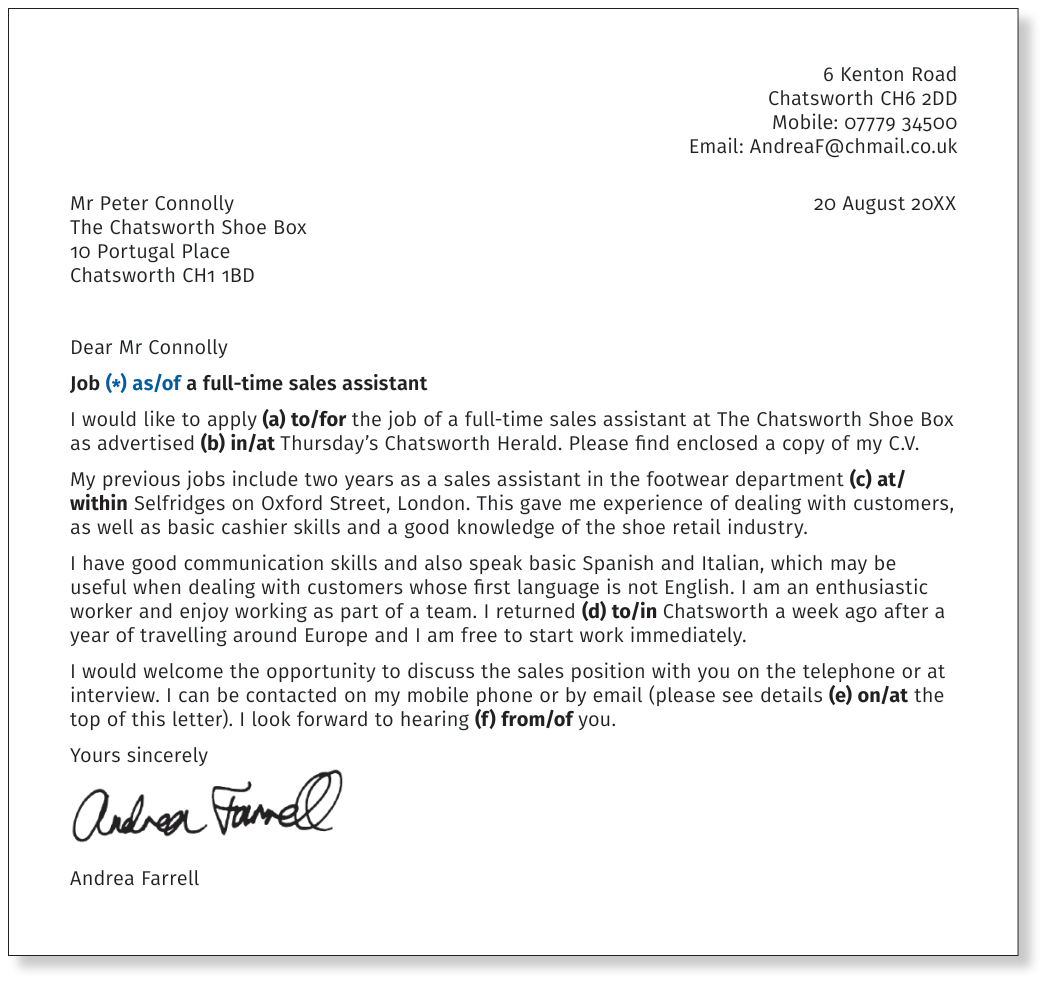
6 Kenton Road Chatsworth CH6 2DD Mobile: 07779 34500 Email: AndreaF@chmail.co.uk Mr Peter Connolly 20 August 20XX The Chatsworth Shoe Box 10 Portugal Place Chatsworth CH1 1BD Dear Mr Connolly Job (*) as/of a full-time sales assistant I would like to apply (a) to/for the job of a full-time sales assistant at The Chatsworth Shoe Box as advertised (b) in/at Thursday’s Chatsworth Herald. Please find enclosed a copy of my C.V.
My previous jobs include two years as a sales assistant in the footwear department (c) at/ within Selfridges on Oxford Street, London. This gave me experience of dealing with customers, as well as basic cashier skills and a good knowledge of the shoe retail industry.
I have good communication skills and also speak basic Spanish and Italian, which may be useful when dealing with customers whose first language is not English. I am an enthusiastic worker and enjoy working as part of a team. I returned (d) to/in Chatsworth a week ago after a year of travelling around Europe and I am free to start work immediately.
I would welcome the opportunity to discuss the sales position with you on the telephone or at interview. I can be contacted on my mobile phone or by email (please see details (e) on/at the top of this letter). I look forward to hearing (f) from/of you.
Yours sincerely
Andrea Farrell Example (*) as a b c d e f
Read Andrea Farrell’s letter again. Find a word in the letter to complete the following sentences.
a To for something, such as a job, means to ask if you can have that job.
b When I say ‘please find my C.V. ’ it means that I have put my C.V. in the envelope together with my covering letter.
c A is a person who deals with the money that a shop or a business has in its cash register at the end of every day.
d Your are the things that you can do well, especially in relation to your job.
e If you are about something, it means that you like that activity and you enjoy doing it.
f If you are to start work, it means that you are available to begin working immediately.
g An is the chance to do something.
h If a is available with a particular company it means that the company has a job for which it needs an employee.
Help desk
What do these words mean?
communication skills — a person’s ability to speak and listen to other people in an effective way. The opposite of good communication skills is poor communication skills.
Speaking & Writing for this topic
Two short tasks scored against TOEFL rubrics. The prompt is generated for this topic — use the vocabulary you have just studied.
Suggested structureclick to expand
- The last time I…
- I clearly remember when…
- A few weeks ago, I…
- The situation was…
- What was happening is that…
- It all began because…
- This is similar to what we just studied because…
- What we learned about chatsworth applies here, since…
- I noticed that shoe mattered a lot in that moment.
- Looking back, I think…
- What I learned is that…
- Next time, I would…
- Use at least 3 keywords from the prompt list.
- Keep sentences short and clear — don't try to be poetic.
- Pause briefly between the four sections so the listener can follow.
Suggested structureclick to expand
- The main idea here is …
- What stands out about this concept is …
- For example, chatsworth shows that …
- This works because shoe …
- As a result, …
- This is why …
- Use at least 3 keywords from the prompt list.
- End with a full stop. No bullet points.
AN EMPLOYMENT CONTRACT ~23 min
cash register — the machine into which a shop or some other business puts the money when a customer pays for something. Also called ‘a till’.
There are two very important words connected with talking about any contract. These are:
• clause (noun): a clause is a section of the contract. A clause usually has a number, for example, clause 1 of the contract. Sometimes a clause is divided into further sections, for example, 1.1, 1.2, 1.3, etc. • provision (noun): a provision is a term contained in a contract. All of the terms and conditions of a contract are called the provisions of the contract. Lawyers often use the verb ‘to provide’, for example, ‘Clause 1 of the contract provides that the employee is entitled to four weeks’ holiday every year’. This means that it is an obligation of the employer to give the employee four weeks’ holiday.
Here are the titles of some clauses that you will find in an employment contract. Lawyers usually call them ‘clause headings’. On the next page are descriptions of what each clause deals with. Match the headings of the clauses with the descriptions provided.
a This clause deals with the payment that the employee will receive in return for working for the employer.
The clause heading is
b This clause deals with the employee’s obligation not to tell anyone about certain information that belongs to the employer.
The clause heading is
c This clause deals with the period of time that the contract will be valid.
The clause heading is
d This clause deals with the amount of time that the employee is obliged to work every week or month.
The clause heading is
e This clause deals with what the employer must do if he or she is unhappy with the way that the employee is behaving at work.
The clause heading is
f This clause deals with the arrangements for the employee to have money in his or her old age.
The clause heading is
g This clause gives the name of the employee’s job.
The clause heading is
h This clause deals with the time that the employee is allowed to stay away from work to rest and relax and still receive his or her pay.
The clause heading is
i This clause deals with the ways in which the contract of employment can end.
The clause heading is
j This clause deals with what an employee must do if he or she is unhappy at work and wants to complain to the employer.
The clause heading is
k This clause deals with the employee’s obligation after the contract of employment ends not to start the same business or work for a rival of the employer for a certain period of time.
The clause heading is
l This clause deals with the money that an employer must pay to an employee when the employee is ill and cannot work.
The clause heading is
Help desk
What do these words mean?
a rival — a person or an organisation that is in the same type of business as you and is in competition with you for the same customers or clients.
procedure — the accepted or correct way of doing something.
A new employee has some questions about her employment contract. Complete each question using the correct word from the box below.
a What does thetermof the contract mean?
It means the duration of the contract.
b What are theprovisionsof a contract?
They are all of the terms and conditions contained in the contract.
c What is my jobtitle?
It is assistant manager.
d What are myhoursof employment?
Monday to Friday, 9am to 5.30pm.
e What will my annualsalarybe?
£25,000 a year.
f How many weeks’holidaycan I have?
You are entitled to four weeks a year, in addition to public holidays.
g Am I entitled tosick paywhen I am ill?
Yes. But you must provide us with a medical certificate.
h How much notice must I give if I want toterminatethe contract?
Four weeks. We use that time to find a new employee who can begin work at the time that you leave us.
Here are the clause headings from Exercise 1 again. Below are some very short extracts from an employment contract. Match the correct heading from the blue box with each extract.
a ‘For a period of 12 months after the termination of this agreement the Employee agrees that he or she will not start a business that is the same or similar to the Employer’s business.’
The clause is
b ‘The Employer shall pay the Employee a salary of £21,000 a year.’
The clause is
c ‘If you have a complaint relating to your employment you should follow the procedure attached to this contract in order to inform your manager about your complaint.’
The clause is
d ‘The Employer agrees to employ the Employee in the position of sales assistant.’
The clause is
e ‘On the first day of your absence from work you must inform your manager. If you are absent for more than seven days you must provide your manager with a medical certificate signed by your doctor.’
The clause is
f ‘This contract is for a duration of 12 months.’
The clause is
g ‘Employees who wish to contribute to the Fund may do so until the age of 65 years.’
The clause is
h ‘The Employee is entitled to 25 days per year in addition to public holidays.’
The clause is
i ‘The Employee shall not during the term of his or her employment disclose any material information relating to his or her employment to any third party.’
The clause is
j ‘A summary of the rules and procedures that the Employer must follow in relation to difficulties with the Employee’s performance in the workplace is attached to this contract.’
The clause is
k ‘The Employee is required to work Mondays to Fridays between 8.30am and 5.30pm, with one hour for lunch.’
The clause is
l ‘The Employer may end this agreement by giving four weeks’ written notice to the Employee.’
The clause is
Help desk
What do these words mean?
absence — when somebody is not in the place where you expect that person to be, such as at school or at work, then it is described as an absence. The adjective is ‘absent’.
fund — an amount of money that a person or an organisation keeps for a particular purpose. It can be to pay for something special, such as a college fund to pay for education, or it can be a way of saving money to spend in the future, such as a pension fund.
material — important, significant.
public holiday — a day that the government says is a holiday for everyone in the country. The important public holidays in the UK are Christmas Day and New Year’s Day. In the USA 4 July is also a public holiday.
notice — a warning period. When you give notice to someone you tell that person that something is going to happen in the future.
contribute — to give money towards something. This is often because you want to, and not because it is an obligation.
Speaking & Writing for this topic
Two short tasks scored against TOEFL rubrics. The prompt is generated for this topic — use the vocabulary you have just studied.
Suggested structureclick to expand
- The last time I…
- I clearly remember when…
- A few weeks ago, I…
- The situation was…
- What was happening is that…
- It all began because…
- This is similar to what we just studied because…
- What we learned about Term of the contract applies here, since…
- I noticed that Holidays mattered a lot in that moment.
- Looking back, I think…
- What I learned is that…
- Next time, I would…
- Use at least 3 keywords from the prompt list.
- Keep sentences short and clear — don't try to be poetic.
- Pause briefly between the four sections so the listener can follow.
Suggested structureclick to expand
- The main idea here is …
- What stands out about Confidentiality is …
- For example, Term of the contract shows that …
- This works because Holidays …
- As a result, …
- This is why …
- Use at least 3 keywords from the prompt list.
- End with a full stop. No bullet points.
HOW CAN AN EMPLOYMENT CONTRACT END? ~23 min
Read this information about the ways that an employment contract can end and then do the exercises that follow.
Resignation The employee resigns from his or her job. This means that the employee informs the employer that he or she will stop working for the employer’s business. This might be because the employee wants to work for a new employer. The employee must usually tell the employer in writing that he or she wishes to resign. This is called a letter of resignation. The employee will usually work a notice period of perhaps two weeks or four weeks. This means, for example, that an employee who wishes to stop work on 1 July must give his or her employer a letter of resignation on 3 June. Resigning is known informally as ‘handing in your notice’.
Retirement The employee retires from work. This means the employee leaves his or her job with the intention not to work again because he or she is a certain age. In many countries the age of retirement is 65 years old. However, some employees choose to take early retirement if they have enough money. When an employee retires they must live on the money they receive from their pension. Most people in the UK have a state pension, which they receive from the government. When they are working they pay some money to the government each month to pay for their pension. In the UK this is called a National Insurance contribution. Some people also have a private pension plan. This is because they want more money than the state pension gives them.
Redundancy The employee is made redundant. This means that an employee leaves his or her job because the employer does not need them. This might be because business is not good for the employer or because the business is closing. The employee usually receives a redundancy payment. This is an amount of money that the employer pays to the employee as a final payment. The amount of money that the employee receives sometimes depends on the number of years that he or she worked for the employer. The employer sometimes offers the employee training for a new career as part of the redundancy deal. Training means learning the skills necessary to do a different job.
Dismissal The employer dismisses the employee. The employee is dismissed. This means that the employer is unhappy with the performance or behaviour of the employee and tells him or her that they no longer have a job. This might be, for example, because the employee is not doing the job well or because the employee is always late for work. Dismissal is known informally as ‘being fired’ in the USA and as ‘being sacked’ in the UK. Employment law states that the employer must follow a certain procedure of warning the employee before this can happen. However, the employer is not obliged to follow this procedure when the employee is guilty of gross misconduct. Gross misconduct is very bad behaviour, such as stealing money from the employer.
A fixed-term contract ends The employee stops working for the employer or leaves his or her job because his or her contract was for a specific period of time, which has ended. For example, I agree to work in an office for six months. My contract is a fixed-term contract for six months. At the end of the six-month period I stop working for that employer.
Choose a word from the previous page to complete these sentences about resignation.
a Toresignmeans to tell your employer that you intend to stop working for him or her.
b The correct way to resign is usually to give your employer a letter ofresignation.
c When an employee resigns he or she must usually work anoticeperiod of several weeks.
d In the UK the informal way to say ‘resigning’ is to sayhandingin your notice.
Choose a word from the previous page to complete these sentences about retirement.
a Toretirefrom work means to stop working with the intention that you will not work again.
b Some people choose to take earlyretirementand stop working at the age of 45 or 50 years old, for example.
c When a person retires they usually live on the money from apension.
d A private pensionplanis a way of saving extra money for old age in case the money from the government is not enough.
Choose a word from the previous page to complete these sentences about redundancy.
a When an employee is maderedundantit is usually because the employer no longer needs so many workers.
bRedundancyis a great problem in western Europe and the USA at the moment. This is because many goods and services are cheaper to produce in other countries.
c The final sum of money that an employer pays to an employee can be a very large amount. This is called a final redundancypaymentand sometimes depends on the number of years that the employee worked for the employer.
d When John lost his job at the car factory he was offered atrainingcourse in computer skiIIs to help him find a new job.
Choose a word from the previous page to complete these sentences about dismissal.
a The printing companydismissedJason because he did some printing for his friend and he did not ask his friend to pay for it.
b I dismissed an employee for grossmisconductlast year because she telephoned me to say that she was ill but really she was on holiday in Spain.
c My employer did not follow the correctprocedurewhen he dismissed me. My lawyer says that I can make a claim against my employer because he breached employment law.
d The informal word for dismissed in the USA is ‘fired’ and in the UK it is ‘ ’.
Choose a word from the previous page to complete these sentences about the end of a fixed-term contract.
a I amleavingthe company at the end of the month because my contract ends on 31 July.
b My contract with the airline is for afixedterm of 12 months so I leave next April.
c We cannot employ you after March. Your contract is for a specificperiodof time and it ends on 31 March.
d Your contract will be for a fixed, 12-monthterm.
Complete these sentences with the correct preposition.
a Susan resignedfromher job last week.
b I wrote a letterofresignation and gave it to my employer yesterday.
c How much money will you have to liveonwhen you retire?
d I was fired because I was always lateforwork.
e Resigning from work is sometimes known informally as ‘handinginyour notice’.
f Two employees were guiltyofgross misconduct and they were sacked immediately.
g My contract of employment isfora term of 18 months.
h Last week I informed my employer that I intend to stop working for heron30 September.
i Your employer will pay you a redundancy paymentof£10,000.
j The amount of money you receive as a redundancy payment dependson/uponthe number of years you worked for your employer before you were made redundant.
Speaking & Writing for this topic
Two short tasks scored against TOEFL rubrics. The prompt is generated for this topic — use the vocabulary you have just studied.
Suggested structureclick to expand
- The last time I…
- I clearly remember when…
- A few weeks ago, I…
- The situation was…
- What was happening is that…
- It all began because…
- This is similar to what we just studied because…
- What we learned about employment applies here, since…
- I noticed that contract mattered a lot in that moment.
- Looking back, I think…
- What I learned is that…
- Next time, I would…
- Use at least 3 keywords from the prompt list.
- Keep sentences short and clear — don't try to be poetic.
- Pause briefly between the four sections so the listener can follow.
Suggested structureclick to expand
- The main idea here is …
- What stands out about this concept is …
- For example, employment shows that …
- This works because contract …
- As a result, …
- This is why …
- Use at least 3 keywords from the prompt list.
- End with a full stop. No bullet points.
ACTING FOR AN EMPLOYEE ~16 min
Emma Lucas is an employment lawyer in Chatsworth. Read what she says about representing employees in employment cases. The most important words are in the key vocabulary below. On the next page you will see some questions and answers. Match each question with the correct answer.
‘When I represent an employee it is usually because he or she has a grievance against an employer. A grievance is a complaint. The law says that employers must listen to grievances and help the employee.
Unfortunately some employers do not do this. Employees often come to me because the employer has not followed the correct procedure for dealing with a grievance. When an employee leaves a job because the employer does not listen to a grievance, the law says that it is not fair. Sometimes employees consult me because although the employer followed the correct grievance procedure, the employee feels they were not treated in a fair way. The employee has the right to make a claim against the employer in a special employment court called a tribunal. Most towns and cities in the UK have a Tribunal Office where an employee can file a claim. When an employee makes a claim to a tribunal he or she must state the grounds for the claim. Here are some of the reasons that employees give to a tribunal:
• Discrimination. To discriminate against someone at work means to act towards that person in a different, more negative way from other employees. Employees often claim that they had a bad experience at work because of their age, their sex, the colour of their skin, their nationality, or because they have some physical or mental disability. • Harassment. To harass someone means to act towards someone in a way that makes that person feel uncomfortable or distressed. Sometimes it is the employer who harasses the employee. Sometimes it is other employees who do it. In this case the employer has a duty to stop the harassment. If the employer does not stop the harassment and the employee leaves work, it is constructive dismissal. The employee can make a claim against the employer if this happens. Harassment is sometimes called bullying in the workplace. In Europe the word ‘mobbing’ is sometimes used. This word is not used in the UK. • Unfair dismissal. If an employer unfairly dismisses an employee, it means that the employer fired the employee without a good reason. Most employers do what is called an appraisal of an employee’s performance every year. An appraisal is an evaluation or a judgement of how the employee is doing. If an employee gets two or three bad appraisals the employer might not want to continue employing that person. The problem is, employees often think their appraisal was unfair.’
What is a grievance? (1) What does harassment mean? (5)
What is a procedure? (2) What is constructive dismissal? (6)
What is an employment tribunal? (3) What is unfair dismissal? (7)
What does discrimination mean? (4) What is an appraisal? (8)
a It is a special court. It hears employment cases. It is less formal than a normal court but it has its own rules, which people must obey.
b It is when an employee leaves a job because he or she is very unhappy and the employer is doing nothing to help the situation.
c It means treating someone in a different way at work. It may be because that person is a woman or has a disability, for example.
d It is the accepted, correct way of doing something.
e It is a type of assessment of someone’s performance, especially at work.
f It is when an employer fires an employee, and the employee thinks that there was not a good reason for it.
g It means behaving in a way that makes someone feel very unhappy or uncomfortable.
h It is a complaint.
Complete these sentences with a word or phrase from the key vocabulary in Exercise 1.
a I am sure my employer treats me badly because I am a foreigner. My lawyer says that I can sue my employer on the grounds ofdiscrimination.
b I was the only woman in my office. The men working there made jokes about me all of the time and said that my job was only to make coffee for them. I stopped working there because it was horrible and my employer didn’t help me. The grounds for my claim wereconstructivedismissal.
c I have made a claim against my employer. The case will be heard next month by an employment.
d I had anappraisalfrom my employer last week. It was very good. My employer said that I am a good employee and I work well with others.
e I am making a claim forunfairdismissal. My employer sacked me last month and the only reason was that my employer’s daughter wanted to have my job.
Speaking & Writing for this topic
Two short tasks scored against TOEFL rubrics. The prompt is generated for this topic — use the vocabulary you have just studied.
Suggested structureclick to expand
- The last time I…
- I clearly remember when…
- A few weeks ago, I…
- The situation was…
- What was happening is that…
- It all began because…
- This is similar to what we just studied because…
- What we learned about grievance applies here, since…
- I noticed that consult mattered a lot in that moment.
- Looking back, I think…
- What I learned is that…
- Next time, I would…
- Use at least 3 keywords from the prompt list.
- Keep sentences short and clear — don't try to be poetic.
- Pause briefly between the four sections so the listener can follow.
Suggested structureclick to expand
- The main idea here is …
- What stands out about tribunal is …
- For example, grievance shows that …
- This works because consult …
- As a result, …
- This is why …
- Use at least 3 keywords from the prompt list.
- End with a full stop. No bullet points.
ACTING FOR AN EMPLOYER ~14 min
The employment lawyer, Emma Lucas, is going to talk about acting for an employer. Before you read what Emma says, complete the definitions of the words below by matching the first half of each sentence with the correct ending.
(*) Non-contentious work is… …a meeting where a group of people learn and talk about a new subject. (1)
a Legislation is… …work that does not involve any kind of dispute or argument between people.
b Regulations are… …all of the laws passed by a government or an organisation such as the European Union. (2)
c A seminar is… …a statement that someone has done something wrong. However, it is not proven. (3)
d A duty of care is… …to keep part of someone’s salary as a punishment because that person did something wrong. (4)
e Contentious work is… …an organisation of workers who unite for better pay and working conditions. (5)
f An allegation is… …rules that a person or a country must obey. (6)
g To dock pay means… …work that a lawyer does that involves a dispute or an argument between people. (7)
h To be fired on-the-spot means… …a duty to take care and not to harm anyone by your actions. (8)
i A trade union is… …that an employee is dismissed immediately and without any warning. The more formal way of saying fired on-the-spot is to say that the employer dismissed the employee ‘summarily’. (9)
j A strike is… …a situation where a group of employees stop working for a period of time because of a disagreement with an employer. (10)
Here is what Emma Lucas says about acting for an employer. Choose a word or phrase from the box below to complete the text.
‘Acting for an employer is very different from acting for an employee. Often my job is doing non-contentious work. Non-contentious means that the employer is not involved in a dispute with anyone. It means doing work such as drafting contracts of employment or giving employers some advice about the latest (a). There are many (b) regulationsthat employers need to know about. A lot of these come from the European Union. It is very important that employers comply with employment law. This means that employers must follow employment law. To inform employers about new legislation my law firms holds (c) seminars. These are meetings where groups of employers receive information from our law firm about how new laws will affect them. The employers can ask us questions if they are not sure about anything. A lot of new regulations are about health and safety issues. For example, an employer has a (d) duty of careto employees and to any people who visit the employer’s premises. In this situation, the duty of care is a duty to make sure that no employee or visitor is harmed. This includes things like making sure that employees have the proper training to do their job correctly and safely. It also includes making sure that machinery or office equipment is safe.
Sometimes I have to do (e) contentiouswork. This is because an employee makes a claim against my client, the employer. Some employees make very serious (f) allegationsand it is my job to defend my client at an employment tribunal. Sometimes the employee’s claim is valid and the employer must pay compensation. Last month I advised an employer who (g) dockedan employee’s pay as a punishment because the employee was always late for work. This means that the employer kept part of the employee’s pay. I explained to the employer that he is not allowed to do this. A tribunal would support the employee in this situation. Another employer fired an employee (h) on-the-spotfor being late. This means he dismissed the employee immediately and without warning. Again, I explained that this is not legal. In that case, the employee’s (i) trade unionbecame involved. This is an organisation of people who work in the same job or profession who help each other when a member has a problem like this. An employer has to be careful because when a trade union is involved it could lead to a (j) strike. This is a situation where a group of employees stop working because one of them or a group of them have a grievance against the employer.’
Speaking & Writing for this topic
Two short tasks scored against TOEFL rubrics. The prompt is generated for this topic — use the vocabulary you have just studied.
Suggested structureclick to expand
- The last time I…
- I clearly remember when…
- A few weeks ago, I…
- The situation was…
- What was happening is that…
- It all began because…
- This is similar to what we just studied because…
- What we learned about docked applies here, since…
- I noticed that legislation mattered a lot in that moment.
- Looking back, I think…
- What I learned is that…
- Next time, I would…
- Use at least 3 keywords from the prompt list.
- Keep sentences short and clear — don't try to be poetic.
- Pause briefly between the four sections so the listener can follow.
Suggested structureclick to expand
- The main idea here is …
- What stands out about allegations is …
- For example, docked shows that …
- This works because legislation …
- As a result, …
- This is why …
- Use at least 3 keywords from the prompt list.
- End with a full stop. No bullet points.
AN EMPLOYMENT CASE ~14 min
Julie Murphy is an employee. She is making a claim against her employer at an employment tribunal. Read the information in the box and answer the questions that follow using a full sentence.
‘My name is Julie Murphy. Today I am at an employment tribunal. I am the claimant. I am making a claim against my former employer. I must use the word ‘former’ because he is no longer my employer. My former employer has an estate agency in the town of Chatsworth. An estate agent sells houses. His name is Keith Penhaligon. I worked for Mr Penhaligon as a receptionist in his office for four years. My job was to welcome people who came into the office and give them information about property that was for sale. I liked my job. I was a good employee. I was never late for work. I had a good relationship with my colleagues. During the four years that I worked there I only had two days’ absence.
Six months ago Mr Penhaligon said that he needed an assistant manager. He advertised the vacant position in the local newspaper. The advertisement said that candidates for the job should be ‘young and ambitious and with previous experience of working for an estate agent’. I am 27 years old, very ambitious and I have experience. I applied for the job. 15 other people also applied for the job. Mr Penhaligon refused to interview me for the job. He explained that it was a waste of his time to discuss my C.V. and talk about the job. He told me this was because I got married a year ago. He said that he was afraid I would have a baby very soon and would need lots of time away from work. He said he would prefer to employ an older woman or a man. I stopped working for Mr Penhaligon immediately. I am very angry. I am making a claim on the grounds of discrimination.’
a What type of business does Julie Murphy’s former employer have?
Answer:
b What was Julie Murphy’s job?
Answer:
c Did Julie Murphy have a good relationship with the other people in her office?
Answer:
d How many days did Julie Murphy have away from work?
Answer:
e Where did Mr Penhaligon advertise the job of assistant manager?
Answer:
f What was the total number of candidates for the job of assistant manager?
Answer:
g What did Mr Penhaligon refuse to do?
Answer:
h Who would Mr Penhaligon prefer to employ as assistant manager?
Answer:
i How does Julie Murphy feel about Mr Penhaligon’s decision?
Answer:
j What are the grounds for Julie Murphy’s claim?
Answer:
Speaking & Writing for this topic
Two short tasks scored against TOEFL rubrics. The prompt is generated for this topic — use the vocabulary you have just studied.
Suggested structureclick to expand
- The last time I…
- I clearly remember when…
- A few weeks ago, I…
- The situation was…
- What was happening is that…
- It all began because…
- This is similar to what we just studied because…
- What we learned about employment applies here, since…
- I noticed that case mattered a lot in that moment.
- Looking back, I think…
- What I learned is that…
- Next time, I would…
- Use at least 3 keywords from the prompt list.
- Keep sentences short and clear — don't try to be poetic.
- Pause briefly between the four sections so the listener can follow.
Suggested structureclick to expand
- The main idea here is …
- What stands out about this concept is …
- For example, employment shows that …
- This works because case …
- As a result, …
- This is why …
- Use at least 3 keywords from the prompt list.
- End with a full stop. No bullet points.
UNIT 4 VOCABULARY CHECK ~2 min
- absence
- absent
- applicant
- apply
- appraisal
- bullying
- candidate
- cashier
- clause
- closing date
- confidentiality
- constructive dismissal
- contentious
- covering letter
- C.V.
- disability
- disciplinary
- discriminate
- discrimination
- dismiss
- dismissal
- dismissed
- dock
- employee
- employer
- estate agent
- fired
- fixed-term contract
- former
- full-time
- grievance
- gross misconduct
- harass
- harassment
- interview
- job title
- made redundant
- manager
- maternity leave
- misconduct
- non-competition
- non-contentious
- notice period
- on-the-spot
- part-time
- pay
- payroll
- pension
- procedure
- provide that
- provision
- redundancy
- redundant
- regulations
- remuneration
- resign
- resignation
- retire
- retirement
- sacked
- salary
- secretary
- seminar
- sick pay
- staff
- strike
- team
- temporary
- term
- termination
- track record
- trade union
- tribunal
- unfair dismissal
- vacant position
- wages
- well-motivated
- wide range
FOUNDATION LEVEL PRACTICE ~19 min
Look at the sentences below. Each sentence contains a mistake. The mistake is either an incorrect word or a word that should not be there. Put a circle around the word. Do not circle more than one word for each sentence. There is an example at the beginning (*).
Example (*) The telephone company employs thousands of staffs.
1 Your skills are the things that you can do good.
2 Your employer did not make the correct procedure when he dismissed you.
3 Could you please confirm me that you agree to pay my client for his work?
4 Marco explained me at our meeting that his company dismissed him because he is a foreigner.
5 I would like to discuss about my salary for next year.
Read the text below. There are ten words missing from the text. In the spaces below, write the missing words. The first letter of each word has been provided for you. There is an example at the beginning (*).
DISMISSING AN EMPLOYEE FOR GROSS MISCONDUCT Gross misconduct is (*)noticethat is completely unacceptable. When an employee is guilty of gross misconduct the law does not expect an employer to tolerate it. The employer can usually dismiss the employee without giving him or her any warning. A lawyer would describe this as dismissing the employee without (1)grounds.
When an employee is dismissed on the (2)groundsof gross misconduct he or she might file a (3)noticeagainst the employer in a special court called an employment tribunal. The tribunal will take several (4)claiminto account when deciding if the employer acted fairly. One of the most important things that an employer must do is make sure that the correct disciplinary (5)factorsis followed. Even in cases of very serious misconduct the employer should:
• Inform the employee in (6)factorswhat the problem is, as well as speaking to him or her about it. This normally takes the form of a letter. • Allow the employee a face-to-face meeting to discuss the misconduct. The employer must tell the employee that he or she is entitled to a have a (7)noticeunion representative or some other witness present at that meeting. • Allow the employee to (8)groundsagainst the decision if he or she is dismissed.
Employers must follow these rules. It is very dangerous to dismiss an employee on-the-(9)grounds. This means asking the employee to leave immediately without having a proper investigation. If an employer does this, then the employee will almost certainly (10)noticefor damages and he or she is very likely to win.
(*) behaviour
| # | Phrase | Definition |
|---|---|---|
| (1) | n | (6) w |
| (2) | g | (7) t |
| (3) | c | (8) a |
| (4) | f | (9) s |
| (5) | p | (10) s |
Read the text below. It is from a contract. Some of the words in the text are underlined. The meanings of these words appear in the list below, but they are not in the same order. Match the underlined words in the text with the correct meanings by writing the letters (A, B, C, etc) in the list below. There is an example at the beginning(*).
Speaking & Writing for this topic
Two short tasks scored against TOEFL rubrics. The prompt is generated for this topic — use the vocabulary you have just studied.
Suggested structureclick to expand
- The last time I…
- I clearly remember when…
- A few weeks ago, I…
- The situation was…
- What was happening is that…
- It all began because…
- This is similar to what we just studied because…
- What we learned about foundation applies here, since…
- I noticed that level mattered a lot in that moment.
- Looking back, I think…
- What I learned is that…
- Next time, I would…
- Use at least 3 keywords from the prompt list.
- Keep sentences short and clear — don't try to be poetic.
- Pause briefly between the four sections so the listener can follow.
Suggested structureclick to expand
- The main idea here is …
- What stands out about this concept is …
- For example, foundation shows that …
- This works because level …
- As a result, …
- This is why …
- Use at least 3 keywords from the prompt list.
- End with a full stop. No bullet points.
FROM AN EMPLOYMENT CONTRACT ~6 min
2. The (AA) Term of this Agreement shall commence on 1 December 20XX and shall continue until 30 November 20XX unless terminated by either (A) party in accordance with the (B) terms of this Agreement.
3. The Employer agrees that (C) remuneration shall be paid into the Employee’s bank account on the 25th day of each calendar month.
4. The Employee shall (D) be entitled to normal remuneration during sickness (E) absence for a maximum of six weeks in any period of 12 months.
5. The Employee shall be entitled to (F) contribute to the Employer’s (G) pension scheme.
6. The Employer may (H) terminate this Agreement without notice if the Employee shall at any time:
Be guilty of gross (I) misconduct.
• (J) Disclose confidential information which has detrimentally affected the interests of the Employer.
(*) AA the duration of the contract, the period of time for which the contract is valid bad or unacceptable behaviour tell, reveal end the duties and conditions contained in a contract to have the right to something a person or company who signs a contract a period of time a person is away from the place they are expected to be money that a person receives after he or she stops working to give because you choose to give and not because you must payment
Speaking & Writing for this topic
Two short tasks scored against TOEFL rubrics. The prompt is generated for this topic — use the vocabulary you have just studied.
Suggested structureclick to expand
- The last time I…
- I clearly remember when…
- A few weeks ago, I…
- The situation was…
- What was happening is that…
- It all began because…
- This is similar to what we just studied because…
- What we learned about from applies here, since…
- I noticed that employment mattered a lot in that moment.
- Looking back, I think…
- What I learned is that…
- Next time, I would…
- Use at least 3 keywords from the prompt list.
- Keep sentences short and clear — don't try to be poetic.
- Pause briefly between the four sections so the listener can follow.
Suggested structureclick to expand
- The main idea here is …
- What stands out about this concept is …
- For example, from shows that …
- This works because employment …
- As a result, …
- This is why …
- Use at least 3 keywords from the prompt list.
- End with a full stop. No bullet points.