
The Language of Company Law
WHO RUNS A COMPANY? ~25 min
Jessica Ryder is a law student at the University of Chatsworth. She must write a short paper about the people who are connected with a company. The most important words are in the key vocabulary below. Read the text and answer the questions below using a full sentence.
When the founders of a new company register the company at Companies House, the company exists as a separate legal entity. This is important as it means that the company is separate from its owners, who are the shareholders of the company. Shareholders are also known as the members of the company. The people who work for the company are the employees.
The people who have the power to run the company are the directors. The company’s articles of association give the directors this power. Together, the directors are called the Board of Directors. They make all the decisions about the management of the company.
There is a lot of paperwork in connection with a company. Some of this is financial paperwork, for example dealing with the payroll, which means calculating salaries and wages for the employees. It also involves sending invoices to people who buy goods or services from the company, and paying Example: Who are the shareholders?
invoices from suppliers. Companies usually employ an accountant to deal with all this financial paperwork. Other paperwork is in connection with the legal administrative duties of a company. This includes the duty to send an annual return each year to Companies House, containing up-to-date information about the company, together with annual financial accounts. It is often the duty of the company secretary to make sure that the company complies with these requirements. If this person fails to send the correct documents to Companies House at the correct time, then he or she may have to pay a fine.
Each year, a qualified accountant, called an auditor, must inspect all the financial records of most companies. The auditor has to look at the creditors and the debtors of a company. Creditors are the people, including banks and other companies, who the company owes money to. Debtors are all the people who owe money to the company. The auditor must be satisfied that the annual financial records are accurate.
Answer: The shareholders, also known as the members, are the owners of the company.
a Who are the employees?
b What do the directors of a company do?
c What does an accountant do?
d What does a company secretary do?
continued
e What does an auditor do?
f What are creditors?
g What are debtors?
Look at the following statements. All of the statements are made by people or organisations that have a connection with a company called Foxtrot Ltd. Complete each statement by using the correct word from the key vocabulary in Exercise 1.
a Kerry Knight I invested £5000 in Foxtrot Ltd by buying shares in the company. I am a of the company. I am also known as a member of the company.
b The manager of the Royal Chatsworth Bank Foxtrot Ltd took out a loan from us six months ago. They owe us £4200. We are a of Foxtrot Ltd.
c Harry Orm I am a of Foxtrot Ltd, together with two others, Mary Parker and Josh Copeland. Mary and I are also shareholders, but Josh does not own any shares in the company. Together we make all the decisions about the company and we are responsible for running the company.
d Mary Parker I am a director of Foxtrot Ltd and I am also the company . This means that in addition to my duties as a director, I have the important task of making sure that I follow all the statutory requirements connected with a company, for example, sending notices of meetings to shareholders and sending documents to Companies House.
e Samuel Dickenson I am an accountant and I work for a firm called AB Chartry & Co. Most of my clients are medium-size private limited companies. One of my clients is Foxtrot Ltd. I have to check the company’s financial accounts and make sure that they are accurate and show the true financial position of the company. I am Foxtrot Ltd’s .
f Eliza Taylor I work for Foxtrot Ltd as their . I deal with all the financial transactions of the company. For example, I send invoices to people and pay our suppliers. I also deal with the payroll each month to make sure that all of our employees receive their correct monthly salary.
g Ron Baxter I bought some goods from Foxtrot Ltd three weeks ago. The cost of the goods is £795.20. I have an invoice for these goods, which I must pay next week. I am a of Foxtrot Ltd.
h Jane Wilkinson I am one of Foxtrot’s . I work in the sales department. I like working here. I receive a good salary and I also receive a commission on any new sales.
Help desk
What do these words mean?
suppliers — people or companies that provide goods or services to other people or companies, often on a regular basis.
Speaking & Writing for this topic
Two short tasks scored against TOEFL rubrics. The prompt is generated for this topic — use the vocabulary you have just studied.
Suggested structureclick to expand
- The last time I…
- I clearly remember when…
- A few weeks ago, I…
- The situation was…
- What was happening is that…
- It all began because…
- This is similar to what we just studied because…
- What we learned about shareholders applies here, since…
- I noticed that employees mattered a lot in that moment.
- Looking back, I think…
- What I learned is that…
- Next time, I would…
- Use at least 3 keywords from the prompt list.
- Keep sentences short and clear — don't try to be poetic.
- Pause briefly between the four sections so the listener can follow.
Suggested structureclick to expand
- The main idea here is …
- What stands out about accountant is …
- For example, shareholders shows that …
- This works because employees …
- As a result, …
- This is why …
- Use at least 3 keywords from the prompt list.
- End with a full stop. No bullet points.
AREAS OF COMPANY LAW ~14 min
an invoice — a piece of paper that shows what you are buying and how much you must pay.
Ellson Garwood law firm want to recruit a lawyer to work in their company and commercial department. They put the following advertisement in a legal magazine. The most important words or phrases are in the key vocabulary. Read the advertisement and put the correct words or phrases from the key vocabulary into each sentence below to complete the definition.
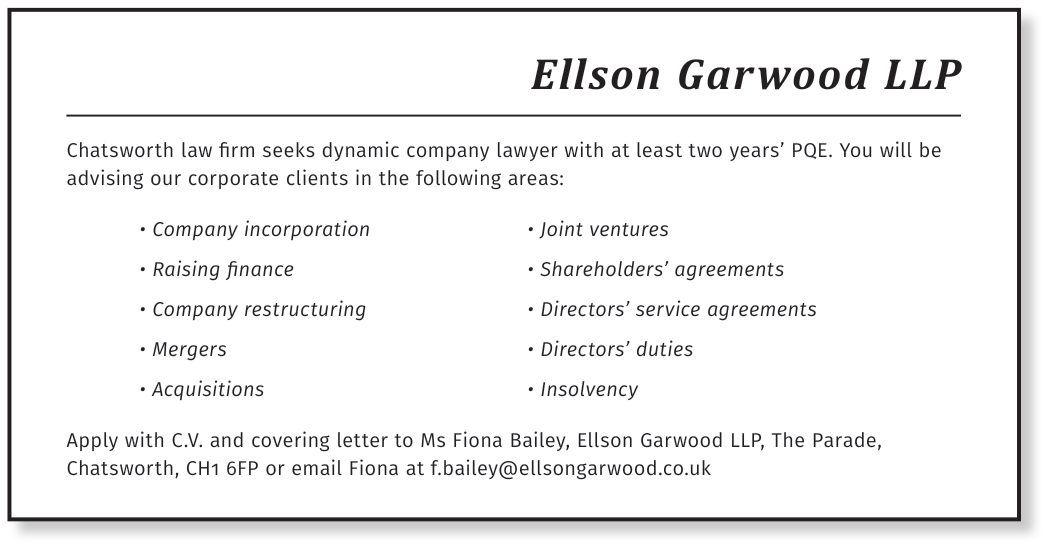
Chatsworth law firm seeks dynamic company lawyer with at least two years’ PQE. You will be advising our corporate clients in the following areas:
Company incorporation Raising finance Company restructuring Mergers Acquisitions Joint ventures Shareholders’ agreements Directors’ service agreements Directors’ duties Insolvency Apply with C.V. and covering letter to Ms Fiona Bailey, Ellson Garwood LLP, The Parade, Chatsworth, CH1 6FP or email Fiona at f.bailey@ellsongarwood.co.uk
aDirectors’ service agreementsare contracts of work between a company and a director. They are similar to contracts of employment. The agreement contains all of the details of the director’s position, for example his or her remuneration, obligations, any restrictive covenant that applies, and a confidentiality clause.
bInsolvencyis a situation where a company does not have enough money to pay its debts.
cMergerstake place when two companies join together to form one company.
d Obtaining money from banks, private individuals, or investment institutions is known more formally asraising finance.
eAcquisitionsoccur when one company buys another company. They are also called takeovers.
continued
fIncorporating companiesis all of the legal work involved in setting up a new company.
gRestructuring companiesis changing the existing structure of companies with the aim of improving their performance.
h Situations where two or more companies work together on a particular project for a limited period of time are calledjoint ventures. Each company remains independent from each other.
i Agreements between the members of a company are calledshareholders’ agreements. They are important as they contain the members’ obligations to the company and to each other. For example, they state what happens when a shareholder wants to sell his or her shares.
j All of the obligations and requirements of a director are calleddirectors’ duties.
Peter Hapworth saw the advertisement and wrote a letter to Fiona Bailey. Peter’s letter is mixed up. Put the parts of the letter in the correct order by writing your answers in the boxes numbered 2-9 below. There is an example at the beginning, which is the start of the letter.
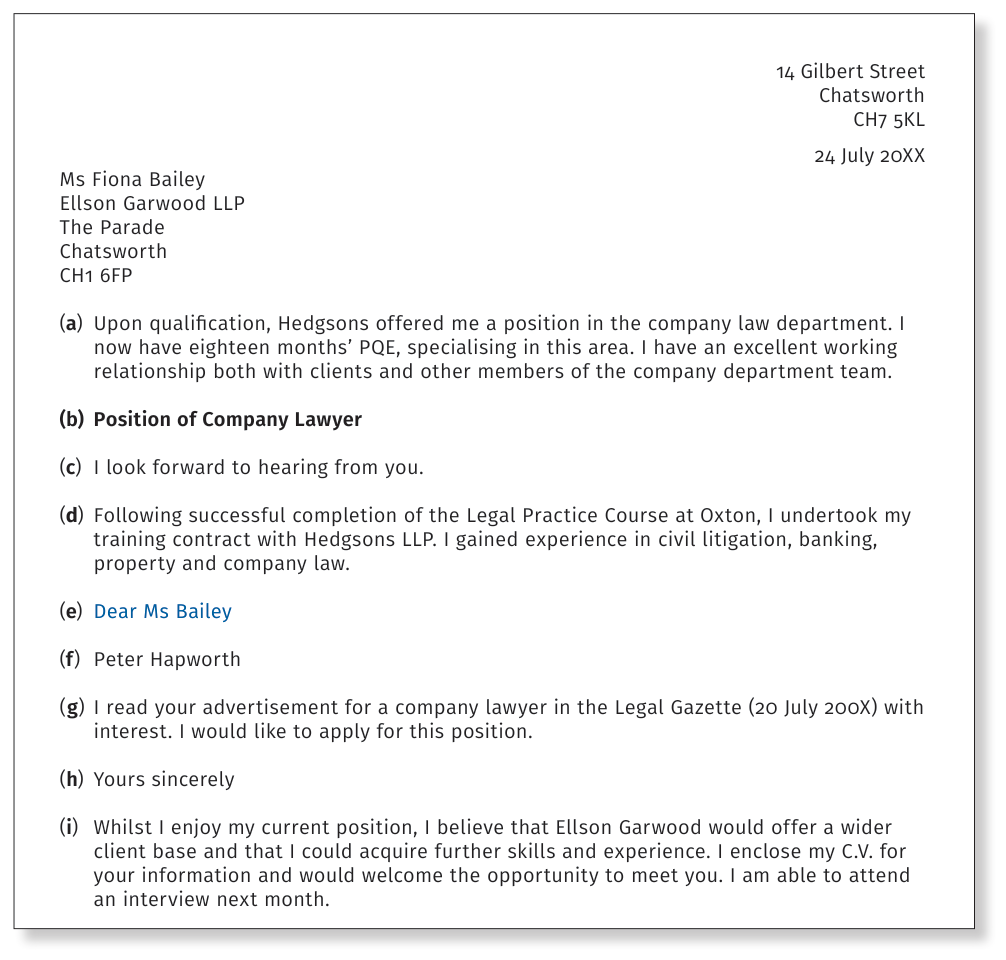
14 Gilbert Street Chatsworth CH7 5KL 24 July 20XX Ms Fiona Bailey Ellson Garwood LLP The Parade Chatsworth CH1 6FP
(a) Upon qualification, Hedgsons offered me a position in the company law department. I now have eighteen months’ PQE, specialising in this area. I have an excellent working relationship both with clients and other members of the company department team.
(b) Position of Company Lawyer
(c) I look forward to hearing from you.
(d) Following successful completion of the Legal Practice Course at Oxton, I undertook my training contract with Hedgsons LLP. I gained experience in civil litigation, banking, property and company law.
(e) Dear Ms Bailey
(f) Peter Hapworth
(g) I read your advertisement for a company lawyer in the Legal Gazette (20 July 200X) with interest. I would like to apply for this position.
(h) Yours sincerely
(i) Whilst I enjoy my current position, I believe that Ellson Garwood would offer a wider client base and that I could acquire further skills and experience. I enclose my C.V. for your information and would welcome the opportunity to meet you. I am able to attend an interview next month.
(1) e (2) (3) (4) (5) (6) (7) (8) (9)
Help desk
What do these words mean?
PQE — an abbreviation for post qualification experience. That means how many years a lawyer has worked following the date of his or her qualification as a lawyer. PQE is used frequently in job advertisements for lawyers.
undertook — in this context, it means ‘did’.
Speaking & Writing for this topic
Two short tasks scored against TOEFL rubrics. The prompt is generated for this topic — use the vocabulary you have just studied.
Suggested structureclick to expand
- The last time I…
- I clearly remember when…
- A few weeks ago, I…
- The situation was…
- What was happening is that…
- It all began because…
- This is similar to what we just studied because…
- What we learned about Restructuring companies applies here, since…
- I noticed that Shareholders’ agreements mattered a lot in that moment.
- Looking back, I think…
- What I learned is that…
- Next time, I would…
- Use at least 3 keywords from the prompt list.
- Keep sentences short and clear — don't try to be poetic.
- Pause briefly between the four sections so the listener can follow.
Suggested structureclick to expand
- The main idea here is …
- What stands out about Directors’ service is …
- For example, Restructuring companies shows that …
- This works because Shareholders’ agreements …
- As a result, …
- This is why …
- Use at least 3 keywords from the prompt list.
- End with a full stop. No bullet points.
DIRECTORS ~18 min
to acquire further skills — to get more practice in doing something so that you become better at doing that thing.
client base — the number and type of people and companies that a law firm provides a service to.
David Merriman is talking about his job as a director of a company. The most important words are highlighted in the text. Read what David says and then complete the sentences on the next page by matching the first half of each sentence with the correct ending.
‘My name is David Merriman. I’m one of the directors of Halloway & Riggs Ltd. Our company produces mobility equipment for people who cannot walk properly. Halloway & Riggs Ltd has a board of five directors. Four of us are executive directors. That means that we are the people who make all of the day-to-day decisions about running the company. We also have one non-executive director, called Jack Drury. As a non-executive director, he is not involved in the daily running of the company, but he gives us advice on new designs for our equipment.
When the shareholders of Halloway & Riggs Ltd appointed me as a director of the company six years ago, the rules about the duties of directors were not really very clear. There wasn’t a statute dealing with the duties of directors. The law came from the common law. The main duties of a director were the duty to act with care and skill, and the fiduciary duty of good faith. Because a director knows so much about a company, the shareholders must trust the director always to act in the best interests of the company. For example, we, as directors, aren’t allowed to make a secret profit by using our knowledge of the company for our own benefit.
However, since the Companies Act 2006 came into force, the law about the duties of directors is a little clearer. The Act includes some provisions about directors. It talks about executive directors and non- executive directors, which I mentioned earlier. It also talks about shadow directors. Basically, a shadow director is a person who is not officially a director of the company, because the shareholders did not appoint him or her as a director, but this person gives instructions to the other directors and the directors usually do as they say. Executive directors, non-executive directors and shadow directors all have the same duties and responsibilities to the company. Directors have a duty to avoid a conflict of interest. In other words, we’re not allowed to be in a position where our personal interest may tempt us to do something that would not be in the best interests of the company. If a director has a personal interest that may conflict with the interests of the company, then the director must tell the other directors about it. In other words the director must disclose that interest so that everyone knows about it.
I hope to remain in my position of director of Halloway & Riggs Ltd for many years. My service agreement with the company expires in two years, but I hope that the shareholders will reappoint me. I can remember only one occasion, which was three years ago, when the directors and shareholders were so dissatisfied with the performance of one of the directors, that the shareholders had to remove that director. That means they dismissed him. I would be devastated if that happened to me. I’m very proud of the company and its products and I firmly believe that this company has a great future. I will do my very best to ensure that I exercise my powers as a director to the best of my ability.’
a Executive directors… …a situation in which you are in a position of trust towards another person, often in a professional capacity, and if you take a particular action, this will give good results to you, while at the same time giving bad results to the other person. (1)
b Non-executive directors… …advise the company about particular matters, but they do not take part in the daily decision-making. (2)
c Appointed means… …use that power. (3)
d A fiduciary duty is… …elected or chosen for a particular position. (4)
e A shadow director is… …dismiss that person from his or her position as a director. (5)
f A conflict of interest is… …run the company and make all the decisions about the company. (6)
g To disclose information means to… …give that information to someone or tell someone about it. (7)
h To remove a director means to… …a duty to act in the best interests of someone because that person trusts you. (8)
i To exercise a power means to… …someone who, even though he or she has no official position of authority, gives instructions to the official directors. (9)
Read what David Merriman says again and decide if the following statements are true or false.
a David Merriman is a member of the board of directors of Halloway & Riggs Ltd.
b Jack Drury is a member of the board of directors of Halloway & Riggs Ltd.
c David Merriman has been a director of Halloway & Riggs Ltd for six years.
d The directors are allowed to make a profit from their position but they must not tell anyone about it.
e David Merriman wants to retire in two years.
f Three years ago, the shareholders removed David Merriman from his position as a director.
Help desk
What do these words mean?
mobility equipment — this is equipment which helps people to move. For example, wheelchairs, crutches and walking sticks.
good faith — honesty and sincerity, loyalty.
the best of my ability — to do something to the best of your ability is to do it as well as you possibly can.
devastated — extremely upset.
Speaking & Writing for this topic
Two short tasks scored against TOEFL rubrics. The prompt is generated for this topic — use the vocabulary you have just studied.
Suggested structureclick to expand
- The last time I…
- I clearly remember when…
- A few weeks ago, I…
- The situation was…
- What was happening is that…
- It all began because…
- This is similar to what we just studied because…
- What we learned about directors applies here, since…
- I noticed that this concept mattered a lot in that moment.
- Looking back, I think…
- What I learned is that…
- Next time, I would…
- Use at least 3 keywords from the prompt list.
- Keep sentences short and clear — don't try to be poetic.
- Pause briefly between the four sections so the listener can follow.
Suggested structureclick to expand
- The main idea here is …
- What stands out about this concept is …
- For example, directors shows that …
- This works because this concept …
- As a result, …
- This is why …
- Use at least 3 keywords from the prompt list.
- End with a full stop. No bullet points.
COMPANY MEETINGS ~8 min
Christine Martin works at the Chatsworth Business Advice Bureau. This is an office that gives advice and information to people who want to start a new business. Christine is writing an information sheet about company meetings. The most important words or phrases are in the key vocabulary below. Read the first page of the information sheet and answer the questions that follow using a full sentence.
Key vocabulary • company meetings • annual general meeting extraordinary proxy general meeting
Speaking & Writing for this topic
Two short tasks scored against TOEFL rubrics. The prompt is generated for this topic — use the vocabulary you have just studied.
Suggested structureclick to expand
- The last time I…
- I clearly remember when…
- A few weeks ago, I…
- The situation was…
- What was happening is that…
- It all began because…
- This is similar to what we just studied because…
- What we learned about board meetings applies here, since…
- I noticed that chairperson mattered a lot in that moment.
- Looking back, I think…
- What I learned is that…
- Next time, I would…
- Use at least 3 keywords from the prompt list.
- Keep sentences short and clear — don't try to be poetic.
- Pause briefly between the four sections so the listener can follow.
Suggested structureclick to expand
- The main idea here is …
- What stands out about convene is …
- For example, board meetings shows that …
- This works because chairperson …
- As a result, …
- This is why …
- Use at least 3 keywords from the prompt list.
- End with a full stop. No bullet points.
Chatsworth Business Advice Bureau ~24 min
Company meetings
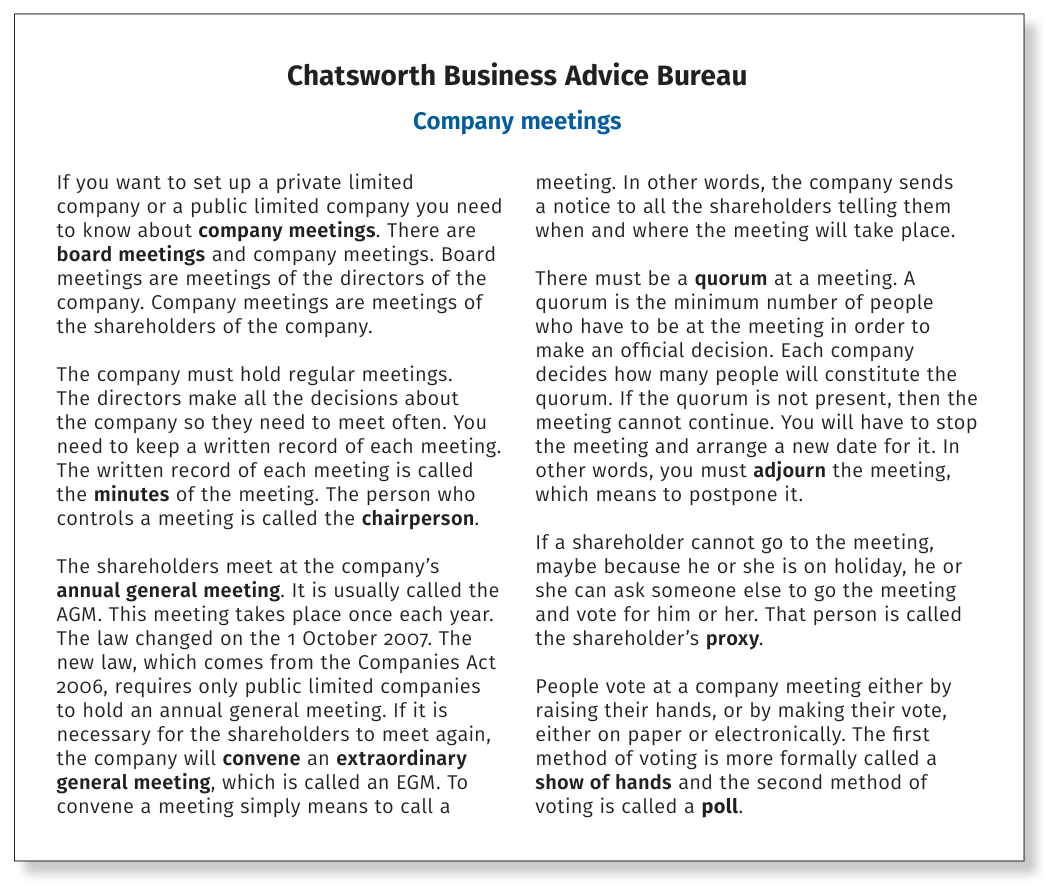
If you want to set up a private limited company or a public limited company you need to know about company meetings. There are board meetings and company meetings. Board meetings are meetings of the directors of the company. Company meetings are meetings of the shareholders of the company.
The company must hold regular meetings. The directors make all the decisions about the company so they need to meet often. You need to keep a written record of each meeting. The written record of each meeting is called the minutes of the meeting. The person who controls a meeting is called the chairperson.
The shareholders meet at the company’s annual general meeting. It is usually called the AGM. This meeting takes place once each year. The law changed on the 1 October 2007. The new law, which comes from the Companies Act 2006, requires only public limited companies to hold an annual general meeting. If it is necessary for the shareholders to meet again, the company will convene an extraordinary general meeting, which is called an EGM. To convene a meeting simply means to call a
a Who attends board meetings?
Answer:
b Who attends company meetings?
Answer: meeting. In other words, the company sends a notice to all the shareholders telling them when and where the meeting will take place.
There must be a quorum at a meeting. A quorum is the minimum number of people who have to be at the meeting in order to make an official decision. Each company decides how many people will constitute the quorum. If the quorum is not present, then the meeting cannot continue. You will have to stop the meeting and arrange a new date for it. In other words, you must adjourn the meeting, which means to postpone it.
If a shareholder cannot go to the meeting, maybe because he or she is on holiday, he or she can ask someone else to go the meeting and vote for him or her. That person is called the shareholder’s proxy.
People vote at a company meeting either by raising their hands, or by making their vote, either on paper or electronically. The first method of voting is more formally called a show of hands and the second method of voting is called a poll.
continued
c What are the minutes of a meeting?
Answer:
d What does the chairperson do at a meeting?
Answer:
e How often does an annual general meeting take place?
Answer:
f What does the abbreviation EGM mean?
Answer:
g There must be a minimum number of people attending a meeting before that meeting can continue. What is this minimum number of people called?
Answer:
h What are the two methods of voting at a company meeting?
Answer:
Use the correct words or phrases from the key vocabulary in Exercise 1 to complete the following sentences.
a We need at least five people to attend the meeting before we can make any decisions. There are only four people here, so we do not have a present.
b If you want to read what happened at a meeting, you should look at the of the meeting.
c The company’s takes place in March of every year.
d Meetings of the shareholders are generally known as .
e I’m afraid there is not a quorum at this meeting. We will the meeting now and hold it again next week.
f The AGM of Great Finance plc will take place next month. One of the shareholders, Daphne Mercier, will be in France when the meeting takes place. Daphne asked her friend, Teresa, to be her and vote on her behalf at the meeting.
g One method of voting that is very often used at company meetings is where each shareholder raises his or her hand, in other words, voting by a .
h Granger Ltd held its AGM last month. Now it is necessary to hold another meeting. This time it will be an .
i The directors hold regular at which they discuss the position of the company and make decisions about the company.
j There are a number of matters that we must discuss. We need to a company meeting as soon as possible.
k All the shareholders voted by completing the voting form. This written vote is called a .
l Two of the shareholders became very angry during the meeting and started to shout at each other.
The had to ask them to be quiet.
Here is the second page of the information sheet about company meetings. The most important words or phrases are in the key vocabulary below. Read the information sheet and decide if the statements on the next page are true or false.
Speaking & Writing for this topic
Two short tasks scored against TOEFL rubrics. The prompt is generated for this topic — use the vocabulary you have just studied.
Suggested structureclick to expand
- The last time I…
- I clearly remember when…
- A few weeks ago, I…
- The situation was…
- What was happening is that…
- It all began because…
- This is similar to what we just studied because…
- What we learned about resolutions applies here, since…
- I noticed that carry mattered a lot in that moment.
- Looking back, I think…
- What I learned is that…
- Next time, I would…
- Use at least 3 keywords from the prompt list.
- Keep sentences short and clear — don't try to be poetic.
- Pause briefly between the four sections so the listener can follow.
Suggested structureclick to expand
- The main idea here is …
- What stands out about notice is …
- For example, resolutions shows that …
- This works because carry …
- As a result, …
- This is why …
- Use at least 3 keywords from the prompt list.
- End with a full stop. No bullet points.
Chatsworth Business Advice Bureau ~20 min
Company meetings
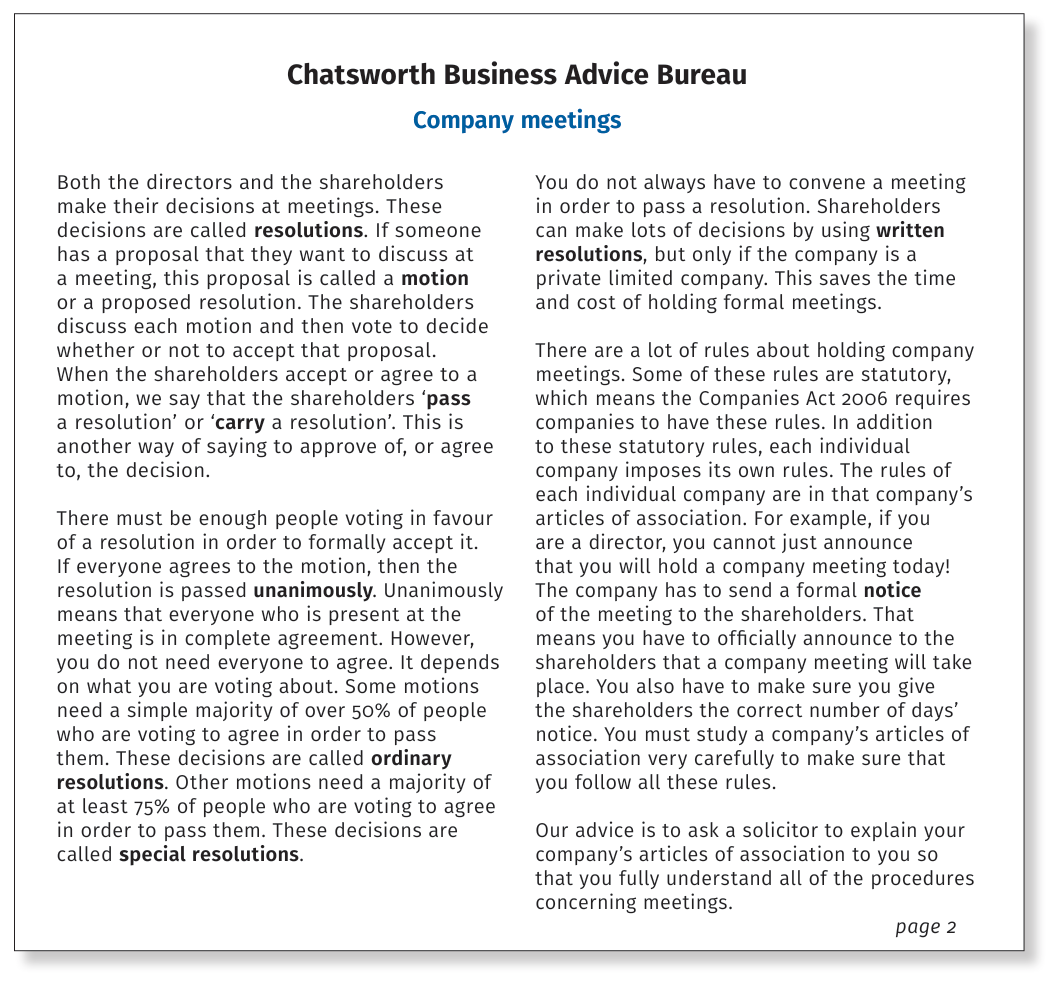
Both the directors and the shareholders make their decisions at meetings. These decisions are called resolutions. If someone has a proposal that they want to discuss at a meeting, this proposal is called a motion or a proposed resolution. The shareholders discuss each motion and then vote to decide whether or not to accept that proposal. When the shareholders accept or agree to a motion, we say that the shareholders ‘pass a resolution’ or ‘carry a resolution’. This is another way of saying to approve of, or agree to, the decision.
There must be enough people voting in favour of a resolution in order to formally accept it. If everyone agrees to the motion, then the resolution is passed unanimously. Unanimously means that everyone who is present at the meeting is in complete agreement. However, you do not need everyone to agree. It depends on what you are voting about. Some motions need a simple majority of over 50% of people who are voting to agree in order to pass them. These decisions are called ordinary resolutions. Other motions need a majority of at least 75% of people who are voting to agree in order to pass them. These decisions are called special resolutions.
You do not always have to convene a meeting in order to pass a resolution. Shareholders can make lots of decisions by using written resolutions, but only if the company is a private limited company. This saves the time and cost of holding formal meetings.
There are a lot of rules about holding company meetings. Some of these rules are statutory, which means the Companies Act 2006 requires companies to have these rules. In addition to these statutory rules, each individual company imposes its own rules. The rules of each individual company are in that company’s articles of association. For example, if you are a director, you cannot just announce that you will hold a company meeting today! The company has to send a formal notice of the meeting to the shareholders. That means you have to officially announce to the shareholders that a company meeting will take place. You also have to make sure you give the shareholders the correct number of days’ notice. You must study a company’s articles of association very carefully to make sure that you follow all these rules.
Our advice is to ask a solicitor to explain your company’s articles of association to you so that you fully understand all of the procedures concerning meetings. page 2
a A proposed resolution is called a motion.
b In order to pass a resolution, all the shareholders must always agree unanimously.
c Ordinary resolutions need over 50% of people voting in favour of them.
d Shareholders can only pass resolutions at a formal meeting.
e All of the rules about company meetings are in the Companies Act 2006.
Rewrite each of the sentences below, using the correct word or phrase from the key vocabulary in Exercise 3 to replace the underlined word or words.
Example: The shareholders passed a decision to issue 100 new shares. The shareholders passed a resolution to issue 100 new shares.
a We will now discuss the following proposed resolution, proposed by Jane Edwards.
We will now discuss the following , proposed by Jane Edwards.
b The shareholders accepted a resolution to change the name of the company.
The shareholders a resolution to change the name of the company.
c This resolution is a decision which requires over 50% of the votes to be in favour of it in order for it to succeed. This resolution is an .
d The company sent a formal announcement to all of its shareholders informing them that the company is convening an EGM, which will take place on 12 June.
The company sent a to all of its shareholders informing them that the company is convening an EGM, which will take place on 12 June.
e This resolution is a decision which requires at least 75% of the votes to be in favour of it in order for it to succeed.
This resolution is a .
f The shareholders passed the resolution with complete agreement.
The shareholders passed the resolution .
g For most matters, the shareholders of Restart Ltd do not need to meet, as they are happy to use decisions in writing.
For most matters, the shareholders of Restart Ltd do not need to meet, as they are happy to use .
Help desk
What do these words mean?
a voting form — a paper that sets out the possible choices. You decide which of these choices you want, then write a cross (X) next to your choice.
to raise your hand — to put one of your hands high into the air above your head.
Speaking & Writing for this topic
Two short tasks scored against TOEFL rubrics. The prompt is generated for this topic — use the vocabulary you have just studied.
Suggested structureclick to expand
- The last time I…
- I clearly remember when…
- A few weeks ago, I…
- The situation was…
- What was happening is that…
- It all began because…
- This is similar to what we just studied because…
- What we learned about chatsworth applies here, since…
- I noticed that business mattered a lot in that moment.
- Looking back, I think…
- What I learned is that…
- Next time, I would…
- Use at least 3 keywords from the prompt list.
- Keep sentences short and clear — don't try to be poetic.
- Pause briefly between the four sections so the listener can follow.
Suggested structureclick to expand
- The main idea here is …
- What stands out about this concept is …
- For example, chatsworth shows that …
- This works because business …
- As a result, …
- This is why …
- Use at least 3 keywords from the prompt list.
- End with a full stop. No bullet points.
COMPANY FINANCE — A CASE STUDY ~22 min
Look at this case study of a private limited company. Some of the words are highlighted. Without using a dictionary try to decide whether the highlighted words are verbs or nouns.
Farmfoods Ltd is a private limited company which supplies animal food to farms for sheep, cows and other animals. The company traded successfully for the past four years. The company’s most valuable asset is its factory where the company manufactures the animal food. The directors decided to expand the business. Farmfoods Ltd needed to borrow a lot of money to finance this expansion. The directors applied for a large loan from the Royal Chatsworth Bank. The bank considered the application and agreed to lend the company the money. However, the bank wanted a guarantee from Farmfoods Ltd that the company would repay the loan. The bank demanded a fixed charge over Farmfood Ltd’s assets. The directors agreed to grant a mortgage to the bank over Farmfoods Ltd’s factory. The bank now has security over the factory. If Farmfoods Ltd defaults on the loan repayments, the bank can take the factory from Farmfoods Ltd.
Here are the highlighted words again. Fill each gap in the following sentences with the correct word from the blue box below to complete the definitions that follow.
a Toborrowmoney means to take money from someone else for an agreed period of time and then pay it back.
b Tolendmoney means to give money to someone else for an agreed period of time. That person must then give the money back to you.
c Aloanis a sum of money that you borrow from another person. You must pay back that money, usually with interest.
d Torepaymoney is to pay back the money that you borrowed from someone.
e Anassetis something that you own which has a value. It can have a very low value, for example a CD, or a very high value, for example a house.
continued
f Tofinancea project means to obtain money in order to be able to pay for that project.
g Aguaranteeis a promise to do something.
hSecurityis a guarantee that you will pay back to someone the money that you owe to them. It is often ‘fixed’ to a particular asset, which means that if you don’t pay back the money, that person will take the asset that you used to guarantee payment.
i Amortgageis one example of security. It is a legal document which gives a house or a building as security for a loan. If the owner of the house does not pay the loan back, then the person who lent the money can take the house and sell it in order to get his or her money back.
j If someonedefaultson payment it means that he or she fails to make that payment.
k Achargeis a type of security. A fixed charge is attached to a particular asset and gives the charge holder the right to take that asset if the borrower does not pay the money that it owes. An example of a fixed charge is a mortgage. There are other types of charge, which are less important than fixed charges.
l Togranta mortgage over your property is to use that property as security for a loan.
Look at the second part of the case study. Decide in each case which is the correct preposition from the two possibilities.
Unfortunately, Farmfoods Ltd experienced a very bad year (*) of/in trading last year. (a) Until/After a period of terrible weather which ruined the crops, Farmfoods Ltd had to increase its prices (b) with/by 15% and its customers found other more competitive suppliers. The company’s plans (c) for/to expansion did not receive approval (d) from/to the planning authorities. The company cannot pay the instalments (e) for/on the loan from the Royal Chatsworth Bank and last month the bank demanded full repayment (f) of/to the loan. Farmfoods Ltd is insolvent. The company is unable to pay its debts.
Answers Example (*) of aAfterbbycfordfromeonf
The directors of Farmfoods Ltd are looking at the list of its creditors. Creditors are either secured creditors or unsecured creditors. Secured creditors have some sort of security or guarantee of repayment, while unsecured creditors have no guarantee of payment. Read the information about Farmfoods Ltd’s creditors and decide if each creditor is a secured creditor or an unsecured creditor.
a Print It Ltd. This is a company that supplies printing services to Farmfoods Ltd. Farmfoods Ltd did not give any guarantee for payment of any amount.
Answer:
b Chatsworth Royal Bank. The bank has a mortgage over Farmfoods Ltd’s factory to guarantee repayment of this loan.
Answer:This is a secured creditor.continued
c HGFT Bank. Farmfoods Ltd also took out a loan from this bank. HGFT Bank holds a charge over some of Farmfoods Ltd’s assets.
Answer:
d Spin Electric plc. This company provides Farmfoods Ltd with electricity. Farmfoods Ltd has not paid any of its electricity bills for five months. Farmfoods Ltd did not give any guarantee for payment of any amount.
Answer:
e Grotell & Co. This is a partnership that supplies packaging to Farmfoods Ltd. There are two invoices from Grotell & Co that are waiting to be paid. There is no guarantee for payment of any amount.
Answer:
Speaking & Writing for this topic
Two short tasks scored against TOEFL rubrics. The prompt is generated for this topic — use the vocabulary you have just studied.
Suggested structureclick to expand
- The last time I…
- I clearly remember when…
- A few weeks ago, I…
- The situation was…
- What was happening is that…
- It all began because…
- This is similar to what we just studied because…
- What we learned about asset applies here, since…
- I noticed that loan mattered a lot in that moment.
- Looking back, I think…
- What I learned is that…
- Next time, I would…
- Use at least 3 keywords from the prompt list.
- Keep sentences short and clear — don't try to be poetic.
- Pause briefly between the four sections so the listener can follow.
Suggested structureclick to expand
- The main idea here is …
- What stands out about lend is …
- For example, asset shows that …
- This works because loan …
- As a result, …
- This is why …
- Use at least 3 keywords from the prompt list.
- End with a full stop. No bullet points.
CLOSING A COMPANY ~21 min
Sam Clark is a law student at the University of Chatsworth. He must write a short summary about closing a company. Here is Sam’s summary. The most important words or phrases are in the key vocabulary below. Read the information and answer the questions that follow using a full sentence.
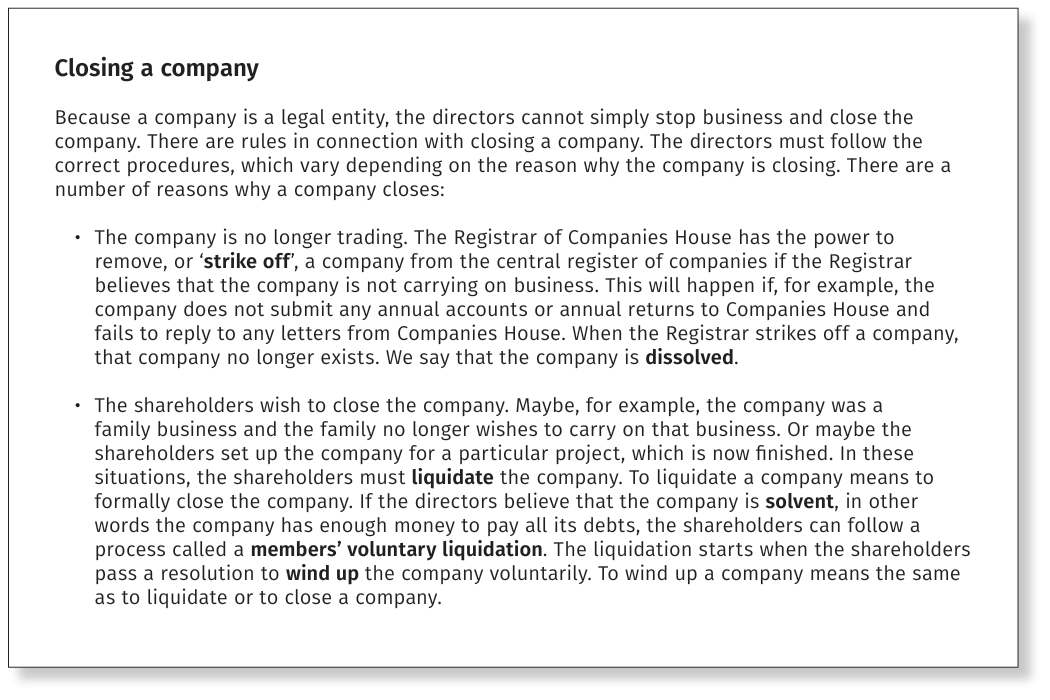
Closing a company
Because a company is a legal entity, the directors cannot simply stop business and close the company. There are rules in connection with closing a company. The directors must follow the correct procedures, which vary depending on the reason why the company is closing. There are a number of reasons why a company closes:
• The company is no longer trading. The Registrar of Companies House has the power to remove, or ‘strike off’, a company from the central register of companies if the Registrar believes that the company is not carrying on business. This will happen if, for example, the company does not submit any annual accounts or annual returns to Companies House and fails to reply to any letters from Companies House. When the Registrar strikes off a company, that company no longer exists. We say that the company is dissolved.
• The shareholders wish to close the company. Maybe, for example, the company was a family business and the family no longer wishes to carry on that business. Or maybe the shareholders set up the company for a particular project, which is now finished. In these situations, the shareholders must liquidate the company. To liquidate a company means to formally close the company. If the directors believe that the company is solvent, in other words the company has enough money to pay all its debts, the shareholders can follow a process called a members’ voluntary liquidation. The liquidation starts when the shareholders pass a resolution to wind up the company voluntarily. To wind up a company means the same as to liquidate or to close a company.
continued
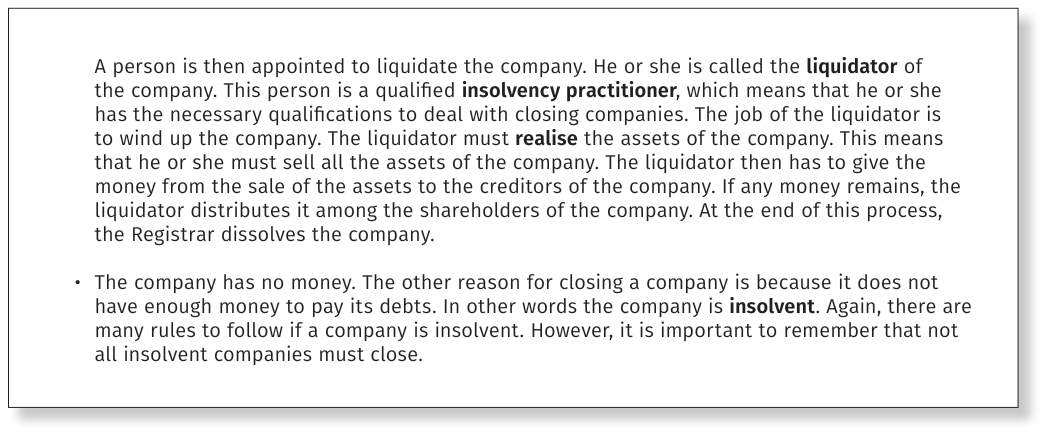
A person is then appointed to liquidate the company. He or she is called the liquidator of the company. This person is a qualified insolvency practitioner, which means that he or she has the necessary qualifications to deal with closing companies. The job of the liquidator is to wind up the company. The liquidator must realise the assets of the company. This means that he or she must sell all the assets of the company. The liquidator then has to give the money from the sale of the assets to the creditors of the company. If any money remains, the liquidator distributes it among the shareholders of the company. At the end of this process, the Registrar dissolves the company.
• The company has no money. The other reason for closing a company is because it does not have enough money to pay its debts. In other words the company is insolvent. Again, there are many rules to follow if a company is insolvent. However, it is important to remember that not all insolvent companies must close.
a What does to strike off a company mean?
Answer:
b What does to liquidate a company mean?
Answer:
c What adjective describes a company which is able to pay all of its debts?
Answer:
d Which phrasal verb has the same meaning as to liquidate?
Answer:
e Who has the task of winding up a company?
Answer:
f What does to realise assets mean?
Answer:
g What is an insolvent company?
Answer:
Use the correct words or phrases from the key vocabulary in Exercise 1 to complete the following sentences.
a If you want to be aninsolvency practitioneryou must have special qualifications which allow you to deal with the process of closing companies.
b I am pleased to report that after a very difficult year of trading, this company is nowsolventand we are in a position where we are able to pay all of our debts.
c Amembers’ voluntary liquidationis a procedure where the shareholders of a solvent company decide to close the company.
d When lawyers talk about closing a company they either use the verb ‘toliquidate, wind up’ a company or the phrasal verb ‘toinsolvency practitioner’ a company. These verbs have the same meaning.
e As Hawksend Ltd failed to respond to any letters or demands from Companies House, the Registrar is going tostrike offHawksend Ltd from the register of companies.
f Following a terrible year of trading during which Klarx Ltd made massive losses, Klarx Ltd announced that the company isinsolventand does not have the money to pay all of its creditors.
g When a company is in liquidation, theliquidatoris the person who has to wind up the company.
h Torealisean asset means to sell that asset in order to raise some money.
i At the end of the process of liquidating a company, the company isdissolvedand does not exist any more.
Help desk
What do these words mean?
to vary — to change, to alter.
massive — extremely big.
to carry on business — to trade.
Speaking & Writing for this topic
Two short tasks scored against TOEFL rubrics. The prompt is generated for this topic — use the vocabulary you have just studied.
Suggested structureclick to expand
- The last time I…
- I clearly remember when…
- A few weeks ago, I…
- The situation was…
- What was happening is that…
- It all began because…
- This is similar to what we just studied because…
- What we learned about strike off applies here, since…
- I noticed that solvent mattered a lot in that moment.
- Looking back, I think…
- What I learned is that…
- Next time, I would…
- Use at least 3 keywords from the prompt list.
- Keep sentences short and clear — don't try to be poetic.
- Pause briefly between the four sections so the listener can follow.
Suggested structureclick to expand
- The main idea here is …
- What stands out about wind up is …
- For example, strike off shows that …
- This works because solvent …
- As a result, …
- This is why …
- Use at least 3 keywords from the prompt list.
- End with a full stop. No bullet points.
INSOLVENT COMPANIES ~17 min
Read this information about what happens to a company when it is insolvent and then do the exercises that follow.
Introduction If a company cannot pay its debts when they are due, the company is insolvent. Directors have a duty not to allow a company to continue to trade when they know that the company is insolvent. The directors must decide what to do. They must consider which of the available insolvency proceedings will benefit the company. Insolvency proceedings are formal ways of dealing with the debts of the company. There are different types of company insolvency proceedings. The most common insolvency proceedings are:
Administration A company is in administration when either the directors, a secured creditor, or a court appoints an insolvency practitioner to be the administrator of the company. The administrator takes control of the company and has to manage the company for the benefit of the creditors of the company. The aim of administration is to try to ‘rescue’ the company so that it can continue to trade as a going concern, or, if that is not possible, to sell the company’s assets for the best possible price.
Receivership A company is in receivership when a creditor, whose debt is secured by a charge over the company’s assets, appoints a receiver. The receiver can sell the assets subject to the charge and use the money he or she receives to repay the creditor.
Creditors’ voluntary liquidation This can take place when the company cannot pay its debts. The company has to pass a resolution stating that the company cannot continue in business due to its debts. A liquidator is appointed to wind up the company. The liquidator has to realise the assets of the company and give the proceeds to the creditors. The proceeds are the money that you receive from selling something. If any money is left after payment of the creditors, the liquidator will give that money to the shareholders. At the end of the liquidation process, the Registrar at Companies House dissolves the company.
Compulsory liquidation This takes place when a creditor presents a winding-up petition to the court, on the grounds that the company cannot pay its debts, and the court makes an order for the company to be wound up. Following the order, the Official Receiver becomes the liquidator of the company. At the end of the liquidation, the company is dissolved.
Choose the correct word from the introduction section above to complete the following sentences.
a If a debt isdue, it means that it is time for you to pay that debt now.
b If a company is unable to pay its debts, in the UK we say the company isinsolvent. In the USA they say that the company is bankrupt.
cInsolvencyis the state of not being able to pay your debts.
d A lawyer who specialises in insolvency can advise which of the available insolvencyproceedingswould be the best to use in a particular situation.
Choose a word or phrase from the administration section on the previous page to complete the following sentences.
a The person who has the power to run a company which is in administration is called theadministrator. This person must be a qualified insolvency practitioner.
b Tomanagea company means to run a company.
c If you do something for thebenefitof someone, this means that you act in that person’s best interests to get the best result for him or her.
d Agoing concernis a business that is actively trading.
Choose a word or phrase from the receivership section on the previous page to complete the following sentences.
a Adebtis an amount of money that you owe to someone.
b Achargeis a form of security to ensure that a company or person repays money which it owes to someone.
c Areceiveris the person who must take control of a company’s assets and try to recover enough money to pay back a particular secured creditor.
d In this context, the expression ‘ ’ means ‘covered by’.
Choose a word or phrase from the creditors’ voluntary liquidation section on the previous page to complete the following sentences.
a If a company makes a formal decision at a company meeting, it passes aresolution.
b The phrasal verb ‘ ’ a company means to formally close the company.
c Torealiseassets means to sell assets in order to obtain money.
d A formal way of referring to the money that you get from selling something is to say the ‘
of sale’.
Choose a word or phrase from the compulsory liquidation section on the previous page to complete the following sentences.
a When a personpresentsa document he or she officially gives that document to someone or files the document in a particular place.
b Awinding-up petitionis a document that starts the process of liquidation. It is a request made to the court to liquidate a company.
c A formal way of saying ‘for the reason that’ is to say ‘on thegroundsthat’.
d If a company is in compulsory liquidation, theOfficial Receiverbecomes the liquidator of the company.
Speaking & Writing for this topic
Two short tasks scored against TOEFL rubrics. The prompt is generated for this topic — use the vocabulary you have just studied.
Suggested structureclick to expand
- The last time I…
- I clearly remember when…
- A few weeks ago, I…
- The situation was…
- What was happening is that…
- It all began because…
- This is similar to what we just studied because…
- What we learned about insolvent applies here, since…
- I noticed that companies mattered a lot in that moment.
- Looking back, I think…
- What I learned is that…
- Next time, I would…
- Use at least 3 keywords from the prompt list.
- Keep sentences short and clear — don't try to be poetic.
- Pause briefly between the four sections so the listener can follow.
Suggested structureclick to expand
- The main idea here is …
- What stands out about this concept is …
- For example, insolvent shows that …
- This works because companies …
- As a result, …
- This is why …
- Use at least 3 keywords from the prompt list.
- End with a full stop. No bullet points.
UNIT 9 VOCABULARY CHECK ~2 min
- accountant
- acquisition
- adjourn
- administration
- administrator
- annual general meeting
- appoint
- auditor
- bankrupt
- board
- call
- carry
- chairperson
- charge
- client base
- company secretary
- compulsory liquidation
- conflict
- convene
- creditor
- debtor
- declare
- director
- dissolve
- elect
- employee
- executive director
- exercise
- extraordinary general meeting
- fiduciary duty
- finance
- fixed charge
- good faith
- grant
- insolvency
- insolvency practitioner
- insolvency proceedings
- insolvent
- joint venture
- liquidation
- liquidator
- majority
- manage
- material
- meeting
- members’ voluntary liquidation
- merger
- minutes
- mortgage
- motion
- non-executive director
- notice
- official receiver
- ordinary resolution
- pass
- petition
- poll
- present
- proceeds
- propose
- proxy
- quorum
- raise
- realise
- receiver
- receivership
- remove
- resolution
- restructure
- secured creditor
- serve
- service agreement
- shadow director
- shareholders
- shareholders’ agreements
- show of hands
- solvent
- special resolution
- strike off
- suppliers
- takeover
- unanimously
- undertake
- unsecured creditor
- wind up
- written resolution
FOUNDATION LEVEL PRACTICE ~14 min
Look at the groups of words below. In each group, three of the words belong to the same subject area, but there is one word that does not belong. Put a circle around the word that is the odd one out. Do not circle more than one answer for each sentence. There is an example at the beginning (*).
| # | Phrase | Definition |
|---|---|---|
| (*) | A wind up B liquidate | C quorum D strike off |
| (1) | A convene B hold | C call D debt |
| (2) | A shadow B executive | C creditor D non-executive |
| (3) | A liquidation B profit | C administration D receivership |
| (4) | A director B mortgage | C security D charge |
| (5) | A vote B merger | C poll D show of hands |
Here is a conversation between two lawyers. The conversation is mixed up. Put the conversation in the correct order. Write your answers in the boxes numbered 2—9 below. There is an example at the beginning (*), which is the start of the conversation.
(*) Good morning Sarah. How are you?
a Another one? There seem to be so many businesses in financial trouble at the moment. Is this one a large company?
b I’m OK thanks. How’s life in the insolvency department? Are you busy?
c A familiar story, I’m afraid. The company did really well at first and made a profit. Then the directors made some decisions about expanding the company, which didn’t produce the results they wanted. They borrowed a lot of money from the bank and now they can’t make the loan repayments.
d No. Last week, the bank demanded full payment of the loan, which the company can’t pay. There are a lot of other creditors, too. But after the bank gets its money back, I don’t think there will be any money left for them. And certainly none for the shareholders. The company will be wound up.
e No, it’s small. 15 employees I think.
f So what will happen? Isn’t there any chance of saving the company?
g Very busy. I’m just going to start work on a new matter. Another liquidation.
h 15 more people out of a job, then. What happened?
(1) (*) (2) (3) (4) (5) (6) (7) (8) (9)
Look at the sentences below. Each sentence contains a mistake. The mistake is either an incorrect word or a word that should not be there. Put a circle around the word. Do not circle more than one answer for each sentence. There is an example at the beginning (*).
Example (*) We need to borrow some money to the bank.
1 As a director I must to exercise the duty of care and skill.
2 In my opinion, this motion is not for the best interests of the company.
3 At the meeting the shareholders passed the resolution unanimous.
4 The bank will lend us the money but it wants security of the loan.
5 Our non-executive director knows about this and she will give us an advice.
Speaking & Writing for this topic
Two short tasks scored against TOEFL rubrics. The prompt is generated for this topic — use the vocabulary you have just studied.
Suggested structureclick to expand
- The last time I…
- I clearly remember when…
- A few weeks ago, I…
- The situation was…
- What was happening is that…
- It all began because…
- This is similar to what we just studied because…
- What we learned about foundation applies here, since…
- I noticed that level mattered a lot in that moment.
- Looking back, I think…
- What I learned is that…
- Next time, I would…
- Use at least 3 keywords from the prompt list.
- Keep sentences short and clear — don't try to be poetic.
- Pause briefly between the four sections so the listener can follow.
Suggested structureclick to expand
- The main idea here is …
- What stands out about this concept is …
- For example, foundation shows that …
- This works because level …
- As a result, …
- This is why …
- Use at least 3 keywords from the prompt list.
- End with a full stop. No bullet points.