
The Legal Profession
THE IMPORTANCE OF COLLOCATIONS ~8 min
Collocations are words that form natural partnerships in English. For example, we say, ‘Merry Christmas!’ but ‘Happy New Year!’
Why can’t we say ‘Merry New Year’? It’s because a native English speaker wouldn’t expect these words to go together. They do not form a good collocation. Legal English is full of collocations. They might be:
verb+noun Do you accept liability?
noun+verb The gap has widened between them.
verb+adverb Could we please discuss this matter rationally?
adjective+noun She made a fatal error.
adverb+adjective This is a highly contentious dispute.
The key to learning accurate legal English is to have a good familiarity with collocation. Some nouns form good collocations with more than one verb. Some nouns form a good collocation with just one verb. The important thing is to start to notice accurate collocations and memorise them. For example:
to draft a contract to honour a contract to breach a contract Good collocation:
to write a contract to respect a contract to infringe a contract Bad collocation:
As you work through this book you will see many collocations. To help you notice and remember accurate collocations they have been put into a collocation bank for you. The symbol means ‘memorise’.
Collocation bank
Look at these sentences. They contain some important legal collocations. Complete the sentences with the correct collocation from the four choices on the next page.
a Solicitors are allowed to clients in court.
b I am afraid I can’t help you. I am a commercial lawyer and this is a criminal .
c What are the for your case?
d I will my final law exams in June of next year.
e My client is a new factory and he needs advice about the relevant health and safety regulations.
| # | Phrase | Definition |
|---|---|---|
| a | A represent B work for | C stand for D advocate |
| b | A issue B matter | C subject D point |
| c | A grounds B reasons | C motives D basis |
| d | A pass B make | C prepare D take |
| e | A starting B launching | C opening D initiating |
Speaking & Writing for this topic
Two short tasks scored against TOEFL rubrics. The prompt is generated for this topic — use the vocabulary you have just studied.
Suggested structureclick to expand
- In my experience…
- From what I have seen…
- My honest view is that…
- The principal reason is that…
- This matters because…
- What makes to draft a contract decisive here is…
- For instance, when I…
- A clear example is…
- Consider the case where to honour a contract was involved…
- On the other hand,…
- Furthermore,…
- That said, one should not forget that…
- Overall, this shows that…
- The lesson, then, is…
- For these reasons, I believe…
- Aim for 4–5 keywords woven naturally into your answer.
- Use at least two linking phrases (Furthermore, On the other hand, As a result…).
- Avoid filler words like "basically" or "like".
Suggested structureclick to expand
- The most important point in this concept is …
- My position is that …
- The principal reason is that to draft a contract …
- This is supported by …
- A concrete illustration is …
- For instance, …
- However, some argue that …
- On the other hand, …
- In conclusion, …
- Taken together, …
- Aim for 4–5 keywords used in natural context.
- Use 3+ linking words across the answer.
- Vary sentence length to avoid monotony.
THE IMPORTANCE OF PREPOSITIONS ~8 min
As you work through this book you will see many prepositions. To help you notice and remember accurate prepositions in a legal context they have been put into a preposition bank for you. The symbol means ‘memorise’.
Preposition bank an attorney at law ‘My daughter is an attorney at law in Atlanta.’
to work on something ‘I’m currently working on a merger agreement.’
• to send a cheque for an amount of money ‘Please send a cheque for £2000.’
subject to something ‘The goods are for sale at this price subject to availability.’
Complete these sentences with the correct preposition.
a The judge awarded my client £20,000indamages.
b Suing someone is a more informal way of saying starting proceedingsagainstsomeone.
c A small claim is a claimfor/toa maximum of £10,000.
d Stephen works for a law firminManhattan.
e When you areindispute with someone you can start a claim in the civil court.
f Could I take a lookatyour employment contract?
Using the knowledge that you have about collocations and prepositions correct the language below.
‘My name is Luigi and I am a lawyer (a) at Milan. I work (b) into a big law firm. Today I am very busy. I am (c) writing a contract (d) to a new client. This afternoon I am (e) speaking for a different client in court. It is a (f) disrespect of contract case. I think we will win the case because our (g) reasons are very strong.’
‘My name is Luigi and I am a lawyer (a) inMilan. I work (b) fora big law firm. Today I am very busy. I am (c) draftinga contract (d) fora new client. This afternoon I am (e) acting for/representinga different client in court. It is a (f) breachof contract case. I think we will win the case because our (g) groundsare very strong.’
Speaking & Writing for this topic
Two short tasks scored against TOEFL rubrics. The prompt is generated for this topic — use the vocabulary you have just studied.
Suggested structureclick to expand
- In my experience…
- From what I have seen…
- My honest view is that…
- The principal reason is that…
- This matters because…
- What makes importance decisive here is…
- For instance, when I…
- A clear example is…
- Consider the case where prepositions was involved…
- On the other hand,…
- Furthermore,…
- That said, one should not forget that…
- Overall, this shows that…
- The lesson, then, is…
- For these reasons, I believe…
- Aim for 4–5 keywords woven naturally into your answer.
- Use at least two linking phrases (Furthermore, On the other hand, As a result…).
- Avoid filler words like "basically" or "like".
Suggested structureclick to expand
- The most important point in this concept is …
- My position is that …
- The principal reason is that importance …
- This is supported by …
- A concrete illustration is …
- For instance, …
- However, some argue that …
- On the other hand, …
- In conclusion, …
- Taken together, …
- Aim for 4–5 keywords used in natural context.
- Use 3+ linking words across the answer.
- Vary sentence length to avoid monotony.
SOLICITORS AND BARRISTERS ~19 min
Diana Williams is a lawyer. Today she is going to visit a school in her town to talk to the students about a career in law. Here are some of Diana’s notes for her talk. In this section she is talking about the two separate professions that exist in England, solicitors and barristers. Fill in the gaps in the text with the correct word from the box below.
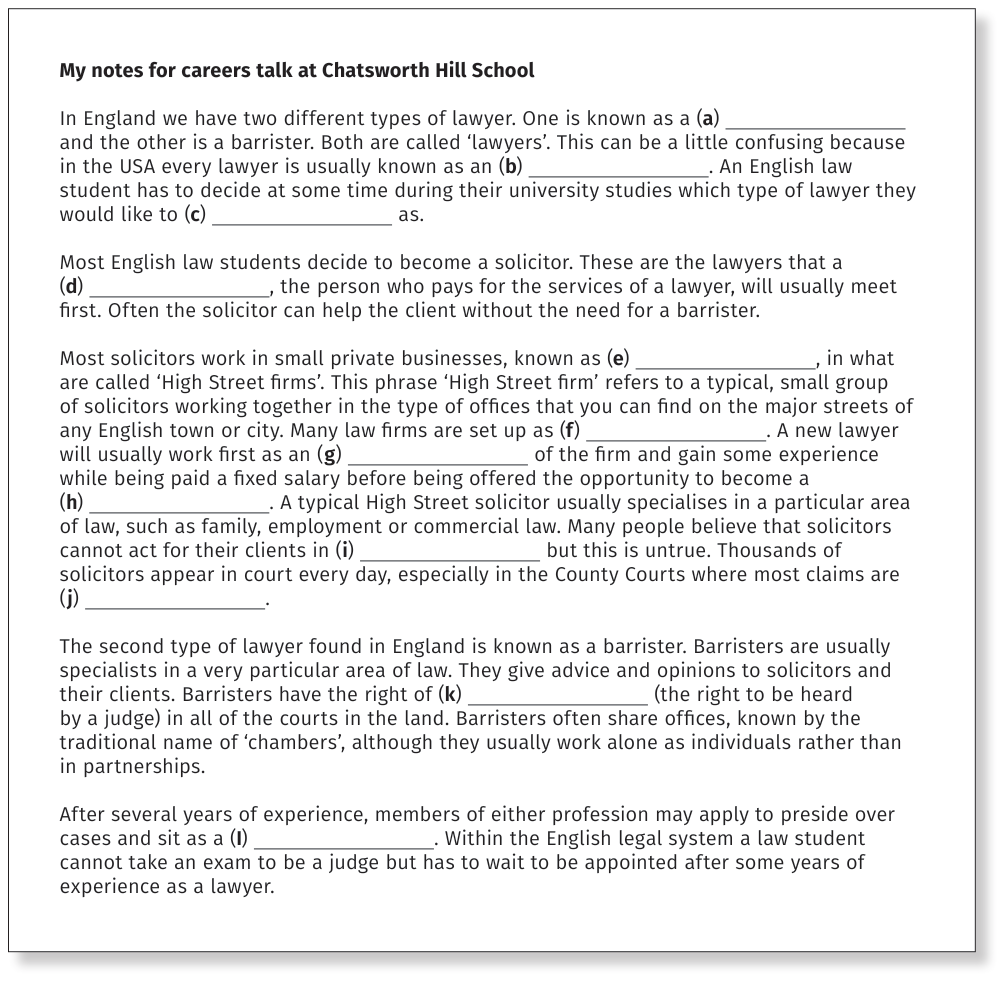
My notes for careers talk at Chatsworth Hill School In England we have two different types of lawyer. One is known as a (a) solicitorand the other is a barrister. Both are called ‘lawyers’. This can be a little confusing because in the USA every lawyer is usually known as an (b) attorney. An English law student has to decide at some time during their university studies which type of lawyer they would like to (c) qualifyas.
Most English law students decide to become a solicitor. These are the lawyers that a (d) client, the person who pays for the services of a lawyer, will usually meet first. Often the solicitor can help the client without the need for a barrister.
Most solicitors work in small private businesses, known as (e) practices, in what are called ‘High Street firms’. This phrase ‘High Street firm’ refers to a typical, small group of solicitors working together in the type of offices that you can find on the major streets of any English town or city. Many law firms are set up as (f) partnerships. A new lawyer will usually work first as an (g) associateof the firm and gain some experience while being paid a fixed salary before being offered the opportunity to become a (h) partner. A typical High Street solicitor usually specialises in a particular area of law, such as family, employment or commercial law. Many people believe that solicitors cannot act for their clients in (i) courtbut this is untrue. Thousands of solicitors appear in court every day, especially in the County Courts where most claims are (j) issued.
The second type of lawyer found in England is known as a barrister. Barristers are usually specialists in a very particular area of law. They give advice and opinions to solicitors and their clients. Barristers have the right of (k) audience(the right to be heard by a judge) in all of the courts in the land. Barristers often share offices, known by the traditional name of ‘chambers’, although they usually work alone as individuals rather than in partnerships.
After several years of experience, members of either profession may apply to preside over cases and sit as a (i) court. Within the English legal system a law student cannot take an exam to be a judge but has to wait to be appointed after some years of experience as a lawyer.
Collocation bank
to be known as something ‘They are known as barristers.’
to qualify as something ‘She qualified as a lawyer two years ago.’
to go into partnership with someone ‘He is going to go into partnership with his brother.’
‘Tom specialises in commercial litigation.’
to work in/for a business ‘He works in a law firm but she works for a bank.’
to preside over a case ‘The insurance case has started and Judge Mortimer is presiding over it.’
Look at the solicitor’s advertisements on the next page. Give the name and the telephone number of the firm of solicitors that I should call if I have the following legal problems.
a I have reached the age of 50 and I am thinking about what I want to happen to my property after my death.
b I want to begin a business importing electrical goods from one European Union country into another and I want to know what the rules are.
c I am a woman who is angry that a man doing the same job in the factory where I work is paid more than I am.
d I am a visitor to England from the USA. I came to work in London 18 months ago, with the permission of the British authorities. However, I only had permission to be here for a year and now I am afraid because I have broken the law.
Firm of solicitors Telephone number
- a
- b
- c
- d
Speaking & Writing for this topic
Two short tasks scored against TOEFL rubrics. The prompt is generated for this topic — use the vocabulary you have just studied.
Suggested structureclick to expand
- In my experience…
- From what I have seen…
- My honest view is that…
- The principal reason is that…
- This matters because…
- What makes partner decisive here is…
- For instance, when I…
- A clear example is…
- Consider the case where judge was involved…
- On the other hand,…
- Furthermore,…
- That said, one should not forget that…
- Overall, this shows that…
- The lesson, then, is…
- For these reasons, I believe…
- Aim for 4–5 keywords woven naturally into your answer.
- Use at least two linking phrases (Furthermore, On the other hand, As a result…).
- Avoid filler words like "basically" or "like".
Suggested structureclick to expand
- The most important point in practices is …
- My position is that …
- The principal reason is that partner …
- This is supported by …
- A concrete illustration is …
- For instance, …
- However, some argue that …
- On the other hand, …
- In conclusion, …
- Taken together, …
- Aim for 4–5 keywords used in natural context.
- Use 3+ linking words across the answer.
- Vary sentence length to avoid monotony.
1st CALL ACCIDENT CENTRE ACCIDENT? ~3 min
Someone been careless?
NO WIN NO FEE (Home and hospital visits)
FREEPHONE 0500 652 1112 Swanhouse Place, Chatsworth Professional, friendly, effective.
Speaking & Writing for this topic
Two short tasks scored against TOEFL rubrics. The prompt is generated for this topic — use the vocabulary you have just studied.
Suggested structureclick to expand
- In my experience…
- From what I have seen…
- My honest view is that…
- The principal reason is that…
- This matters because…
- What makes Business Law decisive here is…
- For instance, when I…
- A clear example is…
- Consider the case where Commercial Property was involved…
- On the other hand,…
- Furthermore,…
- That said, one should not forget that…
- Overall, this shows that…
- The lesson, then, is…
- For these reasons, I believe…
- Aim for 4–5 keywords woven naturally into your answer.
- Use at least two linking phrases (Furthermore, On the other hand, As a result…).
- Avoid filler words like "basically" or "like".
Suggested structureclick to expand
- The most important point in Intellectual Property is …
- My position is that …
- The principal reason is that Business Law …
- This is supported by …
- A concrete illustration is …
- For instance, …
- However, some argue that …
- On the other hand, …
- In conclusion, …
- Taken together, …
- Aim for 4–5 keywords used in natural context.
- Use 3+ linking words across the answer.
- Vary sentence length to avoid monotony.
Telephone: 0771 777 5454 ~2 min
Offices in London, Oxford and Chatsworth
Solicitor
NUMBER ONE FOR EMPLOYMENT LAW
If you have a problem in any of the following areas call today for first class advice
Speaking & Writing for this topic
Two short tasks scored against TOEFL rubrics. The prompt is generated for this topic — use the vocabulary you have just studied.
Suggested structureclick to expand
- In my experience…
- From what I have seen…
- My honest view is that…
- The principal reason is that…
- This matters because…
- What makes telephone decisive here is…
- For instance, when I…
- A clear example is…
- Consider the case where this concept was involved…
- On the other hand,…
- Furthermore,…
- That said, one should not forget that…
- Overall, this shows that…
- The lesson, then, is…
- For these reasons, I believe…
- Aim for 4–5 keywords woven naturally into your answer.
- Use at least two linking phrases (Furthermore, On the other hand, As a result…).
- Avoid filler words like "basically" or "like".
Suggested structureclick to expand
- The most important point in this concept is …
- My position is that …
- The principal reason is that telephone …
- This is supported by …
- A concrete illustration is …
- For instance, …
- However, some argue that …
- On the other hand, …
- In conclusion, …
- Taken together, …
- Aim for 4–5 keywords used in natural context.
- Use 3+ linking words across the answer.
- Vary sentence length to avoid monotony.
UNFAIR DISMISSAL / REDUNDANCY ~2 min
Speaking & Writing for this topic
Two short tasks scored against TOEFL rubrics. The prompt is generated for this topic — use the vocabulary you have just studied.
Suggested structureclick to expand
- In my experience…
- From what I have seen…
- My honest view is that…
- The principal reason is that…
- This matters because…
- What makes unfair decisive here is…
- For instance, when I…
- A clear example is…
- Consider the case where dismissal was involved…
- On the other hand,…
- Furthermore,…
- That said, one should not forget that…
- Overall, this shows that…
- The lesson, then, is…
- For these reasons, I believe…
- Aim for 4–5 keywords woven naturally into your answer.
- Use at least two linking phrases (Furthermore, On the other hand, As a result…).
- Avoid filler words like "basically" or "like".
Suggested structureclick to expand
- The most important point in this concept is …
- My position is that …
- The principal reason is that unfair …
- This is supported by …
- A concrete illustration is …
- For instance, …
- However, some argue that …
- On the other hand, …
- In conclusion, …
- Taken together, …
- Aim for 4–5 keywords used in natural context.
- Use 3+ linking words across the answer.
- Vary sentence length to avoid monotony.
BULLYING / DISABILITY RIGHTS ~2 min
Speaking & Writing for this topic
Two short tasks scored against TOEFL rubrics. The prompt is generated for this topic — use the vocabulary you have just studied.
Suggested structureclick to expand
- In my experience…
- From what I have seen…
- My honest view is that…
- The principal reason is that…
- This matters because…
- What makes bullying decisive here is…
- For instance, when I…
- A clear example is…
- Consider the case where disability was involved…
- On the other hand,…
- Furthermore,…
- That said, one should not forget that…
- Overall, this shows that…
- The lesson, then, is…
- For these reasons, I believe…
- Aim for 4–5 keywords woven naturally into your answer.
- Use at least two linking phrases (Furthermore, On the other hand, As a result…).
- Avoid filler words like "basically" or "like".
Suggested structureclick to expand
- The most important point in this concept is …
- My position is that …
- The principal reason is that bullying …
- This is supported by …
- A concrete illustration is …
- For instance, …
- However, some argue that …
- On the other hand, …
- In conclusion, …
- Taken together, …
- Aim for 4–5 keywords used in natural context.
- Use 3+ linking words across the answer.
- Vary sentence length to avoid monotony.
EQUAL PAY / DISCRIMINATION ~2 min
Speaking & Writing for this topic
Two short tasks scored against TOEFL rubrics. The prompt is generated for this topic — use the vocabulary you have just studied.
Suggested structureclick to expand
- In my experience…
- From what I have seen…
- My honest view is that…
- The principal reason is that…
- This matters because…
- What makes equal decisive here is…
- For instance, when I…
- A clear example is…
- Consider the case where discrimination was involved…
- On the other hand,…
- Furthermore,…
- That said, one should not forget that…
- Overall, this shows that…
- The lesson, then, is…
- For these reasons, I believe…
- Aim for 4–5 keywords woven naturally into your answer.
- Use at least two linking phrases (Furthermore, On the other hand, As a result…).
- Avoid filler words like "basically" or "like".
Suggested structureclick to expand
- The most important point in this concept is …
- My position is that …
- The principal reason is that equal …
- This is supported by …
- A concrete illustration is …
- For instance, …
- However, some argue that …
- On the other hand, …
- In conclusion, …
- Taken together, …
- Aim for 4–5 keywords used in natural context.
- Use 3+ linking words across the answer.
- Vary sentence length to avoid monotony.
BREACH OF CONTRACT ~3 min
www.judybarclay.co.uk 0771 3339989 25 Haymarket Lane, Chatsworth.
Patel & Co, Solicitors SPECIALISTS IN IMMIGRATION LAW Email: PaulinePatel@law.com Tel: 0771 333 2323 40 Royal Crescent, Chatsworth.
Call today!
Specialists in all areas of Education Law including: SPECIAL EDUCATION NEEDS / DYSLEXIA / ADMISSIONS 0771 411 8888 33 Belvedere Gardens, Chatsworth DAVID ROSS & CO
Charity law / Conveyancing Litigation / Wills and Probate
Accident and Injury
Divorce and Family
info@rossforjustice.com 0771 222 0046 14 Havery Road, Chatsworth
AND EXCLUSIONS and NEGLIGENCE CLAIMS
Speaking & Writing for this topic
Two short tasks scored against TOEFL rubrics. The prompt is generated for this topic — use the vocabulary you have just studied.
Suggested structureclick to expand
- In my experience…
- From what I have seen…
- My honest view is that…
- The principal reason is that…
- This matters because…
- What makes breach decisive here is…
- For instance, when I…
- A clear example is…
- Consider the case where contract was involved…
- On the other hand,…
- Furthermore,…
- That said, one should not forget that…
- Overall, this shows that…
- The lesson, then, is…
- For these reasons, I believe…
- Aim for 4–5 keywords woven naturally into your answer.
- Use at least two linking phrases (Furthermore, On the other hand, As a result…).
- Avoid filler words like "basically" or "like".
Suggested structureclick to expand
- The most important point in this concept is …
- My position is that …
- The principal reason is that breach …
- This is supported by …
- A concrete illustration is …
- For instance, …
- However, some argue that …
- On the other hand, …
- In conclusion, …
- Taken together, …
- Aim for 4–5 keywords used in natural context.
- Use 3+ linking words across the answer.
- Vary sentence length to avoid monotony.
Suffered from SOLICITORS’ NEGLIGENCE? ~2 min
Contact us now FREE initial consultation *N0 WIN NO FEE
Speaking & Writing for this topic
Two short tasks scored against TOEFL rubrics. The prompt is generated for this topic — use the vocabulary you have just studied.
Suggested structureclick to expand
- In my experience…
- From what I have seen…
- My honest view is that…
- The principal reason is that…
- This matters because…
- What makes suffered decisive here is…
- For instance, when I…
- A clear example is…
- Consider the case where from was involved…
- On the other hand,…
- Furthermore,…
- That said, one should not forget that…
- Overall, this shows that…
- The lesson, then, is…
- For these reasons, I believe…
- Aim for 4–5 keywords woven naturally into your answer.
- Use at least two linking phrases (Furthermore, On the other hand, As a result…).
- Avoid filler words like "basically" or "like".
Suggested structureclick to expand
- The most important point in this concept is …
- My position is that …
- The principal reason is that suffered …
- This is supported by …
- A concrete illustration is …
- For instance, …
- However, some argue that …
- On the other hand, …
- In conclusion, …
- Taken together, …
- Aim for 4–5 keywords used in natural context.
- Use 3+ linking words across the answer.
- Vary sentence length to avoid monotony.
FREEPHONE 0500 542 542 ~16 min
1st call for action Matthew Morrison Solicitors 51 Queen Anne Square, Chatsworth
Find a word in the advertisements that matches the following definitions.
a Not taking enough care over something that you
d An organisation that exists in order to collect are responsible for with the result that mistakes are made or someone is hurt.
The word is money, food or goods and give them to people who need them.
The word is
b The process of legally transferring the ownership of land or buildings from one person to another.
The word is
c A situation where someone has to leave their job because they are no longer needed by their employer.
The word is
e The state of a business not having enough money to pay what it owes.
The word is
f A person or company which pays rent to another person to allow them to live in or use land or buildings.
The word is
Say whether the following statements about the advertisements are true or false.
a If I invent a new type of water heater that I don’t want anyone else to be able to copy, I should call 0771 777 5454.
b If I want to study law, I should call McCarthy Kyle & Co.
c Matthew Morrison will always accept any client on a no win no fee basis.
d The 1st Call Accident Centre specialises in the law of tort.
e Matthew Morrison deals with complaints about other solicitors. Collocation bank
to import goods from another country ‘She imported her car from Belgium.’
to import goods into a country ‘She imported her car into England.’
to take care over/with something ‘Please take care over/with that document because it is very important.’
to deal with something or someone ‘Could you please deal with Mr Jones for me as I am busy this morning?’
Speaking & Writing for this topic
Two short tasks scored against TOEFL rubrics. The prompt is generated for this topic — use the vocabulary you have just studied.
Suggested structureclick to expand
- In my experience…
- From what I have seen…
- My honest view is that…
- The principal reason is that…
- This matters because…
- What makes to make a will decisive here is…
- For instance, when I…
- A clear example is…
- Consider the case where a breach of contract was involved…
- On the other hand,…
- Furthermore,…
- That said, one should not forget that…
- Overall, this shows that…
- The lesson, then, is…
- For these reasons, I believe…
- Aim for 4–5 keywords woven naturally into your answer.
- Use at least two linking phrases (Furthermore, On the other hand, As a result…).
- Avoid filler words like "basically" or "like".
Suggested structureclick to expand
- The most important point in this concept is …
- My position is that …
- The principal reason is that to make a will …
- This is supported by …
- A concrete illustration is …
- For instance, …
- However, some argue that …
- On the other hand, …
- In conclusion, …
- Taken together, …
- Aim for 4–5 keywords used in natural context.
- Use 3+ linking words across the answer.
- Vary sentence length to avoid monotony.
AREAS OF LAW ~16 min
Look at the words in the box and decide if they come from civil law or criminal law.
| # | Phrase | Definition |
|---|---|---|
| a | robbery criminal civil | e litigation criminal civil |
| b | contract criminal civil | f sue criminal civil |
c partnership criminal civil g business criminal civil
| # | Phrase | Definition |
|---|---|---|
| d | prison criminal civil | h prosecute criminal civil |
Look at the categories of civil law and match them with the simple definitions provided below.
Maritime lawIntellectual property lawIT law The law of tortThe law of equity and trustsIntellectual property law Business and company lawFamily lawFamily law Contract lawIT lawEmployment/labour law The law of equity & trustsThe law of real property/conveyancingThe law of real property/conveyancing
a The law that deals with the protection of the rights of inventors (who might invent a new drug or machine) or artistes (who might write a book or a song).
b The law that deals with situations where someone has control of property for a period of time and must look after it for the benefit of someone else.
c The law that deals with events such as divorce and the custody of (the right to look after) children.
d The law that deals with everything connected with information and how it is passed between people, especially by means of the Internet.
e The law that deals with land, including transferring the ownership of buildings or land from one person to another.
f The law that deals with private agreements between people or companies and tries to make sure that no one suffers a loss if an agreement is broken.
g The law that deals with every citizen’s responsibility not to harm other people in any way, even if it is not a contractual or criminal situation.
h The law that deals with people’s rights, pay or conditions in the workplace.
i The law that deals with the way businesses are set up (created) and run (operated) and how they must work in relation to each other and the general public.
j The law that deals with everything connected with the sea or ships.
Look at the situations below and decide which area of civil law is relevant.
a Anna agreed to pay Paul £4000 to landscape the garden at her new house. Paul has now finished the work but Anna says she is not satisfied with it and she has refused to pay him.
The area of law isContract law
b Caroline and Susan want to start a business together. They need a solicitor to draft an agreement for them about how they will share all the responsibilities of the business.
The area of law isBusiness and company law
c Daniel wants his two-year old grandson, Wayne, to have his house when he dies. However, if Daniel dies before Wayne is 21 years old Daniel wants his friend, Harry, to look after the house until Wayne reaches 21 years old.
The area of law isThe law of equity and trusts
d Emily has been in hospital and has been very ill after an operation. She thinks that the doctor was negligent and that he has made her illness worse by his actions. She wants to claim damages.
The area of law isThe law of tortCollocation bank
e Bill has been married to Ruth for 14 years.
However, he now wishes to leave Ruth and live with Jane. Bill and Ruth cannot decide how to share their property between them.
The area of law isFamily law
f Phillip has received an offer to buy his house, but there is a problem with the exact position of the boundary. The buyer’s solicitor must check this before the contract is signed.
The area of law isThe law of real property/conveyancing
g Elisabeth’s company transports goods from South America to England by ship. However, there was a bad storm at sea last week and the ship carrying the goods sank off the coast of France.
The area of law isMaritime law
h David has been using the Internet to send a lot of private emails at work and his boss says that this is an abuse of the time for which he is paid. David has been sent home from work on full pay because his boss is investigating the situation.
The area of law isEmployment law
• to pass information between two people or among a group of people ‘Once the confidential information had passed between the two of them, it was known among the whole group in the office in just a few days.’
to be married to someone ‘She has been married to Peter for seven years.’
to be on full pay ‘The company suspended him from work on full pay.’
Speaking & Writing for this topic
Two short tasks scored against TOEFL rubrics. The prompt is generated for this topic — use the vocabulary you have just studied.
Suggested structureclick to expand
- In my experience…
- From what I have seen…
- My honest view is that…
- The principal reason is that…
- This matters because…
- What makes to pass information decisive here is…
- For instance, when I…
- A clear example is…
- Consider the case where to run a business was involved…
- On the other hand,…
- Furthermore,…
- That said, one should not forget that…
- Overall, this shows that…
- The lesson, then, is…
- For these reasons, I believe…
- Aim for 4–5 keywords woven naturally into your answer.
- Use at least two linking phrases (Furthermore, On the other hand, As a result…).
- Avoid filler words like "basically" or "like".
Suggested structureclick to expand
- The most important point in to set up a business is …
- My position is that …
- The principal reason is that to pass information …
- This is supported by …
- A concrete illustration is …
- For instance, …
- However, some argue that …
- On the other hand, …
- In conclusion, …
- Taken together, …
- Aim for 4–5 keywords used in natural context.
- Use 3+ linking words across the answer.
- Vary sentence length to avoid monotony.
THE REGISTER OF LETTER WRITING ~25 min
Diana Williams has received this letter from a student at the school where she gave her talk. The words that have been underlined are too informal. Complete the same letter on the next page by choosing a better word or phrase from those in the blue box.
6 The Gate Chatsworth CH15 2MM Miss Diana Williams 24 April 20XX Chester and Pelton, Solicitors 227 Gallowgate Chatsworth CH1 4NG Dear Miss Williams Your talk at Chatsworth Hill School last week Thank you very much for the talk that you gave to our class on Tuesday. It was very interesting. I am thinking very seriously about becoming a lawyer and I hope that you can answer some questions about one or two things that were not included in your talk.
(a) In the first place, I am a little worried about the process of (b) using the civil court to start off a legal process. I am thinking of getting a claim form and some leaflets to try to find out more. If I go to the County Court in Chatsworth, will I be allowed to pick up a claim form just to look at? Also, could you tell me a little more about (c) writing more complicated legal documents such as contracts? I am very nervous about this part of the work. My mother and father bought a new house recently and the solicitor who did the (d) real estate transfer of ownership seemed to do a lot of very difficult paperwork. What happens if I make a mistake? Can the client (e) start a case in the court if I give them (f) wrong advice?
Also, you said that in the future there is going to be a lot of (g) discussing problems with someone who can help find an agreement between clients instead of going to court so often. This worries me a little. Does it mean that there will be less work for lawyers and some firms may think about making people (h) out of work?
(i) Last, you said that lawyers usually work in partnership and are rarely (j) lawyers who work alone. What will happen if I join a partnership about (k) getting the usual pav from mv law firm when I am ill, or when I have a baby and I need to take (I) some time awav from work to look after him or her?
Thank you in advance for your help.
Yours sincerely
Emma Soame
CH15 2MM Miss Diana Williams 24 April 20XX Chester and Pelton, Solicitors 227 Gallowgate Chatsworth CH1 4NG Dear Miss Williams Your talk at Chatsworth Hill School last week Thank you very much for the talk that you gave to our class on Tuesday. It was very interesting. I am thinking very seriously about becoming a lawyer and I hope that you can answer some questions about one or two things that were not included in your talk.
(a)Firstly, I am a little worried about the process of (b) .issuing a claimI am thinking of getting a claim form and some leaflets to try to find out more. If I go to the County Court in Chatsworth, will I be allowed to pick up a claim form just to look at? Also, could you tell me a little more about (c)draftingmore complicated legal documents such as contracts? I am very nervous about this part of the work. My mother and father bought a new house recently and the solicitor who did the (d) seemed to do a lot of very difficult paperwork. What happens if I make a mistake? Can the client (e)conveyancingif I give them (f) advice?
Also, you said that in the future there is going to be a lot of (g)conveyancingbetween clients instead of going to court so often. This worries me a little. Does it mean that there will be less work for lawyers and some firms may think about making people (h) ?
(i)conveyancing, you said that lawyers usually work in partnership and are rarely (j) . What will happen if I join a partnership about (k)Firstly, or when I have a baby and I need to take (I) ?
Thank you in advance for your help.
Yours sincerely
Emma Soame
LISTENING
Listen to this trainee lawyer speaking about his experience of working for a major law firm in London. Some words are missing from the text. Listen carefully and write the missing words in the box below.
‘My name is Rob Jones and I’m a trainee with a law firm. I’ve always wanted to be a (a) and I can’t imagine doing any other job. I started working here at Taylor Wallis a year ago. Taylor Wallis is a global law firm with its headquarters in the City of London. I studied law at Manchester University but I wanted to do my training contract in London because I’m interested in (b) law and banking and I think the best positions with the top law firms are here. I think my parents were disappointed that I didn’t become a (c) and work in chambers and wear a wig in court, but I wasn’t interested in that at all!
With this law firm the two-year training contract is divided into four periods. Each six-month period is called a ‘seat’. My first seat was in the (d) department. That really just means dealing with companies and businesses. I was involved in meeting clients, (e) documents and took part in some very high value deals. Of course, I had lots of support from the experienced people working on my team (we call them the principals) but I was surprised at how much responsibility they gave me.
My second seat was in the property department. This involved (f) for clients who were buying and selling domestic and commercial property, much of it office buildings here in London. I was able to get some experience of (g) as well as a little landlord and (h) law when we dealt with rentals.
Next I will be moving into the (i) property department. I’m really pleased about that as it covers quite a few different areas of law and can involve famous clients. At the moment the department is dealing with a breach of copyright case for a famous musician.
I hope to stay with Taylor Wallis when I (j) as a lawyer next year. In fact, I’m looking forward to being based in London for most of my legal career.’
Speaking & Writing for this topic
Two short tasks scored against TOEFL rubrics. The prompt is generated for this topic — use the vocabulary you have just studied.
Suggested structureclick to expand
- In my experience…
- From what I have seen…
- My honest view is that…
- The principal reason is that…
- This matters because…
- What makes mediation decisive here is…
- For instance, when I…
- A clear example is…
- Consider the case where sick pay was involved…
- On the other hand,…
- Furthermore,…
- That said, one should not forget that…
- Overall, this shows that…
- The lesson, then, is…
- For these reasons, I believe…
- Aim for 4–5 keywords woven naturally into your answer.
- Use at least two linking phrases (Furthermore, On the other hand, As a result…).
- Avoid filler words like "basically" or "like".
Suggested structureclick to expand
- The most important point in Finally is …
- My position is that …
- The principal reason is that mediation …
- This is supported by …
- A concrete illustration is …
- For instance, …
- However, some argue that …
- On the other hand, …
- In conclusion, …
- Taken together, …
- Aim for 4–5 keywords used in natural context.
- Use 3+ linking words across the answer.
- Vary sentence length to avoid monotony.
USING YOUR KNOWLEDGE ~10 min
Collocation review Complete these sentences with a collocation that you have seen.
a You are 50 years old now Mr Johnson, you should really think about a will.
b If you do not honour your side of the agreement that you have signed, I’m afraid I will have to sue you for of contract.
c I have spent the last few hours a business partnership agreement for two new clients.
d I finished my training contract and started work two years ago, so I’m fairly new to the legal profession. When did you as a lawyer?
e I am thinking of a new business and I need some advice about how to start.
f She has been her own business for several years now and she has been very successful.
g There are two separate professions who are allowed to law in England but in the USA they don’t make this distinction.
h I’m afraid my client a very serious loss due to your client’s actions.
i We are starting proceedings immediately and we will be claiming of £10,000.
j I am going to my law exams in June next year.
Vocabulary review Complete these sentences with a word that you have seen.
a A person who pays rent to a landlord is a .
b He has worked for that company for 20 years but business isn’t good at the moment and they might have to make him .
c They went into last year, which means they own and run the business together.
d She is an expert in procedures. She deals with companies that don’t have enough money to pay their debts.
e She deals with . It concerns the buying and selling of land and houses and making sure the ownership of them is legally transferred.
f The process of two people talking about their legal problem with an independent person to help them agree on a solution is called .
g If you want to sue someone who hasn’t been careful enough, the grounds for your case would probably be .
h The type of lawyer who works in chambers and pleads cases (usually in the higher courts) is known as a .
i Things that are produced in order to be sold are called .
j A lawyer in the USA is usually known by the general name of .
Preposition review Complete these sentences with the correct preposition.
a I am working a very interesting merger project at the moment.
b A landlord is a person who receives rent someone.
c I’m afraid that this firm does not deal criminal law.
d I am based Stockholm at the moment.
e In your claim form you have made some very serious allegations my client.
f She imports goods Germany from China.
g Which judge is presiding this case?
h We will lend you the money subject confirmation of the amount of your salary.
i Please send a cheque £20 to this address.
j Have you heard the news? Jennifer and Steven have gone partnership.
Speaking & Writing for this topic
Two short tasks scored against TOEFL rubrics. The prompt is generated for this topic — use the vocabulary you have just studied.
Suggested structureclick to expand
- In my experience…
- From what I have seen…
- My honest view is that…
- The principal reason is that…
- This matters because…
- What makes using decisive here is…
- For instance, when I…
- A clear example is…
- Consider the case where your was involved…
- On the other hand,…
- Furthermore,…
- That said, one should not forget that…
- Overall, this shows that…
- The lesson, then, is…
- For these reasons, I believe…
- Aim for 4–5 keywords woven naturally into your answer.
- Use at least two linking phrases (Furthermore, On the other hand, As a result…).
- Avoid filler words like "basically" or "like".
Suggested structureclick to expand
- The most important point in this concept is …
- My position is that …
- The principal reason is that using …
- This is supported by …
- A concrete illustration is …
- For instance, …
- However, some argue that …
- On the other hand, …
- In conclusion, …
- Taken together, …
- Aim for 4–5 keywords used in natural context.
- Use 3+ linking words across the answer.
- Vary sentence length to avoid monotony.
HIGHER LEVEL PRACTICE ~22 min
There is a word or phrase missing from the following sentences. For each sentence circle the word or phrase which best fits into the space from the options provided. Do not mark more than one answer for each sentence. There is an example at the beginning (*).
Example If a person loses his or her job for a reason that is not valid it is called unfair (*) .
1 Solicitors are allowed to (1) clients in court.
2 This is a criminal (2) , so I will have to refer you to a colleague who deals with criminal law.
3 I studied some landlord and (3) law when I was at university but I don’t remember it now.
4 It is legal in England and America for some lawyers to work on a no win no (4) basis.
5 I don’t think I will ever want to (5) as a judge because I enjoy my job as a solicitor.
6 I think it is fair that everyone gets (6) pay for doing the same job.
7 I have decided to specialise in land law so I expect to be doing a lot of (7) .
8 My law firm has a good reputation for handling (8) property cases, especially if computer software is copied without the designer’s permission.
9 If a lawyer is allowed to be heard in a particular court we say that he or she has right of
(9) .
10 If you want the judge to award you damages from the defendant you will have to prove to the court that you have (10) a loss.
| # | Phrase | Definition |
|---|---|---|
| (*) | A firing B redundancy | C dismissal D release |
| (1) | A talk for B act for | C represent for D advocate for |
| (2) | A problem B topic | C subject D matter |
| (3) | A renter B occupier | C tenant D resident |
| (4) | A payment B fee | C salary D money |
| (5) | A sit B practise | C arbitrate D rule |
| (6) | A same B equivalent | C alike D equal |
| (7) | A transferring B assigning | C relocating D conveyancing |
| (8) | A invention B creative | C intellectual D original |
| (9) | A speaking B consultation | C hearing D audience |
(10) A suffered B experienced C had D endured
Read the text below and think of the word that best fits each space. Use only one word in each space. Write your answers in the box below. There is an example at the beginning (*).
Barristers at work Life as a barrister is prestigious but it can also be extremely stressful. Julia de Burca is a barrister in London. The first difficulty Julia had was to (*)practiseas a barrister at all. Only 1200 or so law students manage to pass the Bar Professional Training Course in England and Wales every year. Only around 500 are awarded tenancy. In an average year approximately 1,500 students begin the course, so many do not make it.
The Bar Professional Training Course is described as a bridge between the academic study of law and having to actually (1)practiselaw in the real world. Julia passed the course three years ago.
In a typical day Julia leaves her flat at 7.30am and arrives at (2)practise, the special name for a barrister’s office, at 8.30am. Julia shares a building with 14 other barristers. However, they are not partners. Barristers are allowed to share office accommodation but they do not usually form (3)chambers. Most barristers are self-(4)partnerships.
If she is representing a client that day Julia travels directly to court. Speaking on behalf of a client in court is called (5)partnershipsa case. As a barrister, Julia has the right of audience in court at every level. She is a confident (6)practise, which means that she is skilled at speaking in court. Julia is very successful in court, as she loves public speaking. She is also required to do a lot of research and a lot of (7)chambers, which means writing legal documents. On days when Julia is not in court she spends her time preparing cases and writing opinions. She usually leaves work at around 7.30pm, taking any work that is not finished with her. Julia often works long hours over the weekend.
Julia is a specialist in insolvency, so she advises clients who (8)chambersmoney but for some reason they cannot pay. All of Julia’s clients are companies. When a company has financial problems, Julia will advise the company if it can legally continue trading. She sometimes has to defend clients in court when legal (9)practisehave been issued against them. If her client loses the case and the judge awards (10)partnershipsto the claimant then Julia will advise her client on what to do next.
Example (*) qualify
(1) (6)
(2) (7)
(3) (8)
(4) (9)
(5) (10)
LISTENING
Listen to the conversation between a lawyer and some students. Answer the questions below.
1 How long has Helen Reay been working as a solicitor?
2 What is the subject of Helen Reay’s university degree?
3 How long a period of study is the Post-Graduate Diploma in Law?
4 What reason does Helen Reay give for law firms employing lawyers whose first degree is not in law?
5 What is the LLB?
6 What is advocacy?
7 When Helen Reay speaks about the Legal Practice Course she mentions four skills that are taught on the course. Two of the skills are drafting documents and advocacy. What are the other two?
8 One of the students names an area of study that she is not very good at. What is it?
9 Helen Reay says that getting a training contract with a law firm after university is a competitive business.
What reason does she give for that?
10 What is the roll of solicitors?
Speaking & Writing for this topic
Two short tasks scored against TOEFL rubrics. The prompt is generated for this topic — use the vocabulary you have just studied.
Suggested structureclick to expand
- In my experience…
- From what I have seen…
- My honest view is that…
- The principal reason is that…
- This matters because…
- What makes higher decisive here is…
- For instance, when I…
- A clear example is…
- Consider the case where level was involved…
- On the other hand,…
- Furthermore,…
- That said, one should not forget that…
- Overall, this shows that…
- The lesson, then, is…
- For these reasons, I believe…
- Aim for 4–5 keywords woven naturally into your answer.
- Use at least two linking phrases (Furthermore, On the other hand, As a result…).
- Avoid filler words like "basically" or "like".
Suggested structureclick to expand
- The most important point in this concept is …
- My position is that …
- The principal reason is that higher …
- This is supported by …
- A concrete illustration is …
- For instance, …
- However, some argue that …
- On the other hand, …
- In conclusion, …
- Taken together, …
- Aim for 4–5 keywords used in natural context.
- Use 3+ linking words across the answer.
- Vary sentence length to avoid monotony.