
Understanding Contracts 2
RISK AND TITLE ~13 min
You need to know about...
Risk In a contract for the sale of goods, the parties usually agree which of them will carry the risk of the goods being lost or damaged before delivery. In other words, which of the parties has liability in this situation. It is important to be sure who has liability because this can affect what insurance each party needs to take out. Let’s say, for example, that there is a contract between a book publishing company and a printing company. The contract states that the printing company will produce 10,000 copies of a book for the publishing company. The printing company also agrees to store the books in its warehouse until they are required. What happens if there is a fire in the warehouse? Whose responsibility is it to pay for the insurance of the books? Who takes the risk if there is any loss or damage at all before delivery?
Title Title means ownership of the goods or products. Lawyers sometimes refer to having ownership of something as having ‘title to’ the products. Lawyers also refer to having ownership of something as having ‘property in’ the products. Title is important because when you are the buyer of products you need to be certain about when title passes from the seller to you. Perhaps as the buyer, you want to sell the products to a third party. At what point do you have the legal right to do so? If you are the seller, you might want to retain title until you have been paid. The clause in a contract that deals with title is often called a ‘retention of title’ or ROT clause. It is a clause that says ownership of the products remains with the seller until the buyer has paid for them.
Read the following text about using a retention of title clause in a contract. Fill the gaps in the text with the correct word from the box below.
In most contracts for the (a) saleof goods or products it is a good idea to include a retention of title clause. This clause is intended to (b) protectthe seller from a buyer who does not pay for the goods, or only pays in part. The clause will state that the goods remain the (c) propertyof the seller until the buyer has actually paid for them. If the buyer does not pay for the goods he or she is a (d) debtor, which is a person who owes money to someone. A retention of title clause will also usually give the seller the right to enter onto the debtor’s (e) premisesand take back goods that have been delivered but not paid for. However, sometimes a particular difficulty arises in this situation. What happens if the debtor was paying for the goods in (f) instalments? Let’s say the debtor has paid half of the total price of the goods and insists that he or she therefore has a legal right to keep half of the goods? The answer for the seller is to include what is called an ‘all monies’ provision in the contract of sale. This is a provision which states that until a buyer has paid everything that he or she owes to the seller, then the seller (g) retainsownership of all of his or her goods in the buyer’s possession. This means that the seller can take back goods even in cases where the buyer claims that he or she has paid for those (h) particulargoods.
Here are some briefing notes published by a firm of solicitors. The firm publishes briefing notes to give advice to its commercial clients. These briefing notes aim to help clients to reach decisions about what they want to include in their contracts. Read the briefing notes and find the words in the notes to match the definitions that follow.
Speaking & Writing for this topic
Two short tasks scored against TOEFL rubrics. The prompt is generated for this topic — use the vocabulary you have just studied.
Suggested structureclick to expand
- In my experience…
- From what I have seen…
- My honest view is that…
- The principal reason is that…
- This matters because…
- What makes property decisive here is…
- For instance, when I…
- A clear example is…
- Consider the case where particular was involved…
- On the other hand,…
- Furthermore,…
- That said, one should not forget that…
- Overall, this shows that…
- The lesson, then, is…
- For these reasons, I believe…
- Aim for 4–5 keywords woven naturally into your answer.
- Use at least two linking phrases (Furthermore, On the other hand, As a result…).
- Avoid filler words like "basically" or "like".
Suggested structureclick to expand
- The most important point in premises is …
- My position is that …
- The principal reason is that property …
- This is supported by …
- A concrete illustration is …
- For instance, …
- However, some argue that …
- On the other hand, …
- In conclusion, …
- Taken together, …
- Aim for 4–5 keywords used in natural context.
- Use 3+ linking words across the answer.
- Vary sentence length to avoid monotony.
Solicitors ~50 min
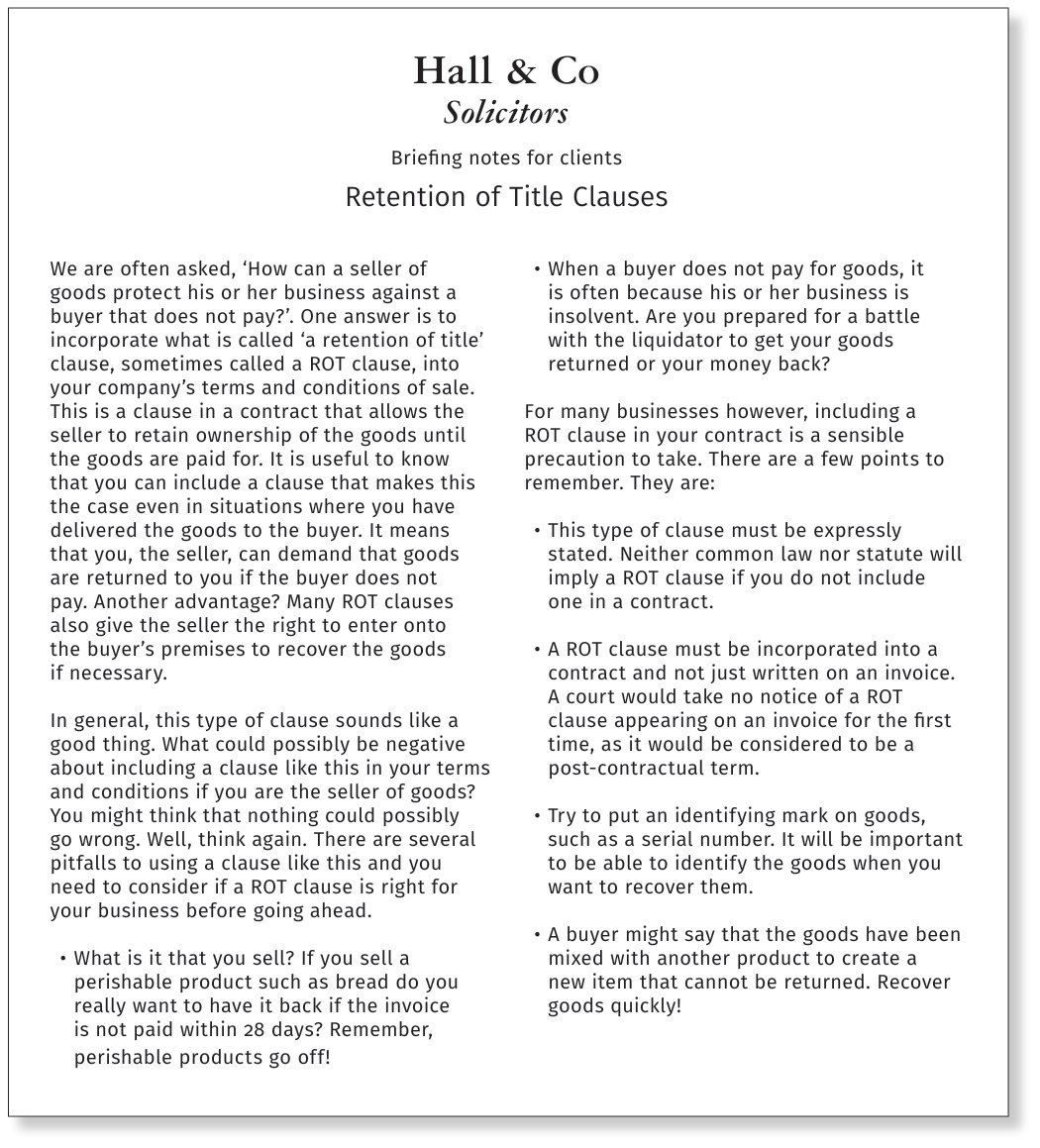
Briefing notes for clients Retention of Title Clauses We are often asked, ‘How can a seller of goods protect his or her business against a buyer that does not pay?’. One answer is to incorporate what is called ‘a retention of title’ clause, sometimes called a ROT clause, into your company’s terms and conditions of sale. This is a clause in a contract that allows the seller to retain ownership of the goods until the goods are paid for. It is useful to know that you can include a clause that makes this the case even in situations where you have delivered the goods to the buyer. It means that you, the seller, can demand that goods are returned to you if the buyer does not pay. Another advantage? Many ROT clauses also give the seller the right to enter onto the buyer’s premises to recover the goods if necessary.
In general, this type of clause sounds like a good thing. What could possibly be negative about including a clause like this in your terms and conditions if you are the seller of goods? You might think that nothing could possibly go wrong. Well, think again. There are several pitfalls to using a clause like this and you need to consider if a ROT clause is right for your business before going ahead.
• What is it that you sell? If you sell a perishable product such as bread do you really want to have it back if the invoice is not paid within 28 days? Remember, perishable products go off!
• When a buyer does not pay for goods, it is often because his or her business is insolvent. Are you prepared for a battle with the liquidator to get your goods returned or your money back?
For many businesses however, including a ROT clause in your contract is a sensible precaution to take. There are a few points to remember. They are:
This type of clause must be expressly stated. Neither common law nor statute will imply a ROT clause if you do not include one in a contract.
• A ROT clause must be incorporated into a contract and not just written on an invoice. A court would take no notice of a ROT clause appearing on an invoice for the first time, as it would be considered to be a post-contractual term.
• Try to put an identifying mark on goods, such as a serial number. It will be important to be able to identify the goods when you want to recover them.
• A buyer might say that the goods have been mixed with another product to create a new item that cannot be returned. Recover goods quickly!
a To include something as part of a design, a plan or a document.
The word is
b Problems that are likely to happen when you are taking part in a particular activity.
The word is
c A word used to describe goods that are likely to decay quite quickly, such as fruit or fish.
The word is
d A person who deals with the winding up of a company. His or her job is to make sure that the company’s creditors are paid.
The word is
e Something that you take to prevent something dangerous or problematic from happening in the future.
The word is
f Clearly and unmistakably stated. In a contractual situation, it usually means written as opposed to spoken.
The word is
Read the briefing notes again and answer the following questions using a full sentence.
a What is a retention of title clause?
b What additional right does a retention of title clause often give the seller of goods to assist him or her in recovering any unpaid goods that are on the buyer’s premises?
c If a buyer has not paid for goods what do the briefing notes say is often the reason for it?
d What is the pitfall of including a retention of title clause in a contract if you are the seller of perishable goods?
e Does statute assist a seller who has not included a retention of title clause in a contract for the sale of goods?
f If a seller wrote a retention of title clause on an invoice how would a court describe the clause?
g How do the briefing notes suggest that a seller makes his or her goods easily identifiable?
h The briefing notes suggest that if any goods are not paid for then the seller should get those goods back very quickly. What is the reason for this?
Collocation bank
‘She paid for the goods with her credit card.’ • to pay in/by instalments ‘The seller agreed to allow the buyer to pay for the goods in instalments.’ • to protect against non-payment ‘There are several things that a seller can do to protect himself against non-payment.’
• to incorporate a clause into a contract ‘It is a good idea to incorporate a retention of title clause into a contract.’ • to mix one product with another ‘We cannot recover the glue that we sold them as it has been mixed with other products in the manufacture of furniture.’
The clause below deals with both risk and title. The clause is from a contract between a printing company and a publishing company. In this case the goods mentioned in the contract are books. Decide whether the statements that follow the clause are true or false.
The property and risk in the Goods shall pass from the Seller to the Buyer upon Delivery. Where all or part of the Goods are retained by the Seller but the Buyer has paid the agreed price, the property in such Goods shall pass to the Buyer upon payment but the risk in such Goods shall remain with the Seller until Delivery takes place.
a When books that the buyer has paid for are delivered to the buyer, he or she then becomes the legal owner of those books.
b If books that the buyer has not paid for yet are mistakenly delivered to the buyer, the risk for those books stays with the seller.
c If the buyer has paid for books but the books are kept at the seller’s warehouse until they are needed, then the buyer has the risk.
Look at the following clause. Complete the clause with the prepositions from the blue box.
Property (a) the Goods shall not pass (b) the Buyer (c) payment is made by the Buyer to the Company (d) the agreed price.
Look at the following clause. Complete the clause with the prepositions from the blue box.
Property in the Goods remains (a) the Company (b) all times in the case of a hire agreement and until payment is made (c) full in the case of sale (d) the Goods.
Look at the following clause. Complete the clause with the prepositions from the blue box.
The Company guarantees that it has the authority to transfer title and that title (a) the Goods when transferred to the Buyer is lawful. The Goods are free (b) any security except as otherwise agreed (c) the parties (d) writing.
Look at this example of a retention of title clause. It is a typical ‘all monies’ clause as mentioned in Exercise 1. Fill each gap in the clause with the correct word from the blue box.
| # | Phrase | Definition |
|---|---|---|
| (a) | delivery and the passing of risk in the Goods or any other (b) agreement (c) to the Goods shall not pass to the Buyer until the Seller has received the full (d) of the Goods and all other goods sold or agreed to be sold by the Seller to the Buyer for which payment is (e) . | of this |
Speaking & Writing for this topic
Two short tasks scored against TOEFL rubrics. The prompt is generated for this topic — use the vocabulary you have just studied.
Suggested structureclick to expand
- In my experience…
- From what I have seen…
- My honest view is that…
- The principal reason is that…
- This matters because…
- What makes to carry a risk decisive here is…
- For instance, when I…
- A clear example is…
- Consider the case where to take out insurance was involved…
- On the other hand,…
- Furthermore,…
- That said, one should not forget that…
- Overall, this shows that…
- The lesson, then, is…
- For these reasons, I believe…
- Aim for 4–5 keywords woven naturally into your answer.
- Use at least two linking phrases (Furthermore, On the other hand, As a result…).
- Avoid filler words like "basically" or "like".
Suggested structureclick to expand
- The most important point in to take a precaution is …
- My position is that …
- The principal reason is that to carry a risk …
- This is supported by …
- A concrete illustration is …
- For instance, …
- However, some argue that …
- On the other hand, …
- In conclusion, …
- Taken together, …
- Aim for 4–5 keywords used in natural context.
- Use 3+ linking words across the answer.
- Vary sentence length to avoid monotony.
INTELLECTUAL PROPERTY AND CONFIDENTIAL INFORMATION ~37 min
You need to know about...
Intellectual property If a contract is for the sale of goods there is often no need to be concerned with the seller’s intellectual property rights (IP rights). However, in a contract where one party is providing a service to the other, then protection of IP rights can be very important. Let’s say that a designer is commissioned by a record company to design a cover for a new music CD. The CD sells millions of copies and the record company then wants to use the cover design on merchandise such as T-shirts. Who owns the design? Is it the designer or is it the record company? It is important that the contract between the two parties makes this clear.
Confidential information Confidentiality protects information not capable of IP protection. This includes commercial information, trade secrets and processes used by a business in its everyday operations. This type of information is sometimes referred to as ‘know-how’. This information can be very valuable indeed in the hands of a rival organisation. The business needs to include a confidentiality clause, sometimes called a non-disclosure clause, in all of its employees’ contracts. This would prevent any employee from, for example, giving information from the database of clients to any third party.
Sometimes it is not always obvious to a business how valuable its intellectual property or confidential information might be. Many law firms now offer the service of carrying out what is called an ‘IP audit’ for companies. The law firm will identify what intellectual property and confidential information a business has and give advice on how to protect it.
Look at the following two clauses. They are from a contract between a company that needs a website and a website designer. Decide which clause is the non-disclosure clause and which is the intellectual property clause.
a The Designer acknowledges that copyright and any other rights of any nature that may currently exist or be created in the future in respect of any aspect of the Website and any associated material in connection with which the Designer is providing her services shall belong absolutely to the Company.
This is theThis is the IP clauseclause.
b Where the Designer is approaching third parties for contributions or assistance in respect of the Website then the information to be divulged shall be kept to a minimum and a representative of the Company shall attend all such meetings with the Designer.
This is theThis is the non-disclosure clauseclause.
Look at the two clauses in Exercise 1 again. Decide if the following statements are true or false.
a The Designer is completely forbidden to give any information at ail about the Company to any third party.
b The Designer agrees to transfer copyright in the Website to the Company.
c If the Designer needs to have a meeting with another designer to get help or advice then the Company has the right to send someone from the Company with her.
d If any new IP rights develop in connection with the Website in the future, those rights will belong to the Designer.
Read the text below. It is from a seminar for students studying law at the University of Chatsworth. The seminar is about a dispute between two parties to a contract for services. The dispute happened because the parties did not include a clause in the agreement about ownership of intellectual property rights. Complete the text with the prepositions from the box below.
Lydia Barlow works (a) asa self- employed graphic designer here in Chatsworth. Her speciality is the design of marketing material for new companies. Niall King has just started a new business. Niall’s business is a travel company aimed (b) atpeople aged 21 to 25 who wish to travel in the free time they have between finishing university and starting work. The name of Niall’s business is Pure Adventure Travel Ltd.
Niall meets Lydia to plan a brochure to advertise his travel company. He wants her to design a colour brochure (c) with40 pages. He tells Lydia that his budget for the design is £12,000. They sign a contract for services. Niall provided the contract. A month later Lydia provides Niall with the brochure and an invoice (d) for£12,000. Niall is delighted and pays Lydia the £12,000 immediately.
Six months later, Niall puts some of the text and pictures from the brochure (e) ontohis website. Lydia sees the website and contacts Niall. She says that she did not give permission for her work to be used in this way and she requires additional payment. Now the two parties (f) tothe agreement are (g) indispute. How could this dispute have been avoided?
If you are the buyer of work that is creative in nature you need to make sure that you have the right to use any intellectual property connected with the work. There are two ways to do this:
• make sure that the supplier transfers ownership
(h) ofthe intellectual property to you at the time of payment. This is often called an assignment of rights continued
• if there is no assignment, make sure that the Licensing can be more advantageous to the supplier. He or she continues to own the intellectual property but makes money (j) fromallowing others to use it, subject to certain restrictions. A good checklist when granting a licence is:
supplier gives you permission to use the intellectual property. This is usually known as a licence. When you have a licence to use something you are known as the licensee.
What is the difference (i) betweenan assignment of IP rights and a licence to use the intellectual property? The assignment of IP rights means the absolute transfer of those rights in return for payment. The owner of the IP rights usually has to guarantee to the buyer, known as the assignee, that the rights are sold free from any encumbrance. An encumbrance is a third party interest in the rights and might mean that the rights do not belong solely to the seller. In this case, the right to start legal proceedings for infringement of intellectual property rights belongs to the assignee.
Collocation bank
• Is the licence limited to a particular territory? • Is the licence exclusive or non-exclusive? • How long will the licence last? • How much and when does the licensee have to pay? • What other restrictions are there on the use of the material?
The best option in the case above would have been for Niall to have included a clause in his contract with Lydia under which she assigned all of the intellectual property rights in the design work to him to use in any way that he wished.
to be free from any to transfer ownership encumbrance Preposition bank
• to be contracted by someone to do something ‘I have been contracted by the City of London environment department to remove graffiti from this area.’ • in the hands of a rival organisation ‘I am sure that our client list is in the hands of our greatest competitor.’
• to have copyright/IP rights in something ‘The Beatles have sold copyright in much of their music.’ • at the time of payment ‘Ownership transfers to the buyer at the time of payment.’
Read the text in Exercise 3 about the dispute between Lydia Barlow and Niall King again. Answer the following questions by matching them with the correct answers from the list below.
What is Lydia Barlow’s job? (1)
What is the name of the permission that a supplier such as Lydia may give to use the IP rights, even though there is no transfer of ownership? (6)
What is the name of Niall King’s new business? (2)
What is Niall King’s budget for producing his new brochure? (3)
What is a licensee? (7)
What does Lydia Barlow require if Niall King wants to use her design work on his website? (4)
What is the name of the process by which a supplier such as Lydia transfers ownership of IP rights to the buyer at the time of payment? (5)
Can an assignee sue for infringement of IP rights? (8)
What question does the licence checklist ask about the term of a licence? (9)
What would have been the best option for Niall King? (10)
a Pure Adventure Travel Ltd.
f It asks how long it will last.
b A licence to use intellectual property.
g She wants more money.
c Yes.
h She’s a self-employed graphic designer.
d To have included a clause in the agreement that assigned him all of the intellectual property rights in the brochure.
e An assignment of rights.
j £12,000.
i A person who has permission to use intellectual property, even though he or she is not the owner.
Let’s say that Lydia Barlow and Niall King included the following clause in the contract between them. Read the clause, and using information that you already have about the situation between the parties, answer the questions below using a full sentence.
In consideration of the fee specified in Schedule A hereto the Supplier assigns to the Company all present and future copyright in the Product for use in the media throughout the world including, but not limited to advertisements, newspaper and magazine articles, DVDs, website and Internet related material and marketing material in any form.
a Who is the supplier referred to in this clause?
b What is the name of the company referred to in this clause?
c Where must I look to find out how much money the company will pay to the supplier for producing the brochure?
d Does the clause give the company full ownership of the copyright material or just temporary use of the material?
e Which particular word in the clause helped you to answer question (d)?
f Is the company limited to using the copyright material in the places listed in this clause?
g Which phrase in the clause helped you to answer question (f)?
h If the company wants to use the copyright material in an advertisement on the side of a train, does this clause permit it?
In order to protect his confidential information, Niall King could also have included a clause like the one on the next page in his contract with Lydia Barlow. Complete the clause with the words from the blue box below.
The Supplier agrees that she shall not (a) discloseto any (b) thirdparty any confidential information (c) whatsoeveracquired during the existence of this Agreement including, but not (d) limitedto:
• the current or future business plans of the Company • data • marketing strategies • financial information from the date of this Agreement and for a period of one year following its (e) expiration.
Speaking & Writing for this topic
Two short tasks scored against TOEFL rubrics. The prompt is generated for this topic — use the vocabulary you have just studied.
Suggested structureclick to expand
- In my experience…
- From what I have seen…
- My honest view is that…
- The principal reason is that…
- This matters because…
- What makes with decisive here is…
- For instance, when I…
- A clear example is…
- Consider the case where for was involved…
- On the other hand,…
- Furthermore,…
- That said, one should not forget that…
- Overall, this shows that…
- The lesson, then, is…
- For these reasons, I believe…
- Aim for 4–5 keywords woven naturally into your answer.
- Use at least two linking phrases (Furthermore, On the other hand, As a result…).
- Avoid filler words like "basically" or "like".
Suggested structureclick to expand
- The most important point in of is …
- My position is that …
- The principal reason is that with …
- This is supported by …
- A concrete illustration is …
- For instance, …
- However, some argue that …
- On the other hand, …
- In conclusion, …
- Taken together, …
- Aim for 4–5 keywords used in natural context.
- Use 3+ linking words across the answer.
- Vary sentence length to avoid monotony.
WARRANTIES AND INDEMNITIES ~13 min
You need to know about...
Warranties A contractual warranty is a promise or a guarantee contained in a contract. There are different types of warranty depending on what type of contract you are looking at. In a contract for the supply of goods or services for example, a warranty usually takes the form of a promise that the goods or services will be of a certain standard. A lawyer might say that the seller ‘warrants’ the quality of the goods to the buyer. Some warranties do not need to be written. They are presumed to exist or more correctly they are ‘implied’. This is especially true of warranties in contracts between companies and consumers. For example, in the UK, a statute called The Sale of Goods Act (1979) implies warranties about the quality of goods that are sold to consumers. In many commercial contracts between companies however, the warranties are clearly and expressly stated.
Indemnities An indemnity clause in a contract, sometimes called an indemnification clause in the USA, takes this process of guarantee one step further. It is a promise by one party to the contract to compensate the other party if certain losses occur. This compensation could be for a breach of warranty but it could be for some other kind of loss. Let’s take, for example, a contractual situation where a consultant works for a short time with a company to help the company with its marketing plan. The consultant then breaches his contract with the company by disclosing confidential information to a third party and the company suffers a loss as a result. The company will usually be protected by an indemnity clause. The clause will state that the consultant ‘indemnifies’ the company against any loss or damage arising from this type of breach. Indemnity usually covers loss arising from any ‘act, omission or neglect’. Many professionals take out insurance in case a claim is made against them under an indemnity clause.
Look at the following two contract clauses. They are from a contract between a publishing company and a book illustrator. Read both clauses and decide which is the indemnity clause and which is the warranty. Complete each clause by choosing the correct words from the box to fill the gaps.
1 The Designer (a) warrantsthat the Illustrations provided under this contract are original and have not been (b) disclosedto any other party and are not in the public domain.
2 The Designer hereby (c) indemnifiesthe Publisher against any loss, injury, or damage arising from any breach by the Designer of any undertakings in this Agreement, howsoever (d) caused.
Collocation bank
to be of a certain standard ‘These goods are not of the expected standard.’ • a warranty made by one party to the other party ‘This contract contains a warranty made by the seller to the buyer.’
an expressly stated contract term loss arising from a breach ‘I am indemnified against any loss arising from a breach of contract.’ • to indemnify someone against loss or damage ‘The consultant agreed to indemnify the company against any loss or damage.’
Louisa Capaldi works as an illustrator of children’s books. She is self-employed, describing herself as ‘a freelance illustrator’, and enters into contracts with publishing companies several times a year. She is a member of an organisation called ‘The Society of Illustrators’ and often visits the Society’s website for the latest news and advice. She has just found this article on the website. It is about the need for illustrators to be careful when entering into contracts.
Read the article from the website below and answer the questions that follow.
www.TSOI.co.uk/legal/contracts
Speaking & Writing for this topic
Two short tasks scored against TOEFL rubrics. The prompt is generated for this topic — use the vocabulary you have just studied.
Suggested structureclick to expand
- In my experience…
- From what I have seen…
- My honest view is that…
- The principal reason is that…
- This matters because…
- What makes caused decisive here is…
- For instance, when I…
- A clear example is…
- Consider the case where indemnifies was involved…
- On the other hand,…
- Furthermore,…
- That said, one should not forget that…
- Overall, this shows that…
- The lesson, then, is…
- For these reasons, I believe…
- Aim for 4–5 keywords woven naturally into your answer.
- Use at least two linking phrases (Furthermore, On the other hand, As a result…).
- Avoid filler words like "basically" or "like".
Suggested structureclick to expand
- The most important point in to imply a warranty is …
- My position is that …
- The principal reason is that caused …
- This is supported by …
- A concrete illustration is …
- For instance, …
- However, some argue that …
- On the other hand, …
- In conclusion, …
- Taken together, …
- Aim for 4–5 keywords used in natural context.
- Use 3+ linking words across the answer.
- Vary sentence length to avoid monotony.
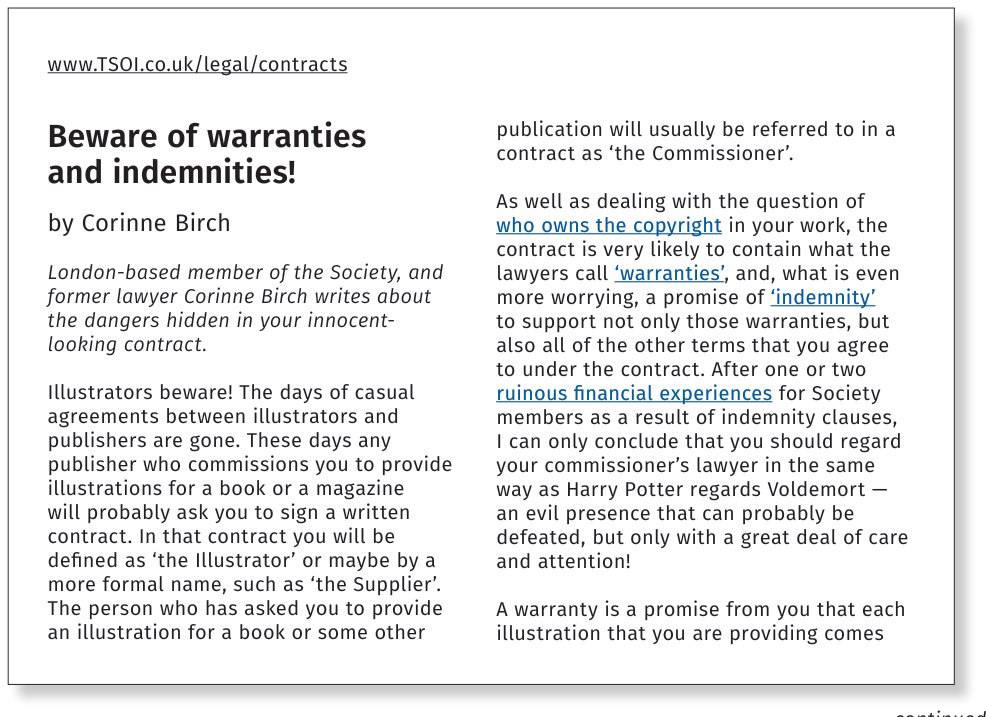
Beware of warranties and indemnities! ~25 min
by Corinne Birch London-based member of the Society, and former lawyer Corinne Birch writes about the dangers hidden in your innocent- looking contract.
Illustrators beware! The days of casual agreements between illustrators and publishers are gone. These days any publisher who commissions you to provide illustrations for a book or a magazine will probably ask you to sign a written contract. In that contract you will be defined as ‘the Illustrator’ or maybe by a more formal name, such as ‘the Supplier’. The person who has asked you to provide an illustration for a book or some other publication will usually be referred to in a contract as ‘the Commissioner’.
As well as dealing with the question of who owns the copyright in your work, the contract is very likely to contain what the lawyers call ‘warranties’, and, what is even more worrying, a promise of ‘indemnity’ to support not only those warranties, but also all of the other terms that you agree to under the contract. After one or two ruinous financial experiences for Society members as a result of indemnity clauses, I can only conclude that you should regard your commissioner’s lawyer in the same way as Harry Potter regards Voldemort — an evil presence that can probably be defeated, but only with a great deal of care and attention!
A warranty is a promise from you that each illustration that you are providing comes continued
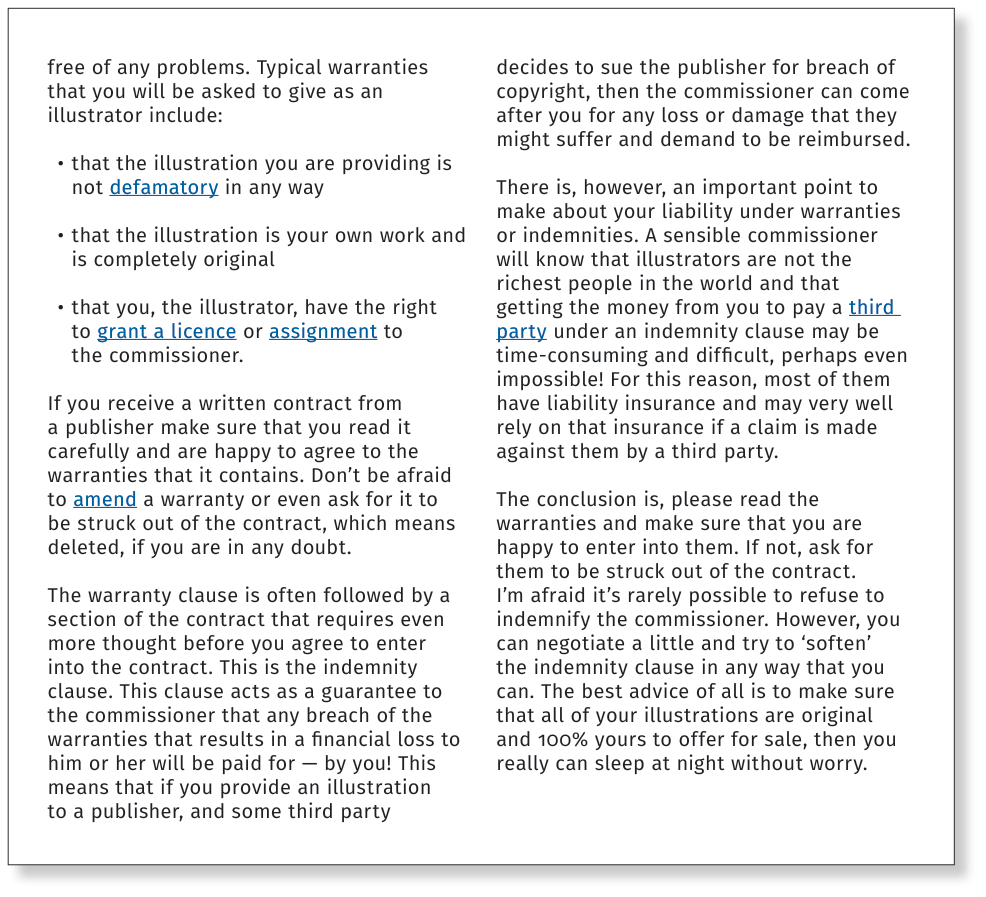
free of any problems. Typical warranties that you will be asked to give as an illustrator include:
• that the illustration you are providing is not defamatory in any way
• that the illustration is your own work and is completely original
• that you, the illustrator, have the right to grant a licence or assignment to the commissioner.
If you receive a written contract from a publisher make sure that you read it carefully and are happy to agree to the warranties that it contains. Don’t be afraid to amend a warranty or even ask for it to be struck out of the contract, which means deleted, if you are in any doubt.
The warranty clause is often followed by a section of the contract that requires even more thought before you agree to enter into the contract. This is the indemnity clause. This clause acts as a guarantee to the commissioner that any breach of the warranties that results in a financial loss to him or her will be paid for — by you! This means that if you provide an illustration to a publisher, and some third party decides to sue the publisher for breach of copyright, then the commissioner can come after you for any loss or damage that they might suffer and demand to be reimbursed.
There is, however, an important point to make about your liability under warranties or indemnities. A sensible commissioner will know that illustrators are not the richest people in the world and that getting the money from you to pay a third party under an indemnity clause may be time-consuming and difficult, perhaps even impossible! For this reason, most of them have liability insurance and may very well rely on that insurance if a claim is made against them by a third party.
The conclusion is, please read the warranties and make sure that you are happy to enter into them. If not, ask for them to be struck out of the contract. I’m afraid it’s rarely possible to refuse to indemnify the commissioner. However, you can negotiate a little and try to ‘soften’ the indemnity clause in any way that you can. The best advice of all is to make sure that all of your illustrations are original and 100% yours to offer for sale, then you really can sleep at night without worry.
The blue links on this website that take the reader to more information on certain subjects are underlined. Which link should Louisa click on to read more about the following?
Example: Information about people who are not party to the contract but may take legal action. Link: third party.
a Information about illustrators who have lost a lot of money.
Link:
b Information about who is the owner of the intellectual property in the illustrations.
Link:
c Information about making changes to clauses contained in contracts.
Link:
d Information about giving someone permission to use your illustrations without giving that person ownership of the illustrations.
Link:
e Information about what is libellous.
Link:
f Information about transferring ownership of copyright completely to the commissioner.
Link:
g Information about certain guarantees that an illustrator may be required to give to the commissioner.
Link:
h Information about the promise an illustrator may be required to make regarding any financial loss the commissioner suffers as a result of a breach of contract.
Link:
Read the article in Exercise 2 again and decide if the following statements are true or false.
a Most illustrators are asked to sign a written contract.
b Some illustrators who are members of the Society have lost money in the past as a result of indemnity clauses in their contracts.
c If a warranty is ‘struck out’ of a contract it means that particular guarantee is deleted from the contract.
d An illustrator will never have to pay for a commissioner’s losses if the commissioner is sued by a third party.
e Many commissioners have insurance against being sued by third parties because they know that illustrators may not be able to pay any damages that might be awarded.
Here is a warranty given by an illustrator to a commissioner. Complete this warranty by choosing a word from the box below to fill each gap in the clause.
The Illustrator (a) ruinous financial experiencesto the Commissioner that the Illustrations provided are original and have not been (b) who owns the copyrightto any third party except to the Commissioner and its advisers and employees. The Illustrator (c) amendwarrants that she has full rights in the Illustrations and that the Illustrations have not been previously (d) grant a licenceor licensed in any form in any part of the world and are not now or ever have been in the public (e) defamatory.
Here is an indemnity given by an illustrator to a commissioner. Complete this indemnity clause by choosing a word from the box below to fill each gap in the clause.
The Illustrator agrees to indemnity and keep (a) the Commissioner (and any other
(b) that the Commissioner shall in the normal operation of its business agree to indemnify) against loss, (c) or damage, including legal (d) in consequence of any breach of the warranties given herein or arising out of any claim regarding an
(e) of breach of copyright or defamation.
Here is a warranty given by the author of a book to a publishing company. Complete the warranty by choosing a preposition from the box below to fill each gap in the clause.
The Author hereby warrants that the Book is the Author’s original work, has not been published before, and is not currently (a) warrantsconsideration for publication elsewhere. Further, that the Book contains no libellous or unlawful statements and that it (b) disclosedno way infringes the rights
| # | Phrase | Definition |
|---|---|---|
| (c) | others, and that the Author, (d) | the owner of the copyright, is |
entitled (e) domainmake this assignment.
Here is an indemnity given by the author of a book to a publishing company. Complete the indemnity clause by choosing a preposition from the box below to fill each gap in the clause.
The Author hereby agrees to indemnify the Publisher (a) indemnifiedany loss or damage resulting
| # | Phrase | Definition |
|---|---|---|
| (b) | any breach by the Author (c) | any warranty, undertaking or |
term in this Agreement and against any legal costs or damages incurred (d) coststhe Publisher (e) allegationa result of any breach by the Author under this Agreement.
Speaking & Writing for this topic
Two short tasks scored against TOEFL rubrics. The prompt is generated for this topic — use the vocabulary you have just studied.
Suggested structureclick to expand
- In my experience…
- From what I have seen…
- My honest view is that…
- The principal reason is that…
- This matters because…
- What makes disclosed decisive here is…
- For instance, when I…
- A clear example is…
- Consider the case where domain was involved…
- On the other hand,…
- Furthermore,…
- That said, one should not forget that…
- Overall, this shows that…
- The lesson, then, is…
- For these reasons, I believe…
- Aim for 4–5 keywords woven naturally into your answer.
- Use at least two linking phrases (Furthermore, On the other hand, As a result…).
- Avoid filler words like "basically" or "like".
Suggested structureclick to expand
- The most important point in costs is …
- My position is that …
- The principal reason is that disclosed …
- This is supported by …
- A concrete illustration is …
- For instance, …
- However, some argue that …
- On the other hand, …
- In conclusion, …
- Taken together, …
- Aim for 4–5 keywords used in natural context.
- Use 3+ linking words across the answer.
- Vary sentence length to avoid monotony.
TERM AND TERMINATION ~33 min
You need to know about...
Term The term of a contract is the period of time for which the contract is valid It means the same as the duration of the contract. The term of the contract is usually stated at the beginning of a written contract. However, it is also often mentioned again in the termination clause.
Termination Almost all contracts contain a clause that specifies the circumstances under which a contract can be brought to an end before the agreed expiry date. This means that the agreed term of the contract will be shortened. Under what circumstances might a contract be terminated by one of the parties? The most common reasons are:
• Agreement. The parties agree that either of them can terminate the contract by giving an agreed period of notice to the other • Breach of contract. One party can terminate the contract if the other party commits a material breach of one or more of the terms and conditions of the contract. However, it usually needs to be a material or significant breach for a court to allow the injured party to terminate rather than accept damages for the loss. The party in breach usually has an agreed period of time to remedy the breach before the injured party can insist upon termination • Insolvency of a party. Most commercial contracts contain a provision in the termination clause that allows one party to terminate the contract if the other party becomes insolvent or goes into liquidation.
A lawyer has been asked to explain the reasons why it is important to include a termination clause in a commercial contract. Here is his first reason. Read what he says and complete his explanation by filling the gaps with the words from the box below.
‘It is absolutely essential to include a termination clause in a contract. There are several reasons for this. The first reason is a very simple one. Let’s imagine that you (a) runa retail business, such as a shop that sells luxury chocolate, in the centre of London. You (b) enterinto a contract with a supplier of chocolate in Belgium. The contract (c) statesthat the supplier in Belgium will deliver a certain quantity of goods to you every month. Both parties expect the contract to continue for a certain period of time before it has to be renegotiated and they (d) agreeupon the term of the contract as 12 months. What will you do if no one buys your chocolate and after three months your business is in trouble? You do not want to be obliged to go on with the contract for another nine months! Therefore, when you (e) negotiatethe terms and conditions of the contract it is essential to say that either party can terminate by (f) givingnotice to the other. A reasonable notice period in a situation such as this is probably four weeks.’
The same lawyer now gives his second reason as to why it is important to include a termination clause. Read what he says and answer the questions that follow using a full sentence.
‘To move on to the second reason for including a termination clause, if you are a party to a contract you must always make sure that you can terminate it if the other party is in serious breach of his or her obligations to you. A court would refer to a serious breach as a ‘material breach’. A breach of a less serious kind, a minor breach, will only give rise to a claim for damages, not termination. Most clauses of this type state that you have to give the other party a chance to solve the problem. In the legal profession we refer to this problem solving as ‘providing a remedy for the breach’. If we imagine a situation where one party is in breach and has not remedied that breach then the injured party might seek to terminate the contract on those grounds. So, what constitutes a material breach? This is a complicated question. A court will examine the parties’ intentions when they signed the contract, as well as the effects of the breach, in deciding whether or not it is material in nature. In general, however, a material breach must be very serious indeed. It must be a threat to the very purpose of the contract and not just an inconvenience.’
1 How does a court refer to a very serious or significant breach of contract?
Answer:
2 What is a minor breach?
Answer:
3 What right does a minor breach normally give rise to for the injured party?
Answer:
4 What is the correct legal name for the solution that the party in breach gives when he or she solves the problem caused by the breach?
Answer:
5 In order to be described as a material breach, what must the breach do with reference to the contract?
Answer:
Here is the lawyer’s final reason for including a termination clause in a contract. Complete his explanation by choosing a preposition from the box below to fill each gap in the text.
‘Finally, the third reason for including a termination clause in any commercial contract is the possibility that the other party may have financial troubles. Most contracts these days state (a) inthe termination clause that if one party stops trading (b) asa business or even threatens to stop trading, then it will bring the contract (c) toan end. This is (d) forthe protection of the other party. Other particular circumstances that are usually listed in a termination clause are one party being the subject (e) ofdissolution, winding up, receivership or any other insolvency proceedings. All of these circumstances can bring a contract to a very sudden end.’
Collocation bank
contract • a to commit a breach Preposition bank
• the circumstances under/in which something can happen ‘Under what circumstances can I terminate this contract?’ • to insist upon/on something ‘I insist upon a remedy for the breach within 30 days.’
to be in breach of your obligations ‘The supplier is in breach of her obligations under this agreement.’ • to give rise to something ‘The other party’s actions will give rise to an award of damages.’
Here is a termination clause. It is contained in a contract between a customer and a company that makes hand- made furniture. Read the termination clause and find a word or phrase in the termination clause that matches the following definitions.
TERMINATION Without prejudice to any other right or remedy available to the Company it shall be entitled to terminate the Contract between the Company and the Customer or suspend any further work due under the Contract between the Company and the Customer without any liability to the Customer, and in the event that work has been carried out but remains unpaid for, the price shall become due immediately notwithstanding any previous agreement to the contrary in the event of:
1. the Customer committing a breach of this Agreement provided the Company has notified him of the breach and in the case of that breach being capable of remedy, the breach has not been remedied within seven days of receipt of such notice 2. the Customer goes into liquidation or having a receiver appointed over any of its assets or becoming subject to an administration order or any other insolvency proceedings or, (being an individual or partnership) the Customer becomes apparently insolvent, bankrupt or the Customer makes any agreement with its creditors or ceases or threatens to cease to carry on business.
a Things that a company owns that have a value.
The word is
b A phrase that means ‘not having any effect upon something at a later date’.
The phrase is
c A solution for a breach of contract.
The word is
d Despite, in spite of.
The word is
e The people or organisations to which a person owes money.
The word is
f Receiving.
The word is
g To stop doing a particular activity for a period of time with the intention that you might or might not start the activity again later on.
The word is
h Stops.
The word is
i Owed.
The word is
j A phrase that means ‘being the object of something.’
The phrase is
Read the termination clause again and decide if the following statements are true or false.
a If the company terminates this contract because the customer commits a breach of the agreement then the company cannot possibly claim any other remedy in future.
b If the company terminates this contract because the customer commits a breach then the customer is obliged to pay immediately for any unpaid work that the company has done.
c The customer has seven days to remedy any breach and the seven days start on the day the customer breaches the contract.
d The company has the right to terminate the contract if the customer makes an agreement with the other people to whom the customer owes money.
e If the customer says that he will probably wind up his business very soon, the company has the right to terminate the contract.
Speaking & Writing for this topic
Two short tasks scored against TOEFL rubrics. The prompt is generated for this topic — use the vocabulary you have just studied.
Suggested structureclick to expand
- In my experience…
- From what I have seen…
- My honest view is that…
- The principal reason is that…
- This matters because…
- What makes agree decisive here is…
- For instance, when I…
- A clear example is…
- Consider the case where run was involved…
- On the other hand,…
- Furthermore,…
- That said, one should not forget that…
- Overall, this shows that…
- The lesson, then, is…
- For these reasons, I believe…
- Aim for 4–5 keywords woven naturally into your answer.
- Use at least two linking phrases (Furthermore, On the other hand, As a result…).
- Avoid filler words like "basically" or "like".
Suggested structureclick to expand
- The most important point in negotiate is …
- My position is that …
- The principal reason is that agree …
- This is supported by …
- A concrete illustration is …
- For instance, …
- However, some argue that …
- On the other hand, …
- In conclusion, …
- Taken together, …
- Aim for 4–5 keywords used in natural context.
- Use 3+ linking words across the answer.
- Vary sentence length to avoid monotony.
FORCE MAJEURE ~18 min
You need to know about...
English-speaking lawyers use the French phrase ‘force majeure,’ because it is internationally understood. The translation into English would be ‘greater force’. A force majeure is a very strong, external force or event that is outside the influence of the parties that prevents one of them from carrying out their obligations under the contract. The interpretation of the phrase according to English law goes a little further than this. Generally speaking, a force majeure is an unforeseen event that prevents one of the parties from carrying out his or her obligations, which could not have been avoided by exercise of duty of care. In other words, a force majeure clause will not necessarily protect one of the parties if he or she was negligent. A typical force majeure clause will cover:
• Natural disasters connected with weather, such as floods, earthquakes or hurricanes. This type of event is often referred to as an ‘Act of God’. • Disasters connected with human activity such as war or revolution. • Problems caused by the failure of a third party, such as a supplier, to fulfil their contractual obligations to one of the contracting parties. If, for example, I am based in London and I agree to supply gas to a major company in London, I now have a contract with that company. However, if my gas supplier in Russia goes out of business and does not provide me with the gas, I cannot fulfil my contractual obligations in London. I could perhaps rely on the force majeure clause in my contract with the London company to avoid action against me for breach of contract. Cases in the UK have established the principle that a contract suddenly becoming too expensive for one of the parties to carry out does not constitute a force majeure.
In the box below is some of the vocabulary that you will often see in a force majeure clause. All of the events listed in the box can prevent one of the parties from carrying out their contractual obligations. Look at the events and decide what type of event they are.
rebellion acts of terrorism electronic failure earthquake communications failure civil war
| # | Phrase | Definition |
|---|---|---|
| war | sabotage | avalanche |
riot epidemic criminal acts flood hijacking arson civil unrest drought mechanical failure strike
a Natural disasters/Acts of God
b Problems caused by modern technology
c Problems caused by human activity
Here is a typical force majeure clause. Complete the clause by choosing a preposition from the box below to fill each gap in the text.
No party shall be liable (a) forany failure to perform its obligations (b) this Agreement in the event that such failure results (c) fromflood, earthquake or any Act (d) ofGod, riot, civil unrest, war or any other cause beyond a party’s reasonable control, including electronic or communications failure but excluding failure due (e) toany breach of duty of care or a party’s financial condition.
Look at this force majeure clause. Complete the clause with the correct words from the box below.
In the event that this Agreement or any part of it can not be performed for any reason beyond the reasonable (a) controlof the Company or the Supplier including but not (b) limitedto such events as Acts of God, war, strikes or civil disturbances, then such non- (c) performanceshall not be deemed a breach of this Agreement. In the event that the obligations under this Agreement cannot be fulfilled for any reason beyond the control of the defaulting party for a continuous period of three months then the other party is entitled to (d) terminatethis Agreement at the end of that three-month period by giving (e) noticein writing.
Collocation bank
to be outside someone’s influence ‘The hurricane in the USA was an event outside the influence of the contracting parties.’
to go out of business ‘My supplier went out of business a few weeks ago.’
Speaking & Writing for this topic
Two short tasks scored against TOEFL rubrics. The prompt is generated for this topic — use the vocabulary you have just studied.
Suggested structureclick to expand
- In my experience…
- From what I have seen…
- My honest view is that…
- The principal reason is that…
- This matters because…
- What makes from decisive here is…
- For instance, when I…
- A clear example is…
- Consider the case where of was involved…
- On the other hand,…
- Furthermore,…
- That said, one should not forget that…
- Overall, this shows that…
- The lesson, then, is…
- For these reasons, I believe…
- Aim for 4–5 keywords woven naturally into your answer.
- Use at least two linking phrases (Furthermore, On the other hand, As a result…).
- Avoid filler words like "basically" or "like".
Suggested structureclick to expand
- The most important point in terminate is …
- My position is that …
- The principal reason is that from …
- This is supported by …
- A concrete illustration is …
- For instance, …
- However, some argue that …
- On the other hand, …
- In conclusion, …
- Taken together, …
- Aim for 4–5 keywords used in natural context.
- Use 3+ linking words across the answer.
- Vary sentence length to avoid monotony.
USING YOUR KNOWLEDGE ~14 min
Collocation review Complete these sentences with a collocation that you have seen.
a The Seller warrants that the property is sold of any encumbrance.
b Contracts contain what are known as express terms that are clearly stated in the agreement but they may also have terms, which a court will presume to exist even if they are not stated.
c It is possible for one of the parties to a contract to terminate on the grounds of breach but it must be a breach and not a minor breach or an inconvenience.
d You are notified that you are in breach of contract and you have 14 days to the breach. If you fail to do so we will terminate our contract with you without further notice.
e The Seller will title to the goods until the full price of the goods has been received by the Seller.
f The service that you to us under this agreement was not satisfactory.
g This is confidential information and you must not it to any third party.
h It is always a good idea to insurance in case a claim is made against you under an indemnity clause. If you had to find the money from your own pocket it could ruin you financially.
i The of this contract is defined as two years.
j We intend to upon the force majeure clause of this contract and we deny that we are in breach of our obligations.
Vocabulary review Complete these sentences with a word that you have seen.
a A of title clause often gives the seller the right to enter onto the buyer’s premises to recover goods that have not been paid for.
b To goods or intellectual property rights to someone is to transfer ownership to that person completely.
c The Author that the Article is her own original work and that no third party has any right in the Article whatsoever.
d An Intellectual Property is a service that many law firms offer to their clients. The law firm will check to see what valuable intellectual property a business has and give advice on how to protect it.
e If you have in goods it means that you are the owner of those goods.
f An ‘all ’ provision in a contract of sale protects the seller. It means that ownership of the goods does not pass to the buyer until the buyer has paid everything that he or she owes under the contract.
g In the USA an indemnity clause is often referred to as an clause.
h If there is a warranty in a contract that you do not want to agree to, you can ask the other party to it out of the contract.
i A clause in a contract states the circumstances in which a contract can be ended before the agreed expiry date.
j A majeure clause in a contract deals with the circumstances in which the parties may be excused performance of their obligations due to some unforeseen event such as a fire or a flood.
Preposition review. Complete these sentences with the correct preposition.
a The designer sent an invoice £2000 to the company that had commissioned her work.
b When you are paying for design work you should always make sure that the designer transfers the intellectual property rights in the work to you the time of payment.
c The Author hereby agrees to indemnify the Company any loss or damage arising from any breach of the terms and conditions of this Agreement.
d A force majeure clause deals with events that are the control of the contracting parties.
e Who is your new travel business aimed ? Is it only for people under the age of 30?
f Please pay the goods that you have received by 3 July.
g I have been commissioned a fashion magazine to take some photographs for their next edition.
h Were the goods that you received last week the standard that you expected?
i The author warrants that the article no way infringes the intellectual property rights of any third party.
j If one party to a contract stops trading a business, then the other party can usually terminate the contract immediately.
Speaking & Writing for this topic
Two short tasks scored against TOEFL rubrics. The prompt is generated for this topic — use the vocabulary you have just studied.
Suggested structureclick to expand
- In my experience…
- From what I have seen…
- My honest view is that…
- The principal reason is that…
- This matters because…
- What makes using decisive here is…
- For instance, when I…
- A clear example is…
- Consider the case where your was involved…
- On the other hand,…
- Furthermore,…
- That said, one should not forget that…
- Overall, this shows that…
- The lesson, then, is…
- For these reasons, I believe…
- Aim for 4–5 keywords woven naturally into your answer.
- Use at least two linking phrases (Furthermore, On the other hand, As a result…).
- Avoid filler words like "basically" or "like".
Suggested structureclick to expand
- The most important point in this concept is …
- My position is that …
- The principal reason is that using …
- This is supported by …
- A concrete illustration is …
- For instance, …
- However, some argue that …
- On the other hand, …
- In conclusion, …
- Taken together, …
- Aim for 4–5 keywords used in natural context.
- Use 3+ linking words across the answer.
- Vary sentence length to avoid monotony.
HIGHER LEVEL PRACTICE ~3 min
Read the contract clause below. The missing prepositions are in the list below. For each gap choose the preposition which best fits into the space from the options provided. Use each option only once. Write your answers in the box below. There is an example at the beginning (*).
Speaking & Writing for this topic
Two short tasks scored against TOEFL rubrics. The prompt is generated for this topic — use the vocabulary you have just studied.
Suggested structureclick to expand
- In my experience…
- From what I have seen…
- My honest view is that…
- The principal reason is that…
- This matters because…
- What makes higher decisive here is…
- For instance, when I…
- A clear example is…
- Consider the case where level was involved…
- On the other hand,…
- Furthermore,…
- That said, one should not forget that…
- Overall, this shows that…
- The lesson, then, is…
- For these reasons, I believe…
- Aim for 4–5 keywords woven naturally into your answer.
- Use at least two linking phrases (Furthermore, On the other hand, As a result…).
- Avoid filler words like "basically" or "like".
Suggested structureclick to expand
- The most important point in this concept is …
- My position is that …
- The principal reason is that higher …
- This is supported by …
- A concrete illustration is …
- For instance, …
- However, some argue that …
- On the other hand, …
- In conclusion, …
- Taken together, …
- Aim for 4–5 keywords used in natural context.
- Use 3+ linking words across the answer.
- Vary sentence length to avoid monotony.
FROM AN INDEMNITY CLAUSE ~8 min
The Licensee agrees (*) indemnify the Proprietor and shall be liable (1) all losses, costs and expenses, including but not limited (2) legal fees (3) a full indemnity basis, arising (4) any breach (5) the Licensee of any of the warranties or agreements made hereunder.
(*) AA (1) (2) (3) (4) (5)
Read the following extract from a contract for the sale of goods. Some of the words or phrases are underlined. Explain the meaning of these underlined words or phrases. You can write one word in plain English or a short explanation. Write your answers below. There is an example at the beginning (*).
Speaking & Writing for this topic
Two short tasks scored against TOEFL rubrics. The prompt is generated for this topic — use the vocabulary you have just studied.
Suggested structureclick to expand
- In my experience…
- From what I have seen…
- My honest view is that…
- The principal reason is that…
- This matters because…
- What makes (AA) to decisive here is…
- For instance, when I…
- A clear example is…
- Consider the case where (A) from was involved…
- On the other hand,…
- Furthermore,…
- That said, one should not forget that…
- Overall, this shows that…
- The lesson, then, is…
- For these reasons, I believe…
- Aim for 4–5 keywords woven naturally into your answer.
- Use at least two linking phrases (Furthermore, On the other hand, As a result…).
- Avoid filler words like "basically" or "like".
Suggested structureclick to expand
- The most important point in (E) for is …
- My position is that …
- The principal reason is that (AA) to …
- This is supported by …
- A concrete illustration is …
- For instance, …
- However, some argue that …
- On the other hand, …
- In conclusion, …
- Taken together, …
- Aim for 4–5 keywords used in natural context.
- Use 3+ linking words across the answer.
- Vary sentence length to avoid monotony.
FROM CLAUSES DEALING WITH THE PURCHASE OF GOODS ~4 min
The (*) property in the Seller’s Products shall remain (1) solely and absolutely with the Seller until such time as the Buyer pays the full purchase price for all Products which the Buyer has contracted to purchase from the Seller. The Seller may, for the purpose of (2) recovery of its Products enter onto any premises where the Products are (3) stored and may repossess the Products.
The Seller (4) warrants that title to the Products when transferred to the Seller is valid and that the Products are transferred free of any security interest or (5) encumbrance except as agreed between the parties in writing.
(*) legal ownership of
AREAS OF LAW
Speaking & Writing for this topic
Two short tasks scored against TOEFL rubrics. The prompt is generated for this topic — use the vocabulary you have just studied.
Suggested structureclick to expand
- In my experience…
- From what I have seen…
- My honest view is that…
- The principal reason is that…
- This matters because…
- What makes from decisive here is…
- For instance, when I…
- A clear example is…
- Consider the case where clauses was involved…
- On the other hand,…
- Furthermore,…
- That said, one should not forget that…
- Overall, this shows that…
- The lesson, then, is…
- For these reasons, I believe…
- Aim for 4–5 keywords woven naturally into your answer.
- Use at least two linking phrases (Furthermore, On the other hand, As a result…).
- Avoid filler words like "basically" or "like".
Suggested structureclick to expand
- The most important point in goods is …
- My position is that …
- The principal reason is that from …
- This is supported by …
- A concrete illustration is …
- For instance, …
- However, some argue that …
- On the other hand, …
- In conclusion, …
- Taken together, …
- Aim for 4–5 keywords used in natural context.
- Use 3+ linking words across the answer.
- Vary sentence length to avoid monotony.
THE LEGAL PROFESSION ~11 min
Exercise 1 (p16) a. criminal b. civil c. civil d. criminal e. civil f. civil g. civil h. criminal
THE IMPORTANCE OF COLLOCATIONS
Exercise 1 (p10) a. (A) b. (B) c. (A) d. (D) e. (C)
d. qualify e. setting up/forming f. running g. practise h. suffered i. damages j. take
Vocabulary review (p21) a. tenant b. redundant c. partnership d. insolvency e. conveyancing f. mediation g. negligence h. barrister i. goods j. attorney
Exercise 2 (p16) a. Intellectual property law b. The law of equity and trusts c. Family law d. IT law e. The law of real property/conveyancing f. Contract law g. The law of tort h. Employment/labour law i. Business and company law j. Maritime law
THE IMPORTANCE OF PREPOSITIONS
Exercise 1 (p11) a. in b. against c. for/to d. in e. in f. at
Preposition review (p22) a. on b. from c. with d. in e. against f. into g. over h. to i. for j. into
Exercise 3 (p17) a. Contract law b. Business and company law c. The law of equity and trusts d. The law of tort e. Family law f. The law of real property/conveyancing g. Maritime law h. Employment law
Exercise 2 (p11) a. in b. for c. drafting d. for e. acting for/representing f. breach g. grounds
SOLICITORS AND BARRISTERS
HIGHER LEVEL PRACTICE
THE REGISTER OF LETTER WRITING
Exercise 1 (p12) a. solicitor b. attorney c. qualify d. client e. practices f. partnerships g. associate h. partner i. court j. issued k. audience l. judge
Exercise 1 (p23) 1. (B) 2. (D) 3. (C) 4. (B) 5. (A) 6. (D) 7. (D) 8. (C) 9. (D) 10. (A)
Exercise 1 (p18) a. Firstly b. issuing a claim c. drafting d. conveyancing e. sue f. negligent g. mediation h. redundant i. Finally j. sole practitioners k. sick pay l. maternity leave
Exercise 2 (p13) a. David Ross & Co
LISTENING
(0771 222 0046) b. Marion Kaye (0771 777 5454) c. Judy Barclay (0771 3339989) d. Patel & Co (0771333 2323)
Exercise 1 (p20) a. solicitor b. insolvency c. barrister d. corporate e. drafting f. acting g. conveyancing h. tenant i. intellectual j. qualify
Exercise 3 (p15) a. negligence b. conveyancing c. redundancy d. charity e. insolvency f. tenant
Exercise 4 (p15) a. True b. False (this law firm specialises in suing
Exercise 2 (p24) 1. practise 2. chambers 3. partnerships 4. employed 5. pleading 6. advocate 7. drafting 8. owe 9. proceedings 10. damages
Exercise 3 (p25) 1. For over ten years. 2. Economics. 3. One year. 4. Because law firms like diversity and to
employ people with a wide range of skills and knowledge. 5. The UK Bachelor’s degree in law. 6. The skill of speaking on behalf of a
USING YOUR KNOWLEDGE
client in court. 7. Negotiation skills and
Collocation review (p21) a. making b. breach c. drafting
schools and colleges for negligence) c. False d. True e. True
client interviewing. 8. Maths.
Postcode: CH5 9QJ Residential status: owner Time at current address: two years and one month Home telephone number: (area code) 0771 (number) 6520309 Mobile telephone number:
9. Because universities produce too many
law graduates. 10. It’s a list of solicitors who are allowed
to practise law.
Speaking & Writing for this topic
Two short tasks scored against TOEFL rubrics. The prompt is generated for this topic — use the vocabulary you have just studied.
Suggested structureclick to expand
- In my experience…
- From what I have seen…
- My honest view is that…
- The principal reason is that…
- This matters because…
- What makes legal decisive here is…
- For instance, when I…
- A clear example is…
- Consider the case where profession was involved…
- On the other hand,…
- Furthermore,…
- That said, one should not forget that…
- Overall, this shows that…
- The lesson, then, is…
- For these reasons, I believe…
- Aim for 4–5 keywords woven naturally into your answer.
- Use at least two linking phrases (Furthermore, On the other hand, As a result…).
- Avoid filler words like "basically" or "like".
Suggested structureclick to expand
- The most important point in this concept is …
- My position is that …
- The principal reason is that legal …
- This is supported by …
- A concrete illustration is …
- For instance, …
- However, some argue that …
- On the other hand, …
- In conclusion, …
- Taken together, …
- Aim for 4–5 keywords used in natural context.
- Use 3+ linking words across the answer.
- Vary sentence length to avoid monotony.
THE LANGUAGE OF BANKING ~8 min
A BANK ACCOUNT
Preposition review (p39) a. with b. from c. for d. of e. at f. by g. of h. over i. within j. through
THE LANGUAGE OF CONTRACT
Exercise 1 (p29) a. Internet banking for quick and easy
Exercise 1 (p33) a. Password b. Online Service c. Customer d. User e. Bank
transactions b. Convenient telephone banking c. Secure PIN number d. Free legal information helpline e. Interest free overdraft facility f. Competitive loan rates
Exercise 2 (p34) a. comply b. disclose c. inform d. suspend e. authorise f. attribute g. cancel h. deems i. render j. process
Exercise 2 (p30) across 2. default 7. interest rate 8. cheque 9. withdrawal 10. income 11. balance 13. borrowing 14. marital status down 1. credit card 3. approved 4. accruing 5. branch 6. statement 7. instalments 12. lender
Exercise 3 (p35) a. 2.2 b. 2.4 c. 2.5
HIGHER LEVEL PRACTICE
Exercise 1 (p40) 1. credit 2. red 3. take 4. instalments 5. interest 6. branch 7. currency 8. rate 9. balance 10. transfers
Exercise 2 (p41) 1. (C) 2. (A) 3. (E) 4. (B) 5. (D)
Exercise 3 (p42) 1. (C) 2. (A) 3. (D) 4. (A) 5. (D) 6. (B) 7. (D) 8. (A) 9. (C) 10. (B)
THE REGISTER OF LETTER WRITING
AN EMAIL FROM THE BANK
Exercise 1 (p36) a. inform b. fallen into arrears c. took out d. instalments e. collect f. accruing g. charged h. standard i. response j. in default
Exercise 1 (p31) a. (5) b. (8) c. (9) d. (7) e. (1) f. (10) g. (2) h. (3) i. (4) j. (6)
Exercise 4 (p43) 1. True 2. True 3. True 4. True 5. False 6. False 7. True 8. True 9. False 10. False
USING YOUR KNOWLEDGE
LISTENING
Collocation review (p38) a. pen b. rate c. made d. withdraw e. check f. range g. cover h. consolidating i. process j. took out
Exercise 1 (p32) Section 1 Purpose of the loan: home improvements Loan amount: £6000 Repayment period: 60 months/five years.
Section 2 Title: Ms Forename: Alison Surname: Finch Middle Initial(s): none Date of Birth: 06.01.1979 Email address: Alison.Finch79@hotmail.com Number of dependant children: one Marital status: divorced What sort of application: single Any other name: No
Speaking & Writing for this topic
Two short tasks scored against TOEFL rubrics. The prompt is generated for this topic — use the vocabulary you have just studied.
Suggested structureclick to expand
- In my experience…
- From what I have seen…
- My honest view is that…
- The principal reason is that…
- This matters because…
- What makes language decisive here is…
- For instance, when I…
- A clear example is…
- Consider the case where banking was involved…
- On the other hand,…
- Furthermore,…
- That said, one should not forget that…
- Overall, this shows that…
- The lesson, then, is…
- For these reasons, I believe…
- Aim for 4–5 keywords woven naturally into your answer.
- Use at least two linking phrases (Furthermore, On the other hand, As a result…).
- Avoid filler words like "basically" or "like".
Suggested structureclick to expand
- The most important point in this concept is …
- My position is that …
- The principal reason is that language …
- This is supported by …
- A concrete illustration is …
- For instance, …
- However, some argue that …
- On the other hand, …
- In conclusion, …
- Taken together, …
- Aim for 4–5 keywords used in natural context.
- Use 3+ linking words across the answer.
- Vary sentence length to avoid monotony.
THE LANGUAGE OF CONTRACT LAW ~16 min
WHERE DOES CONTRACT LAW COME FROM?
Vocabulary review (p38) a. branches b. overdraft c. password d. suspended e. accruing f. instalments g. default h. charges i. red j. statement
Section 3 House name/number: 39
Exercise 1 (p46) a. MP b. drafted c. administrative d. approves e. amendments f. rejects g. elected h. formality i. into force j. legislation
Exercise 2 (p47) a. common b. judge c. precedent d. judgment e. guidance f. binding g. instance h. distinguish
Exercise 3 (p54) a. True b. False c. True d. True
e. as f. by g. for h. from
Exercise 3 (p61) a. are aware b. notice c. replacement d. admitted e. inconvenience f. grounds g. breach h. issue proceedings i. compensation j. as soon as possible
OFFER AND ACCEPTANCE
Exercise 1 (p55) a. counter-offer b. lapse of time c. revocation d. death of the offeror/offeree e. rejection
Exercise 3 (p48) a. from b. of c. as d. for e. through f. on g. to h. into
Exercise 2 (p56) a. 4 b. 1 c. 3 d. 5 e. 2
READING A STATUTE
STARTING A CLAIM FOR BREACH OF CONTRACT
Exercise 1 (p63) a. contracted b. defective c. cover d. dispute
CONSIDERATION
Exercise 1 (p50) a. 2 b. 3 c. 1 d. 5 e. 4
Exercise 1 (p57) a. profit b. detriment c. suffer d. reason e. reciprocal f. contrary g. unqualified h. consent i. terms j. donations
Exercise 2 (p51) a. purports to exclude b. arising in the course of c. occupation of any premises d. void in any case e. have no effect f. incorporate the term
Exercise 2 (p58) a. consideration b. provided c. sum d. provision
Exercise 3 (p51) a. under b. above c. to d. of e. of
LISTENING
THE ELEMENTS OF A CONTRACT
Exercise 2 (p64) See page 262 at the end of the Answer Key.
USING YOUR KNOWLEDGE
Collocation review (p65) a. suggest/make b. stages c. binding d. failed e. common f. provide g. handed h. heard i. awarded j. appeal
Exercise 1 (p59) a. no b. Texas c. on a handshake d. Texaco e. $10.6 billion f. written contracts g. a seal of red wax h. a contract for the sale of land i. bilateral j. unilateral
Exercise 1 (p52) 1. Consideration 2. Offer 3. Intention to create a legal relationship 4. Acceptance
READING A CONTRACT CASE
Exercise 1 (p53) a. This case was heard in the Court
Vocabulary review (p65) a. lapse b. counter c. oral d. statute e. offeror f. overruled g. reciprocal h. detriment i. bilateral j. deed
CONTRACT LAW IN PRACTICE
of Appeal. b. Mr Balfour was a civil servant at the
Exercise 1 (p60) a. in b. over c. into d. for e. to f. at g. of h. from i. through j. against
time of the case. c. The claimant did not return to Ceylon
with her husband because her doctor advised her to stay in England. d. The judge in the court of first instance
decided that the parties had a contract. e. The judge in this case was Lord
Justice Atkin.
Exercise 2 (p54) a. sued b. extent c. term d. hold e. spouses
Exercise 2 (p60) a. to b. of c. with d. against
Preposition review (p66) a. in b. by c. under d. until e. through f. on g. on/upon h. between i. by j. from
HIGHER LEVEL PRACTICE
Exercise 1 (p67) 1. (B) 2. (C) 3. (A) 4. (C)
5. (A) 6. (D) 7. (B) 8. (D) 9. (C) 10. (A)
f. governed g. judgments h. complying i. safety j. paternity k. data l. legislation
Exercise 2 (p68) 1. binding 2. writing 3. Intention 4. terms 5. offeree 6. counter 7. precedents 8. consideration 9. exception 10. deed
b. reimbursed c. incurred d. accordance e. force
Exercise 3 (p81) a. provisions b. neglect c. other than d. adversely e. misconduct f. imposed g. without prejudice to h. in respect of i. convicted j. subject
Exercise 2 (p76) a. advising on family-related issues such
as maternity and paternity rights b. acting on behalf of clients at
employment tribunals c. data protection d. advising on pension rights e. drafting contracts of employment f. health and safety at work issues g. advising on all aspects of discrimination
at work
Exercise 3 (p69) 1. False 2. True 3. True 4. False 5. True 6. True 7. False 8. True 9. False 10. True
Exercise 4 (p81) a. False b. True c. True d. False e. True
Exercise 3 (p76) a. It is difficult to describe a typical
employment case because the work is very varied. b. Paul chose to practise in the area of
AN EMPLOYMENT TRIBUNAL
employment law because the work is varied and interesting. c. An employer is more likely to use
Exercise 1 (p82) a. arises b. sort out c. get d. accept e. hold f. issue
Paul’s services because an employer is more likely to be able to afford legal representation. d. An employment lawyer needs some
Speaking & Writing for this topic
Two short tasks scored against TOEFL rubrics. The prompt is generated for this topic — use the vocabulary you have just studied.
Suggested structureclick to expand
- In my experience…
- From what I have seen…
- My honest view is that…
- The principal reason is that…
- This matters because…
- What makes language decisive here is…
- For instance, when I…
- A clear example is…
- Consider the case where contract was involved…
- On the other hand,…
- Furthermore,…
- That said, one should not forget that…
- Overall, this shows that…
- The lesson, then, is…
- For these reasons, I believe…
- Aim for 4–5 keywords woven naturally into your answer.
- Use at least two linking phrases (Furthermore, On the other hand, As a result…).
- Avoid filler words like "basically" or "like".
Suggested structureclick to expand
- The most important point in this concept is …
- My position is that …
- The principal reason is that language …
- This is supported by …
- A concrete illustration is …
- For instance, …
- However, some argue that …
- On the other hand, …
- In conclusion, …
- Taken together, …
- Aim for 4–5 keywords used in natural context.
- Use 3+ linking words across the answer.
- Vary sentence length to avoid monotony.
THE LANGUAGE OF EMPLOYMENT LAW ~16 min
of the same skills as a family lawyer because emotions are involved and clients feel very strongly about the issues concerned. e. Paul describes the rights of workers
FINDING A JOB
Exercise 1 (p72) a. legislation b. grievance c. absence d. remuneration e. training f. temporary g. track record h. recruitment
Exercise 2 (p82) a. conciliation b. response c. default judgment d. case management
and obligations of employers that arise from Acts of Parliament as statutory rights and obligations. f. Paul has been working for Freeman Smith for 12 years. g. More employment lawyers have been
Exercise 3 (p83) a. False b. True c. False d. True e. True
needed in recent years because employees are more aware of their rights. h. Paul says that employers feel unhappy about current employment law.
Exercise 2 (p72) a. generate b. range c. applicant d. essential
LISTENING
Exercise 1 (p78) a. force b. promotion c. staff d. recruitment e. graduate f. applicants g. currently h. two-day i. related j. financially
Exercise 3 (p74) a. True b. False c. True d. False e. True
Exercise 4 (p74) a. from b. on c. of d. on e. as
Exercise 4 (p84) a. do b. with c. Can d. How e. When
Exercise 5 (p84) a. An employment tribunal hears cases
and makes decisions on matters connected with employment. b. You can get a full list of the categories
of complaints that employment tribunals deal with from the Chatsworth Tribunal Office or from the tribunal office website. c. The staff at an employment tribunal
SOME CLAUSES FROM AN EMPLOYMENT CONTRACT
Exercise 1 (p80) a. under b. of c. into d. on e. In
WORKING IN EMPLOYMENT LAW
Exercise 1 (p75) a. tribunal b. confidential c. representation d. employers e. statutory
Exercise 2 (p80) a. remuneration
office cannot give legal advice. d. The tribunal office gives your employer
28 days to respond to your initial letter of complaint before you can bring a claim. e. The three-month period begins
with the date that your employment ended or when the event that you are complaining about took place.
Exercise 6 (p85) a. employment matters b. unfair dismissal c. seek help d. bring a claim e. complete a claim form
Vocabulary review (p90) a. applicant b. leave c. termination d. dismissal e. discriminate f. sick g. tribunals h. equal i. contentious j. safety
AN EMPLOYMENT CLAIM
Exercise 1 (p86) a. David Cainley b. Dan Beale c. Simon Cole d. Arthur Bentley e. Anna Kingston f. Alex Harmon g. Brian Hedley h. Maggie Redman i. Jack Walsh j. Deborah Clark
Exercise 2 (p97) a. wronged b. care c. breached d. damages e. deterrent f. proof g. redress h. incurred i. distress j. remedy
WHAT IS TORTIOUS LIABILITY?
Preposition review (p91) a. with b. on c. by d. with e. into f. Under g. to h. against i. over j. off
Exercise 2 (p88) a. awarded b. manager c. suspended d. admitted e. distressed f. resigned g. hearing h. alleged i. dismissal j. earnings
Exercise 1 (p98) a. True b. True c. False d. False e. True
Exercise 2 (p99) a. duty of care b. tortious liability c. trespass to land d. omission e. vicarious liability f. negligence g. strict liability h. tortfeasor i. remote j. libel
HIGHER LEVEL PRACTICE
Exercise 1 (p92) 1. (C) 2. (A) 3. (D) 4. (B) 5. (E)
Exercise 3 (p88) a. Maggie Redman was a manager
Exercise 2 (p92) 1. True 2. False 3. True 4. False 5. False 6. True 7. False 8. False 9. True 10. True
at Casa. b. Maggie Redman’s yearly salary at Casa
was £30,000. c. Michael and Sarah Roeder were the
owners of Casa. d. Maggie Redman had been working at
Casa for two months. e. Michael Roeder was not sympathetic
when Maggie Redman told him that she was pregnant. f. Maggie Redman said that she was too distressed to be able to work efficiently after her conversation with Michael Roeder. g. Mr and Mrs Roeder punished Maggie
SOME CATEGORIES OF TORT
Exercise 1 (p101) a. (6) b. (4) c. (2) d. (3) e. (5) f. (8) g. (1) h. (7)
LISTENING
Exercise 3 (p93) 1. refer to 2. consulted 3. in this matter 4. contrary 5. grievance procedure 6. premises 7. gross misconduct 8. dispute 9. unfair dismissal 10. fourteen days of the date of this letter
for alleged offences by docking her salary. h. No, Maggie Redman was not fired from
her job at Casa. i. Maggie Redman’s grounds for bringing a case against her employers were constructive and unfair dismissal and sexual discrimination. j. The tribunal awarded Maggie Redman damages of £60,000.
Exercise 1 (p102) a. the law of obligations b. to remedy a wrong c. monetary compensation/damages d. injunction e. the tort of interfering with another
person’s enjoyment of their land f. tortious liability g. the duty of care h. not to harm a person’s reputation i. defective goods/a defective product j. ‘the dustbin’ or ‘the garbage can’ of the law of obligations
Speaking & Writing for this topic
Two short tasks scored against TOEFL rubrics. The prompt is generated for this topic — use the vocabulary you have just studied.
Suggested structureclick to expand
- In my experience…
- From what I have seen…
- My honest view is that…
- The principal reason is that…
- This matters because…
- What makes language decisive here is…
- For instance, when I…
- A clear example is…
- Consider the case where employment was involved…
- On the other hand,…
- Furthermore,…
- That said, one should not forget that…
- Overall, this shows that…
- The lesson, then, is…
- For these reasons, I believe…
- Aim for 4–5 keywords woven naturally into your answer.
- Use at least two linking phrases (Furthermore, On the other hand, As a result…).
- Avoid filler words like "basically" or "like".
Suggested structureclick to expand
- The most important point in this concept is …
- My position is that …
- The principal reason is that language …
- This is supported by …
- A concrete illustration is …
- For instance, …
- However, some argue that …
- On the other hand, …
- In conclusion, …
- Taken together, …
- Aim for 4–5 keywords used in natural context.
- Use 3+ linking words across the answer.
- Vary sentence length to avoid monotony.
THE LANGUAGE OF THE LAW OF TORT ~22 min
USING YOUR KNOWLEDGE
AN INTRODUCTION TO THE LAW OF TORT
Collocation review (p90) a. highly b. incur c. previous d. applied e. keep f. adversely g. material h. convicted i. contributed j. imposes
Exercise 1 (p96) a. remedy b. wronged c. redress d. care e. breached f. proof g. damages h. incurred i. distress j. deterrent
THE TORT OF NEGLIGENCE
Exercise 1 (p103) a. agree b. ask c. owe d. contribute e. argue f. expect g. do h. establish
Exerclse2 (p104) a. True
b. False c. True d. True e. False
f. by g. on/upon h. of i. in j. for
Exercise 3 (p104) a. upon b. under c. of d. by e. At
d. 3 e. 4 f. g. 8 h. 2
HIGHER LEVEL PRACTICE
Exercise 1 (p109) 1. (C) 2. (D) 3. (A) 4. (D) 5. (B) 6. (B) 7. (D) 8. (C) 9. (B) 10. (C)
THE MOST FAMOUS TORT CASE
Exercise 1 (p105) a. Mrs Donoghue was from Glasgow. b. The address of the cafe was 1
Wellmeadow Street, Paisley. c. No one was able to see the contents
of the bottle because the bottle was opaque. d. Mrs Donoghue’s friend claimed to have
Exercise 2 (p110) 1. (C) 2. (B) 3. (D) 4. (D) 5. (A) 6. (C) 7. (B) 8. (A) 9. (C) 10. (A)
found the partly decomposed remains of a snail in the bottle of ginger beer. e. Mrs Donoghue was treated for gastro-
enteritis soon after her visit to the cafe. f. Mrs Donoghue was treated at the Glasgow Royal Infirmary. g. Mrs Donoghue claimed that
the incident had also caused nervous shock. h. Mrs Donoghue’s friend could have
sued Mr Minchella if he or she had drunk the ginger beer because there was a contract between them. i. It is surprising that Mr Leechman decided to take this case to court because there was no legal precedent for such an action. j. This case established that there is a duty of care between manufacturers and consumers.
Exercise 3 (p111) 1. True 2. False 3. True 4. False 5. True 6. False 7. False 8. False 9. True 10. False
USING YOUR KNOWLEDGE
Collocation review (p107) a. awarded b. loss c. acts d. imposes e. owed f. assumes g. establish h. suffered i. foreseeable j. chain
Exercise 3 (p116) a. on b. in c. at d. of e. by f. to
Exercise 4 (p117) a. nineteenth/19 b. July c. BPP Distribution Ltd d. 3456789 e. The English Educational Press Ltd f. g. Publisher
Exercise 5 (p117) a. registered b. set out c. hereinafter d. chain e. WHEREAS f. engaged
DEFINED TERMS
Exercise 1 (p118) a. 3 b. 2 c. 4 d. 1
Exercise 2 (p119) a. servant b. employee c. professor d. agent e. principal
UNDERSTANDING CONTRACTS (1)
Exercise 3 (p119) a. In b. for c. by d. to e. with f. of
THE DIFFERENT PARTS OF A WRITTEN CONTRACT
Exercise 1 (p114) a. the operative provisions b. the recitals c. the defined terms d. a schedule e. the parties f. the delivery of goods/services
Vocabulary review (p107) a. distress b. tortious c. vicarious d. strict e. tortfeasor f. nuisance g. defamation h. trespass i. remedy/redress j. remote
Exercise 4 (p120) a. (2) b. (1) c. (4) d. (3)
Exercise 5 (p121) a. To be issued with something means to
PARTIES AND RECITALS
Exercise 1 (p115) a. referred b. and c. Buyer d. engaged e. retailer f. subject
Preposition review (p108) a. for b. to c. on/upon d. to e. from
Exercise 2 (p116) a. 5 b. 6 c. 1
be given something in the correct way or using the correct procedure. b. Servants are employees. c. Hereof means of this contract. d. Sums payable means the amounts of
money owed. e. Fields means areas.
Exercise 6 (p121) a. contrary b. servants c. headings d. principal
e. field
f. Overnight
THE OPERATIVE PROVISIONS
Exercise 9 (p128) a. on b. by c. at d. of e. after f. In g. within
Exercise 1 (p122) a. Hirer b. Schedule c. set out d. Premises e. sum f. consideration g. hereto h. hereby i. hereinafter
c. option d. board e. transit
USING YOUR KNOWLEDGE
Collocation review (p134) a. set out b. served c. entering d. carry out/perform e. defective f. set g. comply h. bear i. incurred j. loaded
Exercise 10 (p129) a. Term b. Schedule c. consideration d. defective e. deposit
Exercise 2 (p123) a. The names of the parties have a
capital letter whenever they are used in this contract because they are defined terms. b. The wine importing company has
DELIVERY OF GOODS OR SERVICES
Exercise 1 (p129) a. (C) b. (C) c. (A) d. (C) e. (C)
been given the term ‘the Hirer’ in the definitions section of this contract. c. The hotel has been given the term
‘London Bridge Hotel’ in the definitions section of this contract. d. The Hirer should look in the Schedule
to find out how much the hire of the rooms in the hotel will cost. e. The Hirer also has the right of access
Vocabulary review (p134) a. recitals b. retailer c. servant d. agent e. consideration f. term g. aggregate h. procure i. transit j. essence
Exercise 2 (p130) a. I will find the list of goods that are
to the rooms by the usual routes. f. In later clauses of this contract the three rooms are referred to as ‘the Hired Premises’.
Preposition review (p135) a. on b. to c. to d. to e. for f. under g. on h. between i. Under j. in
being sold under this agreement in Schedule 1. b. The name of the ship is ‘the Queen of
the Liffey’. c. The Seller is responsible for the cost of
Exercise 3 (p124) 1. b, c. 2. a, d.
transporting the goods from the factory where they are made to the ship. d. The Seller is liable for any taxes
that must be paid when the goods leave Ireland. e. The Seller will suffer the loss if some
Exercise 4 (p125) a. howsoever b. execution c. aforesaid d. applied e. expiration f. deposit
of the goods are broken when they are being removed from a lorry to be loaded onto the ship. f. The buyer will suffer the loss if some of the goods are broken a few moments after they are loaded onto the ship.
Exercise 5 (p125) a. Term b. aggregate c. defective d. procurement e. annum
Exercise 3 (p131) a. Seller b. liability c. notice d. receipt e. option f. delivery
Exercise 6 (p126) a. Term b. Agreement c. Tech1 Consulting d. Customer e. Schedule A f. Office Hours g. Premises h. Schedule B
Exercise 4 (p131) a. by b. for c. of d. to e. from f. within
Exercise 7 (p126) a. of b. by c. with
HIGHER LEVEL PRACTICE
Exercise 1 (p136) 1. (B) 2. (E) 3. (D) 4. (A) 5. (C)
Exercise 2 (p136) 1. (B) 2. (D) 3. (C) 4. (E) 5. (A)
Speaking & Writing for this topic
Two short tasks scored against TOEFL rubrics. The prompt is generated for this topic — use the vocabulary you have just studied.
Suggested structureclick to expand
- In my experience…
- From what I have seen…
- My honest view is that…
- The principal reason is that…
- This matters because…
- What makes language decisive here is…
- For instance, when I…
- A clear example is…
- Consider the case where tort was involved…
- On the other hand,…
- Furthermore,…
- That said, one should not forget that…
- Overall, this shows that…
- The lesson, then, is…
- For these reasons, I believe…
- Aim for 4–5 keywords woven naturally into your answer.
- Use at least two linking phrases (Furthermore, On the other hand, As a result…).
- Avoid filler words like "basically" or "like".
Suggested structureclick to expand
- The most important point in this concept is …
- My position is that …
- The principal reason is that language …
- This is supported by …
- A concrete illustration is …
- For instance, …
- However, some argue that …
- On the other hand, …
- In conclusion, …
- Taken together, …
- Aim for 4–5 keywords used in natural context.
- Use 3+ linking words across the answer.
- Vary sentence length to avoid monotony.
THE LANGUAGE OF BUSINESS LAW ~18 min
INCORPORATED AND UNINCORPORATED BUSINESSES
Exercise 5 (p132) a. cover the costs b. which arises from c. In the event that d. be binding upon e. incurred by the Customer f. 48 hours of receipt
Exercise 8 (p127) a. payable b. reviewed c. increase d. Included e. Additional
Exercise 6 (p132) a. borne b. liable
Exercise 1 (p138) a. incorporated businesses: legal
entity, private limited company, share, dividend, member, limited liability partnership, corporation tax, public limited company, limited liability. b. unincorporated businesses:
partnership, unlimited liability, partner, joint and several liability, sole trader.
Exercise 2 (p138) a. partnership b. public limited company c. private limited company d. limited liability partnership e. sole trader
g. thereof
Exercise 5 (p145) a. notice b. expulsion c. determine d. retirement e. provisions f. by reason of g. dissolution h. commencement i. ceases j. resignation k. subject to l. duration m. majority n. survivors
SOLE TRADERS
Exercise 1 (p140) a. Setting up b. Liability c. Profits/losses d. Employing staff e. Tax f. Management g. Capital
Exercise 2 (p141) a. set up b. for c. run d. with e. to f. makes g. bear h. unlimited i. personal j. from k. over
Exercise 6 (p146) a. True b. False c. False d. True e. False f. True
f. incorporate g. memorandum of association h. subscribers i. registered office j. objects k. articles of association l. compliance
LISTENING
Exercise 1 (p152) a. Outback Adventures Ltd b. 15 London Road, Oxton, Hapshire,
0X5 4HJ c. No d. 01482 685341 e. No f. Alice Baker g. 64 Green Lane, Lettford, Hapshire,
0X37 3FS h. Ms i. See p265 at the end of the Answer Key.
PAPERWORK
Exercise 7 (p147) a. Proportions means ratios, usually
Exercise 1 (p153) See p263 at the end of the Answer Key.
expressed as a percentage. b. Determined means decided. c. Entitled to means to have the right
PARTNERSHIPS
Exercise 2 (p155) a. name b. registered office c. objects d. liability e. share capital f. subscribers
to something. d. To draw means to take money from
Exercise 1 (p141) a. register b. legal entity c. self-employed d. profits e. joint and several f. creditor g. assets h. equity i. salaried j. sleeping k. dissolved l. resigns
an account. e. Aggregate means total.
THE REGISTER OF LETTER WRITING
Exercise 3 (p156) See p265 at the end of the Answer Key.
Exercise 1 (p147) a. contributing b. share any profits c. liable d. partnership debts/debts of the
SHARES AND SHARE CAPITAL
Exercise 1 (p157) a. £300,000 b. £1 c. 200,000 d. 100,000 e. 160,000 f. 80p
partnership e. draw £500 a month each/take monthly
drawings of £500 f. retirement age as being 60 g. expulsion from/expelling a partner from h. dissolve
THE LANGUAGE OF DRAFTING
Exercise 1 (p143) a. (2) b. (3) c. (1)
COMPANIES
LIMITED LIABILITY PARTNERSHIPS
Exercise 1 (p149) a. incorporated businesses b. legal entity c. disclose d. members e. limited liability f. corporation tax g. income tax h. directors i. dividend j. company secretary k. single-member company l. share capital
Exercise 2 (p143) a. (2) b. (1) c. (3) d. (5) e. (4)
Exercise 3 (p144) a. schedule b. whatsoever c. Annexed d. context e. respective
Exercise 1 (p158) a. it became possible to set up a limited
liability partnership in the UK in April 2001. b. Accountancy firms and law firms like
to use this particular structure for their business. c. A limited liability partnership has to
send an annual return and accounts to Companies House each year. d. Someone knows that a business is a
limited liability partnership because the name of the partnership must end with LLP. e. An LLP is taxed as a partnership. f. A limited liability partnership must have at least two designated members.
INCORPORATING A COMPANY
Exercise 4 (p144) a. hereto b. hereof c. respective d. annexed e. former f. whatsoever
Exercise 1 (p151) a. sole b. liability c. entity d. incurred e. off-the-shelf
THE LANGUAGE OF DRAFTING
Exercise 1 (p159) a. to
HIGHER LEVEL PRACTICE
b. of c. in d. with e. under f. at
Exercise 1 (p163) 1. (C) 2. (A) 3. (E) 4. (D) 5. (B)
Exercise 2 (p159) a. (9) b. (5) c. (7) d. (4) e. (1) f. (6) g. (2) h. (3) i. (8)
Exercise 2 (p163) 1. (C) 2. (A) 3. (E) 4. (D) 5. (B)
Exercise 3 (p164) 1. incorporated 2. entity 3. members 4. single 5. minimum 6. limited 7. register/file 8. memorandum 9. rules 10. comply
Exercise 3 (p160) a. take effect b. determine c. subsist d. In the event that e. prior f. benefit g. consent h. ratify i. indemnify
Exercise 4 (p160) a. False b. True c. True d. True e. True
e. US f. UK g. UK h. US i. UK j. UK k. US
SALUTATIONS
Exercise 1 (p172) a. Ms Slater b. Sir or Madam/Sirs c. Mattheis d. Ms Gabanna e. Ms Wallis and Mr Dongahue f. Dr Barley g. Sir or Madam/Sirs h. Sir or Madam i. Mr and Mrs Simpson j. Mrs Robson k. Madam
COMPLIMENTARY CLOSE
Exercise 1 (p173) a. Yours sincerely b. Yours faithfully c. Yours sincerely d. Yours sincerely e. Yours faithfully f. Yours faithfully g. Yours sincerely h. Yours sincerely i Yours faithfully
Exercise 4 (p165) 1. He was made redundant 2. 24 months 3. A private limited company 4. An off-the-shelf company 5. Exclusive Art Ltd 6. Paul Evans and his wife, Judith Evans 7. No 8. The issued share capital 9. He uses his home address 10. The certificate of incorporation
USING YOUR KNOWLEDGE
Collocation review (p161) a. considered b. declared c. fluctuated d. unlimited e. disclose f. settled g. go h. issued/allotted i. take j. record
SUBJECT LINES
Exercise 1 (p176) a. Letter 3 b. Letter 1 c. Letter 2
Speaking & Writing for this topic
Two short tasks scored against TOEFL rubrics. The prompt is generated for this topic — use the vocabulary you have just studied.
Suggested structureclick to expand
- In my experience…
- From what I have seen…
- My honest view is that…
- The principal reason is that…
- This matters because…
- What makes language decisive here is…
- For instance, when I…
- A clear example is…
- Consider the case where business was involved…
- On the other hand,…
- Furthermore,…
- That said, one should not forget that…
- Overall, this shows that…
- The lesson, then, is…
- For these reasons, I believe…
- Aim for 4–5 keywords woven naturally into your answer.
- Use at least two linking phrases (Furthermore, On the other hand, As a result…).
- Avoid filler words like "basically" or "like".
Suggested structureclick to expand
- The most important point in this concept is …
- My position is that …
- The principal reason is that language …
- This is supported by …
- A concrete illustration is …
- For instance, …
- However, some argue that …
- On the other hand, …
- In conclusion, …
- Taken together, …
- Aim for 4–5 keywords used in natural context.
- Use 3+ linking words across the answer.
- Vary sentence length to avoid monotony.
MODERN LETTER WRITING ~21 min
PUTTING A LETTER TOGETHER
THE LAYOUT OF A LETTER
Exercise 1 (p178) 1. b 2. f 3. j 4. h 5. I 6. d 7. a 8. g 9. i 10. e 11. c 12. k
Exercise 1 (p168) a. Sender’s address b. The date c. Recipient’s details d. Subject line/the salutation e. The salutation/subject line f. The body of the letter g. The complimentary close h. The signature i. Printed signature block
Vocabulary review (p161) a. expel b. invest c. certificate d. nominal/par/face e. several f. incorporate/register g. entity h. drawings i. subscribers j. objects
Exercise 2 (p169) a. The letterhead b. The date c. Reference d. Recipient’s details e. Subject line/the salutation f. The salutation/subject line g. The body of the letter h. The complimentary close i. The signature j. Printed signature block
Preposition review (p162) a. in b. as c. to d. on e. of f. at g. of h. to i. to j. on/upon
DATES
Exercise 1 (p170) a. UK b. US c. US d. UK
THE REGISTER OF LETTER WRITING
Exercise 1 (p179) a. (3) b. (2) c. (1)
Exercise 2 (p180) a. (1) b. (3) c. (1) d. (3) e. (2)
Exercise 3 (p181) a. (4) b. (8) c. (2) d. (1) e. (3) f. (5) g. (7) h. (6)
e. (1) f. (10) g. (4) h. (8) i. (5) j. (7)
i. agreed j. start k. connected with l. clear
Exercise 8 (p193) a. damage b. advice c. insurance d. evidence e. evidence f. compensation g. proof h. research
Exercise 2 (p189) a. the b. provide/supply c. trips d. for/in respect of e. proof f. My client requests a full account of how his funds have been used. g. advised h. court i. incur j. Please confirm as soon as possible that you have received this letter.
Exercise 4 (p182) a. consider b. earlier/above c. conceming/regarding d. ask that e. buyers f. as soon as possible
Exercise 5 (p182) a. confirms this b. waived c. breach d. have failed to make your payments e. your creditors f. liable
Exercise 9 (p194) a. a lot of b. some c. policy d. much e. piece of f. compensation g. proof h. a great deal
CORRECTING COMMON MISTAKES IN LETTER WRITING
Exercise 1 (p190) a. (5) b. (2) c. (3) d. (4) e. (1)
THE CONTENT OF THE LETTER
Exercise 1 (p183) a. We are writing to confirm that...
Thank you for your letter of/dated 12 June. With reference to our telephone conversation... b. We are pleased to inform you that...
Exercise 10 (p194) a. disturbance b. admission c. amendment d. dismissal e. response f. abatement g. distinction h. loss
Exercise 2 (p190) a. Dear b. instructed, Mr c. requesting, received, response d. received, enclosed e. resolved/settled, start
I am pleased to tell you that... c. Unforunately/Regrettably...
We regret to inform you that... I am afraid/sorry... d. We would be grateful if you could/
Exercise 3 (p190) a. information b. to c. said d. explain to me e. start to build
would... I would appreciate it if you could... Please/Kindly... e. I am sorry about the delay in replying.
We apologise for any inconvenience caused. Please accept our apologies. f. I enclose... Please find enclosed... g. If you have any questions, please do not hesitate to contact us. If we can help in any way, please let us know. I look forward to hearing from you...
Exercise 4 (p190) a. (1) b. (5) c. (3) d. (2) e. (4)
Exercise 5 (p191) a. hereby b. abovementioned c. forthwith d. hereto e. hereunder
TYPICAL SENTENCES IN LEGAL LETTERS
Exercise 1 (p185) a. I act on behalf of... b. I am instructed that... c. I am writing to... d. If I do not hear from you within 14 days
Exercise 11 (p195) a. advice b. response c. journey d. effect e. proof
Exercise 12 (p195) a. incorrect b. correct c. incorrect d. correct e. correct f. incorrect g. correct h. incorrect
Exercise 13 (p195) a. rate, take out b. waste, incur c. due, outstanding d. dispute, pay e. denies, find
Exercise 6 (p192) a. act b. his/her/the c. conduct, immediately d. attached/enclosed e. requested
of the date of this letter, I am instructed to start legal proceedings immediately. e. I look forward to hearing from you as soon as possible.
Exercise 7 (p192) a. provide b. If c. According to d. obtain e. perform f. people g. consider h. ended
LETTER WRITING CLINIC
Exercise 1 (p187) a. (6) b. (9) c. (3) d. (2)
Exercise 14 (p196) a. to act for your behalf (on) b. responsibility of your case (for) c. currently of the rate (at) d. placed at a client account (in) e. audited from (by) f. responsibility of (for)
Exercise 15 (p197) a. of b. to c. for d. as e. to
Exercise 16 (p197) a. in b. of c. with d. to e. on
Exercise 2 (p203) a. Advising on methods of raising finance b. Drawing up and advising on
i. pass j. proposed k. unanimously l. proxy
shareholders’ agreements c. Giving advice on voting procedures at
Exercise 2 (p210) a. False b. False c. True d. False e. True f. True g. False
meetings and drafting resolutions d. Drafting directors’ service agreements e. Advising on company insolvency
HIGHER LEVEL PRACTICE
procedures f. Dealing with mergers and acquisitions g. Dealing with joint ventures h. Dealing with company formations and restructuring a company
Exercise 1 (p198) 1. on your behalf 2. denied/refuted 3. have breached 4. liability 5. substandard work 6. start proceedings 7. further notice 8. be successful 9. as soon as possible 10. contact me
DIRECTORS
Exercise 1 (p205) a. appoint b. serve c. remove d. classed e. accustomed f. exercise g. improperly h. disqualification
Exercise 2 (p199) 1. dated 14 July 20XX 2. claim 3. dispute 4. grounds 5. suffered 6. none of my client’s staff were 7. negligent 8. earnings 9. emotional distress 10. costs
Exercise 3 (p211) a. held b. accounts c. auditors d. directors e. Registered f. member g. proxy h. poll
INSOLVENCY
Exercise 2 (p206) a. You must have at least one director in a
Exercise 1 (p212) a. (2) b. (8) c. (6) d. (4) e. (5) f. (1) g. (3) h. (7)
private limited company. b. The company may be liable to pay him
some compensation or damages. c. He is a non-executive director. He has the same legal responsibilities as other directors. d. Yes, he is a shadow director. e. Fiduciary duty means that you must act
Speaking & Writing for this topic
Two short tasks scored against TOEFL rubrics. The prompt is generated for this topic — use the vocabulary you have just studied.
Suggested structureclick to expand
- In my experience…
- From what I have seen…
- My honest view is that…
- The principal reason is that…
- This matters because…
- What makes modern decisive here is…
- For instance, when I…
- A clear example is…
- Consider the case where letter was involved…
- On the other hand,…
- Furthermore,…
- That said, one should not forget that…
- Overall, this shows that…
- The lesson, then, is…
- For these reasons, I believe…
- Aim for 4–5 keywords woven naturally into your answer.
- Use at least two linking phrases (Furthermore, On the other hand, As a result…).
- Avoid filler words like "basically" or "like".
Suggested structureclick to expand
- The most important point in this concept is …
- My position is that …
- The principal reason is that modern …
- This is supported by …
- A concrete illustration is …
- For instance, …
- However, some argue that …
- On the other hand, …
- In conclusion, …
- Taken together, …
- Aim for 4–5 keywords used in natural context.
- Use 3+ linking words across the answer.
- Vary sentence length to avoid monotony.
THE LANGUAGE OF COMPANY LAW ~32 min
Exercise 2 (p213) a. nature b. IP c. No. d. c/o e. Petition f. effects g. deliver up
in good faith and in the interests of the company as a whole.
PEOPLE CONNECTED WITH A COMPANY
Exerclse 3 (p207) a. (5) b. (1) c. (3) d. (4) e. (2)
Exercise 1 (p202) a. (6) b. (7) c. (2) d. (4) e. (1) f. (5) g. (8) h. (3)
LISTENING
Exercise 3 (p214) a. False b. True c. True d. False e. True
Exercise 1 (p207) a. case law b. because they are in a position of
Exercise 2 (p202) a. shareholders b. directors c. company secretary d. employees e. accountant f. debtors g. creditors h. auditor
trust and confidence in relation to the company c. 2006 d. so that the law is made clear for
Exercise 4 (p215) a. in b. into c. into d. in e. into f. into
directors e. seven f. the success of the company g. the individual director’s level of
specialist knowledge h. conflicts of interest i. his or her interest j. a fine
WORKING IN COMPANY LAW
Exercise 1 (p203) a. incorporating b. dispute c. employment d. insolvency e. formations f. raising g. acquisitions h. resolutions i. statutory
WHO GETS THE ASSETS?
Exercise 1 (p215) a. prevent b. collect c. sell d. raise e. pay f. exist
COMPANY MEETINGS
Exercise 1 (p209) a. extraordinary b. have c. convene d. elect e. show f. poll g. resolution h. taking
Exercise 2 (p216) a. (4) b. (2) c. (6) d. (7)
UNDERSTANDING CONTRACTS (2)
e. (5) f. (3) g. (1)
USING YOUR KNOWLEDGE
RISK AND TITLE
Collocation review (p217) a. convening/calling b. passed/carried c. raising d. petition e. take f. remove g. appointed h. adjourn i. put/placed j. realising
Exercise 1 (p224) a. sale b. protect c. property d. debtor e. premises f. instalments g. retains h. particular
Exercise 2 (p225) a. incorporate b. pitfalls c. perishable d. liquidator e. precaution f. expressly
Vocabulary review (p217) a. motion b. minutes c. proceeds d. quorum e. auditors f. poll g. shadow h. merger i. acquisition j. executive
d. price e. due
INTELLECTUAL PROPERTY AND CONFIDENTIAL INFORMATION
Exercise 1 (p229) a. This is the IP clause b. This is the non-disclosure clause
Exercise 2 (p230) a. False b. True c. True d. False
Exercise 3 (p230) a. as b. at c. with d. for e. onto f. to g. in h. of i. between j. from
Exercise 3 (p226) a. It is a clause in a contract that allows
the seller to retain ownership of goods until they are paid for. b. The seller also has the right to enter
Exercise 4 (p232) a. (2) b. (6) c. (8) d. (10) e. (5) f. (9) g. (4) h. (1) i. (7) j. (3)
onto the buyer’s premises to recover the goods. c. If a buyer has not paid for goods it is
Preposition review (p218) a. into b. from c. at d. in e. on f. with g. in h. in i. with j. to
often because the buyer’s business is insolvent. d. The goods might go off. e. No, statute does not assist a seller who
has not included a ROT clause in his or her contract for the sale of goods. f. The court would describe this information as a post-contractual term. g. The briefing notes suggest that a
Exercise 5 (p233) a. The supplier referred to in this clause is
seller puts a serial number on his or her goods. h. The buyer might say that the goods
HIGHER LEVEL PRACTICE
Exercise 1 (p219) 1. (B) 2. (C) 3. (D) 4. (A) 5. (A) 6. (D) 7. (B) 8. (C) 9. (A) 10. (D)
Lydia Barlow. b. The company referred to in this clause
is Pure Adventure Travel Ltd. c. I must look in Schedule A to find out
have been mixed with another product to create a new item that cannot be returned.
Exercise 4 (p227) a. True b. False c. False
Exercise 5 (p228) a. in b. to c. until d. of
Exercise 2 (p220) 1. (D) 2. (B) 3. (E) 4. (A) 5. (C)
Exercise 6 (p228) a. with b. at c. in d. of
Exercise 3 (p220) 1. difficulties 2. grounds 3. dissolved 4. manage 5. concern 6. proceeds 7. settle 8. pass 9. realising 10. ceases
Exercise 7 (p228) a. to b. from c. by d. in
Exercise 8 (p229) a. Notwithstanding b. provision c. title
how much the company will pay to the supplier for producing the brochure. d. The clause gives the company full
ownership of the copyright material. e. The word is ’assigns’. f. No, the company is not limited to using the copyright material in the places listed in this clause. g. The phrase is ‘not limited to’. h. Yes, this clause does permit it.
Exercise 6 (p233) a. disclose b. third c. whatsoever d. limited e. expiration
WARRANTIES AND INDEMNITIES
Exercise 1 (p234) Clause 1 is the warranty. Clause 2 is the indemnity. a. warrants b. disclosed c. indemnifies d. caused
Exercise 2 (p235) a. ruinous financial experiences b. who owns the copyright c. amend d. grant a licence e. defamatory f. assignment g. warranties h. indemnity
Exercise 4 (p241) a. assets b. without prejudice c. remedy d. notwithstanding e. creditors f. receipt of g. suspend h. ceases i. due j. subject to
Exercise 3 (p237) a. True b. True c. True d. False e. True
Exercise 5 (p242) a. False b. True c. False d. True e. True
Exercise 4 (p237) a. warrants b. disclosed c. further d. assigned e. domain
e. at f. for g. by h. of i. in j. as
HIGHER LEVEL PRACTICE
Exercise 1 (p247) 1. (E) 2. (C) 3. (B) 4. (A) 5. (D)
Exercise 2 (p247) 1. only/exclusively 2. getting back, taking possession of 3. kept in a particular place for a period of
FORCE MAJEURE
time 4. guarantees, promises 5. a third party interest
Exercise 1 (p243) a. earthquake, flood, epidemic, drought,
avalanche b. mechanical failure, communications
Exercise 5 (p238) a. indemnified b. party c. injury d. costs e. allegation
failure, electronic failure c. rebellion, war, riot, civil unrest, acts of
terrorism, sabotage, hi-jacking, strike, civil war, criminal acts, arson
Exercise 2 (p244) a. for b. under c. from d. of e. to
Exercise 6 (p238) a. under b. in c. of d. as e. to
Exercise 3 (p244) a. control b. limited c. performance d. terminate e. notice
Exercise 7 (p238) a. against b. from c. of d. by e. as
USING YOUR KNOWLEDGE
TERM AND TERMINATION
Collocation review (p245) a. free b. implied c. material d. remedy e. retain f. provided g. disclose h. take out i. term j. rely
Exercise 1 (p239) a. run b. enter c. states d. agree e. negotiate f. giving
Exercise 2 (p240) 1. The court refers to a very serious
breach as ‘a material breach’. 2. A minor breach is a less serious kind
Vocabulary review (p245) a. retention b. assign c. warrants d. audit e. property f. monies g. indemnification h. strike i. termination j. force
of breach. 3. A minor breach normally gives rise to a
claim for damages. 4. The correct legal name for the solution
that the party in breach gives is ‘a remedy’. 5. A breach must be a threat to the
purpose of the contract in order to be described as a material breach.
Exercise 3 (p240) a. in b. as c. to d. for e. of
Preposition review (p246) a. for b. at c. against d. beyond/outside
Exercise 2 (p64)
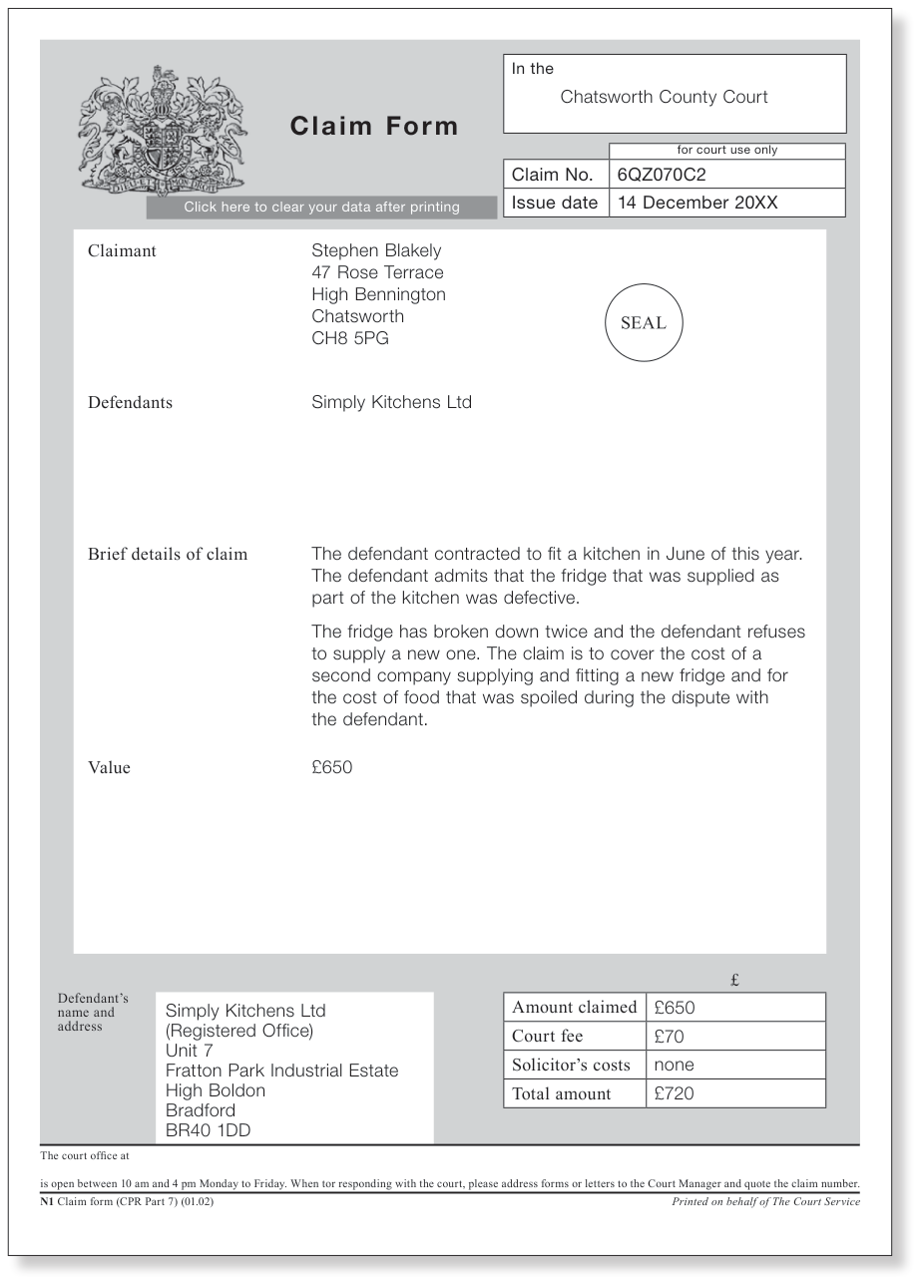

In the
Chatsworth County Court
Claim Form
Issue date 14 December 20XX
Claimant
Stephen Blakely 47 Rose Terrace High Bennington Chatsworth CH8 5PG
Defendants
Simply Kitchens Ltd
Brief details of claim
The defendant contracted to fit a kitchen in June of this year. The defendant admits that the fridge that was supplied as part of the kitchen was defective.
The fridge has broken down twice and the defendant refuses to supply a new one. The claim is to cover the cost of a second company supplying and fitting a new fridge and for the cost of food that was spoiled during the dispute with the defendant.
Value
£650
Simply Kitchens Ltd (Registered Office) Fratton Park Industrial Estate High Boldon Bradford BR40 1DD
Amount claimed £650
Court fee £70
Solicitor’s costs none
Total amount £720
Exercise 1 (p153)
Outback Adventures Ltd
15 London Road
Oxton
Hapshire 0X5 4HJ
Peter Craig
01482 685341
Company Secretary
Ms
Outback Adventures Ltd
Alice
Baker
Bradman
64 Green Line
Lettford
Hapshire 0X37 3FS
England
Directors
Dr
Shane
Bradman
Oxton
None
87 Hunts Road
Hapshire 0X2 6GP
1 4 0 7 1 9 7 9 Austrian
Travel Consultant
Directors
Mr
Craig
Oxton
England
Peter Robert
15 London Road
Hapshire 0X5 4HJ
2 1 1 1 1 9 7 9
Exercise 1 (p152)
Director’s details Director’s details Full name, including title Dr Shane Bradman Mr Peter Robert Craig Address 87 Hunts Road Oxton Hapshire 0X2 6GP 15 London Road Oxton Hapshire 0X5 4HJ Date of birth 14 July 1979 21 November 1978 Nationality Australian British Occupation Travel Consultant Managing Director Director of other companies? No No
Exercise 3 (p156)
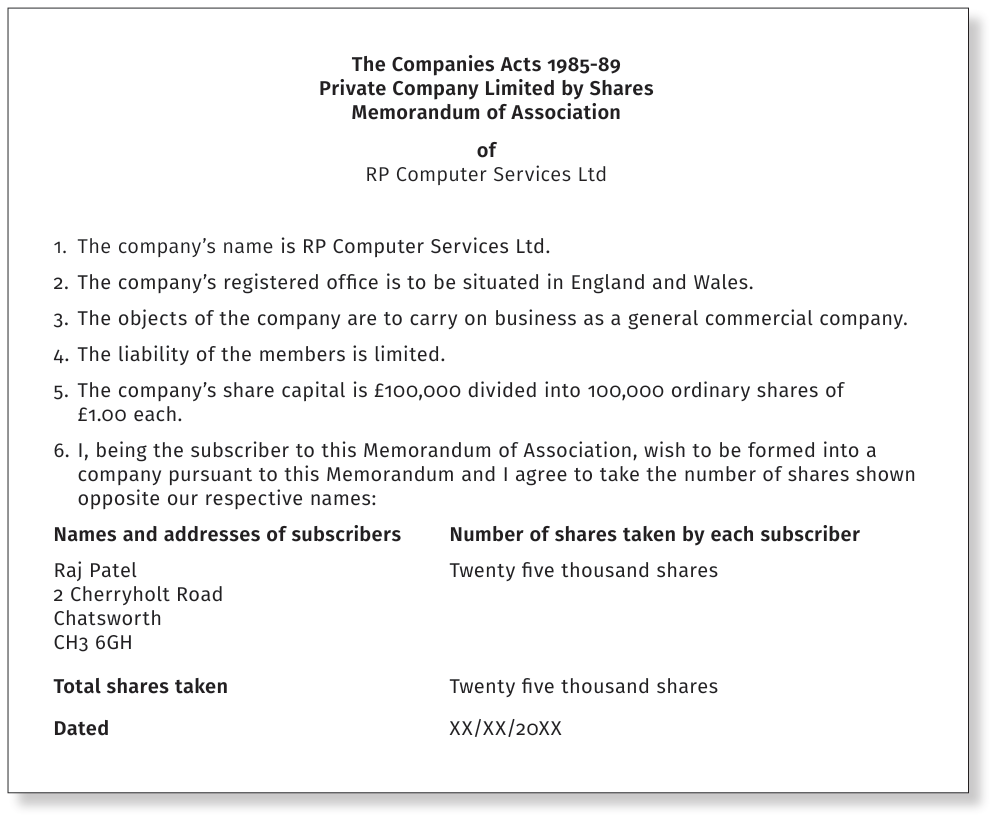
The Companies Acts 1985-89 Private Company Limited by Shares Memorandum of Association of RP Computer Services Ltd 1. The company’s name is RP Computer Services Ltd.
2. The company’s registered office is to be situated in England and Wales.
3. The objects of the company are to carry on business as a general commercial company.
4. The liability of the members is limited.
5. The company’s share capital is £100,000 divided into 100,000 ordinary shares of £1.00 each.
6. I, being the subscriber to this Memorandum of Association, wish to be formed into a company pursuant to this Memorandum and I agree to take the number of shares shown opposite our respective names:
Names and addresses of subscribers Number of shares taken by each subscriber Raj Patel Twenty five thousand shares 2 Cherryholt Road Chatsworth CH3 6GH Total shares taken Twenty five thousand shares Dated XX/XX/20XX
position to give you a bit of advice. Who would like to start?
speak in court. But it’s actually not true. Solicitors are required to do a year of practical training after their degree and that training includes advocacy, which is the skill of speaking on behalf of a client in court. If you choose to be a solicitor you will have to do this extra year of training at university. It’s called the Legal Practice Course.
S1: I’ll start, if I may. I would like to ask about the training that you had to do to become a lawyer. I know that you have to go to university and do a law degree. But what happens next?
Speaking & Writing for this topic
Two short tasks scored against TOEFL rubrics. The prompt is generated for this topic — use the vocabulary you have just studied.
Suggested structureclick to expand
- In my experience…
- From what I have seen…
- My honest view is that…
- The principal reason is that…
- This matters because…
- What makes language decisive here is…
- For instance, when I…
- A clear example is…
- Consider the case where company was involved…
- On the other hand,…
- Furthermore,…
- That said, one should not forget that…
- Overall, this shows that…
- The lesson, then, is…
- For these reasons, I believe…
- Aim for 4–5 keywords woven naturally into your answer.
- Use at least two linking phrases (Furthermore, On the other hand, As a result…).
- Avoid filler words like "basically" or "like".
Suggested structureclick to expand
- The most important point in this concept is …
- My position is that …
- The principal reason is that language …
- This is supported by …
- A concrete illustration is …
- For instance, …
- However, some argue that …
- On the other hand, …
- In conclusion, …
- Taken together, …
- Aim for 4–5 keywords used in natural context.
- Use 3+ linking words across the answer.
- Vary sentence length to avoid monotony.
THE LEGAL PROFESSION ~21 min
L: Well, let’s make it clear. When you talk about training to become a lawyer you are talking about two different professions. If you want to work as a lawyer you must first of all choose whether you want to be a solicitor or a barrister. The training for each profession is different.
UNIT LISTENING Trainee lawyer: My name is Rob Jones and I’m a trainee with a law firm. I’ve always wanted to be a solicitor and I can’t imagine doing any other job. I started working here at Taylor Wallis a year ago. Taylor Wallis is a global law firm with its headquarters in the City of London. I studied law at Manchester University but I wanted to do my training contract in London because I’m interested in insolvency law and banking and I think the best positions with the top law firms are here. I think my parents were disappointed that I didn’t become a barrister and work in chambers and wear a wig in court, but I wasn’t interested in that at all!
S1: What skills do they teach on the course?
L: A whole range of things. As we’ve already said, advocacy. You need to be confident as a solicitor when speaking in court. You are taught how to draft documents correctly. Some negotiation skills. And of course, client interviewing. Being able to interview a client well is extremely important.
S2: Really? I thought that both branches of the profession were required to do a law degree and then barristers had to find a place in chambers and solicitors had to do some training with a law firm.
S2: That all sounds good. But I have a worry about something. I’m not very good at maths. Will that be a problem?
L: Not exactly. It might surprise you to know that it’s not actually a requirement in the UK for a lawyer to have a law degree. My degree is in economics actually, although most of my colleagues in the office do have a degree in law. I studied economics for three years and then I took a one-year course at the same university, now called the Post-Graduate Diploma in law. It’s a kind of conversion course to law for people with degrees in other subjects. It was a difficultyear. It was very intensive but very enjoyable too. I learned a lot.
With this law firm the two-year training contract is divided into four periods. Each six-month period is called a ‘seat’. My first seat was in the corporate department. That really just means dealing with companies and businesses. I was involved in meeting clients, drafting documents and took part in some very high value deals. Of course, I had lots of support from the experienced people working on my team, we call them the principals, but I was surprised at how much responsibility they gave me.
L: Not really. The Legal Practice Course does cover business management skills and you will be tested on your ability to keep accounts. But that’s something that you’ll just have to learn if you really want to be a solicitor. I’m not very good at that side of things either I’m afraid, but I soon got the hang of it.
S1: And after the Legal Practice Course, are you a qualified solicitor?
L: I’m afraid not. You still need to get a training contract with a law firm and for many students that’s the difficult part. The truth is that our universities produce more law graduates than we need, so getting a training contract with a law firm is a competitive business. The training contract gives you two years of practical experience working as a solicitor. When the two years are completed you are a qualified solicitor and your name is added to the list of solicitors who are allowed to practise law — or, to give the list its correct name, the roll. The roll is kept at the headquarters of the Law Society of England and Wales, which is in London. And one more thing. Remember, qualifying as a solicitor or as a barrister is expensive. The Legal Practice Course currently costs around £7000 so you will have to pay that on top of the cost of your degree. But don’t let me put you off a career in law. I found my training very hard and very expensive but I haven’t regretted my choice of career at all.
S1: So a law firm will be happy to employ me if I have a degree in pyschology? That’s the subject that I really would like to take but I didn’t think it would be possible if I want a career in law.
My second seat was in the property department. This involved acting for clients who were buying and selling domestic and commercial property, much of it office buildings here in London. I was able to get some experience of conveyancing as well as a little landlord and tenant law when we dealt with rentals.
L: Yes, that’s right. So long as you take the conversion course you’ll be OK. Law firms like diversity. It gives them people with a wide range of skills and knowledge.
S2: That’s interesting. But I want to take a law degree and become a lawyer in the traditional way. If someone wants to be a barrister, is a law degree the best qualification for them?
Next I will be moving into the intellectual property department. I’m really pleased about that, as it covers quite a few different areas of law and can involve famous clients. At the moment the department is dealing with a breach of copyright case for a famous musician.
L: The usual route for both solicitors and barristers is to start with a law degree. The law degree in the UK is known as the LLB. This is the Bachelor’s degree in law. The Master’s degree is called the LLM. The LLB takes three years and is ideal for both solicitors and barristers. After that the training and the exams are different for the two professions.
I hope to stay with Taylor Wallis when I qualify as a lawyer next year. In fact, I’m looking forward to being based in London for most of my legal career.
EXTRA LISTENING PRACTICE L: Good morning everyone. My name is Helen Reay and I’m a solicitor in a local law firm. I’m here today because I understand that some of you are interested in a career in law and would like to ask me some questions. I’ve been working as a solicitor for over ten years now, so I’m probably in a good
Speaking & Writing for this topic
Two short tasks scored against TOEFL rubrics. The prompt is generated for this topic — use the vocabulary you have just studied.
Suggested structureclick to expand
- In my experience…
- From what I have seen…
- My honest view is that…
- The principal reason is that…
- This matters because…
- What makes legal decisive here is…
- For instance, when I…
- A clear example is…
- Consider the case where profession was involved…
- On the other hand,…
- Furthermore,…
- That said, one should not forget that…
- Overall, this shows that…
- The lesson, then, is…
- For these reasons, I believe…
- Aim for 4–5 keywords woven naturally into your answer.
- Use at least two linking phrases (Furthermore, On the other hand, As a result…).
- Avoid filler words like "basically" or "like".
Suggested structureclick to expand
- The most important point in this concept is …
- My position is that …
- The principal reason is that legal …
- This is supported by …
- A concrete illustration is …
- For instance, …
- However, some argue that …
- On the other hand, …
- In conclusion, …
- Taken together, …
- Aim for 4–5 keywords used in natural context.
- Use 3+ linking words across the answer.
- Vary sentence length to avoid monotony.
THE LANGUAGE OF BANKING AND FINANCE ~36 min
S1: What do solicitors do after their first degree? Solicitors don’t speak in court, so I suppose they don’t need to learn how to do that, do they?
UNIT LISTENING BM: Good morning Miss Finch. Thank you for coming in to see us today. I understand you’d like to take out a loan.
L: I’m not surprised that you have said that because it’s a common misconception that only barristers
AF: Yes, that’s right. I’d like to borrow £6000.
AF: Alison
EXTRA LISTENING PRACTICE RP: Good morning. It’s 7am and you are listening to Central Radio, the radio station with the latest news and travel information for central London this Thursday morning. This is Karen Malloy with our weekly look at money and finance in the Thursday Money Programme. Today’s celebrity guest is that well-known actress from the town of Westborough and London resident, Julie Barrie. Good morning Julie and welcome to Central Radio.
BM: And your surname?
BM: OK. That shouldn’t be a problem. I just need to go through the application form with you and get some information that we’ll need to process your loan.
AF: Finch
BM: Any middle name?
AF: No. Just plain Alison.
BM: Good. That’s nice and easy. And your date of birth please, Ms Finch?
AF: OK.
BM: First of all some general details. We need to confirm that you are a full- time resident in this country?
AF: 6 January 1979.
BM: OK. And do you have an email address?
AF: Yes, I live here in Chatsworth.
JB: Good morning Karen. It’s nice to be here.
AF: It’s Alison.Finch79@hotmail.com
BM: Good. And do you have a bank account?
BM: So there’s a dot between the Alison and the Finch?
AF: Yes, my account is here with your bank. I’ve had it for about four years.
RP: It’s great to have you as a guest on the money programme, Julie. Now, let’s start at the very beginning of your financial life. You were bom in Westborough in the north of England and your first job was at a local theatre. How much was your first salary?
AF: Yes, that’s right.
BM: Great. And do you have a regular income?
BM: Thanks. And your marital status please, Alison?
AF: Yes, I’m paid on the 26 of each month. My pay goes directly into my account.
AF: I’m divorced. I’ve been divorced for two years now.
BM: OK. Any dependant children? AF: Yes, one. I’ve got a little girl. BM: So you’re making this application by yourself? There’s no other applicant?
BM: Good. We just needed to be clear about those points before we start. Now, I’ve got the application form up on the screen. This should just take a few minutes and we can process your loan immediately. First of all, what is the loan for?
AF: That’s right.
JB: You couldn’t really call it a salary, Karen, because I only worked one day a week and I was paid every Friday. When I was 17 I was still at college, but I got a Saturday job at the local theatre. I was an assistant to the stage manager, which was marvellous, because I was being paid for doing something that I loved. The pay was £4 a week, which I thought was a lot of money!
BM: Have you been known by any other name over the last five years, Alison?
AF: It’s for home improvements, actually. I bought my house two years ago and it was fairly cheap because it was in a bad condition. I’d like to put in a new bathroom and a new kitchen. And I’d like to do something with the garden. It’s in a bit of a bad state.
AF: No, Finch is my maiden name. I didn’t change it when I got married. I’ve always been Alison Finch.
I got it cash in hand, which would be unusual these days. I saved £2 a week by giving it to my dad to put into his bank account for me, and the rest I spent. I was quite sensible with money as a young person, but less so now, unfortunately. These days, if I see something I want, I usually buy it!
BM: OK. And now it’s just contact details. You own your own house don’t you? So you’re not a tenant. How long have you been at your current address?
BM: Home improvements. OK. That’s fine. And what amount would you like to borrow? Did you say ten thousand?
AF: Two years and one month.
AF: No, just six thousand.
BM: And your house number please?
BM: That doesn’t seem much for the list of jobs you mentioned. Will it cover everything you have in mind? Our interest rate is very good at the moment so you could probably go a little higher if you needed to.
AF: Number 39.
RP: And where did your open your first bank account? You’re on TV all the time these days advertising the Glen Royal Bank so does that relationship go back to your early days as a saver?
BM: And your postcode?
AF: CH5 9QJ.
BM: CH5 9QJ. Right. The computer is saying 39 Belle Vue Avenue, Chatsworth. Is that your address? AF: Yes, that’s right.
AF: No, six will be fine. I’ve got quotes for everything from the builder and six covers it.
JB: My first current account was actually with the London National Bank. My local branch was in the centre of London, in a street very near Trafalgar Square. It’s not there any more. I walked past it the other day and the building is now a nightclub. The bank has closed most of its London branches because people do so much Internet banking and telephone banking these days. It’s a shame. It was handy for my drama school in Shaftesbury Avenue. I used to go in and draw out £20 every Friday in the company of city businessmen. It made me feel very rich and important even though I wasn’t at all! We had to go into the bank and queue to withdraw money in those days. It was in the 1970s, long before ATMs were around, which makes me feel very old. Most of the £20 was spent on rent. After paying the rent, I had about £4 left to live on for the week.
BM: Good. We’re nearly done. The last thing is your telephone number. Do you have a home telephone?
BM: Fine. You can always apply for more later on if you find that you need it. And what repayment period would you like? You can make your repayments over 24, 36, 60 or 120 months. That will affect the amounts of the monthly repayment of course. The payments will be considerably bigger over a shorter period of time.
AF: Yes I do. But it’s on the blink at
the moment actually. They’re coming to look at it this afternoon. So you’re better getting me on my mobile if you need to speak to me today. Anyway, my landline number is 0771 for Chatsworth, then 652 0309.
AF: I’d like to repay it over five years if I can. So that would be 60.
BM: Thanks. And your mobile? We shouldn’t need it, but just in case.
BM: Good. 60 it is. Now we move on to personal details. Are you Miss or Mrs?
AF: 0899 167 0325.
BM: Thank you. Well, that’s all the info we need for the first page. Now for the next page.
AF: Actually, I’m ‘Ms’. Do you have that title on the form?
BM: Yes, we do. Ms. And your first name please?
RP: Did you run up an overdraft? Most students do.
have an American Express card. I cut all my other credit cards up because the interest rates on them are so high. I also use my debit cards a lot instead of carrying cash with me. I don’t think it’s safe for women to carry cash in big cities nowadays. I was mugged in New York a few years ago, so now I tend not to have more than £10 in my purse. I have a son, Jason, who is 18 this year. I used to keep money at home in case he needed it but now that he’s 18 I just transfer it into his bank account. I normally do that using my bank’s Internet banking service. It’s marvellous. I often do my banking at 2am when I can’t sleep.
JB: Unfortunately, yes. When I got my first real acting job in the late 1970s I was quite badly in debt as a drama student. I had a loan of £3000, which I was paying off in instalments. I seem to remember they were £25 a month, which was a lot. I also had an overdraft. My limit was £100 so my overdraft stood at £100 most of the time I think. On one occasion I got a nasty letter from the bank because I’d exceeded my limit by £11. I never seemed to have any money!
RP: Not for long though. You got your first acting job in London at the age of 21, didn’t you? Your financial situation must have improved somewhat.
be binding. It doesn’t matter if a contract involves a large amount of money or not: a spoken contract is equally as binding upon the parties as a written one.
One of the most famous cases in this area of law is from the United States. In December 1983 a Texas company called Pennzoil agreed to buy another company called Getty Oil. The deal was done with a handshake but no contract was signed between the two companies. Pennzoil then announced the acquisition of Getty Oil.
However, a few weeks later, a third oil company called Texaco announced that it had bought Getty Oil. Remember, no written contract had ever been signed to say that Pennzoil had already bought Getty Oil. It seems that the people at Getty Oil felt that a handshake wasn’t enough to seal such an important deal. However, when Pennzoil successfully sued on the grounds that Texaco had interfered in a legally binding contract they were awarded $10.6 billion in damages. This case shows that it would be a serious mistake to think that because there is no written agreement then there is no contract.
RP: Yes, I think a lot of people do. And one final question, Julie. What’s been your best purchase up until now? The best thing you’ve ever bought?
JB: Yes it did. I got the part of Juliet in a production of Romeo and Juliet and suddenly I earned a lot more money. That must have been in 1978, the year I opened my first savings account. It was with the Glen Royal Bank. I chose them because their interest rates were very good and I opened a high interest account. I was saving for a house in London because the cost of renting was disgraceful, even in those days. I opened a savings account to get together the deposit I needed to buy the house, which was two and a half thousand. It was hard but I think it’s even harder now. I don’t know how young people can afford to live in London at all with prices the way they are.
JB: I would say a work of modem art that I bought from an exhibition at Goldsmith’s College in London. I had no money at the time and I had to borrow £60 from my parents to buy the painting. It took me two years to pay them back although luckily they were kind to me and they didn’t charge me interest. The painting is insured for a million pounds now. That was definitely my best financial move, ever.
To move on now to written contracts, they have been in use since the time of the Romans, and with good reason. A written contract helps avoid disputes. When you have a written contract, both sides know the subject matter, terms and conditions of their transaction. A written contract is usually very detailed but will generally include basic information such as:
RP: Julie Barrie, thank you very much.
JB: Thank you.
Speaking & Writing for this topic
Two short tasks scored against TOEFL rubrics. The prompt is generated for this topic — use the vocabulary you have just studied.
Suggested structureclick to expand
- In my experience…
- From what I have seen…
- My honest view is that…
- The principal reason is that…
- This matters because…
- What makes language decisive here is…
- For instance, when I…
- A clear example is…
- Consider the case where banking was involved…
- On the other hand,…
- Furthermore,…
- That said, one should not forget that…
- Overall, this shows that…
- The lesson, then, is…
- For these reasons, I believe…
- Aim for 4–5 keywords woven naturally into your answer.
- Use at least two linking phrases (Furthermore, On the other hand, As a result…).
- Avoid filler words like "basically" or "like".
Suggested structureclick to expand
- The most important point in this concept is …
- My position is that …
- The principal reason is that language …
- This is supported by …
- A concrete illustration is …
- For instance, …
- However, some argue that …
- On the other hand, …
- In conclusion, …
- Taken together, …
- Aim for 4–5 keywords used in natural context.
- Use 3+ linking words across the answer.
- Vary sentence length to avoid monotony.
THE LANGUAGE OF CONTRACT LAW ~33 min
RP: And did you save enough money to get your house in London?
JB: Indeed I did. I still live in the house that I bought in 1983 in Notting Hill. I got my mortgage from the Glen Royal Bank. It was for £75,000, which I thought was a fortune at the time. The interest rate was fixed at about 5% as I remember for the first five years. After that it was going to go up. Luckily I got a part in a film in Hollywood in 1987 and I was able to pay off my mortgage completely.
• the parties’ names
UNIT LISTENING Professor: The subject of today’s lecture is contract law and the different forms that a contract can take. Not all contracts are alike. In the UK legal system and in the USA, a legally binding contract can be created in several different ways. For example, a contract can be either oral or written. Most legal systems around the world accept the idea that a spoken agreement can be as valid as a written agreement. There is a third way to create a contract and that is in the form of a deed. Once we have established the form that a contract might take, we need to consider its scope. Contracts can be unilateral or bilateral in nature creating quite different obligations for the parties concerned.
RP: That must have been a relief to you. Paying the mortgage is most people’s major financial worry. And how about saving for your retirement? Do you have a lot of money for your old age? Or do you plan to work forever?
JB: I plan to keep on working for as long as I am offered acting roles so I hope to keep on earning money for some time yet. I’ve invested in property all my life so that is my security for my old age. I plan to keep my house in London but I have two houses in France and one by the sea in Brighton so I can sell all three houses if I need to.
• the parties’ obligations
• anything that might happen that will
excuse performance of the contract, and
• the result of a failure of one of the
parties to perform.
This is the most common type of contract and the one that you will come across most often in your professional lives.
If we now look at deeds, a deed is a contract that must be in written form in order to be legally valid. It usually grants a right to do something or to have something. A deed used to need a seal (often made from red wax) to make it valid but these days a signature is usually enough. Any contract for the sale of land must take the form of a deed.
All of these points require some explanation.
And finally, we must consider whether a contract is bilateral or unilateral. The more common of the two is a bilateral contract. This is an agreement in which each of the parties to the contract makes a promise to the other party. For example, in a contract for the sale of a car, the buyer promises
Let’s begin with oral contracts. An oral contract is a spoken agreement. In most cases it’s just as valid as a contract in writing. I am often asked if an oral contract would be binding if it were for a huge amount of consideration. Let’s say a million pounds. The answer is, yes, it would
RP: I see. And how about your financial behaviour these days? Do you have a credit card, for instance? J B: I
P: And consideration?
to pay the seller in exchange for the seller’s promise to give ownership of the car. In a unilateral contract, only one party to the contract makes a promise. A typical example is the reward contract: Anna promises to pay a reward to Kit, if Kit finds Anna’s dog. Kit is not obliged to find the dog, but Anna is obliged to pay the reward if Kit does find the dog.
S2: That’s right. And upon their return of course, the captain broke his promise. He told the sailors that they were paid to work on the ship and that they should not expect extra payment for carrying out their contractual duties.
S2: Yes, there has been an exchange of consideration. Mr Brown has agreed to pay a certain price. And Sellfest UK has agreed to carry out a service in return. Therefore, the parties have a contract.
S1: That seems unfair. I see both points of view but a promise is a promise. I think the court should have enforced the captain’s promise to pay the men.
P: Good. Let’s move on and complicate the situation a little. Let’s say that Sellfast UK does the job very well. Hundreds of people have promised to come to the event, including a few big companies. The best news is that a major catering company called the Ethical Food Company is considering providing free food for everyone who comes to the event. Mr Brown is delighted. He phones the manager of Sellfast UK a week before the event. He tells the manager that he is so pleased with the way that things are going that he will pay a bonus of £1000 if Sellfast UK can persuade the Ethical Food Company to come to the event. Now Mr Brown has promised extra consideration to Sellfast UK, hasn’t he? A potentially complicated situation for the parties, I’m sure you’ll agree. Sure enough, Sellfast UK persuades the Ethical Food Company to come to the event. The manager of Sellfast UK claims his £1000. Mr Brown refuses. He says his original payment covers everything. Is Mr Brown contractually obliged to pay the extra money?
You will need to read about the formation of contracts in your textbooks in time for tomorrow’s seminar. Please look at pages 335 -387 and be prepared to answer questions on this subject tomorrow.
Thank you.
EXTRA LISTENING PRACTICE P: Good morning everyone. The topic of today’s seminar is consideration in contract law. I hope that everyone’s read the relevant cases in your textbook. I asked you to read the 25 pages up to page 285. Let’s begin with a simple question. Can someone please name the essential elements of a contract according to English law?
S1: Intention to create a legal relationship, offer, acceptance and consideration.
P: Good. To make a valid contract all of those things must be present. Over the past few weeks we have looked at three of those elements. Today we will look at consideration. Let me start by asking you to listen to the story of a dispute between two parties. Mr Brown is worried about the environment. He is afraid that pollution and global warming are destroying our planet. Therefore, he decides to do something about his worries. He decides to hold an event to publicise the problem. He calls the event, ‘Save the Planet Day’. He decides to hold his event in St James’s Park, near his home in London, on the 5 April. He contacts a marketing company in Manchester. The name of the marketing company is Sellfast UK. Their job is to advertise the event and to attract companies to attend. Mr Brown has a telephone conversation with Sellfast UK. The manager of Sellfast UK tells Mr Brown that the cost of promoting the event is £5000. Mr Brown agrees to pay this and pays a deposit of £500 by credit card over the phone. So, a contract now exists between Mr Brown and Sellfast UK. Am I correct?
P: Well, the court of 1809 disagreed with you. One of the sailors sued. It was held that the sailors had provided no consideration for the extra payment. They had simply performed the duties that they agreed to carry out under the original contract. So, if we decide that Stilk v Mvrick is the relevant case, and we follow the principle of law that it laid down, then Mr Brown will not be obliged to pay the £1000 bonus to Sellfast UK.
S2: But I don’t think it is the relevant case in this situation. There is a much more recent precedent from 1991 that says if the defendants in a situation like this have received a real benefit, then the extra payment will be enforceable. I don’t think Stilk and Mvrick really applies here.
P: The name of the more recent case, please?
S1: The claimant was called Williams. Is it Williams v Roffev?
S1: I’m not sure. There are several relevant cases on this subject and I don’t know which one applies.
P: Good. Go on. Why is that case relevant?
P: Imagine Sellfast UK is your client. The manager wants the extra £1000 he was promised? Would you advise him to sue? As you know, a court is obliged to refer to case law. What is the relevant precedent case for a situation such as this?
S2: Because the judge held that so long as there was no duress or threat for the extra payment and that the offer of extra money was made willingly and voluntarily, the extra benefit one of the parties receives, in our case the attendance of the Ethical Food Company, should be paid for with extra consideration from the other side. I think Sellfast UK would be successful if they sued Mr Brown. If I were their solicitor, I would cite Williams v Roffev,
S1: I think the relevant case might be Stilk v Myrick? The principle of law seems to be the same.
P: Good. Go on. You are on the right track.
S1: In the case of Stilk v Mvrick some English sailors brought a claim against their employer. The facts of the case were that when a ship was at sea, several sailors deserted -they just left the ship without permission. I think the year was 1809; it was a long time ago. The captain of the ship panicked about getting back to England with so few men on board to do the necessary work. He promised the remaining sailors that if they would take the ship safely home they would receive a bonus as well as their normal pay. In fact, I think he promised to divide the wages of the deserting sailors between the sailors who stayed. The sailors agreed and expected to receive a bonus upon their return to England.
S2: Yes. All of the elements of a contract are present. One of the parties is a business, so according to case law a court will assume that there was an automatic intention to create a legal relationship.
S1: And there was clear offer and acceptance. The parties are clear as to the terms of the contract and they have both agreed to them.
P: Agreed. Well done. That is a good example of finding the correct precedent to support your client’s case. Now, let’s move on to the next situation.
Speaking & Writing for this topic
Two short tasks scored against TOEFL rubrics. The prompt is generated for this topic — use the vocabulary you have just studied.
Suggested structureclick to expand
- In my experience…
- From what I have seen…
- My honest view is that…
- The principal reason is that…
- This matters because…
- What makes language decisive here is…
- For instance, when I…
- A clear example is…
- Consider the case where contract was involved…
- On the other hand,…
- Furthermore,…
- That said, one should not forget that…
- Overall, this shows that…
- The lesson, then, is…
- For these reasons, I believe…
- Aim for 4–5 keywords woven naturally into your answer.
- Use at least two linking phrases (Furthermore, On the other hand, As a result…).
- Avoid filler words like "basically" or "like".
Suggested structureclick to expand
- The most important point in this concept is …
- My position is that …
- The principal reason is that language …
- This is supported by …
- A concrete illustration is …
- For instance, …
- However, some argue that …
- On the other hand, …
- In conclusion, …
- Taken together, …
- Aim for 4–5 keywords used in natural context.
- Use 3+ linking words across the answer.
- Vary sentence length to avoid monotony.
THE LANGUAGE OF EMPLOYMENT LAW ~29 min
seen as excluding younger people from applying.
I have prepared a fact sheet for you to collect at the end of the seminar but we will now have a question and answer session based on the new legislation.
As well as being careful about the words that you use you also need to be careful about making general statements in job adverts. For example, requiring that all applicants for a particular job have a degree if it is not really necessary to do so, might be seen as discriminating against older people. This is because younger people are more likely to have had the benefit of a university education.
UNIT LISTENING Lawyer: Good morning, ladies and gentleman. First of all, thank you very much for coming along to this breakfast seminar at Freeman Smith this morning. You are all very welcome. My name is Paul Hollingsworth and as most of you know, I’m a partner in the employment law department here at Freeman Smith.
Thank you.
EXTRA LISTENING PRACTICE L: Good afternoon Mr Winter. Please take a seat.
C: Thank you.
L: How can I help you today? I understand you have filed a claim with an employment tribunal. Is that right?
Just to make local employers here in Chatsworth fully aware of the situation, I have with me a copy of Thursday’s edition of our local newspaper, the Chatsworth Herald. As you all know, the Herald carries a jobs vacant section every Thursday. It might come as a shock to you to discover that approximately 25% of all of the adverts in the newspaper this week breach the new legislation. That means that all of these advertisers are open to claims from potential employees who might feel that they have been discriminated against on the grounds of age.
The subject of this morning’s talk is the Age Discrimination Act, a new Act of Parliament that came into force a few days ago on 1 October. This new legislation will affect all of you as employers and one of the key messages that I have for you today is the importance of complying with it in order to avoid being taken to employment tribunals by unhappy employees. From now on you should be very aware of how you treat employees with regard to their age. The new regulations will have an impact on every aspect of a company’s employment policies including pay and benefits, promotion, dismissal, redundancy and retirement and even training opportunities.
C: Yes, I filed a claim a couple of days ago for unfair dismissal against my employer. I was an officer with the West Midlands Police Force. I used to work mostly in the centre of Birmingham. They sacked me two weeks ago.
L: Oh dear. I’m sorry to hear that. On what grounds?
C: They sacked me on the grounds of my attendance record. I’ve been off work a lot the last few years. I don’t argue with that. They said I’d taken 770 days sick over the last four years, which is probably true. I hadn’t bothered to count the days, to be honest with you.
Now let’s move on to employees who are currently working for you. A case was brought against an employer in Ireland last year by a female employee aged 61. Her name is Brenda Flanagan. Brenda worked in the accounts department of a large chemical company and there is a normal retirement age of 65 for people in her position. This particular lady did not wish to retire at 65 and intended to make a request to continue working when she received notice of her retirement. The employer arranged a two-day training course for everyone in Brenda’s department on a new software package that they are going to use. The employer told Brenda that she would not be trained because she is retiring soon and it wasn’t worth spending the money on training her. Brenda took legal action against her employer immediately.
It might surprise you to learn that one of the most important areas for you to consider as employers is the language that you use in advertising job vacancies. When you are looking for new staff you have to be very aware of the words you use in any newspaper or Internet advertisement as well as in any internal memo you might write advertising a new or vacant position within the company.
To use another country’s experiences as a guide for us here in the UK, our neighbours in the Republic of Ireland introduced legislation six years ago to prevent employers discriminating against employees on the grounds of age. Our research of how things have worked out in Ireland is interesting. It tells us that most claims in tribunals have been based on discriminatory advertising rather than discrimination in the workplace. In other words, too many employers are using discriminatory language in the recruitment process. So what do you need to be aware of when you advertise a job? Well, first you should remember not to use certain words in your advert that suggest you only want people of a certain age. You might for example, face legal action from older people if you advertise for a ‘young, dynamic graduate’ to fill a position in your company. These words ‘young’ and ‘dynamic’ have been interpreted as automatically excluding older people. On the other hand, be careful of words such as ‘senior’, ‘mature’ or ‘well-experienced’ as they could be
L: That’s an awful lot of time to be off work sick. Why was that?
C: Well, that’s the unfair part. I was very badly injured when I was on duty in June, four years ago. My colleague and I were called to a house in Birmingham late one night where there was a domestic dispute. It turned out to be a very serious argument between a husband and a wife. I was kicked in the head by the man of the house during the course of the incident. I lost my hearing in my left ear for months. It’s still not completely better yet!
L: I see. That sounds terrible! So you would agree that you have had a lot of time away from work because you were ill but you would say in your defence that it’s all due to an incident that happened at work. And on the basis of those facts you claim your dismissal is unfair?
Another age-related case was brought on quite different grounds. Michael aged 55, worked in an office where most of the rest of the staff are aged 25 to 40. Everyone in the office including the manager, often met for drinks on Friday evenings but they didn’t ask Michael to join them. Michael discovered that they discussed work issues on those nights out and he felt undervalued and excluded.
C: Precisely! They are firing me for something that is not my fault. Surely they can’t do this to me?
L: Well let’s see, shall we? It depends on what procedures were followed and what the facts of the case are following the attack upon you four years ago. Let’s start at the beginning. You say you were injured at work in June of that year?
In both cases above, Brenda and Michael were successful at tribunals. Both successfully argued that they had suffered from age discrimination at work. I cannot stress to you strongly enough how important it is to be aware of the new regulations and not to suffer financially because of compensation payments to employees.
C: Yes, that’s right. The attack left me partially deaf.
L: Any other injuries? Any broken bones?
C: No. Just bruising to my face. The main problem was with my ear.
tribunal that your employer has acted unreasonably and I’m not sure that that’s true in this case.
L: I see. And did that improve? Did your hearing return?
to stop and the obvious remedy is therefore, injunction.
So, having established that the law of tort is concerned with redress and that this redress can take several forms, let’s now turn to the question of liability in tort. We would correctly term this, ‘tortious liability’. What is the scope of this liability in our legal system? It is absolutely impossible for every act in society that causes harm to another to lead the victim to demand a remedy. If, for example, I start a business such as a cafe in an area where there is already a cafe and I provide a better service, then I have caused my competitor to suffer a loss. But should I be liable for that loss? Of course not! No reasonable person would suggest otherwise. So it is therefore a fairly easy matter to establish that not all losses or harm that a person suffers can be remedied.
C: Really? So you agree with them?
C: Yes, it did. After about six months my hearing was much improved. But being away from work had left me suffering from depression. I was alone at home day after day with nothing to do. I became very miserable and I had to return to the doctor for anti- depressant tablets.
L: Not at all, you have my full sympathy. But I’m afraid the tribunal has to be realistic. On the basis of what you’ve told me today I would advise you to think again before proceeding with your claim.
C: I see. I’ll think about it. Thank you.
L: But your initial injury was better? The injury to your ear. Am I right in saying that?
Speaking & Writing for this topic
Two short tasks scored against TOEFL rubrics. The prompt is generated for this topic — use the vocabulary you have just studied.
Suggested structureclick to expand
- In my experience…
- From what I have seen…
- My honest view is that…
- The principal reason is that…
- This matters because…
- What makes language decisive here is…
- For instance, when I…
- A clear example is…
- Consider the case where employment was involved…
- On the other hand,…
- Furthermore,…
- That said, one should not forget that…
- Overall, this shows that…
- The lesson, then, is…
- For these reasons, I believe…
- Aim for 4–5 keywords woven naturally into your answer.
- Use at least two linking phrases (Furthermore, On the other hand, As a result…).
- Avoid filler words like "basically" or "like".
Suggested structureclick to expand
- The most important point in this concept is …
- My position is that …
- The principal reason is that language …
- This is supported by …
- A concrete illustration is …
- For instance, …
- However, some argue that …
- On the other hand, …
- In conclusion, …
- Taken together, …
- Aim for 4–5 keywords used in natural context.
- Use 3+ linking words across the answer.
- Vary sentence length to avoid monotony.
THE LANGUAGE OF THE LAW OF TORT ~36 min
C: It wasn’t completely better but the doctor said despite that, I was fit to return to work after six months, yes. It was my psychological condition, not my physical condition, that left me unable to work.
UNIT LISTENING Professor: Today’s lecture is a general introduction to the law of tort. First of all, let’s ask ourselves ’what
are the aims of this area of law?’ Why do we need to have a law of tort, or as some people call it, the law of obligations, at all? Those are questions that really require a lengthy answer because the law of tort covers so many different situations in life. On a very general level however, we can say that the law of tort is concerned with the idea of redress.
L: I see. And what did your employer have to say about that?
C: My supervisor was a woman called Roz Shannon. She was extremely unreasonable. Not very sympathetic, to say the least! She told me after I’d been absent for a year that she was doing all she could to help me and that I had another 12 months to improve my attendance record. She said that as long as I was employed she couldn’t recruit anyone to replace me and my colleagues needed help. It was horrible. I was made to feel very guilty.
In general, the scope of tortious liability is as follows. The law says that I have an automatic duty of care towards other people in general. It doesn’t matter who they are or whether or not I have any kind of relationship with them. I nevertheless have a civil duty not to harm them in any way. I am not allowed by law to hurt another person physically or to harm their reputation. This duty is independent of any kind of contractual agreement. The duty exists in the law itself and does not depend on the consent of the parties as it does in the law of contract. To give you an example, the law of tort says that I have an automatic duty not trespass on your land. An automatic duty. The duty exists because the law says so and not because I have made any private agreement with you to undertake such a duty.
Students often ask me for a precise definition of ‘redress’, because it’s not a word that you hear used in the street every day. I would say that redress means to remedy a wrong. To restore the balance of things. A person who has suffered a wrong wants to be put back in the situation that they were in before. A member of the public will usually describe this as a process of compensation rather than redress. This is probably because the claimant, in the vast majority of tort actions that come before the courts, is seeking monetary compensation for the wrong that he or she has suffered. To those in the legal profession, this monetary compensation is more correctly known as ‘damages’. So please don’t confuse the two terms. Redress and compensation are quite different things.
L: There’s a good chance that she will say exactly that at the tribunal. It’s a fair point to make, that they couldn’t do without you for too long, especially once you had recovered from your initial injury. I’m afraid that some employers are not too sympathetic about depression and believe that going back to work is the best solution to the problem.
C: That’s exactly the attitude she had! She wrote me a letter last week saying that she would file a defence saying I’d only managed to work for six weeks in the last four years and that I refused to return to work.
Of course, in practical terms there is often an overlap in any real-life situation between the law of contract and the law of tort. If we take the example of a company supplying a defective product to a group of consumers, this may result in concurrent liability in contract and tort. In other words, the company may be liable in both areas of law at the same time. The claimant may not of course, recover damages twice! Similarly, tort and crime overlap. There are some torts that are also crimes, sometimes with the same names in both areas of law, for example, assault. Assault is both a crime and a tort. In some cases the evidence from a criminal trial is used in a later civil action based on the same offence. Let’s look at a criminal case involving a road traffic accident, for example. The state will bring a criminal prosecution if the driver of a vehicle caused an accident and he or she was breaking the criminal law. The evidence from the criminal case may then later be
Let’s stick with the idea of redress for a moment. We’ve established that monetary compensation is one type of redress. What else can the courts offer to the injured party? Well, in many cases the claimant is not seeking money at all, but an injunction to prevent the occurrence of harm in the future. If we take as an example a case of the tort of nuisance, which is the tort of interfering with an individual’s enjoyment of his or her land, you can clearly see that the defendant is engaged in a continuing act. Let’s say the nuisance is one of noise. Damages are available to the defendant but are clearly not the desired remedy for a claimant who is suffering over a long period of time. The claimant wants the nuisance
L: And is that true? Have you only worked for six weeks since the attack?
C: Yes. I was recovering from the attack at work and became depressed. Then my closest friend moved away to Australia and that made me worse. My mother became very ill. Everything seemed to be too much for me. They offered me the chance to go back on a part- time basis at first but I couldn’t even manage that.
L: I see. Well Mr Winter, if your employer has followed the correct procedures and has tried to support you in your return to work, I don’t really think you have much chance of success. You will have to convince the
used as evidence of negligence in civil proceedings.
was totally unacceptable. I had a terrible row with the boy’s father at that meeting. He said that his son was a good lad and that I was victimising him. They insisted that the boy had the knife only because he was going fishing after school. It was a nasty business. The father was outraged about it. But, luckily the headmistress agreed with me. The boy was ordered out of the school without taking any of his final exams. I believe he works as a window cleaner these days.
The conclusion is to look at the law of tort as part of the wider law. Some legal commentators have somewhat unfairly termed it as ‘the dustbin’ or ‘the garbage can’ of the law of obligations. They mean it is there simply to deal with cases that other, longer established areas of law cannot deal with. I disagree. The law of tort exists for good reason and it is an essential area of expertise for the modern lawyer.
libellous comments to be removed immediately and the defendant was ordered to pay £1,250 in damages and costs of £150. Of course, the local
newspaper ran the story and everyone in the town could see that the teacher was the victim of a libel.
C: Can we start action immediately? The sooner that this is over the better.
L: I have a feeling we won’t need to. We’ll make some enquiries to find out who the Internet Service Provider is who hosts the website. We’ll write to them and to Mr Hetherington and say that if the defamatory comments are removed immediately and there is a public apology then we will be willing to settle out of court.
L: And has this story been mentioned on the website? Because if a story is true you know, we can’t usually defend it. What happened may have been unpleasant but if the facts are correct then there’s probably not much we can do.
EXTRA LISTENING PRACTICE L: Good afternoon Mr Kelly. Please take a seat.
C: Thank you.
L: I will need to take a few details about you in a moment, as you are a new client. You seem very upset. How can I help you today?
C: Let’s do that then. Could you start the process today? I’m not interested in the damages so much as making sure my good reputation is restored. If we can get some money out of him I’ll donate all of it to charity, then I’ll have a much needed holiday! I would like my legal costs to be covered though. I don’t see why I should have to pay for his stupidity.
C: No, not at all. This story hasn’t been mentioned. But Gary Hetherington is a member of the FriendsAgain website and he has written a lot about me that is most definitely not true!
C: Yes, I am very upset. I was told by a good friend of mine that you are an excellent libel lawyer, Miss Reay. I hope you can help me because my life has been absolutely destroyed by untrue rumours. My wife and I have even thought about moving to France to get away from it all. It’s been a terrible time for us.
L: Has he really? That’s a different matter. Can you tell me what’s been written?
L: Certainly. And don’t worry about this. The law in the UK says that once an Internet Service Provider is aware of a defamation they have a legal duty to remove it immediately. If they don’t remove it within a reasonable period of time they too can be liable for damages. That rule was established in this country as long ago as 1996.1 imagine the Service Provider will insist that it’s removed pretty quickly once they receive our letter. Which will hopefully be within a day or two.
C: Actually, I’ve printed off his comments. I can email them as well if you like. Here... it fits onto one sheet of paper but it’s devastating none the less.
L: Oh dear. I’m very sorry to hear that Mr Kelly. We do have a good reputation for our work on defamation cases at this firm. I’m sure we can help you. Would you tell me a few details about what has happened to you?
L: Thank you. So he says, ‘Does anyone remember that miserable, boring Kelly? The big, fat idiot that taught us French? Did you know that he was thrown out of the school in 1990? The headmistress found out that he was having an affair with one of his 16 year-old pupils and fired him immediately.’
C: Certainly. The rumours started on the Internet. Have you heard of a website called FriendsAgain.com? It’s a website where people can get back in touch with their old school friends.
C: Thank you Miss Peay. You have no idea what a relief this is to me.
C: That’s exactly what he says. Of course, I retired in 1990, everyone who was at the school at that time knows that. But the people reading that website clearly don’t know that. People keep on sympathising with my wife. An old friend of ours rang from Australia last week to say how sorry he was. I feel that I can’t hold my head up in this town at all. Is there anything we can do?
L: Yes, I know of it. I think most people have heard about that website. When you join the website you can chat to old school friends. Am I correct?
C: Yes, that’s the one. I’m not a member myself but I was a teacher at St Bernadette’s school in Middleton between 1975 and 1990. I’m retired now of course.
L: Don’t worry Mr Kelly. We’re here to help. Let’s get some details from you and we can get the ball rolling.
Speaking & Writing for this topic
Two short tasks scored against TOEFL rubrics. The prompt is generated for this topic — use the vocabulary you have just studied.
Suggested structureclick to expand
- In my experience…
- From what I have seen…
- My honest view is that…
- The principal reason is that…
- This matters because…
- What makes language decisive here is…
- For instance, when I…
- A clear example is…
- Consider the case where tort was involved…
- On the other hand,…
- Furthermore,…
- That said, one should not forget that…
- Overall, this shows that…
- The lesson, then, is…
- For these reasons, I believe…
- Aim for 4–5 keywords woven naturally into your answer.
- Use at least two linking phrases (Furthermore, On the other hand, As a result…).
- Avoid filler words like "basically" or "like".
Suggested structureclick to expand
- The most important point in this concept is …
- My position is that …
- The principal reason is that language …
- This is supported by …
- A concrete illustration is …
- For instance, …
- However, some argue that …
- On the other hand, …
- In conclusion, …
- Taken together, …
- Aim for 4–5 keywords used in natural context.
- Use 3+ linking words across the answer.
- Vary sentence length to avoid monotony.
THE LANGUAGE OF BUSINESS LAW ~41 min
UNIT LISTENING L: Good morning, Mr Craig. I’ve got all the documents we need here to set up your company. I’ll go through them with you and we’ll fill them in now, then you’ll be able to sign them. First of all, we must complete this form. It’s called Form 10 and it gives information about the first directors of the company. First of all, the company name. It’s Outland Adventures, isn’t it?
L: Yes, there is. There is a very recent precedent in English law that helps us enormously with your situation. In 2002 a very similar case came before the County Court in Lincoln. A teacher named Jim Murray had been libelled by a former pupil on a very similar website to this one. In fact, the defendant in that case strangely enough, is now a teacher himself so it was pretty unbelievable that he could have made such stupid remarks.
L: I see. Please go on.
C: Well as you can imagine, I’ve taught thousands of pupils in my time. I was a modern languages teacher, mostly French and German you know. I’m afraid I was a strong disciplinarian. I was strict with my pupils but they usually got good exam results. But I wasn’t very popular with some of the kids. In fact, one of my worst behaved pupils, Gary Hetherington, was expelled from the school. That must have been in 1980 or 81. I was present at a meeting with him and his parents and I insisted that he would not be allowed back into my class. He brought a knife to school, which
C: Well, that was the name we were using up to yesterday. But Shane, who is the other person who’s setting up this company with me, and I have decided that we want to call it Outback Adventures, to show that we’re specialising in trips to Australia.
C: You mean this has happened before? And the teacher sued?
L: Precisely. On the grounds that he was the victim of a serious defamation. And he won. The court ordered the
L: I see. So what we’ve got to do now is check that the name is available for you.
L: And does she prefer Mrs or Ms?
C: Better put Ms.
for 15 years. However, I got a good redundancy package and this meant that I could survive for 24 months without an income. I decided I would turn this into a positive experience and do what I have always wanted to do, which is to become my own boss. I decided to set up a business sourcing and selling goods from Asia and Africa. Not all types of goods, but concentrating on art. Paintings, textiles and sculptures, in particular. All of my business is done online — I have travelled extensively all over the world and have made a lot of really good contacts, so I thought I could successfully combine this with my computer skills. Also, working with the Internet meant I could work from home without a lot of additional funding.
L: And when will Ms Baker be able to sign the form?
C: How do we do that?
L: Oh, it’s an easy procedure. We search the register of names to see if the name is already being used. If it is, you won’t be able to use it. We can make a search online. Here we are. I’m putting in your proposed name... yes, yes, that’s available. Good. Let me write that on Form 10... Outback Adventures Ltd.
C: She’ll be coming in to sign it with Shane at lunchtime today.
L: Good. Right the last thing we need is the directors’ details. I understand that you and Shane will be the directors? Shane’s surname is Bradman isn’t it? We have to list the directors in alphabetical order so Shane’s details need to go first. It’s Shane, spelt S-H-A-N-E and Bradman spelt B-R-A-D-M-A-N, isn’t it?
C: Why have you added Ltd on the end of the name?
L: Ltd stands for Limited. If you’re setting up a private limited company as you are, then by law the name of the company must end either with the word Limited, or the abbreviation, Ltd.
C: Yep. He doesn’t have a middle name. But he’s actually a Dr. He did a PhD degree in ecotourism.
I considered the type of structure that would be best for my business and decided to set up a private limited company. I wanted to give the impression that it was a bigger business than just me working in the spare bedroom! By being a private limited company I can sign myself as director on all my correspondence with customers and suppliers. People’s perceptions are really important.
L: Right. And his address?
C: I see. What’s next?
C: 87 Hunts Roads, Oxton, Hapshire, 0X2 6GP.
L: I need your registered office address. The registered office is the place where all official documents will be sent, for example, tax documents, and communications from Companies House. Also, if someone sues the company, he or she can send the claim form to the registered office.
L: And what’s his date of birth?
C: 14 July 1979.
L: And his nationality?
C: Oh, he’s an Aussie.
L: OK, let me just write that. There, Australian. And his business occupation is...?
C: I’ll use my home address. It’s 15 London Road, Oxton, Hapshire.
I thought about buying an off-the-shelf company from a company formation agent, but in the end I decided to see a lawyer because I don’t know anything about the law involved in setting up a company and I wanted to make sure everything was done properly. I also wanted to make sure the company was set up exactly for our purposes. The lawyer acting for us did a great job and said we could incorporate the company under the name of our choice. There are a lot of rules about names which surprised me. Obviously you can’t use a name which might cause offence to people, and you can’t use a name that an existing company has, or one that’s very similar to it. There are also some words that you have to get special permission to use in a company’s name, such as ‘English’.
C: Put down travel consultant.
L: Hapshire is H-A-P-S-H-l-R-E?
L: And finally, has he been a director of any other company in the last five years?
C: Exactly.
L: And the postcode?
C: 0X5 4HJ
C: No.
L: OK. The next section is only used if an agent is acting for you, so we don’t need to complete it. Next, are the contact details. You can choose if you want to complete this or not. It’s so that if the staff at Companies House have any questions about the form, they know who to contact.
L: Thank you. Now I need your details, Mr Craig. I’ve got your name and address.
C: Yes, except my middle name. That’s Robert.
L: And your birthday?
C: 21 November 1978.
C: OK, put my name, Peter Craig and my phone number, which is 01482 685341. Then I see the form has a space for DX number. What does DX mean?
L: And your nationality is British?
C: Yes.
L: Now we have to complete your business occupation.
L: That means document exchange. It’s a special type of postal service. Instead of sending letters by the normal postal service, law firms usually use DX — it’s quicker and usually cheaper than the ordinary post. I’ll leave it blank, as it doesn’t affect you. Now, the Company Secretary.
I wanted to make sure that we could use the name as a domain name on the Internet as well as using it as the company name. We wanted to call it Executive Art, but when I did an online Companies House search to see if the name was available, it wasn’t. We finally chose Exclusive Art Ltd.
C: Oh, put Managing Director. That sounds very important!
L: Right, and have you been a director of any other company within the past five years, Mr Craig?
C: No.
L: Great, that’s all done. All it needs for you is to sign just here... and here, where it says signed by the subscribers. The subscribers are the first shareholders of the company. Good. And Shane and his sister can sign it when they come in.
C: That’s going to be Shane’s sister. She works for a big finance company. She’s called Alice Bradman, no, wait, that was her maiden name. She got married last year, now she’s...let methink... ah yes, Baker. I’ve got her address written down here you are. 64 Green Lane, Lettford. That’s with a double T, L-E-double T- F-O-R-D. That’s also in Hapshire. Postcode is 0X37 3FS.
Anyway, our solicitor asked us a lot of questions and drew up a number of documents including the Memorandum and Articles of Association. My wife, Judith, and I are the only shareholders and we are both directors of the company. We had to appoint a company secretary too, and luckily for me Judith’s friend agreed to be our company secretary. She’s a lawyer although she doesn’t practise now as she has two young
EXTRA LISTENING PRACTICE Paul Evans: My name is Paul Evans, was made redundant 12 months ago. I was very upset when it happened as I had worked for the company
children. We had to decide on the amount of capital that the company has. There are two different capital values, the authorised share capital and the issued share capital. I’ve learned a lot in setting this company up! Basically, the authorised share capital is the total nominal value of shares that the company is allowed to issue and the issued share capital is the amount the company actually does issue. I think that’s right! Our lawyer advised us on the amounts. Then we had to choose a registered office. We just use our home address. Obviously if we rent an office, which I think we will do soon, we might change the address of the registered office. The other document which our lawyer drafted for us, the articles of association, contains all the rules and regulations of the company. It covers things like company meetings, notice periods, directors’ payments, issuing shares and so on. It’s pretty complicated and to be honest I started to read it but soon gave up because it is so complicated! But our solicitor ran through the most important points with us. We had to pay a fee to register the company, and two weeks after we sent all the documents to Companies House we received the certificate of incorporation. That was four months ago. We’ve already got two good orders from some big customers. I know it’s not going to be easy, but it’s an exciting time for us.
the company and therefore generally only the company can enforce them. The Act then lists seven specific duties. The first duty is the duty of a director to act within the company’s constitution and only exercise powers for the purpose for which they are intended. The second duty found in section 172 is the duty to promote the success of the company for the benefit of its members as a whole. This new duty broadly replaces the common law fiduciary duty to act in the “best interests of the company” that I mentioned earlier. In fulfilling the duty to promote the success of the company, the Act says that the directors must have regard to a long list of specific factors. These include the likely long-term consequence of any decision, the interests of the company’s employees, the company’s business relationships with suppliers, customers and others, the impact of the company’s operations on their community and the environment and so on. There was considerable criticism of this new duty, with people expressing fears that directors will be more defensive in their actions. This is because directors must consider this long list of factors with every action they take. Time will tell whether this happens or not.
I’ve prepared a fact sheet for you, summarising your duties as a director under the new legislation, which you can take before you go. Now, are there any questions about what I’ve mentioned before we move on the next point?
EXTRA LISTENING PRACTICE
Hello and welcome to the Banking and Insolvency department. My name is Kim Watts and I’m very pleased to meet you all.
This is quite a large department doing a lot of varied work. I specialise in insolvency. Most of our clients are either banks or companies. The banks have generally made a large loan to a company, often secured by a debenture, and now the company is failing to make its repayments on the loan, because it is in financial difficulties. The bank instructs us to assist with the recovery of the debt. Our other clients represent the other side of the coin. They are companies who are facing insolvency and they come to us for advice on the best way forward.
The most common description of insolvency is that a company cannot pay its debts when they become due. There are various insolvency procedures that are available to companies. I’d like now to briefly outline these procedures, as they often cause confusion until you become more familiar with them.
The third duty is to exercise independent judgment, while section 174 deals with the fourth duty, which is to exercise reasonable care, skill and diligence. An important factor to consider in this area is the individual director’s level of specialist knowledge. The common law principles are now clear. Directors who have specialist knowledge must exercise greater care and skill than those who do not have this particular knowledge. Similarly, different skills will be expected of, say a finance director and a personnel director.
Speaking & Writing for this topic
Two short tasks scored against TOEFL rubrics. The prompt is generated for this topic — use the vocabulary you have just studied.
Suggested structureclick to expand
- In my experience…
- From what I have seen…
- My honest view is that…
- The principal reason is that…
- This matters because…
- What makes language decisive here is…
- For instance, when I…
- A clear example is…
- Consider the case where business was involved…
- On the other hand,…
- Furthermore,…
- That said, one should not forget that…
- Overall, this shows that…
- The lesson, then, is…
- For these reasons, I believe…
- Aim for 4–5 keywords woven naturally into your answer.
- Use at least two linking phrases (Furthermore, On the other hand, As a result…).
- Avoid filler words like "basically" or "like".
Suggested structureclick to expand
- The most important point in this concept is …
- My position is that …
- The principal reason is that language …
- This is supported by …
- A concrete illustration is …
- For instance, …
- However, some argue that …
- On the other hand, …
- In conclusion, …
- Taken together, …
- Aim for 4–5 keywords used in natural context.
- Use 3+ linking words across the answer.
- Vary sentence length to avoid monotony.
THE LANGUAGE OF COMPANY LAW ~19 min
UNIT LISTENING: Lawyer: Good morning, ladies and gentlemen. Thank you for coming to this seminar. This morning’s topic is the role of company directors following the recent introduction of new legislation. This affects all companies in the United Kingdom. The role and duty of directors has developed over the years from case law and statute. You are all aware of the fiduciary duty of the director to the company. Directors have this fiduciary duty because they are in a position of trust and confidence in relation to the company. Directors have a general obligation to act in good faith and in the best interests of the company and not for any improper purpose. They mustn’t, for example, make a secret profit out of their position.
First is the compulsory liquidation of a company. This is when the court orders the company to be wound up. Winding up usually starts by a creditor making a petition on the grounds that the company cannot pay its debts. The Official Receiver, who is an officer of the court, becomes the liquidator of the company and he or she has a duty to investigate the company’s affairs and the causes of its failure, including the conduct of the directors. A director can be disqualified from acting as a director for a period of time if, for example, he or she made the position of the creditors worse by continuing to trade when the company was insolvent. When the winding up is complete, the company is formally dissolved and it no longer exists.
Section 175 provides for the fifth duty, which is to avoid conflicts of interest. A director must avoid a situation in which he or she has, or can have, a direct or indirect interest that conflicts, or possibly may conflict with, the interest of the company. This duty is not infringed however, if the matter has been authorised by independent directors, so long as the director in question does not form part of the quorum making the decision. For those of you from companies having two directors with a quorum requirement of two be careful!
A director’s duties were not clearly stated in statute until 2006. However, following the Companies Act 2006, there is a now a statutory statement of directors’ duties. This was done so that the law is made clear for directors. The codified duties are contained in sections 170 to 177 of the Act. Section 170 makes it clear that the duties of a director are owed to
Next is administration. This is a court order made to appoint an administrator to manage the company’s affairs. A court may make an administration order when the company is unable to pay its debts and the court considers that by making an administration order, the whole or part of the company may be saved as a going concern. The company, its directors or its creditors start the procedure by making a petition against the company. While an administration order is in force, the company cannot be wound up and
The sixth duty is not to accept benefits, including bribes, from third parties, while the final duty is the duty in section 177 for a director to declare his or her interest in a proposed transaction before the transaction is entered into. If a director breaches this duty, he or she commits an offence, which may result in a fine.
experience of all these procedures during your six-month period with this department. We have a great team here and everyone will be very happy to answer any questions you have, so please feel free to come to any of us at any time.
legal proceedings against the company cannot be started except with approval of the court. The administrator takes control of all the property of the company and makes proposals for the creditors to consider. The administration order continues until the court decides that the order is no longer needed and formally discharges it.
Another insolvency procedure is receivership or administrative receivership. A receiver is appointed by the holder of a debenture of the company secured by a floating charge. Usually this is a bank. The company is said to be “in receivership”. The receiver has the power to sell the assets covered by the floating charge and give the proceeds to the charge-holder.
A further procedure is a company voluntary arrangement. We call this a CVA. This is when a company makes an agreement with its creditors in order to settle its debts over an agreed period of time. The agreement has to be approved by the court. Meetings of the company and creditors are called to approve the proposed arrangement. Once approved, all creditors who had notice of the meeting and were entitled to vote are bound by the terms of the arrangement. The company can continue trading during the CVA and afterwards.
Finally, there are two types of voluntary liquidation. Members’ voluntary liquidation means that the directors have made a statutory declaration of solvency — in other words, the directors believe that a company is solvent. This happens when a family business is sold off, for example, or if the purposes of the company have come to an end. The liquidation starts when the members, in a general meeting, pass a resolution to wind up the company voluntarily. Remember, if it is a voluntary liquidation, the company is not insolvent.
In the case of a creditors’ voluntary liquidation, the company cannot pay its debts. The process is started by the directors, not the creditors. The company carries an extraordinary resolution to say that it cannot continue in business because of its liabilities and that it is advisable to wind up. A liquidator is appointed to wind up the company’s affairs. The liquidator does this by realising the company’s assets and paying its creditors. If anything is left over, the members of the company receive it.
In both types of voluntary liquidation, when the company’s affairs are fully wound up, the formal dissolution of the company occurs and it ceases to exist.
Well, I hope that this helps just a little. I am sure that you will gain some
Speaking & Writing for this topic
Two short tasks scored against TOEFL rubrics. The prompt is generated for this topic — use the vocabulary you have just studied.
Suggested structureclick to expand
- In my experience…
- From what I have seen…
- My honest view is that…
- The principal reason is that…
- This matters because…
- What makes language decisive here is…
- For instance, when I…
- A clear example is…
- Consider the case where company was involved…
- On the other hand,…
- Furthermore,…
- That said, one should not forget that…
- Overall, this shows that…
- The lesson, then, is…
- For these reasons, I believe…
- Aim for 4–5 keywords woven naturally into your answer.
- Use at least two linking phrases (Furthermore, On the other hand, As a result…).
- Avoid filler words like "basically" or "like".
Suggested structureclick to expand
- The most important point in this concept is …
- My position is that …
- The principal reason is that language …
- This is supported by …
- A concrete illustration is …
- For instance, …
- However, some argue that …
- On the other hand, …
- In conclusion, …
- Taken together, …
- Aim for 4–5 keywords used in natural context.
- Use 3+ linking words across the answer.
- Vary sentence length to avoid monotony.