
The Language of Business Law
INCORPORATED AND UNINCORPORATED BUSINESSES ~20 min
Lawyers often talk about the differences between incorporated businesses and unincorporated businesses. Look at each of the words and phrases in the blue box and decide if it is connected with:
a incorporated businesses
b unincorporated businesses legal entity member partnership limited liability partnership private limited company corporation tax share joint and several liability unlimited liability public limited company dividend limited liability partner sole trader
Look at the following list of five different business structures. Read what the people say below and match their businesses with the correct business structure.
a Esther Jackson: ‘We set up our business together two years ago. I’m an accountant and Mark is a builder.
We trade under the name of MH Property Services. Mark does all the building work while I deal with all the paperwork. Mark and I share all the profits. We didn’t have to register the business anywhere, but we joined the local small builders’ association. We took out a loan from the bank when we set up, to buy a van and any tools that Mark needed. The bank insisted on securing the loan on our house, but as we were confident about the future of the business, we decided to take this risk. We’re doing quite well at the moment.’
This type of business is a
b Harriet Higgins: ‘I own shares in Express Enterprises, which I bought two years ago through a stockbroker.
Express Enterprises has just announced that it has made record profits this year. It has declared a dividend, which provides an excellent return on my investment. This dividend is to be distributed soon. All of the shareholders will be delighted that the price of shares has risen by 21 pence each since this announcement was made. Stockbrokers are reporting that a lot of people are interested in buying Express Enterprises’s shares.’
This type of business is a
c Hassan Abdullah: ‘I own a specialist business consultancy firm. I have office premises in Birmingham and I employ two full-time employees. I have just completed the annual return for the last year of trading, providing details of the capital, the shareholders, address of the registered office and other information. My accountant is preparing the annual financial accounts. Business fluctuated last year, but I am optimistic that it will grow and provide a steady income.’
This type of business is a
d Elliot Solomon: ‘The four of us set up our accountancy business about 18 months ago. After considering the options, we decided on this type of business structure. Most new professional services are using this structure. There is less risk involved as we are only liable for the amount of money we contributed to the business. Tax was another consideration. We didn’t want to pay corporation tax which is generally at a higher rate, so we opted for this. We each have to pay income tax on our share of the business profits.’
This type of business is a
e Suzanne Marshall: ‘I am a maths teacher. I used to work in a big school, but decided that I wanted to do private tutoring, specialising in helping children who find it difficult to understand maths. The business is very successful and I have a waiting list of parents who are interested in their children having lessons with me. I don’t want a big business, I’m happy just doing the hours I want. I can be as flexible as I want. If I need more money, I just accept extra pupils. The business is easy to run and I’m not restricted by rules and regulations.’
This type of business is asole traderCollocation bank
to trade under a name ‘The business is owned by Mr Fox, and trades under the name of “Foxgloves”.’ • to insist on something ‘I advised her to settle the case, but she insisted on taking legal action.’ • to be confident about something ‘He took his law exams last week and he says that he is confident about the results.’ • to own shares in a company ‘My uncle owns shares in Harlax plc and also in Janson plc.’ • to be interested in doing something ‘I am interested in buying shares in Next Express plc.’
‘I own shares in a number of companies which provide me with a good return on my investment.’ • to decide on something ‘Our lawyer advised us about the different business structures and we finally decided on a partnership.’ • to opt for something ‘At first we wanted to set up a private limited company, but in the end we opted for a partnership.’ • to be restricted by something ‘Companies are restricted by a lot of rules and regulations.’
Speaking & Writing for this topic
Two short tasks scored against TOEFL rubrics. The prompt is generated for this topic — use the vocabulary you have just studied.
Suggested structureclick to expand
- In my experience…
- From what I have seen…
- My honest view is that…
- The principal reason is that…
- This matters because…
- What makes sole trader decisive here is…
- For instance, when I…
- A clear example is…
- Consider the case where limited liability was involved…
- On the other hand,…
- Furthermore,…
- That said, one should not forget that…
- Overall, this shows that…
- The lesson, then, is…
- For these reasons, I believe…
- Aim for 4–5 keywords woven naturally into your answer.
- Use at least two linking phrases (Furthermore, On the other hand, As a result…).
- Avoid filler words like "basically" or "like".
Suggested structureclick to expand
- The most important point in partnership is …
- My position is that …
- The principal reason is that sole trader …
- This is supported by …
- A concrete illustration is …
- For instance, …
- However, some argue that …
- On the other hand, …
- In conclusion, …
- Taken together, …
- Aim for 4–5 keywords used in natural context.
- Use 3+ linking words across the answer.
- Vary sentence length to avoid monotony.
SOLE TRADERS ~14 min
José Perez is a website designer. He is thinking about starting his own business and yesterday evening he went to a talk given by the local BusinessConnect office, which gives information to entrepreneurs. Look at José’s notes and match the headings in the blue box with the correct summary in the notes.
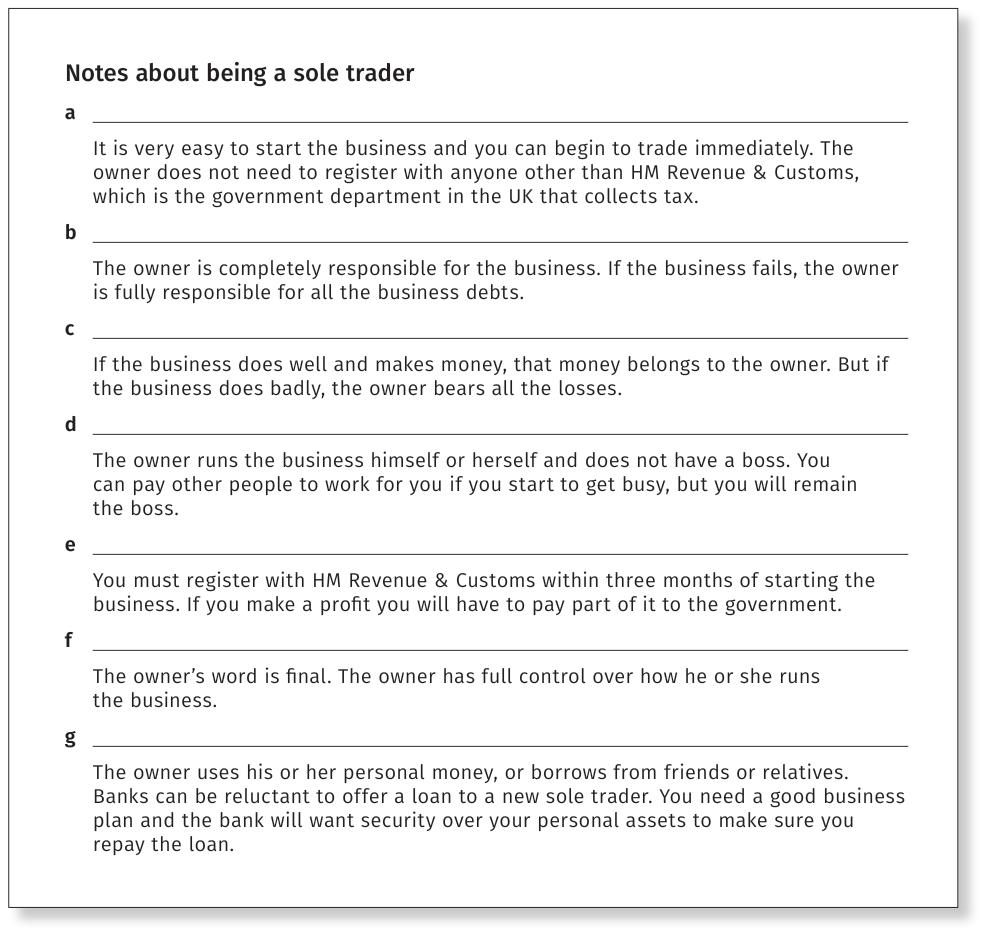
Notes about being a sole trader
- aIt is very easy to start the business and you can begin to trade immediately. The owner does not need to register with anyone other than HM Revenue & Customs, which is the government department in the UK that collects tax.
- bThe owner is completely responsible for the business. If the business fails, the owner is fully responsible for all the business debts.
- cIf the business does well and makes money, that money belongs to the owner. But if the business does badly, the owner bears all the losses.
- dThe owner runs the business himself or herself and does not have a boss. You can pay other people to work for you if you start to get busy, but you will remain the boss.
- eYou must register with HM Revenue & Customs within three months of starting the business. If you make a profit you will have to pay part of it to the government.
- fThe owner’s word is final. The owner has full control over how he or she runs the business.
- gThe owner uses his or her personal money, or borrows from friends or relatives. Banks can be reluctant to offer a loan to a new sole trader. You need a good business plan and the bank will want security over your personal assets to make sure you repay the loan. Collocation bank
‘I am going to register with the local association of small businesses.’ • to be responsible for something ‘You are responsible for notifying us if you change your address.’ • to do something within a period of time ‘I need to answer that letter within five days.’ • to have security over assets ‘The bank has security over my house.’
to borrow something from someone ‘I had to borrow £100 from my dad last week as I had no money to pay my rent.’ • to belong to someone ‘The house belonged to my uncle before he died.’ • to have control over something ‘He has full control over the banking arrangements of the business.’
José Perez is talking about the advantages and disadvantages of being a sole trader. Using your knowledge of collocations and prepositions, correct the language below.
‘I considered all the advantages and disadvantages when I (a) created my business and in the end I opted (b) to a type of business in which I am called a sole trader. It is easy to (c) operate and you don’t need to register (d) to anyone except the tax authorities. As I am the sole owner, I am entitled (e) for all the profits that the business (f) earns, but if things go wrong, I (g) take all the losses. I have (h) unrestricted liability for the debts of the business, which means that my (i) own assets are at risk if I can’t pay my creditors. I borrowed some money (j) with the bank, and they now have security (k) for my house.’
‘I considered all the advantages and disadvantages when I (a) set upup my business and in the end I opted (b) fora type of business in which I am called a sole trader. It is easy to (c) runand you don’t need to register (d) withanyone except the tax authorities. As I am the sole owner, I am entitled (e) toall the profits that the business
| # | Phrase | Definition |
|---|---|---|
| (f) | , but if things go wrong, I (g) | all the losses. I have |
(h) unlimitedliability for the debts of the business, which means that my (i) personalassets are at risk if I can’t pay my creditors. I borrowed some money (j) fromthe bank, and they now have security (k) overmy house.’
Speaking & Writing for this topic
Two short tasks scored against TOEFL rubrics. The prompt is generated for this topic — use the vocabulary you have just studied.
Suggested structureclick to expand
- In my experience…
- From what I have seen…
- My honest view is that…
- The principal reason is that…
- This matters because…
- What makes Setting up decisive here is…
- For instance, when I…
- A clear example is…
- Consider the case where Management was involved…
- On the other hand,…
- Furthermore,…
- That said, one should not forget that…
- Overall, this shows that…
- The lesson, then, is…
- For these reasons, I believe…
- Aim for 4–5 keywords woven naturally into your answer.
- Use at least two linking phrases (Furthermore, On the other hand, As a result…).
- Avoid filler words like "basically" or "like".
Suggested structureclick to expand
- The most important point in Capital is …
- My position is that …
- The principal reason is that Setting up …
- This is supported by …
- A concrete illustration is …
- For instance, …
- However, some argue that …
- On the other hand, …
- In conclusion, …
- Taken together, …
- Aim for 4–5 keywords used in natural context.
- Use 3+ linking words across the answer.
- Vary sentence length to avoid monotony.
PARTNERSHIPS ~10 min
The Royal Chatsworth Bank has produced some Business Fact Sheets for its customers. The fact sheet about partnerships is on the next page. Fill the gaps in the text with the correct words or phrases from the box below.
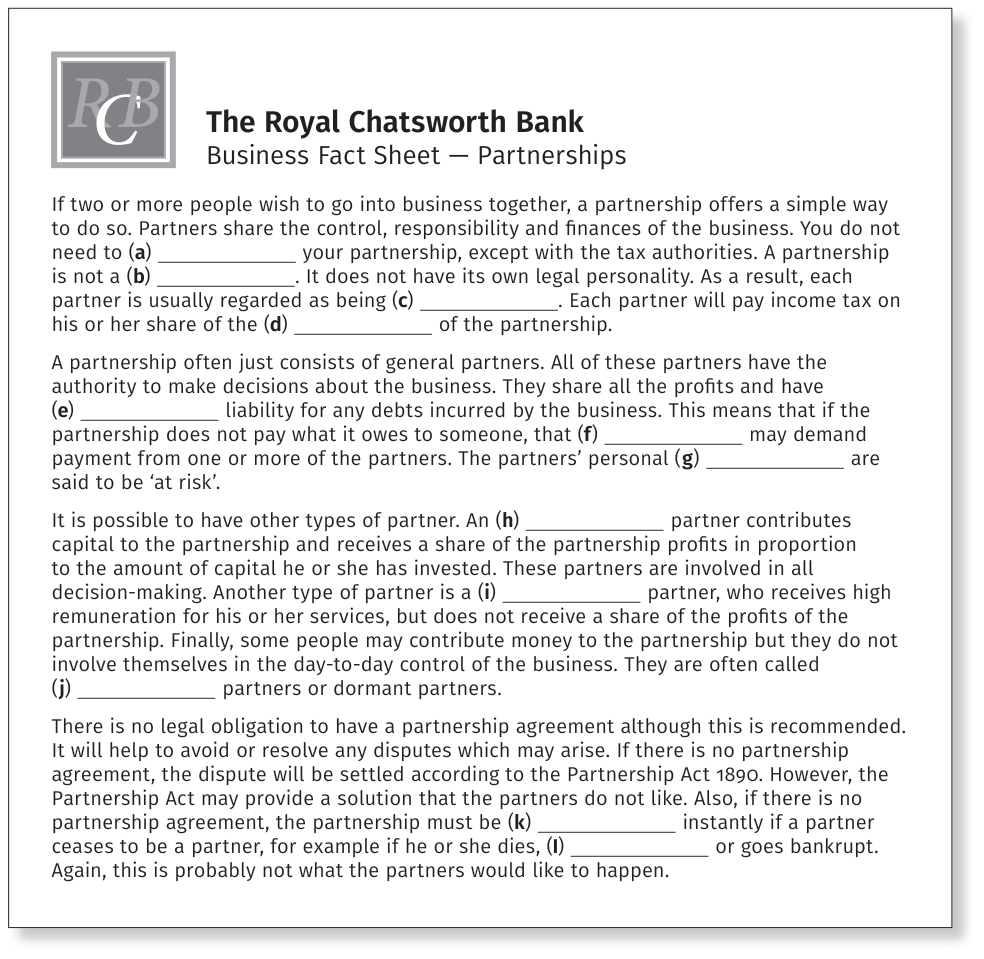
The Royal Chatsworth Bank Business Fact Sheet — Partnerships
If two or more people wish to go into business together, a partnership offers a simple way to do so. Partners share the control, responsibility and finances of the business. You do not need to (a) registeryour partnership, except with the tax authorities. A partnership is not a (b) legal entity. It does not have its own legal personality. As a result, each partner is usually regarded as being (c) self-employed. Each partner will pay income tax on his or her share of the (d) profitsof the partnership.
A partnership often just consists of general partners. All of these partners have the authority to make decisions about the business. They share all the profits and have (e) joint and severalliability for any debts incurred by the business. This means that if the partnership does not pay what it owes to someone, that (f) creditormay demand payment from one or more of the partners. The partners’ personal (g) assetsare said to be ‘at risk’.
It is possible to have other types of partner. An (h) equitypartner contributes capital to the partnership and receives a share of the partnership profits in proportion to the amount of capital he or she has invested. These partners are involved in all decision-making. Another type of partner is a (i) salariedpartner, who receives high remuneration for his or her services, but does not receive a share of the profits of the partnership. Finally, some people may contribute money to the partnership but they do not involve themselves in the day-to-day control of the business. They are often called (j) sleepingpartners or dormant partners.
There is no legal obligation to have a partnership agreement although this is recommended. It will help to avoid or resolve any disputes which may arise. If there is no partnership agreement, the dispute will be settled according to the Partnership Act 1890. However, the Partnership Act may provide a solution that the partners do not like. Also, if there is no partnership agreement, the partnership must be (k) dissolvedinstantly if a partner ceases to be a partner, for example if he or she dies, (i) salariedor goes bankrupt. Again, this is probably not what the partners would like to happen.
Collocation bank
‘All disputes are resolved according to the terms of your partnership agreement.’
‘My diet consists of coffee and chocolate!’
Speaking & Writing for this topic
Two short tasks scored against TOEFL rubrics. The prompt is generated for this topic — use the vocabulary you have just studied.
Suggested structureclick to expand
- In my experience…
- From what I have seen…
- My honest view is that…
- The principal reason is that…
- This matters because…
- What makes joint and several decisive here is…
- For instance, when I…
- A clear example is…
- Consider the case where sleeping was involved…
- On the other hand,…
- Furthermore,…
- That said, one should not forget that…
- Overall, this shows that…
- The lesson, then, is…
- For these reasons, I believe…
- Aim for 4–5 keywords woven naturally into your answer.
- Use at least two linking phrases (Furthermore, On the other hand, As a result…).
- Avoid filler words like "basically" or "like".
Suggested structureclick to expand
- The most important point in creditor is …
- My position is that …
- The principal reason is that joint and several …
- This is supported by …
- A concrete illustration is …
- For instance, …
- However, some argue that …
- On the other hand, …
- In conclusion, …
- Taken together, …
- Aim for 4–5 keywords used in natural context.
- Use 3+ linking words across the answer.
- Vary sentence length to avoid monotony.
THE LANGUAGE OF DRAFTING ~31 min
Francesca Rodd is a lawyer who specialises in partnerships. Two of her clients, Samantha Sully and Kate Mace, are setting up a beauty salon. Samantha and Kate have already met Francesca once to ask some questions about operating a business as a partnership. However, they have now decided to include a third partner, Angie Forrest, in the business. The addition of a new partner means that Francesca will have to think carefully when she defines the term ‘partner’ in the agreement.
All three partners have instructed Francesca that they would like new partners to be able to join them in future if the business is successful. This is another factor that Francesca will have to take into consideration when she defines the term ‘partner’ in the partnership agreement.
The clause that Francesca drafts must:
a include all three current partners.
b include any partner who may join the partnership in the future.
c exclude any partner who leaves the partnership. This applies to any future partners as well as the three current partners.
The three situations above that Francesca must cover in her clause are described in more detail below. Match the situations with the correct description.
Any individual who used to be a partner of the business but who now stops being a partner for any reason at all. (1)
All of the individuals who are parties to this agreement at the date of this agreement. (2)
Any individual or individuals who join the partnership each starting from the particular date on which he/she adds his/her name to the schedule attached to this agreement. (3)
Here are some words that Francesca will need to use when she drafts the clause that provides a definition of the term ‘partner’ in the partnership agreement. Match each word with the correct meaning.
a Respective means… …a document containing extra information that is attached to a contract. (1)
b A schedule is… …relevant, particular, the one thing in a group of things that refers to or belongs to a particular person. (2)
c Annexed means… …attached. (3)
d Context means… …at all. (4)
e Whatsoever means… …circumstances or situation. (5)
Choose the correct word from the list in Exercise 2 to complete these sentences.
a The specifications for the building work that your client will carry out are contained in thetake effectattached to this contract.
b The company will not pay any additional expensesdetermine, so you should be very careful not to spend more than the money that you have been given.
csubsistto this draft contract is the list of assets that you are purchasing.
d What is the fullIn the event thatof the dispute between the partners? I only have one person’s story so I do not know the exact circumstances.
e After the meeting both of the lawyers returned to their offices to discuss the new developments in the case with theirpriorclients.
Using the descriptions from Exercise 1 and the definitions in Exercise 2 to help you, complete the clause that Francesca drafts for the partnership agreement by putting the words from the blue box below in the correct place.
The ‘Partners’ means all the individuals who are parties (a) at the date
| # | Phrase | Definition |
|---|---|---|
| (b) | and shall include, from the (c) | dates upon which any other |
individuals by the addition of their names and addresses to the schedule (d) hereto such other individual or individuals, and shall unless the context otherwise requires exclude any such individual being a (e) partner of the business who shall have ceased for
| # | Phrase | Definition |
|---|---|---|
| (f) | reason to be a partner (g) | . |
Look at these clauses from the partnership agreement. They deal with when the partnership between the three partners will begin and how long the partnership will continue. Match the words and phrases that are highlighted in the clauses with the meanings below.
2. Commencement and Duration 2.1 Subject to the provisions for retirement, resignation, expulsion and dissolution hereinafter contained the Firm shall continue during the joint lives of the Partners and the survivors of them.
2.2 If any Partner ceases to be a partner by reason of his death or retirement or expulsion in accordance with the provisions of this agreement the Firm shall not determine as regards the surviving or continuing Partners.
2.3 The Partnership shall continue until terminated at the end of any Partnership Year by a majority of the Partners giving to all the other Partners not less than three months’ written notice of their intention to do so.
a Formal communication or warning that something is about to happen.
The word is
b A situation where someone leaves a business partnership because the other partners force him or her to go.
The word is
c To end or to terminate. This word also has another meaning in legal English, which is to ‘decide’. When you see this word in an agreement you must be careful to be sure of which meaning the lawyer is using.
The word is
d A word to describe the situation where someone stops working because he or she has reached a certain age. In many countries this is the age of 65.
The word is
e The terms and conditions contained in a contract.
The word is
f A formal way of saying ‘because of’.
The word is
g The situation where a partnership has been brought to an end so that it no longer exists.
The word is
h A formal word meaning the start or the beginning of something.
The word is
i A formal word meaning ‘stops’.
The word is
j The situation where someone leaves his or her job voluntarily. That person stops working by telling the employer, usually by letter, that he or she is leaving.
The word is
k A formal way of saying ‘considering what is written in’ or ‘except as stated in’. These words also have another meaning in legal English, which is ‘depending on’. When you see these words in an agreement you must be careful to be sure of which meaning the lawyer is using.
The word is
I A period of time. It has a definite beginning and a definite end.
The word is
m Most of the people or things in a particular group. More than half of any particular group.
The word is
n The remaining partners. The people who continue to be partners after one of the partners dies or leaves the partnership for any other reason.
The word is
In the partnership agreement that Francesca Rodd is drafting, she has referred to the partnership as ‘the Firm’. Samantha, Kate and Angie are the only three partners in the beauty salon. Read the clauses in Exercise 5 again and decide if the following statements are true or false.
a Unless something happens that is stated in the clauses about retirement, resignation, expulsion and dissolution, the partnership will continue while Samantha, Kate and Angie are all alive.
b The word ‘survivors’ in clause 2.1 means the children of Samantha, Kate and Angie.
c If one partner dies, the partnership will end.
d If Kate does something wrong and is forced to leave the Firm, then Samantha and Angie will continue with the partnership.
e If one partner retires at the age of 60, the partnership will end.
f Kate and Angie can end the partnership by writing to Samantha, telling her three months in advance that they want to close the partnership at the end of the Partnership Year.
Here are two more clauses from the partnership agreement. Explain the meaning of each of the highlighted words. Make sure you check how the words are being used in these clauses. There is an example at the beginning (*).
6. Profits and losses The Partners shall share the Profit for each Partnership Year and (*) bear any loss for any Partnership Year in the (a) proportions specified opposite their names in column 2 of Schedule 1 hereto.
7. Drawings Unless otherwise (b) determined by the Partners each Partner shall be (c) entitled to (d) draw from the Partnership Account on account of his share of the Profit for each Partnership Year the (e) aggregate monthly sum stated opposite her name in column 3 of Schedule 1 hereto.
Example: To bear a loss means to carry a loss. You will have to pay for that loss.
a Proportions means b Determined means c Entitled to means
d To draw means e Aggregate means
Speaking & Writing for this topic
Two short tasks scored against TOEFL rubrics. The prompt is generated for this topic — use the vocabulary you have just studied.
Suggested structureclick to expand
- In my experience…
- From what I have seen…
- My honest view is that…
- The principal reason is that…
- This matters because…
- What makes hereto decisive here is…
- For instance, when I…
- A clear example is…
- Consider the case where whatsoever was involved…
- On the other hand,…
- Furthermore,…
- That said, one should not forget that…
- Overall, this shows that…
- The lesson, then, is…
- For these reasons, I believe…
- Aim for 4–5 keywords woven naturally into your answer.
- Use at least two linking phrases (Furthermore, On the other hand, As a result…).
- Avoid filler words like "basically" or "like".
Suggested structureclick to expand
- The most important point in hereof is …
- My position is that …
- The principal reason is that hereto …
- This is supported by …
- A concrete illustration is …
- For instance, …
- However, some argue that …
- On the other hand, …
- In conclusion, …
- Taken together, …
- Aim for 4–5 keywords used in natural context.
- Use 3+ linking words across the answer.
- Vary sentence length to avoid monotony.
THE REGISTER OF LETTER WRITING ~7 min
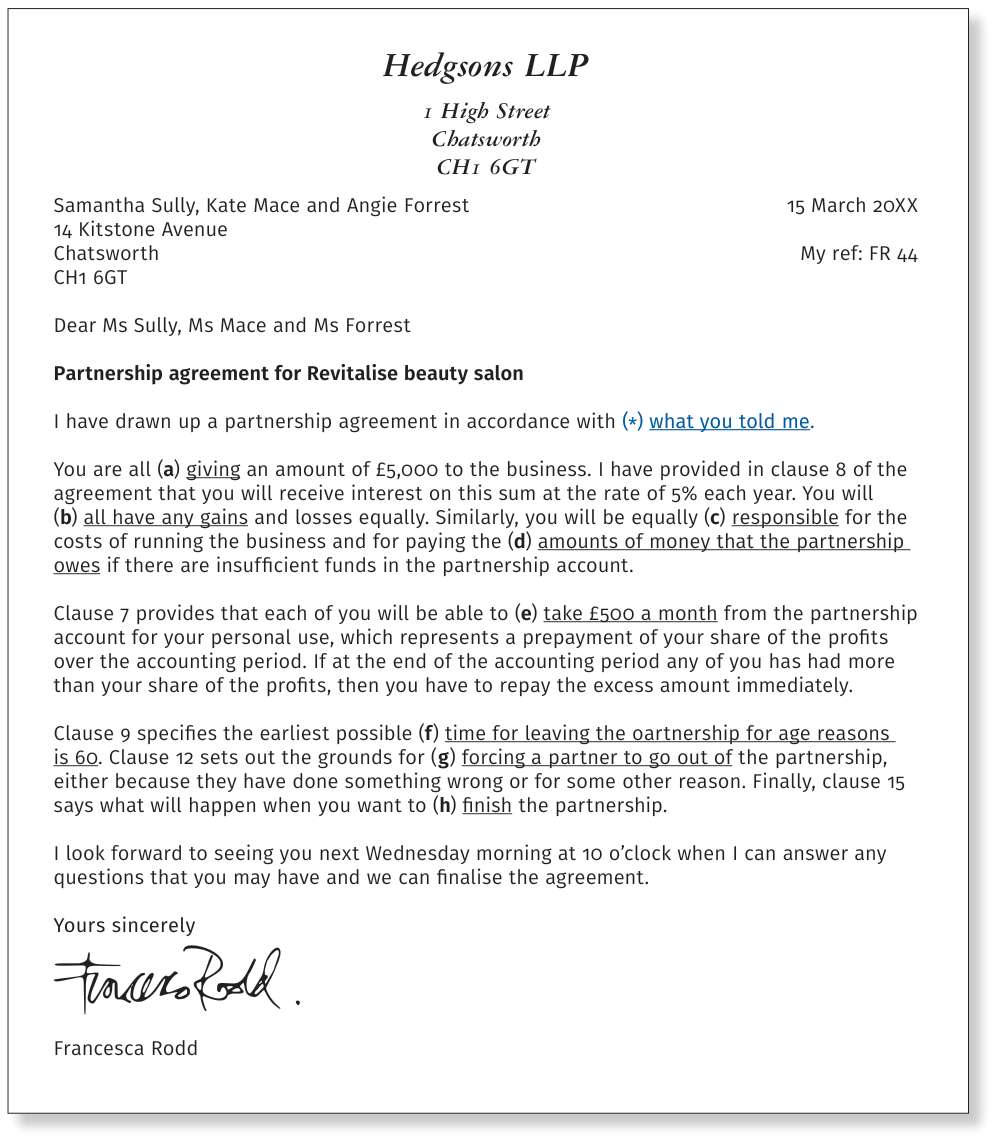
Francesca has written the letter on the next page to her clients, enclosing the partnership agreement that she has drafted for them. The words that have been underlined are too informal. Replace these words with a more appropriate phrase. There is an example at the beginning (*).
(*) your instructions
- a
- b
- c
- d
- e
- f
- g
- h
Speaking & Writing for this topic
Two short tasks scored against TOEFL rubrics. The prompt is generated for this topic — use the vocabulary you have just studied.
Suggested structureclick to expand
- In my experience…
- From what I have seen…
- My honest view is that…
- The principal reason is that…
- This matters because…
- What makes register decisive here is…
- For instance, when I…
- A clear example is…
- Consider the case where letter was involved…
- On the other hand,…
- Furthermore,…
- That said, one should not forget that…
- Overall, this shows that…
- The lesson, then, is…
- For these reasons, I believe…
- Aim for 4–5 keywords woven naturally into your answer.
- Use at least two linking phrases (Furthermore, On the other hand, As a result…).
- Avoid filler words like "basically" or "like".
Suggested structureclick to expand
- The most important point in this concept is …
- My position is that …
- The principal reason is that register …
- This is supported by …
- A concrete illustration is …
- For instance, …
- However, some argue that …
- On the other hand, …
- In conclusion, …
- Taken together, …
- Aim for 4–5 keywords used in natural context.
- Use 3+ linking words across the answer.
- Vary sentence length to avoid monotony.
Hedgsons LLP ~7 min
1 High Street
Chatsworth
CH1 6GT Samantha Sully, Kate Mace and Angie Forrest 15 March 20XX 14 Kitstone Avenue Chatsworth My ref: FR 44 CH1 6GT Dear Ms Sully, Ms Mace and Ms Forrest Partnership agreement for Revitalise beauty salon I have drawn up a partnership agreement in accordance with (*) what you told me.
You are all (a) giving an amount of £5,000 to the business. I have provided in clause 8 of the agreement that you will receive interest on this sum at the rate of 5% each year. You will (b) all have any gains and losses equally. Similarly, you will be equally (c) responsible for the costs of running the business and for paying the (d) amounts of money that the partnership owes if there are insufficient funds in the partnership account.
Clause 7 provides that each of you will be able to (e) take £500 a month from the partnership account for your personal use, which represents a prepayment of your share of the profits over the accounting period. If at the end of the accounting period any of you has had more than your share of the profits, then you have to repay the excess amount immediately.
Clause 9 specifies the earliest possible (f) time for leaving the oartnership for age reasons is 60. Clause 12 sets out the grounds for (g) forcing a partner to go out of the partnership, either because they have done something wrong or for some other reason. Finally, clause 15 says what will happen when you want to (h) finish the partnership.
I look forward to seeing you next Wednesday morning at 10 o’clock when I can answer any questions that you may have and we can finalise the agreement.
Yours sincerely Francesca Rodd
Speaking & Writing for this topic
Two short tasks scored against TOEFL rubrics. The prompt is generated for this topic — use the vocabulary you have just studied.
Suggested structureclick to expand
- In my experience…
- From what I have seen…
- My honest view is that…
- The principal reason is that…
- This matters because…
- What makes hedgsons decisive here is…
- For instance, when I…
- A clear example is…
- Consider the case where this concept was involved…
- On the other hand,…
- Furthermore,…
- That said, one should not forget that…
- Overall, this shows that…
- The lesson, then, is…
- For these reasons, I believe…
- Aim for 4–5 keywords woven naturally into your answer.
- Use at least two linking phrases (Furthermore, On the other hand, As a result…).
- Avoid filler words like "basically" or "like".
Suggested structureclick to expand
- The most important point in this concept is …
- My position is that …
- The principal reason is that hedgsons …
- This is supported by …
- A concrete illustration is …
- For instance, …
- However, some argue that …
- On the other hand, …
- In conclusion, …
- Taken together, …
- Aim for 4–5 keywords used in natural context.
- Use 3+ linking words across the answer.
- Vary sentence length to avoid monotony.
COMPANIES ~14 min
Sandra Hobson is a law student at the University of Chatsworth. She has just attended a lecture on company law. Here are her notes about private limited companies and public limited companies. Read Sandra’s notes and find the words or phrases in the notes that match each of the meanings on the next page.
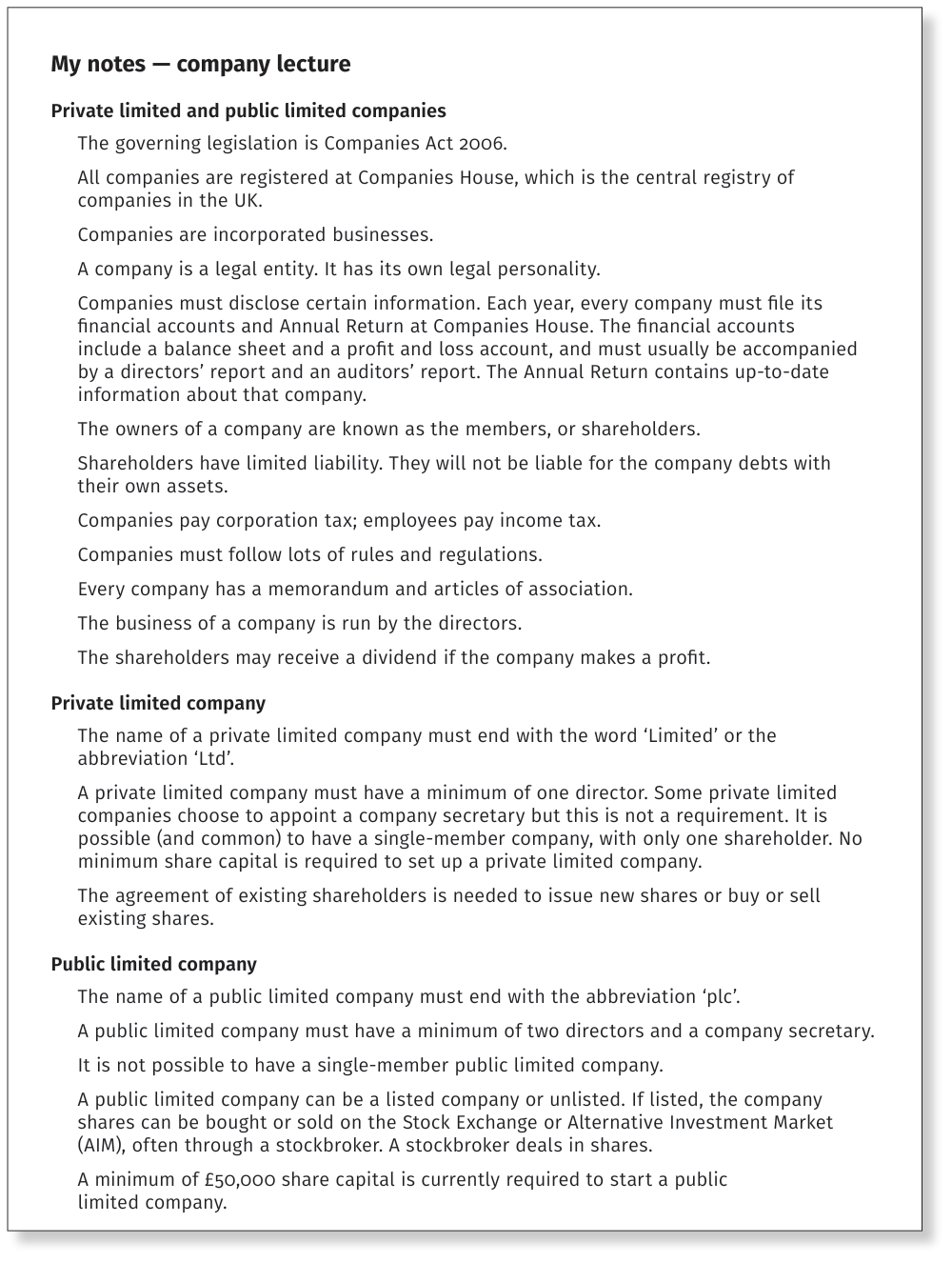
My notes — company lecture
Private limited and public limited companies The governing legislation is Companies Act 2006.
All companies are registered at Companies House, which is the central registry of companies in the UK.
Companies are incorporated businesses.
A company is a legal entity. It has its own legal personality.
Companies must disclose certain information. Each year, every company must file its financial accounts and Annual Return at Companies House. The financial accounts include a balance sheet and a profit and loss account, and must usually be accompanied by a directors’ report and an auditors’ report. The Annual Return contains up-to-date information about that company.
The owners of a company are known as the members, or shareholders.
Shareholders have limited liability. They will not be liable for the company debts with their own assets.
Companies pay corporation tax; employees pay income tax.
Companies must follow lots of rules and regulations.
Every company has a memorandum and articles of association.
The business of a company is run by the directors.
The shareholders may receive a dividend if the company makes a profit.
Private limited company The name of a private limited company must end with the word ‘Limited’ or the abbreviation ‘Ltd’.
A private limited company must have a minimum of one director. Some private limited companies choose to appoint a company secretary but this is not a requirement. It is possible (and common) to have a single-member company, with only one shareholder. No minimum share capital is required to set up a private limited company.
The agreement of existing shareholders is needed to issue new shares or buy or sell existing shares.
Public limited company The name of a public limited company must end with the abbreviation ‘plc’.
A public limited company must have a minimum of two directors and a company secretary.
It is not possible to have a single-member public limited company.
A public limited company can be a listed company or unlisted. If listed, the company shares can be bought or sold on the Stock Exchange or Alternative Investment Market (AIM), often through a stockbroker. A stockbroker deals in shares.
A minimum of £50,000 share capital is currently required to start a public limited company.
a These are businesses which have been formally set up and registered as companies.
Answer:
b This is something that exists in the eyes of the law. It is a legal ‘being’, and can be a person or a company.
Answer:
c This means ‘to make public’, to tell someone, or to reveal.
Answer:
d This is another name for the shareholders of the company.
Answer:
e This means that the shareholders will not lose more than their investment in the company. They will have to pay any amount that they still owe to the company for their shares, but no more.
Answer:
f This is the name of the tax that a company has to pay.
Answer:
g This is the name of the tax that individuals must pay when they earn money.
Answer:
h These are the people who are responsible for the day-to-day management and running of the company.
Answer:
i This is a payment of a company’s profits to the shareholders of the company.
Answer:
j This is the person who must make sure that all the statutory regulations regarding a company are followed.
Answer:
k This is a company that has just one shareholder.
Answer:
I This is the amount of money that represents the value of a company’s shares.
Answer:dividendCollocation bank
to have the agreement of someone ‘We have the agreement of our shareholders to enter into this contract.’ • to do something through someone ‘I am buying some shares in Hatford plc through a stockbroker.’
to file a document at a place ‘You need to file your statement at the court office.’ • to end with something ‘The name of a public limited company always ends with plc.’
Speaking & Writing for this topic
Two short tasks scored against TOEFL rubrics. The prompt is generated for this topic — use the vocabulary you have just studied.
Suggested structureclick to expand
- In my experience…
- From what I have seen…
- My honest view is that…
- The principal reason is that…
- This matters because…
- What makes to disclose information decisive here is…
- For instance, when I…
- A clear example is…
- Consider the case where to issue shares was involved…
- On the other hand,…
- Furthermore,…
- That said, one should not forget that…
- Overall, this shows that…
- The lesson, then, is…
- For these reasons, I believe…
- Aim for 4–5 keywords woven naturally into your answer.
- Use at least two linking phrases (Furthermore, On the other hand, As a result…).
- Avoid filler words like "basically" or "like".
Suggested structureclick to expand
- The most important point in this concept is …
- My position is that …
- The principal reason is that to disclose information …
- This is supported by …
- A concrete illustration is …
- For instance, …
- However, some argue that …
- On the other hand, …
- In conclusion, …
- Taken together, …
- Aim for 4–5 keywords used in natural context.
- Use 3+ linking words across the answer.
- Vary sentence length to avoid monotony.
INCORPORATING A COMPANY ~19 min
Peter Craig and his friend want to set up a new business. They have found a website called www.CoTypes.co.uk, which provides information about the different types of company that exist in the UK. Peter has printed off the following information about private limited companies. Complete the gaps in the text by using the correct word or phrase from the box below.
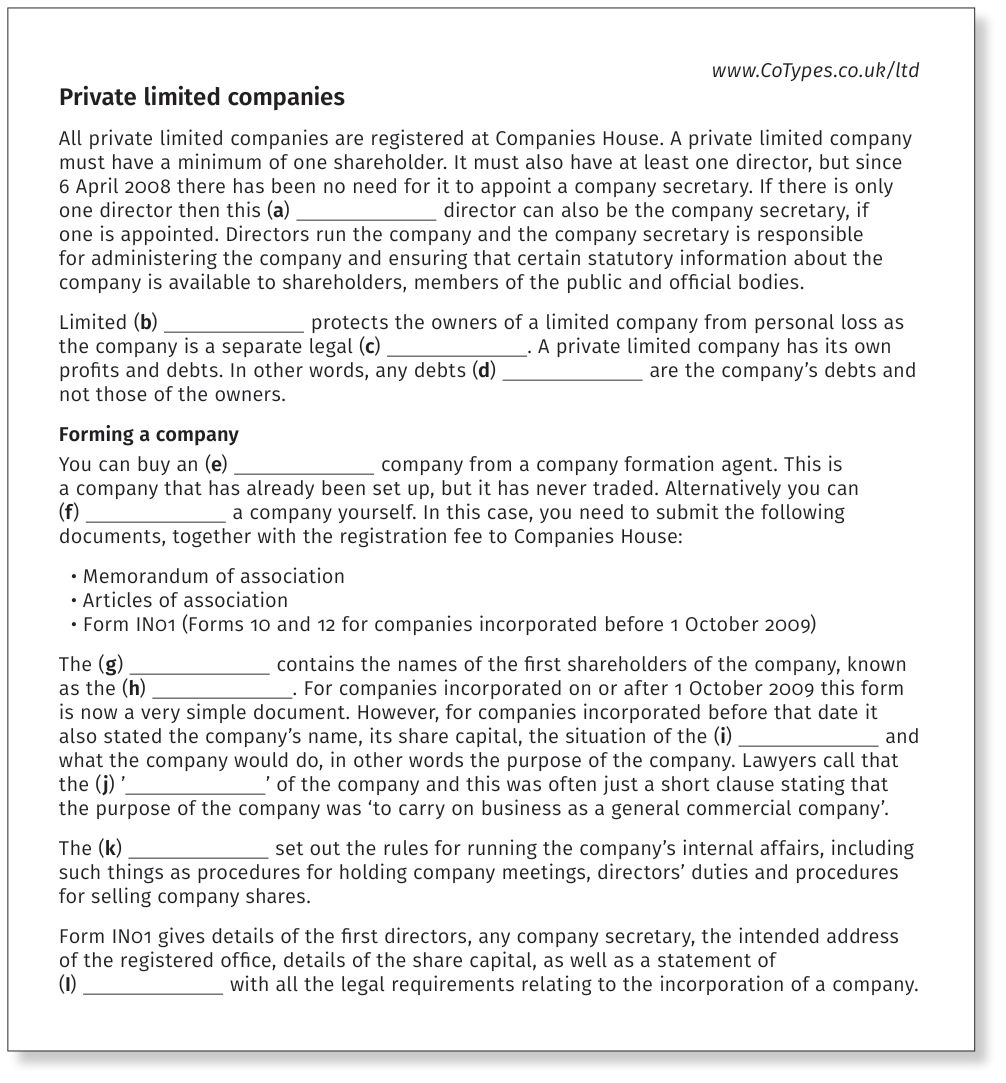
www.CoTypes.co.uk/ltd Private limited companies
All private limited companies are registered at Companies House. A private limited company must have a minimum of one shareholder. It must also have at least one director, but since 6 April 2008 there has been no need for it to appoint a company secretary. If there is only one director then this (a) soledirector can also be the company secretary, if one is appointed. Directors run the company and the company secretary is responsible for administering the company and ensuring that certain statutory information about the company is available to shareholders, members of the public and official bodies.
Limited (b) liabilityprotects the owners of a limited company from personal loss as the company is a separate legal (c) entity. A private limited company has its own profits and debts. In other words, any debts (d) incurredare the company’s debts and not those of the owners.
Forming a company You can buy an (e) off-the-shelfcompany from a company formation agent. This is a company that has already been set up, but it has never traded. Alternatively you can (f) incorporatea company yourself. In this case, you need to submit the following documents, together with the registration fee to Companies House:
• Memorandum of association • Articles of association • Form IN01 (Forms 10 and 12 for companies incorporated before 1 October 2009)
The (g) memorandum of associationcontains the names of the first shareholders of the company, known as the (h) subscribers. For companies incorporated on or after 1 October 2009 this form is now a very simple document. However, for companies incorporated before that date it also stated the company’s name, its share capital, the situation of the (i) registered officeand what the company would do, in other words the purpose of the company. Lawyers call that the (j) ’ ’ of the company and this was often just a short clause stating that the purpose of the company was ‘to carry on business as a general commercial company’.
The (k) articles of associationset out the rules for running the company’s internal affairs, including such things as procedures for holding company meetings, directors’ duties and procedures for selling company shares.
Form IN01 gives details of the first directors, any company secretary, the intended address of the registered office, details of the share capital, as well as a statement of (i) registered officewith all the legal requirements relating to the incorporation of a company.
Preposition bank to protect someone from something ‘A patent will protect your invention from being copied.’ • to have a number of something ‘We need a minimum of 12 people to attend this course.’ • the object of something ‘What is the object of your meeting?’
LISTENING
to have at least a number ‘We need at least £20,000 to finance the project.’ • to make something available to someone ‘I promise that I will make this information available to anyone who asks for it.’ • to submit something to someone ‘You must submit these documents to the tax office by 31 January.’
Peter Craig and his friend decided to set up a private limited company in August 2009. Peter went to see a solicitor called Greg Harrison, who specialises in company law. Listen to their conversation. It is about completing one of the forms which is needed in order to incorporate the new company. Answer the following questions.
a What is the name of the company?
b What is the address of the registered office?
c Is Mr Craig using an agent?
d What is Mr Craig’s telephone number?
e Does Mr Craig have a DX number?
f What is the name of the company secretary?
g What is the address of the company secretary?
h Is the company secretary a Miss, Ms or Mrs?
i Complete the following details about the two directors of the company:
Director’s details Director’s details Full name, including title Address Date of birth Nationality Occupation Director of other companies? Yes/No Yes/No
Speaking & Writing for this topic
Two short tasks scored against TOEFL rubrics. The prompt is generated for this topic — use the vocabulary you have just studied.
Suggested structureclick to expand
- In my experience…
- From what I have seen…
- My honest view is that…
- The principal reason is that…
- This matters because…
- What makes subscribers decisive here is…
- For instance, when I…
- A clear example is…
- Consider the case where incurred was involved…
- On the other hand,…
- Furthermore,…
- That said, one should not forget that…
- Overall, this shows that…
- The lesson, then, is…
- For these reasons, I believe…
- Aim for 4–5 keywords woven naturally into your answer.
- Use at least two linking phrases (Furthermore, On the other hand, As a result…).
- Avoid filler words like "basically" or "like".
Suggested structureclick to expand
- The most important point in objects is …
- My position is that …
- The principal reason is that subscribers …
- This is supported by …
- A concrete illustration is …
- For instance, …
- However, some argue that …
- On the other hand, …
- In conclusion, …
- Taken together, …
- Aim for 4–5 keywords used in natural context.
- Use 3+ linking words across the answer.
- Vary sentence length to avoid monotony.
PAPERWORK ~16 min
Using the details that you have from the Listening Exercise, complete Form 10 below.
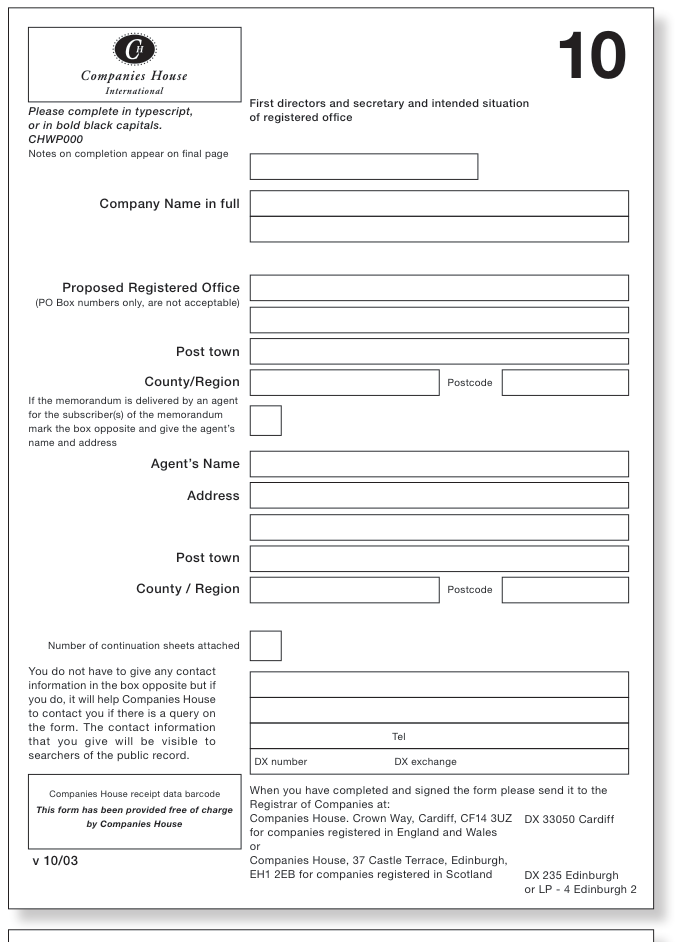
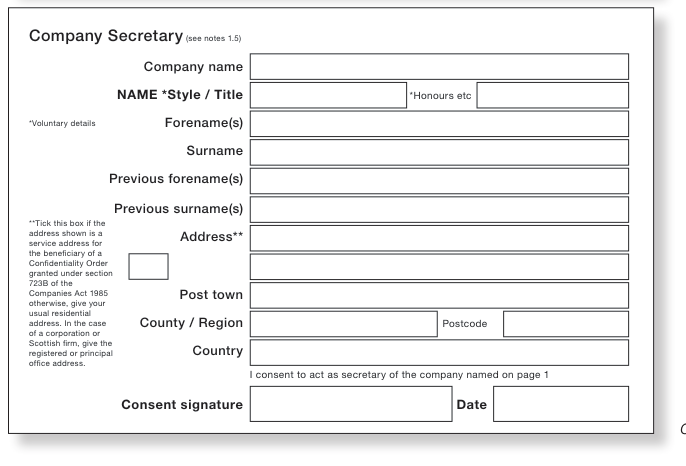
Company Secretary
continued
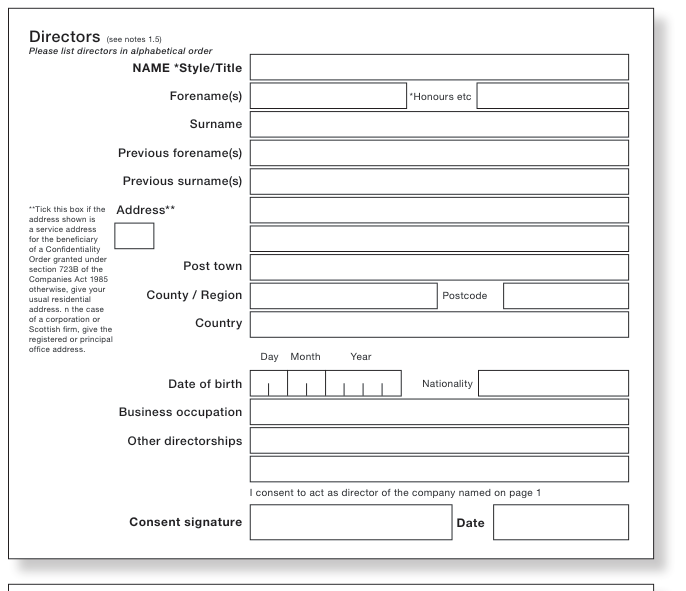
Directors
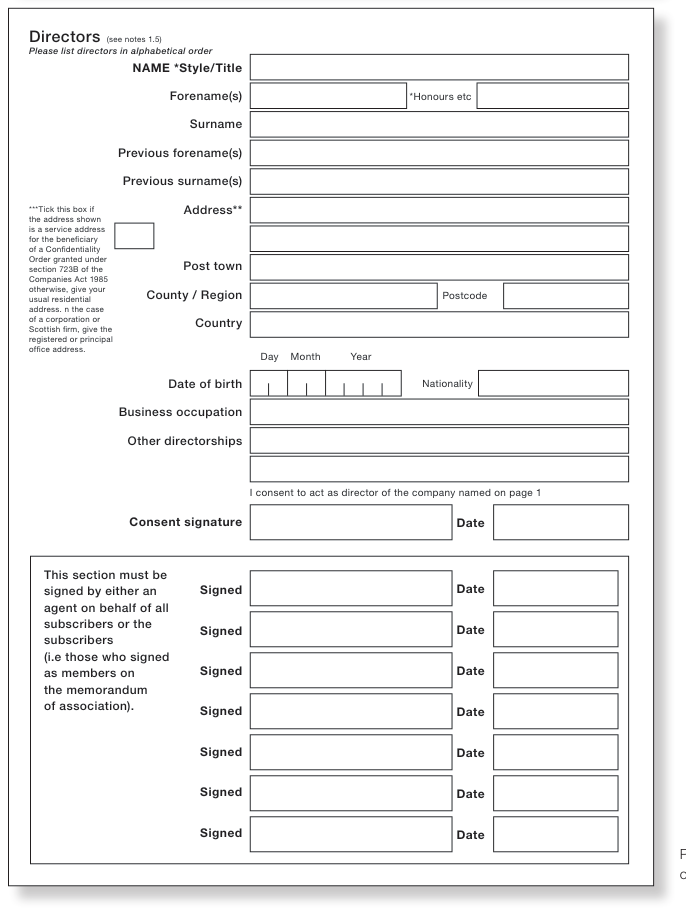
Directors
Peter Craig asks his solicitor, Greg Harrison, to draft the Memorandum of Association of the new company. The memorandum appears below. Fill each gap in the memorandum with the correct word or phrase from the blue box.
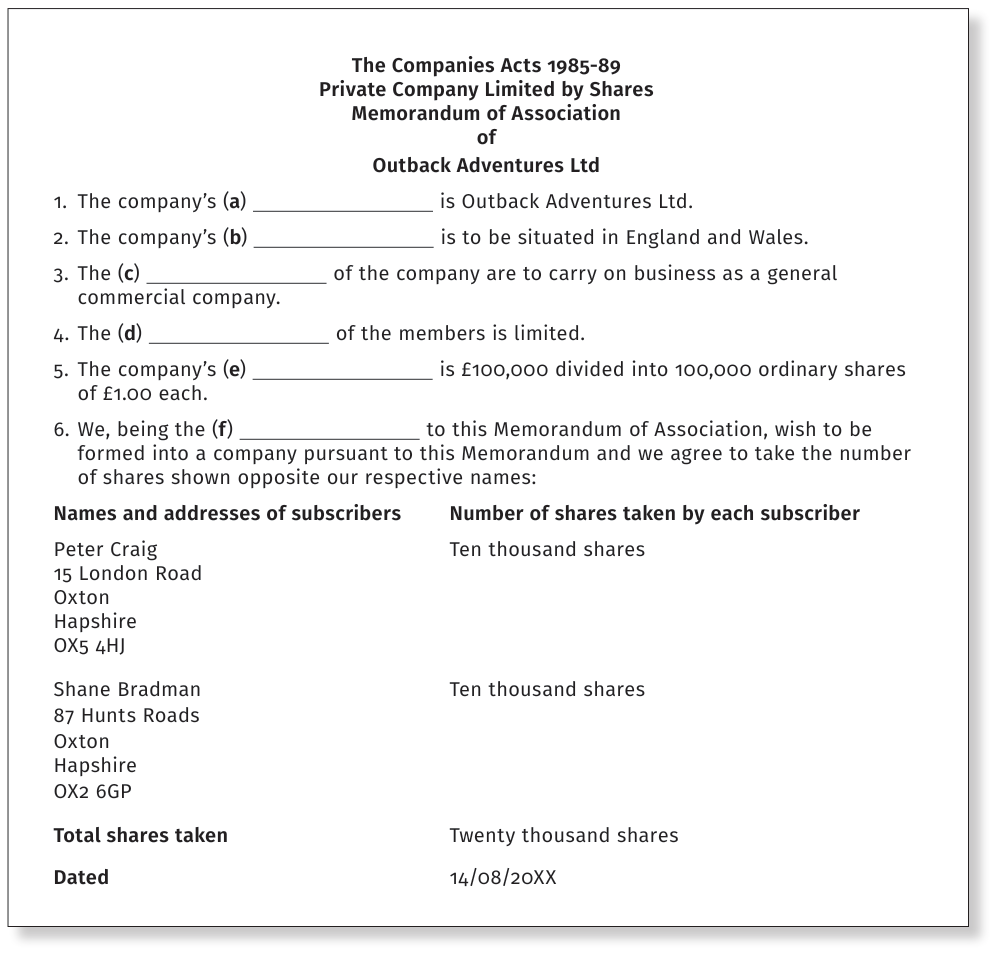
The Companies Acts 1985-89 Private Company Limited by Shares Memorandum of Association of Outback Adventures Ltd 1. The company’s (a) nameis Outback Adventures Ltd.
2. The company’s (b) registered officeis to be situated in England and Wales.
3. The (c) objectsof the company are to carry on business as a general commercial company.
4. The (d) liabilityof the members is limited.
5. The company’s (e) share capitalis £100,000 divided into 100,000 ordinary shares of £1.00 each.
6. We, being the (f) subscribersto this Memorandum of Association, wish to be formed into a company pursuant to this Memorandum and we agree to take the number of shares shown opposite our respective names:
Names and addresses of subscribers Number of shares taken by each subscriber Peter Craig Ten thousand shares 15 London Road Oxton Hapshire OX5 4HJ Shane Bradman Ten thousand shares 87 Hunts Roads Oxton Hapshire OX2 6GP Total shares taken Twenty thousand shares Dated 14/08/20XX
Greg Harrison acted for another client, Raj Patel, in the incorporation of a new company. This company was incorporated before 1 October 2009. Using the memorandum in Exercise 3 as a model, draft the Memorandum of Association for Raj Patel’s new company. Here are the details that must be included in your memorandum.
Client details:
Raj Patel 2 Cherryholt Road Chatsworth CH3 6GH Company details:
RP Computer Services Ltd Capital: £100,000. Nominal value of each share is £1 Issued: 25,000 RP to be sole shareholder
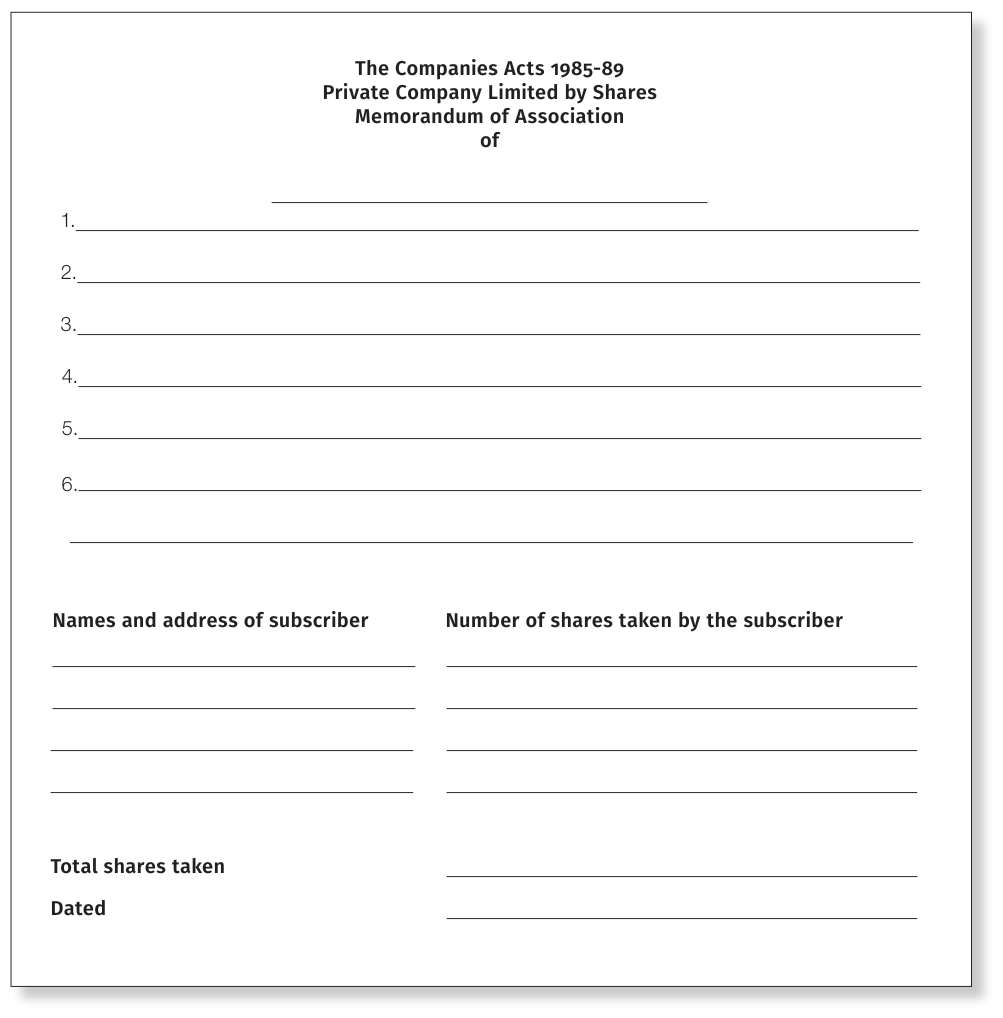
The Companies Acts 1985-89 Private Company Limited by Shares Memorandum of Association of 1.
Names and address of subscriber Number of shares taken by the subscriber Total shares taken Dated
Speaking & Writing for this topic
Two short tasks scored against TOEFL rubrics. The prompt is generated for this topic — use the vocabulary you have just studied.
Suggested structureclick to expand
- In my experience…
- From what I have seen…
- My honest view is that…
- The principal reason is that…
- This matters because…
- What makes objects decisive here is…
- For instance, when I…
- A clear example is…
- Consider the case where liability was involved…
- On the other hand,…
- Furthermore,…
- That said, one should not forget that…
- Overall, this shows that…
- The lesson, then, is…
- For these reasons, I believe…
- Aim for 4–5 keywords woven naturally into your answer.
- Use at least two linking phrases (Furthermore, On the other hand, As a result…).
- Avoid filler words like "basically" or "like".
Suggested structureclick to expand
- The most important point in name is …
- My position is that …
- The principal reason is that objects …
- This is supported by …
- A concrete illustration is …
- For instance, …
- However, some argue that …
- On the other hand, …
- In conclusion, …
- Taken together, …
- Aim for 4–5 keywords used in natural context.
- Use 3+ linking words across the answer.
- Vary sentence length to avoid monotony.
LIMITED LIABILITY PARTNERSHIPS ~12 min
Francesca Rodd is writing a short explanation of limited liability partnerships. Her law firm is going to put this information on its website. Read the text and answer the questions that follow using a full sentence.
Limited Liability Partnerships Limited Liability Partnerships (LLPs) were first introduced in the UK in April 2001. This has become a popular way of structuring a business. This is especially true of professional practices, such as accountancy firms and law firms.
Setting up an LLP involves a similar process to that of setting up a limited company. LLPs are registered at Companies House and the requirements of disclosing information and filing annual returns and accounts are similar to those for companies. The name of the partnership must end with LLP. In the same way that a company has a separate legal personality, so does an LLP. It may sue and be sued in the name of the LLP. The partners of an LLP have the advantage of limited liability, which protects their personal assets. However, an LLP is not taxed as a limited company but as a partnership. Also, an LLP is a more flexible structure than a company, with fewer rules and regulations to comply with.
The partners of an LLP are called members. At least two of those members are chosen to be ‘designated members’, which are the equivalent of the directors of a company. The ‘rules’ of the partnership are contained in an agreement, decided by the members.
We can help you decide if an LLP is the right form of business structure for you and prepare the necessary formation and internal documents.
For more information and legal advice on Limited Liability Partnerships, call Francesca Rodd on 08451 2536478 or email her at frodd@hedgsons.co.uk
a When did it become possible to set up a limited liability partnership in the UK?
b Which professions like to use this particular structure for their business?
c What documents do limited liability partnerships have to send to Companies House each year?
d How does someone know that a business is a limited liability partnership?
e How is an LLP taxed?
f How many designated members must a limited liability partnership have?
Speaking & Writing for this topic
Two short tasks scored against TOEFL rubrics. The prompt is generated for this topic — use the vocabulary you have just studied.
Suggested structureclick to expand
- In my experience…
- From what I have seen…
- My honest view is that…
- The principal reason is that…
- This matters because…
- What makes limited decisive here is…
- For instance, when I…
- A clear example is…
- Consider the case where liability was involved…
- On the other hand,…
- Furthermore,…
- That said, one should not forget that…
- Overall, this shows that…
- The lesson, then, is…
- For these reasons, I believe…
- Aim for 4–5 keywords woven naturally into your answer.
- Use at least two linking phrases (Furthermore, On the other hand, As a result…).
- Avoid filler words like "basically" or "like".
Suggested structureclick to expand
- The most important point in this concept is …
- My position is that …
- The principal reason is that limited …
- This is supported by …
- A concrete illustration is …
- For instance, …
- However, some argue that …
- On the other hand, …
- In conclusion, …
- Taken together, …
- Aim for 4–5 keywords used in natural context.
- Use 3+ linking words across the answer.
- Vary sentence length to avoid monotony.
THE LANGUAGE OF DRAFTING ~27 min
Francesca Rodd is acting for some new clients who wish to set up a limited liability partnership. Francesca has drawn up a deed of partnership. The clause below deals with setting up the limited liability partnership. Fill each gap in the clause with the correct preposition from the blue box.
2.1 The Members shall complete and deliver (a) Companies House all such documents and pay all such fees as shall be necessary to lead to the incorporation (b) the LLP (c) accordance (d) the Limited Liability Partnerships Act 2000.
2.2 The certificate of registration of the LLP issued (e) the Limited Liability Partnerships Act 2000 shall be kept (f) the Registered Office.
Look at the words and phrases in the blue box. Match them with the correct meanings below. You will need these words and phrases to complete the next exercise.
ratify (1) take effect (4) benefit (7)
prior (2) determine (5) consent (8)
subsist (3) indemnify (6) In the event that (9)
| # | Phrase | Definition |
|---|---|---|
| a | if d start to operate | g before |
| b | decide e officially approve | h continue to exist |
| c | good f pay for any damage suffered | i permission |
Read the clause below. It deals with when the business will begin and how long it will continue. Fill each gap in the clause with the correct word or phrase from the blue box in Exercise 2.
3. Commencement and duration 3.1 The the provisions of this Agreement shall (a) on the Commencement Date.
3.2 The LLP shall carry on the Business and/or carry on such other or additional trade profession or business as the Members shall from time to time (b) .
3.3 The LLP shall (c) until wound up in accordance with the provisions of the Limited Liability Partnerships Act 2000.
3.4 (d) any Member may be personally liable under any contract entered into by him (e) to the incorporation of the LLP which was for the (f) of the LLP and with the express or implied (g) of the other Members then the LLP shall on incorporation be deemed to (h) that contract and shall (i) that Member from and against all claims, liabilities and costs in connection with it.
Read the clauses in Exercise 1 and Exercise 3 again and decide if each of the following statements are true or false.
a It does not cost anything to register a limited liability partnership.
b When a new limited liability partnership is set up, it receives a certificate of registration from Companies House.
c The members can change the type of business that the limited liability partnership carries out, if they wish.
d To end a limited liability partnership, the terms of the relevant statute must be followed.
e Clause 3.4 aims to protect the partners from any liability that they may have arising from certain contracts that they signed before the limited liability partnership was officially created.
Speaking & Writing for this topic
Two short tasks scored against TOEFL rubrics. The prompt is generated for this topic — use the vocabulary you have just studied.
Suggested structureclick to expand
- In my experience…
- From what I have seen…
- My honest view is that…
- The principal reason is that…
- This matters because…
- What makes under decisive here is…
- For instance, when I…
- A clear example is…
- Consider the case where at was involved…
- On the other hand,…
- Furthermore,…
- That said, one should not forget that…
- Overall, this shows that…
- The lesson, then, is…
- For these reasons, I believe…
- Aim for 4–5 keywords woven naturally into your answer.
- Use at least two linking phrases (Furthermore, On the other hand, As a result…).
- Avoid filler words like "basically" or "like".
Suggested structureclick to expand
- The most important point in of 2. Incorporation is …
- My position is that …
- The principal reason is that under …
- This is supported by …
- A concrete illustration is …
- For instance, …
- However, some argue that …
- On the other hand, …
- In conclusion, …
- Taken together, …
- Aim for 4–5 keywords used in natural context.
- Use 3+ linking words across the answer.
- Vary sentence length to avoid monotony.
USING YOUR KNOWLEDGE ~11 min
Collocation review Complete these sentences with a collocation that you have seen.
a I’ve all the options available to me and decided to go ahead and start the business.
b The shareholders were pleased when Gernee plc a dividend, as last year they received nothing.
c Harrow & Trot plc has just announced that although business following the changes in interest rates, annual profits were up by 11% last year.
d If the business does badly, I may lose my house as I have liability for all of the debts of the business.
e We will not information about you to any third parties without your permission.
f If you do not have a partnership agreement, any disputes will be according to a statute from 1890.
g I wasn’t able to pay my creditors and had no choice but to bankrupt.
h The company shares to three new members.
i I’ve always wanted to own a business, but was a bit worried about it. Two years ago I decided to a risk and start a nursing agency. I’m pleased to say it’s doing well.
j We had a fantastic year last year — we made profits.
Vocabulary review Complete these sentences with a word that you have seen.
a We are afraid that your behaviour gives us no choice other than to you from the partnership.
b I have decided to all my money in a new company called TenBase plc.
c When a new company is set up, it receives a of incorporation from Companies House.
d The authorised share capital is £100,000 divided into 100,000 shares with a value of £1 each.
e Partners have joint and liability for the partnership debts.
f Their solicitor advised them on the procedure that it is necessary to follow in order to a new company.
g Another expression meaning a legal person is a legal .
h Each partner is allowed to take out some money from the partnership account each month for his or her personal use. This is called his or her .
i The first shareholders of a company are called the .
j Every company incorporated before 1 October 2009 has an clause in its memorandum of association, which states the purpose of the company.
Preposition review Complete these sentences with the correct preposition.
a I want to be a company lawyer as I am very interested commercial and business law.
b We are a limited liability partnership, which operates like a company but is taxed a partnership.
c You must submit an annual return and accounts Companies House every year.
d Our business name appears the list of reputable estate agents.
e We are a small business, consisting four full-time employees and two part time employees.
f You must have least £50,000 share capital to start a public limited company.
g The object this exercise is to make sure that you can remember the correct prepositions!
h According the partnership agreement, each partner is entitled to drawings of £500 each month.
i I authorise you to make this information available Mr Richard Jard.
j The bank is willing to lend us some money, but it is insisting a personal guarantee from each of us.
Speaking & Writing for this topic
Two short tasks scored against TOEFL rubrics. The prompt is generated for this topic — use the vocabulary you have just studied.
Suggested structureclick to expand
- In my experience…
- From what I have seen…
- My honest view is that…
- The principal reason is that…
- This matters because…
- What makes using decisive here is…
- For instance, when I…
- A clear example is…
- Consider the case where your was involved…
- On the other hand,…
- Furthermore,…
- That said, one should not forget that…
- Overall, this shows that…
- The lesson, then, is…
- For these reasons, I believe…
- Aim for 4–5 keywords woven naturally into your answer.
- Use at least two linking phrases (Furthermore, On the other hand, As a result…).
- Avoid filler words like "basically" or "like".
Suggested structureclick to expand
- The most important point in this concept is …
- My position is that …
- The principal reason is that using …
- This is supported by …
- A concrete illustration is …
- For instance, …
- However, some argue that …
- On the other hand, …
- In conclusion, …
- Taken together, …
- Aim for 4–5 keywords used in natural context.
- Use 3+ linking words across the answer.
- Vary sentence length to avoid monotony.
HIGHER LEVEL PRACTICE ~3 min
Read the following clause. The missing words are in the list below. For each gap choose the word which best fits into the space from the options provided. Use each option only once. Write your answers in the box below. There is an example at the beginning (*).
Speaking & Writing for this topic
Two short tasks scored against TOEFL rubrics. The prompt is generated for this topic — use the vocabulary you have just studied.
Suggested structureclick to expand
- In my experience…
- From what I have seen…
- My honest view is that…
- The principal reason is that…
- This matters because…
- What makes higher decisive here is…
- For instance, when I…
- A clear example is…
- Consider the case where level was involved…
- On the other hand,…
- Furthermore,…
- That said, one should not forget that…
- Overall, this shows that…
- The lesson, then, is…
- For these reasons, I believe…
- Aim for 4–5 keywords woven naturally into your answer.
- Use at least two linking phrases (Furthermore, On the other hand, As a result…).
- Avoid filler words like "basically" or "like".
Suggested structureclick to expand
- The most important point in this concept is …
- My position is that …
- The principal reason is that higher …
- This is supported by …
- A concrete illustration is …
- For instance, …
- However, some argue that …
- On the other hand, …
- In conclusion, …
- Taken together, …
- Aim for 4–5 keywords used in natural context.
- Use 3+ linking words across the answer.
- Vary sentence length to avoid monotony.
FROM A PARTNERSHIP AGREEMENT ~9 min
6. Profits, Losses and Salaries 6.1 (*) to the following (1) of this clause the Partners shall (2) the profit for each Partnership Year and (3) any loss for any Partnership Year in the proportions specified opposite their names in column 2 of Schedule 1 hereto.
6.2 There shall be paid in each year by way of gross (4) salaries which shall be deemed to accrue from day to day and shall be paid (5) such sums (if any) as are set out opposite the Partners’ respective names in the Schedule 2 hereto.
(AA) Subject (B) monthly (D) annual (A) share (C) provisions (E) bear (*) AA (1) (2) (3) (4) (5)
Read the following clause. The missing prepositions are in the list below. For each gap choose the preposition which best fits into the space from the options provided. Use each option only once. Write your answers in the box below. There is an example at the beginning (*).
Speaking & Writing for this topic
Two short tasks scored against TOEFL rubrics. The prompt is generated for this topic — use the vocabulary you have just studied.
Suggested structureclick to expand
- In my experience…
- From what I have seen…
- My honest view is that…
- The principal reason is that…
- This matters because…
- What makes from decisive here is…
- For instance, when I…
- A clear example is…
- Consider the case where partnership was involved…
- On the other hand,…
- Furthermore,…
- That said, one should not forget that…
- Overall, this shows that…
- The lesson, then, is…
- For these reasons, I believe…
- Aim for 4–5 keywords woven naturally into your answer.
- Use at least two linking phrases (Furthermore, On the other hand, As a result…).
- Avoid filler words like "basically" or "like".
Suggested structureclick to expand
- The most important point in this concept is …
- My position is that …
- The principal reason is that from …
- This is supported by …
- A concrete illustration is …
- For instance, …
- However, some argue that …
- On the other hand, …
- In conclusion, …
- Taken together, …
- Aim for 4–5 keywords used in natural context.
- Use 3+ linking words across the answer.
- Vary sentence length to avoid monotony.
FROM A LIMITED LIABILITY PARTNERSHIP AGREEMENT ~23 min
10. Drawings 10.1 There shall be paid to each Member (*) the Payment Date (1) each Month the Drawings or such other sum as the Members may (2) time to time agree (3) respect either of all Members or such Members as may thus be determined.
10.2 Any further payments to be made to or on behalf of any Member and any assets to be transferred to or (4) the benefit of any Member shall only be made, transferred or applied (5) the consent of the Members.
(AA) on (B) with (D) for (A) from (C) of (E) in (*) AA (1) (2) (3) (4) (5)
Read the text below and think of the word that best fits each space. Use only one word in each space. Write your answers below. There is an example at the beginning (*).
Companies There are several different types of company in England, but the most common are the private limited company and the (*) limited company. The name of a private limited company must end with ‘ltd’ or ‘limited’ and a public limited company’s name must end with ‘plc’, so you will always know what type of company it is just by looking at its name. A company is an (1) business. This means that it has its own separate legal personality. Lawyers call it a legal (2) . Both types of company must be registered at Companies House. That is the central registry of companies. There are over 2.3 million registered companies in the UK. Every company has its own file at Companies House and anyone can look at the file to find out information about the company. You may like to visit the website of Companies House for more information. The web address is www.companieshouse.gov.uk.
The ‘owners’ of a company are called the (3) or the shareholders. This means that they own shares in that company. A share is a part of the company’s capital. A private company cannot offer shares in the company to members of the public, but a public limited company can do this.
A private limited company can have any number of shareholders. It is very common to have a private limited company with just one shareholder. In this case, the company is called a (4) -member company. A public limited company must have a (5) of two shareholders, but usually has a lot more. Another big difference between the two types of company is the amount of share capital that the companies must have in order to incorporate and register them. Someone may register a private limited company with a very small amount of share capital, maybe only £1, but in order to register a public limited company it must have a substantial amount of share capital. This amount varies, but at the moment it is £50,000. The shareholders of a company have (6) liability, in other words they will not lose any more than the nominal value of their shares.
When someone wants to incorporate a new company they must (7) certain documents at Companies House. There are two very important documents that every company has. These are the (8) of association and the articles of association. For companies incorporated on or after 1 October 2009 the first document is a short document which contains the names and signatures of the subscribers who are forming the company, together with their commitment to take at least one share each in the company. The articles of association set out the internal (9) of the company.
There are a lot of statutory regulations that a company must (10) with. The most recent legislation that governs companies in England and Wales is called the Companies Act 2006.
Example (*) public
(1) (6)
(2) (7)
(3) (8)
(4) (9)
(5) (10)
Listening
Listen to what Paul Evans says about setting up his business and answer the following questions.
1 Why did Paul Evans leave his previous job?
2 Paul calculated how long he could live without earning any money. How long did he decide?
3 What type of business structure did Paul choose to set up?
4 What did Paul consider buying from a company formation agent?
5 What is the name of Paul’s company?
6 Who are the directors of the company?
7 Does the secretary of the company currently work as a lawyer?
8 Paul talks about two share capital values. One is the authorised share capital. What is the other?
9 Where is the registered office of Paul’s company?
10 What did Paul receive from Companies House four months ago?
Speaking & Writing for this topic
Two short tasks scored against TOEFL rubrics. The prompt is generated for this topic — use the vocabulary you have just studied.
Suggested structureclick to expand
- In my experience…
- From what I have seen…
- My honest view is that…
- The principal reason is that…
- This matters because…
- What makes from decisive here is…
- For instance, when I…
- A clear example is…
- Consider the case where limited was involved…
- On the other hand,…
- Furthermore,…
- That said, one should not forget that…
- Overall, this shows that…
- The lesson, then, is…
- For these reasons, I believe…
- Aim for 4–5 keywords woven naturally into your answer.
- Use at least two linking phrases (Furthermore, On the other hand, As a result…).
- Avoid filler words like "basically" or "like".
Suggested structureclick to expand
- The most important point in this concept is …
- My position is that …
- The principal reason is that from …
- This is supported by …
- A concrete illustration is …
- For instance, …
- However, some argue that …
- On the other hand, …
- In conclusion, …
- Taken together, …
- Aim for 4–5 keywords used in natural context.
- Use 3+ linking words across the answer.
- Vary sentence length to avoid monotony.