
The Language of Employment Law
FINDING A JOB ~9 min
On the next page you can see some advertisements from the jobs section of a newspaper. In the box below are some words that are used in the advertisements. Match the words in the box with the meanings provided below.
a The collective name given to all of the laws that have been passed by Parliament and which are enforced by the courts.
b Something that an employee complains about to their employer.
The word isgrievanceThe word is
| # | Phrase | Definition |
|---|---|---|
| c | Non-attendance at work. | The word is |
| d | Payment. | The word is |
e The process of learning the skills needed to do a particular job.
The word is
f The opposite of permanent. For a limited period of time only.
g A person’s past behaviour and attendance that show how well he or she has done their job.
h The process of finding employees to work for a particular organisation or company.
The word isrecruitmentThe word islegislationThe word is
Find a word in the advertisements on the next page that matches the following meanings.
a To produce or create something.
The word isgenerate(from the Chatsworth and Gatford Bank advertisement)
b A group of things that are different but are of the same general type.
The word isrange(from the Chatsworth United Football Club advertisement)
c A person who has formally asked to have a particular job.
The word isapplicant(from the David Ross & Co advertisement)
d Something that is absolutely necessary.
The word isessential(from the Homefast UK Estate Agency advertisement)
‘If you want to join aessentialwinning team come and talk to us.’ The Chatsworth and Gatford Bank Branch Manager Competitive salary + benefits Do you have a proven track record in financial sales? Can you motivate a team to maximise the commercial potential of your branch? You could have found the career you are looking for.
The Chatsworth and Gatford Bank is looking for a branch manager for its Gatford branch.
If you have excellent management skills and are confident of your ability to generate new business opportunities we want to hear from you.
To find out more and apply, email your C.V. to Ali.Makepeace@cagb.co.uk or call 0771 652 9090.
(closing date 31 March)
Speaking & Writing for this topic
Two short tasks scored against TOEFL rubrics. The prompt is generated for this topic — use the vocabulary you have just studied.
Suggested structureclick to expand
- In my experience…
- From what I have seen…
- My honest view is that…
- The principal reason is that…
- This matters because…
- What makes remuneration decisive here is…
- For instance, when I…
- A clear example is…
- Consider the case where recruitment was involved…
- On the other hand,…
- Furthermore,…
- That said, one should not forget that…
- Overall, this shows that…
- The lesson, then, is…
- For these reasons, I believe…
- Aim for 4–5 keywords woven naturally into your answer.
- Use at least two linking phrases (Furthermore, On the other hand, As a result…).
- Avoid filler words like "basically" or "like".
Suggested structureclick to expand
- The most important point in grievance is …
- My position is that …
- The principal reason is that remuneration …
- This is supported by …
- A concrete illustration is …
- For instance, …
- However, some argue that …
- On the other hand, …
- In conclusion, …
- Taken together, …
- Aim for 4–5 keywords used in natural context.
- Use 3+ linking words across the answer.
- Vary sentence length to avoid monotony.
CHATSWORTH UNITED FOOTBALL CLUB ~4 min
Require a personal assistant to join us within the catering department. You will be responsible to the department manager for a wide range of duties including
• recruitment and selection of new kitchen and dining room employees • performance and absence management
of employees • disciplinary and grievance procedures
You should be able to demonstrate an up-to- date knowledge of all of the above and be familiar with current employment legislation.
Should you wish to be considered for this position please send a C.V. and your current remuneration to
Pamela Howard, Chatsworth United Football Club, Old Highgate, Chatsworth, CH1 2SG.
Closing date: 1 April.
Speaking & Writing for this topic
Two short tasks scored against TOEFL rubrics. The prompt is generated for this topic — use the vocabulary you have just studied.
Suggested structureclick to expand
- In my experience…
- From what I have seen…
- My honest view is that…
- The principal reason is that…
- This matters because…
- What makes chatsworth decisive here is…
- For instance, when I…
- A clear example is…
- Consider the case where united was involved…
- On the other hand,…
- Furthermore,…
- That said, one should not forget that…
- Overall, this shows that…
- The lesson, then, is…
- For these reasons, I believe…
- Aim for 4–5 keywords woven naturally into your answer.
- Use at least two linking phrases (Furthermore, On the other hand, As a result…).
- Avoid filler words like "basically" or "like".
Suggested structureclick to expand
- The most important point in this concept is …
- My position is that …
- The principal reason is that chatsworth …
- This is supported by …
- A concrete illustration is …
- For instance, …
- However, some argue that …
- On the other hand, …
- In conclusion, …
- Taken together, …
- Aim for 4–5 keywords used in natural context.
- Use 3+ linking words across the answer.
- Vary sentence length to avoid monotony.
David Ross & Co Solicitors ~2 min
Speaking & Writing for this topic
Two short tasks scored against TOEFL rubrics. The prompt is generated for this topic — use the vocabulary you have just studied.
Suggested structureclick to expand
- In my experience…
- From what I have seen…
- My honest view is that…
- The principal reason is that…
- This matters because…
- What makes david decisive here is…
- For instance, when I…
- A clear example is…
- Consider the case where ross was involved…
- On the other hand,…
- Furthermore,…
- That said, one should not forget that…
- Overall, this shows that…
- The lesson, then, is…
- For these reasons, I believe…
- Aim for 4–5 keywords woven naturally into your answer.
- Use at least two linking phrases (Furthermore, On the other hand, As a result…).
- Avoid filler words like "basically" or "like".
Suggested structureclick to expand
- The most important point in this concept is …
- My position is that …
- The principal reason is that david …
- This is supported by …
- A concrete illustration is …
- For instance, …
- However, some argue that …
- On the other hand, …
- In conclusion, …
- Taken together, …
- Aim for 4–5 keywords used in natural context.
- Use 3+ linking words across the answer.
- Vary sentence length to avoid monotony.
Chatsworth ~4 min
Legal Receptionist
Havery Road, Chatsworth £12.80 per hour 16 hours per week Thurs — Fri: 9am — 5pm (12 Months)
The successful applicant will have experience of client care and using a switchboard. Duties will include meeting and greeting clients, dealing with clients on the telephone and other relevant tasks as required. This is a temporary position for 12 months to cover maternity leave. This is a job- share position. You will be expected to cover holiday leave from Mon to Wed.
For an informal discussion please contact Donna McIntyre on 0771 222 0046.
Closing date 5 April.
Speaking & Writing for this topic
Two short tasks scored against TOEFL rubrics. The prompt is generated for this topic — use the vocabulary you have just studied.
Suggested structureclick to expand
- In my experience…
- From what I have seen…
- My honest view is that…
- The principal reason is that…
- This matters because…
- What makes chatsworth decisive here is…
- For instance, when I…
- A clear example is…
- Consider the case where this concept was involved…
- On the other hand,…
- Furthermore,…
- That said, one should not forget that…
- Overall, this shows that…
- The lesson, then, is…
- For these reasons, I believe…
- Aim for 4–5 keywords woven naturally into your answer.
- Use at least two linking phrases (Furthermore, On the other hand, As a result…).
- Avoid filler words like "basically" or "like".
Suggested structureclick to expand
- The most important point in this concept is …
- My position is that …
- The principal reason is that chatsworth …
- This is supported by …
- A concrete illustration is …
- For instance, …
- However, some argue that …
- On the other hand, …
- In conclusion, …
- Taken together, …
- Aim for 4–5 keywords used in natural context.
- Use 3+ linking words across the answer.
- Vary sentence length to avoid monotony.
Homefast UK Estate Agency ~2 min
Speaking & Writing for this topic
Two short tasks scored against TOEFL rubrics. The prompt is generated for this topic — use the vocabulary you have just studied.
Suggested structureclick to expand
- In my experience…
- From what I have seen…
- My honest view is that…
- The principal reason is that…
- This matters because…
- What makes homefast decisive here is…
- For instance, when I…
- A clear example is…
- Consider the case where estate was involved…
- On the other hand,…
- Furthermore,…
- That said, one should not forget that…
- Overall, this shows that…
- The lesson, then, is…
- For these reasons, I believe…
- Aim for 4–5 keywords woven naturally into your answer.
- Use at least two linking phrases (Furthermore, On the other hand, As a result…).
- Avoid filler words like "basically" or "like".
Suggested structureclick to expand
- The most important point in this concept is …
- My position is that …
- The principal reason is that homefast …
- This is supported by …
- A concrete illustration is …
- For instance, …
- However, some argue that …
- On the other hand, …
- In conclusion, …
- Taken together, …
- Aim for 4–5 keywords used in natural context.
- Use 3+ linking words across the answer.
- Vary sentence length to avoid monotony.
A NEW POSITION FOR A ~18 min
CONFIDENT AND WELL-MOTIVATED PERSON.
This is a sales role focusing upon advising clients who are thinking of selling their home.
Good knowledge of the property selling process is needed, ideally from previous experience of estate agency or property- related employment. However, training can be
provided to the right person if they have no
previous experience. Full driving licence essential.
Please forward C.V. to:
Brendan lngleby 7A Station Lane Burnside, Chatsworth CH6 7FL.
Closing date 1 April.
Read the advertisements on the previous page and decide if the following statements are true or false.
a A legal receptionist is required at David Ross & Co because the receptionist they have at the moment is going to have a baby.
b A person needs previous experience of working as an estate agent to be considered for the job at Homefast UK Estate Agency.
c The job at the Chatsworth and Gatford Bank offers other advantages, (maybe things like a company car or medical insurance), as well as a good salary.
d I can apply for the job at Chatsworth United Football Club until the end of April.
e The job at David Ross & Co is usually done by one employee from Monday to Wednesday and by a different employee from Thursday to Friday.
Look at the advertisements again. Complete the following sentences with the correct preposition.
a I heard Stephen Brown yesterday. He sent me a postcard. He is working in Sydney for a year.
b You can contact me Chatsworth 577 9940.
c Do you have up-to-date knowledge disciplinary and grievance procedures?
d Do you have any experience of dealing with people the telephone?
e My contract of employment says that I have to deal with any task relevant to my job required.
Collocation bank
• to have a track record in a particular area ‘She has a strong track record in financial sales.’ • to be confident of/in something ‘I am confident of my ability to increase sales.’ • to work within/in a department of an organisation ‘A new assistant manager is needed within the accounts department.’
to forward a C.V. to someone to be familiar with something ‘Are you familiar with recent employment legislation?’ • to have experience of a particular job ‘I have five years’ experience of working as a receptionist.’ • to focus on/upon something.
‘In this company we have a strong focus upon client satisfaction.’
Speaking & Writing for this topic
Two short tasks scored against TOEFL rubrics. The prompt is generated for this topic — use the vocabulary you have just studied.
Suggested structureclick to expand
- In my experience…
- From what I have seen…
- My honest view is that…
- The principal reason is that…
- This matters because…
- What makes to have previous experience decisive here is…
- For instance, when I…
- A clear example is…
- Consider the case where to apply for a job was involved…
- On the other hand,…
- Furthermore,…
- That said, one should not forget that…
- Overall, this shows that…
- The lesson, then, is…
- For these reasons, I believe…
- Aim for 4–5 keywords woven naturally into your answer.
- Use at least two linking phrases (Furthermore, On the other hand, As a result…).
- Avoid filler words like "basically" or "like".
Suggested structureclick to expand
- The most important point in this concept is …
- My position is that …
- The principal reason is that to have previous experience …
- This is supported by …
- A concrete illustration is …
- For instance, …
- However, some argue that …
- On the other hand, …
- In conclusion, …
- Taken together, …
- Aim for 4–5 keywords used in natural context.
- Use 3+ linking words across the answer.
- Vary sentence length to avoid monotony.
WORKING IN EMPLOYMENT LAW ~50 min
Paul Hollingsworth is a partner in the law firm Freeman Smith. He works in the employment department. Today Paul Hollingsworth is speaking to a group of trainee lawyers and giving them his opinion about working as a solicitor in employment law. Fill the gaps in the text with a word from the box below.
‘It is extremely difficult to describe a typical case in employment law because there is a lot of variety. For example, the nature of the work means that you have to deal with contentious work, such as acting for a client at an employment (a) tribunal, and non-contentious work, such as drafting a contract of employment. I decided to specialise in employment law because the work is varied and interesting.
Cases are usually of a very sensitive nature and are therefore highly (b) confidential, sometimes requiring very careful handling. I act for both employers and employees, although to be honest, it is usually an employer who is more likely to be able to afford legal (c) representation. However, it is an area of law, perhaps second only to family law, where a client’s emotions are involved. To work in employment law you need to be able to cope with that, and to understand that clients feel very strongly about the issues concerned.
Employment law covers the rights of workers and the obligations of (d) employers. In the UK these rights and obligations come from the following main sources:
• Acts of Parliament, which give rise to
(e) statutoryrights and obligations • Employment contracts, which give rise to contractual rights and obligations. This area is largely (f) governedby the common law and there is a large body of law created by earlier decisions European Union legislation and
(g) judgmentsfrom the European Court of Justice I have been with this firm for 12 years and in that time I have dealt with all aspects of employment law. These include:
• drafting contracts of employment • advising employers on (h) complyingwith new Acts of Parliament • health and (i) safetyat work issues • advising on all aspects of discrimination at work • advising on family-related issues such as maternity and (j) paternityrights • advising on pension rights • (k) dataprotection • acting on behalf of clients at employment tribunals.
It is fair to say that employment law has required an increasing number of lawyers over the last few years, largely because employees are a lot more aware of their rights than they used to be. Also, there has been a lot of new (i) safety, some of it from the European Union, so we have to keep employers completely up-to-date with the law. I think it’s true to say that employers feel slightly under fire at the moment. By that I mean that employers feel they are being attacked by the law, while employees are protected by it. Employing people is a tricky business these days and employers must get good advice every step of the way.’
In Exercise 1, Paul Hollingsworth gave a list of different aspects of employment law that he has dealt with during his 12 years at his law firm. Match the statements below with the correct aspect of employment law mentioned by Paul.
Example statement: ‘A new statute will come into force next year concerning smoking in the workplace. The purpose of this seminar is to make employers here in Chatsworth aware of their duties in this area.’
Aspect of law: advising employers on complying with new Acts of Parliament
a ‘As an employee you are entitled to 52 weeks’ leave after the birth of your child regardless of the number of hours you work or the length of your service with your current employer. However, you must give the correct period of notice.’
b ‘Your claim for unfair dismissal has been filed and your employer now has 28 days in which to respond to your allegations.’
c ‘The information that your company holds on its computers is an asset of the business. We can advise you on how to safeguard it; something that most companies are doing these days.’
d ‘Your employees will receive money from the government when they retire because they paid National Insurance contributions while they were working. However, as an employer you can help your employees by contributing to a private retirement fund for each of them.’
e ‘In clause 10, which deals with termination, I have stated the minimum notice period that your employees must give you if they wish to end their employment with you.’
f ‘It is important as employers to bear in mind that you have a duty of care to visitors to your premises as well as to your employees.’
g ‘Under current legislation, a woman has the right to equal pay if she does the same job as a man.’
Read Paul Hollingsworth’s view of working as an employment lawyer in Exercise 1 again and answer the following questions using a full sentence.
a Why does Paul say that it is so difficult to describe a typical employment case?
b Why did Paul choose to practise in the area of employment law?
c Why does Paul say that an employer is more likely to use his services than an employee?
d Paul says that an employment lawyer needs some of the same skills as a family lawyer. Why is that?
e How does Paul describe the rights of workers and obligations of employers that arise from Acts of Parliament?
f How long has Paul been working for Freeman Smith?
g Paul says that more employment lawyers have been needed in recent years, partly because of more legislation from Europe. What other reason does he give for the increase in the number of employment lawyers?
h Who does Paul say feels unhappy about current employment law — employees or employers?
Collocation bank
to keep up-to-date with the law the law Preposition bank to work in employment law ‘Jane has worked in employment law for five years.’ • to cope with a problem ‘Solicitors in this area of law have to cope with some very emotional clients.’ • to advise someone on a particular issue ‘This morning I advised members of the local Chamber of Commerce on employers’ duties regarding maternity leave.’ • to increase in number over a few years ‘Employment lawyers have greatly increased in number over the last few years.’
to be entitled to leave/ holiday to hold information on a computer ‘All of our clients’ contact details are held on our computer.’ • to contribute to something ‘My employer contributes every month to my private pension plan.’ • to end your employment with a company ‘I give notice that I will end my employment with the Royal Chatsworth Bank on 30 April.’ • under legislation ‘Under current legislation, employers are not allowed to discriminate on the grounds of an employee’s age.’
LISTENING
This morning Paul Hollingsworth of the law firm Freeman Smith, is giving a talk to a group of clients. The clients are all employers in the town of Chatsworth. Paul is going to talk about a new Act of Parliament that will affect the way in which employers advertise job vacancies. Listen carefully and write the missing words in the box on the next page.
‘Good morning, ladies and gentleman. First of all, thank you very much for coming along to this breakfast seminar at Freeman Smith this morning. You are all very welcome. My name is Paul Hollingsworth and as most of you know, I’m a partner in the employment law department here at Freeman Smith.
The subject of this morning’s talk is the Age Discrimination Act, a new Act of Parliament that came into (a) a few days ago on 1 October. This new legislation will affect all of you as employers and one of the key messages that I have for you today is the importance of complying with it in order to avoid being taken to employment tribunals by unhappy employees. From now on you should be very aware of how you treat employees with regard to their age. The new regulations will have an impact on every aspect of a company’s employment policies including pay and benefits, (b) dismissal, redundancy and retirement and even training opportunities.
It might surprise you to learn that one of the most important areas for you to consider as employers is the language that you use in advertising job vacancies. When you are looking for new (c) you have to be very aware of the words you use in any newspaper or Internet advertisement as well as in any internal memo you might write advertising a new or vacant position within the company.
To use another country’s experiences as a guide for us here in the UK, our neighbours in the Republic of Ireland introduced legislation six years ago to prevent employers discriminating against employees on the grounds of age. Our research on how things have worked out in Ireland is interesting. It tells us that most claims in tribunals have been based on discriminatory advertising rather than discrimination in the workplace. In other words, too many employers are using discriminatory language in the (d) process. So what do you need to be aware of when you advertise a job?
Well, first you should remember not to use certain words in your advert that suggest you only want people of a certain age. You might for example, face legal action from older people if you advertise for a ‘young, dynamic (e) ’ to fill a position in your company. These words ‘young’ and ‘dynamic’ have been interpreted as automatically excluding older people. On the other hand, be careful of words such as ‘senior’, ‘mature’ or ‘well-experienced’ as they could be seen as excluding younger people from applying.
As well as being careful about the words that you use, you also need to be careful about making general statements in job adverts. For example, requiring that all (f) for a particular job have a degree if it is not really necessary to do so might be seen as discriminating against older people. This is because younger people are more likely to have had the benefit of a university education.
Just to make local employers here in Chatsworth fully aware of the situation, I have with me a copy of Thursday’s edition of our local newspaper, the Chatsworth Herald. As you all know, the Herald carries a jobs vacant section every Thursday.
Continued It might come as a shock to you to discover that approximately 25% of all of the adverts in the newspaper this week breach the new legislation. That means that all of these advertisers are open to claims from potential employees who might feel that they have been discriminated against on the grounds of age.
Now let’s move on to employees who are (g) working for you. A case was brought against an employer in Ireland last year by a female employee aged 61. Her name is Brenda Flanagan. Brenda worked in the accounts department of a large chemical company and there is a normal retirement age of 65 for people in her position. This particular lady did not wish to retire at 65 and intended to make a request to continue working when she received notice of her retirement. The employer arranged a (h) training course for everyone in Brenda’s department on a new software package that they are going to use. The employer told Brenda that she would not be trained because she was retiring soon and it wasn’t worth spending the money on training her. Brenda took legal action against her employer immediately.
Another age-(i) case was brought on quite different grounds. Michael, aged 55, worked in an office where most of the rest of the staff are aged 25 to 40. Everyone in the office, including the manager, often met for drinks on Friday evenings but they didn’t ask Michael to join them. Michael discovered that they discussed work issues on those nights out and he felt undervalued and excluded.
In both cases above, Brenda and Michael were successful at tribunals. Both successfully argued that they had suffered from age discrimination at work. I cannot stress to you strongly enough how important it is to be aware of the new regulations and not to suffer (j) because of compensation payments to employees.
I have prepared a fact sheet for you to collect at the end of the seminar but we will now have a question and answer session based on the new legislation.
Thank you’.
Speaking & Writing for this topic
Two short tasks scored against TOEFL rubrics. The prompt is generated for this topic — use the vocabulary you have just studied.
Suggested structureclick to expand
- In my experience…
- From what I have seen…
- My honest view is that…
- The principal reason is that…
- This matters because…
- What makes employers decisive here is…
- For instance, when I…
- A clear example is…
- Consider the case where confidential was involved…
- On the other hand,…
- Furthermore,…
- That said, one should not forget that…
- Overall, this shows that…
- The lesson, then, is…
- For these reasons, I believe…
- Aim for 4–5 keywords woven naturally into your answer.
- Use at least two linking phrases (Furthermore, On the other hand, As a result…).
- Avoid filler words like "basically" or "like".
Suggested structureclick to expand
- The most important point in complying is …
- My position is that …
- The principal reason is that employers …
- This is supported by …
- A concrete illustration is …
- For instance, …
- However, some argue that …
- On the other hand, …
- In conclusion, …
- Taken together, …
- Aim for 4–5 keywords used in natural context.
- Use 3+ linking words across the answer.
- Vary sentence length to avoid monotony.
SOME CLAUSES FROM AN EMPLOYMENT CONTRACT ~15 min
A typical employment contract will contain clauses dealing with:
• the term of the contract and the starting date • the job title and job description • hours of employment • salary and expenses • holiday entitlement • sick pay entitlement • discipline and grievance procedures
• non-competition • confidentiality and data protection • pension arrangements • collective agreements/agreements with trade unions • termination • address for notices to be served • governing law/jurisdiction Here are three clauses from a contract of employment. They deal with salary, expenses and termination of the contract. Look at the contract and complete the exercises that follow.
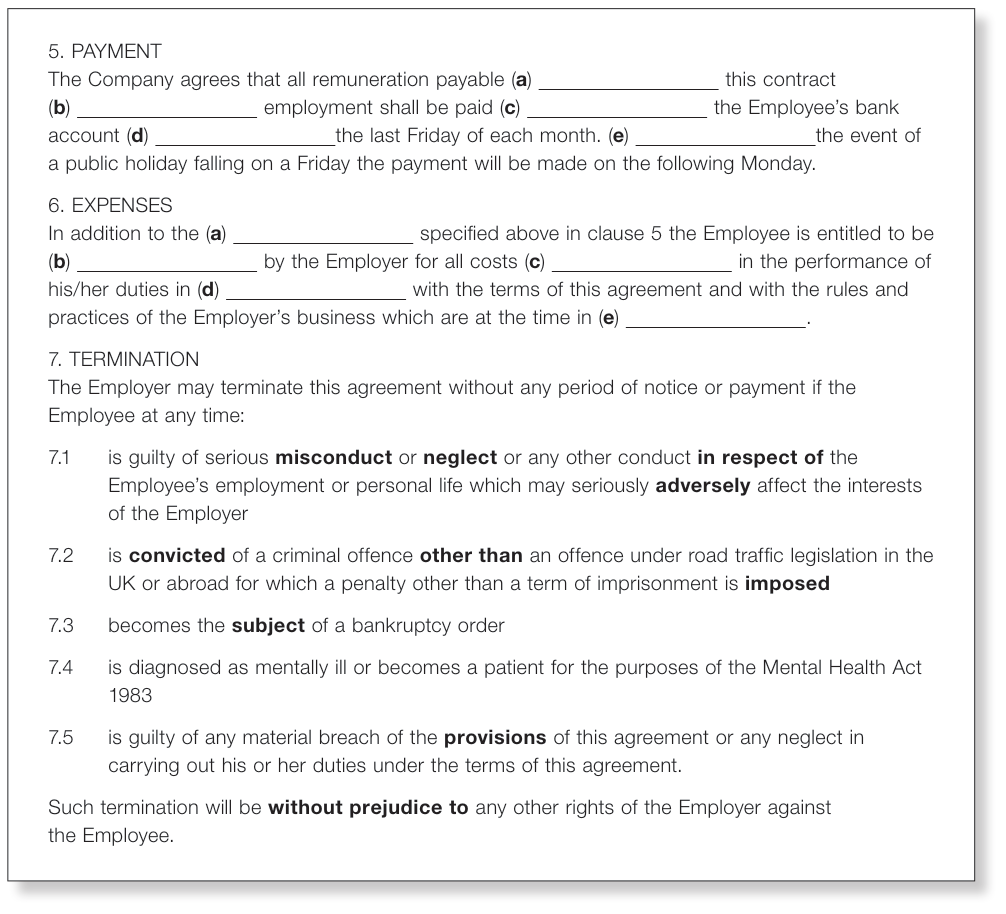
5. PAYMENT The Company agrees that all remuneration payable (a) this contract (b) employment shall be paid (c) the Employee’s bank account (d) the last Friday of each month. (e) the event of a public holiday falling on a Friday the payment will be made on the following Monday.
6. EXPENSES In addition to the (a) specified above in clause 5 the Employee is entitled to be (b) by the Employer for all costs (c) in the performance of his/her duties in (d) with the terms of this agreement and with the rules and practices of the Employer’s business which are at the time in (e) .
7. TERMINATION The Employer may terminate this agreement without any period of notice or payment if the Employee at any time:
7.1 is guilty of serious misconduct or neglect or any other conduct in respect of the Employee’s employment or personal life which may seriously adversely affect the interests of the Employer 7.2 is convicted of a criminal offence other than an offence under road traffic legislation in the UK or abroad for which a penalty other than a term of imprisonment is imposed 7.3 becomes the subject of a bankruptcy order 7.4 is diagnosed as mentally ill or becomes a patient for the purposes of the Mental Health Act 7.5 is guilty of any material breach of the provisions of this agreement or any neglect in carrying out his or her duties under the terms of this agreement.
Such termination will be without prejudice to any other rights of the Employer against the Employee.
Look at clause 5 of the employment contract above. It deals with payment of the employee. Complete the clause by using one of the prepositions in the box below.
Look at clause 6 of the employment contract above. It deals with expenses that the employer must pay back to the employee. Complete the clause by using one of the words in the box below.
Look at clause 7 of the employment contract. It deals with the circumstances in which the employer can terminate the contract without giving any warning to the employee. Match the words that are highlighted in the clause with the meanings below.
| # | Phrase | Definition |
|---|---|---|
| a | The terms and conditions contained in a contract. | Answer: |
| b | A failure to do something when it is your duty to do it. | Answer: |
| c | Except, with the exception of. | Answer: |
| d | Negatively, badly. | Answer: |
| e | Bad or dishonest behaviour. | Answer: |
| f | Forced upon you. You have no choice about it. | Answer: |
| g | Having no effect on something. | Answer: |
| h | Regarding or concerning. | Answer: |
| i | To be found guilty of a criminal act. | Answer: |
j In this context, it means the person that something happens to.
Answer:
Read the three clauses again and decide if the following statements are true or false.
a The employee must collect his or her pay from the company office on the last Friday of each month.
b If New Year’s Day is on a Friday the employee will be paid on the following Monday.
c If the employee makes a negative statement about the company’s products when he is at a party with his friends he could possibly be dismissed.
d If the employee is stopped by the police for driving too fast and she receives a fine of £200 she could possibly be dismissed.
e If the employee cannot pay his debts and a court has issued an order to say that he is insolvent he can be dismissed immediately.
Collocation bank
to be reimbursed by someone ‘I was reimbursed by my employer for my train fare to London.’ • in respect of something ‘My employer wrote to me last week in respect of my redundancy payment.’ • under the terms of an agreement ‘Under the terms of your contract you are entitled to five weeks’ holiday.’
Speaking & Writing for this topic
Two short tasks scored against TOEFL rubrics. The prompt is generated for this topic — use the vocabulary you have just studied.
Suggested structureclick to expand
- In my experience…
- From what I have seen…
- My honest view is that…
- The principal reason is that…
- This matters because…
- What makes into decisive here is…
- For instance, when I…
- A clear example is…
- Consider the case where of was involved…
- On the other hand,…
- Furthermore,…
- That said, one should not forget that…
- Overall, this shows that…
- The lesson, then, is…
- For these reasons, I believe…
- Aim for 4–5 keywords woven naturally into your answer.
- Use at least two linking phrases (Furthermore, On the other hand, As a result…).
- Avoid filler words like "basically" or "like".
Suggested structureclick to expand
- The most important point in reimbursed is …
- My position is that …
- The principal reason is that into …
- This is supported by …
- A concrete illustration is …
- For instance, …
- However, some argue that …
- On the other hand, …
- In conclusion, …
- Taken together, …
- Aim for 4–5 keywords used in natural context.
- Use 3+ linking words across the answer.
- Vary sentence length to avoid monotony.
AN EMPLOYMENT TRIBUNAL ~26 min
to be in force ‘There are rules in force as to where employees are allowed to smoke cigarettes at work.’ • to be the subject of something ‘I was the subject of an investigation into a breach of confidentiality when I worked for the government.’
Employment cases in the UK are heard in Employment Tribunal Offices. An employment tribunal is not as formal as a court but it must follow the correct rules of procedure in the same way as a normal court. Employment tribunals have the power to make decisions but there is a period where the parties are encouraged to reach an agreement before a case is heard. On the next page you can see a diagram summarising the process of making a claim at an employment tribunal.
The diagram on the next page uses some important collocations to describe the process of making a claim at an employment tribunal. Using the diagram to help you, complete the sentences below using a verb or a phrasal verb.
a First of all a disputearises.
b The parties should then try tosort outthe dispute.
c If the parties cannot agree then the claimant shouldgetadvice from a professional.
d The tribunal willacceptthe claim if it is presented on the correct form.
e The tribunal will thenholda hearing to examine the facts of the case.
f The tribunal will finallyissuea judgment.
The diagram contains some formal words and phrases. Find the words or phrases in the diagram that match the meanings provided below.
a A process in which the two parties to a dispute are brought together in order to try to find a solution.
Mediation is an example of this.
b The formal answer to a claim.
c An order issued by the court which says that the claimant has won the case because the respondent failed to file a response to the claim.
d The process in which the parties to the dispute agree on the conduct of the case, for example agreeing whether expert evidence is needed, what documents must be disclosed to each side and the time allowed for this, etc.
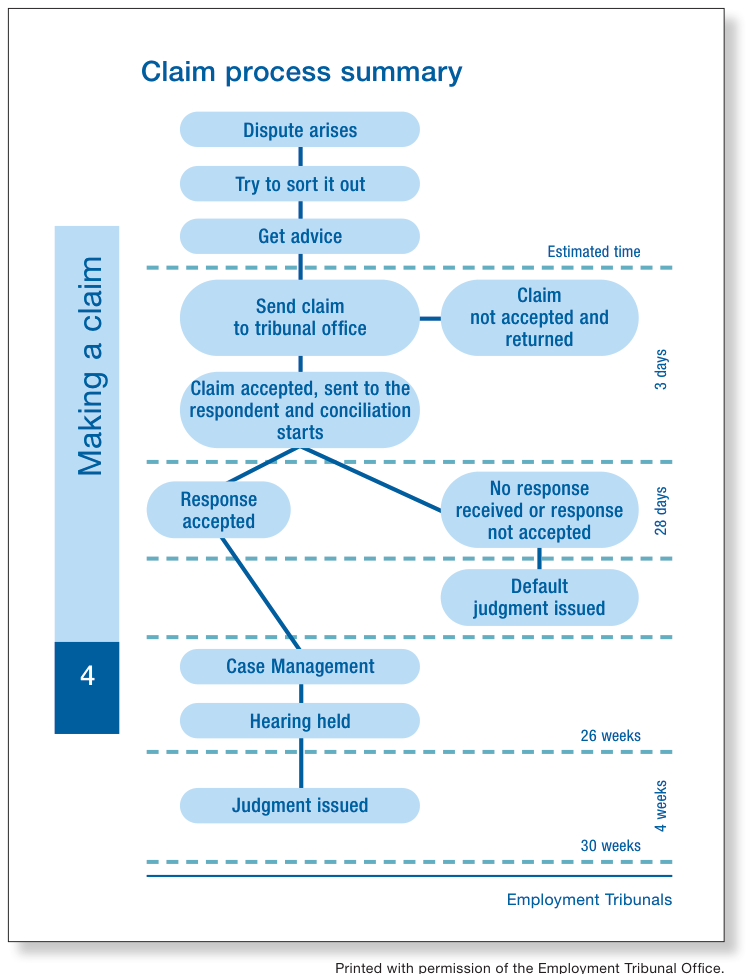
Claim process summary Dispute arises Try to sort it out Get advice Making a claim
Estimated time
Claim not accepted and Send claim tocase managementtribunal office returned
3 days 28 days 4 weeks
Claim accepted, sent to the respondent and conciliation starts Response accepted No response received or response not accepted Default judgment issued Case Management Hearing held
26 weeks
Judgment issued
30 weeks
Employment Tribunals
Look at the diagram again and say whether the following statements are true or false.
a The first thing an employee who is in dispute with his or her employer should do is file a claim with an employment tribunal.
b The ‘defendant’ is known as a ‘respondent’ in a case at an employment tribunal.
c The respondent has just three days to respond to the claim.
d If the respondent does not respond to the claim then the tribunal can rule in favour of the claimant without a hearing.
e The entire process takes about 30 weeks from start to finish.
Maggie Redman is an employee of a business in Chatsworth. She is involved in a serious dispute with her employer. Maggie has some questions about employment tribunals. Complete her questions with a word from the box below.
a What exactly do employment tribunalsdo?
b Where can I get a full list of the categories of complaints that employment tribunals deal?
cCanthe staff at an employment tribunal office give me legal advice?
dHowlong does the tribunal office give my employer to respond to my initial letter of complaint before I can bring a claim?
e I understand that I have three months in which to make a complaint about my employer.
does the three-month period begin?
On the next page is a leaflet that Maggie Redman has picked up from her local tribunal office in Chatsworth. The information needed to answer Maggie’s questions from Exercise 4 is contained in the leaflet. Answer Maggie’s questions using a full sentence. Each sentence has been started for you.
a An employment tribunal
b You can get
c The staff at
d The tribunal office
e The three-month period
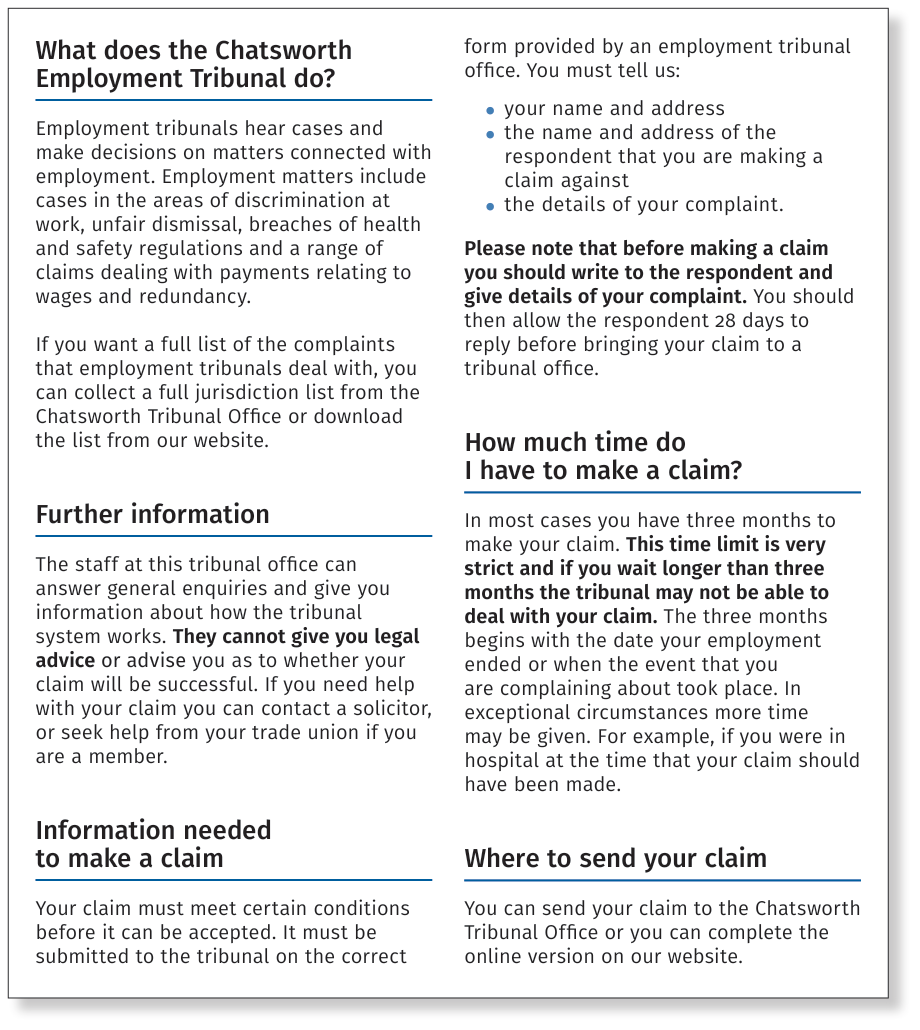
What does the Chatsworth Employment Tribunal do?
form provided by an employment tribunal office. You must tell us:
Employment tribunals hear cases and make decisions on matters connected with employment. Employment matters include cases in the areas of discrimination at work, unfair dismissal, breaches of health and safety regulations and a range of claims dealing with payments relating to wages and redundancy.
If you want a full list of the complaints that employment tribunals deal with, you can collect a full jurisdiction list from the Chatsworth Tribunal Office or download the list from our website.
Further information respondent that you are making a claim against • the details of your complaint.
Please note that before making a claim you should write to the respondent and give details of your complaint. You should then allow the respondent 28 days to reply before bringing your claim to a tribunal office.
How much time do I have to make a claim?
In most cases you have three months to make your claim. This time limit is very strict and if you wait longer than three months the tribunal may not be able to deal with your claim. The three months begins with the date your employment ended or when the event that you are complaining about took place. In exceptional circumstances more time may be given. For example, if you were in hospital at the time that your claim should have been made.
The staff at this tribunal office can answer general enquiries and give you information about how the tribunal system works. They cannot give you legal advice or advise you as to whether your claim will be successful. If you need help with your claim you can contact a solicitor, or seek help from your trade union if you are a member.
Information needed to make a claim Your claim must meet certain conditions before it can be accepted. It must be submitted to the tribunal on the correct Where to send your claim You can send your claim to the Chatsworth Tribunal Office or you can complete the online version on our website.
Look at the leaflet again. In each of the examples below, tick the box which uses the correct collocation.
| # | Phrase | Definition |
|---|---|---|
| (*) | listen to a case | hear a case |
| a | employment matters | employment affairs |
| b | unjust dismissal | unfair dismissal |
| c | seek help | search for help |
| d | bring a claim | do a claim |
| e | draft a claim form | complete a claim form |
Speaking & Writing for this topic
Two short tasks scored against TOEFL rubrics. The prompt is generated for this topic — use the vocabulary you have just studied.
Suggested structureclick to expand
- In my experience…
- From what I have seen…
- My honest view is that…
- The principal reason is that…
- This matters because…
- What makes with decisive here is…
- For instance, when I…
- A clear example is…
- Consider the case where How was involved…
- On the other hand,…
- Furthermore,…
- That said, one should not forget that…
- Overall, this shows that…
- The lesson, then, is…
- For these reasons, I believe…
- Aim for 4–5 keywords woven naturally into your answer.
- Use at least two linking phrases (Furthermore, On the other hand, As a result…).
- Avoid filler words like "basically" or "like".
Suggested structureclick to expand
- The most important point in your name and address is …
- My position is that …
- The principal reason is that with …
- This is supported by …
- A concrete illustration is …
- For instance, …
- However, some argue that …
- On the other hand, …
- In conclusion, …
- Taken together, …
- Aim for 4–5 keywords used in natural context.
- Use 3+ linking words across the answer.
- Vary sentence length to avoid monotony.
AN EMPLOYMENT CLAIM ~35 min
If you want to make a claim at an employment tribunal you must check that the nature of your claim is covered by the tribunal’s jurisdiction list. On the next page you will see ten types of claim that are covered by the jurisdiction list. Look at the employees’ complaints below. Match each employee with the correct type of complaint.
Anna Kingston ‘I am a machine operator in a factory in Chatsworth. I have worked here for two years. I have just discovered that a man who works here is paid £2 an hour more than I am for doing exactly the same job as me.’
David Cainley ‘I work in the office of a publishing company. I had to attend a disciplinary meeting last month because I was accused of using the Internet to look at football websites during paid working hours. I was dismissed at the end of that meeting. I was extremely angry because my employer refused to allow my trade union representative to attend the disciplinary meeting with me.’
Arthur Bentley ‘I am 55 years old. I work for a travel agency. Last month our manager resigned and the job of branch manager became available. Despite the fact that I have 20 years’ experience of this type of work, a younger man in my office was promoted over me. The area manager actually told me afterwards that although they were impressed by me at my interview they thought that I was too old to handle the new technology that the company were planning to introduce over the next few years. I feel that this is extremely unfair.’
Simon Cole ‘I am 45 years old. I applied for a job working in a petrol station in Chatsworth. The job advertisement said applicants should be ‘young and dynamic’. I was not selected for interview, despite lots of previous experience of doing similar jobs. I believe the employer only wanted people who were younger than me.’
Brian Hedley ‘I am 19 years old. I work for a sole trader who runs a gardening business. Last month I decided to take out a loan and the bank asked for my last three months’ payslips. My employer pays me in cash at the end of every day and refuses to give me payslips. Without proof that I earn money I can’t get a loan.’
Jack Walsh ‘I am 23 years old. I do seasonal work for a local fruit grower near Chatsworth and I pick fruit for eight hours every day. The law says that my employer must pay me at least £10.42 an hour but my employer only pays £5 an hour.’
Deborah Clark ‘I worked in the office at a local brewery. My employer needed to reduce the number of administrative staff last month because there wasn’t enough work for everyone. Two of us in the office, my colleague Jane and I, have young children and we only work 20 hours a week in comparison to the other employees who work 37 hours a week. The boss made Jane and I redundant, although we had actually been there longer than some other employees.’
Alex Harmon ‘I am 41 years old and I have worked for all of my working life in a factory that produces furniture. The factory is due to close in two months and we will all be made redundant. It is really difficult to get a new job at my age but to make matters worse my employer refused to let me have a morning off to go for an interview.’
Dan Beale ‘I work for an advertising agency based here in Chatsworth. My employment contract clearly states that I will be paid on 26th of each month but my employer always pays me later than that. I have had a few financial troubles as a result.’
Maggie Redman ‘I used to work as a manager of a restaurant business until I resigned last July. I didn’t want to resign but when my employers found out that I was expecting a baby they treated me very badly and I didn’t feel that I could stay.’
Jurisdiction list
a You have suffered a detriment or have been dismissed as a result of your employer’s refusal to allow you to be accompanied at a disciplinary/grievance hearing.
Employee name:
b You have a complaint based upon breach of contract.
Employee name:
c You have a complaint based upon a discriminatory advertisement.
Employee name:
d You have suffered discrimination in the workplace on the grounds of age.
Employee name:
e Your employer has failed to provide equal pay for equal work.
Employee name:
f Your employer has failed to allow time off to seek work during a redundancy situation.
Employee name:
g Your employer has failed to provide a written pay statement.
Employee name:
h You have suffered a detriment or have been dismissed on the grounds of pregnancy.
Employee name:
i You have suffered a detriment or have been dismissed as a result of your employer’s failure to pay the minimum wage.
Employee name:
j You have suffered less favourable treatment or have been dismissed as a result of being a part-time employee rather than a full-time employee.
Employee name:Deborah ClarkCollocation bank
to be promoted over someone ‘Sandra has worked here for seven years now and three people have been promoted over her.’ • to have time off work ‘I had a lot of time off work last year due to family problems.’
• in comparison to/with something/someone ‘We are paid well in this country in comparison to/with workers who make cars in other countries.’ • to be paid in cash ‘Many illegal workers are paid in cash.’
Read the newspaper story on the next page. It is a story about a hearing at an employment tribunal. Fill the gaps in the text with a word from the box below.
Read the newspaper story again and answer the following questions using a full sentence.
a What was Maggie Redman’s job at Casa?
b What was Maggie Redman’s yearly salary at Casa?
c Who were the owners of Casa?
d How long had Maggie Redman been working at Casa when she discovered she was going to have a baby?
e Was Michael Roeder sympathetic towards Maggie Redman when she told him that she was pregnant?
f What reason did Maggie Redman give for being unable to work efficiently after her conversation with Michael Roeder?
g When Maggie Redman returned to work, how did Mr and Mrs Roeder financially punish her for alleged offences such as making late payments to suppliers?
h Was Maggie Redman fired from her job at Casa?
i What were Maggie Redman’s grounds for bringing a case against her employers?
j What did the tribunal award to Maggie Redman when it upheld her complaints?
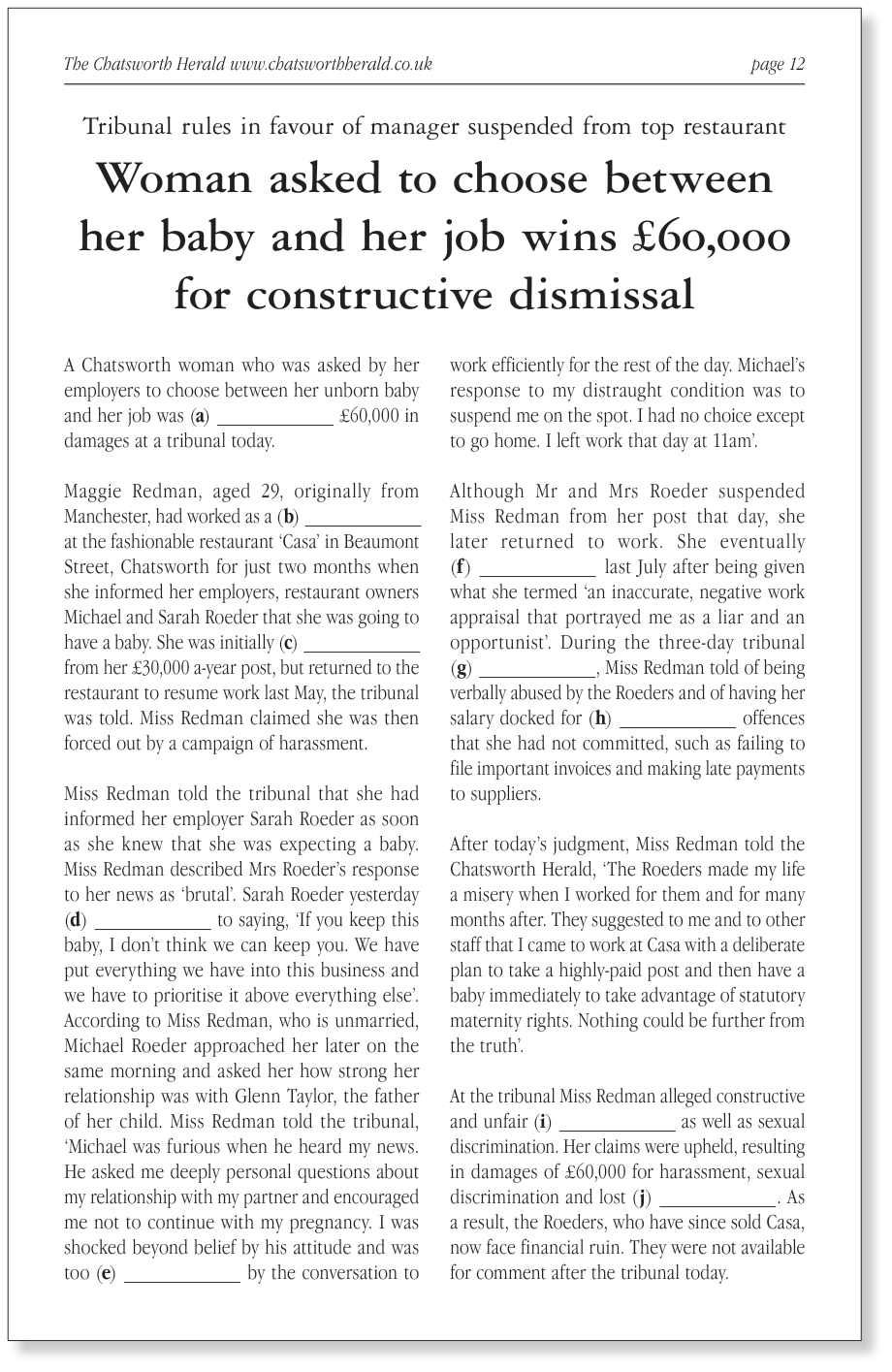
The Chatsworth Herald www.chatsworthherald.co.uk page 12 Tribunal rules in favour of manager suspended from top restaurant A Chatsworth woman who was asked by her employers to choose between her unborn baby and her job was (a) £60,000 in damages at a tribunal today.
work efficiently for the rest of the day. Michael’s response to my distraught condition was to suspend me on the spot. I had no choice except to go home. I left work that day at 11am’.
Maggie Redman, aged 29, originally from Manchester, had worked as a (b) at the fashionable restaurant ‘Casa’ in Beaumont Street, Chatsworth for just two months when she informed her employers, restaurant owners Michael and Sarah Roeder that she was going to have a baby. She was initially (c) from her £30,000 a-year post, but returned to the restaurant to resume work last May, the tribunal was told. Miss Redman claimed she was then forced out by a campaign of harassment.
Although Mr and Mrs Roeder suspended Miss Redman from her post that day, she later returned to work. She eventually (f) last July after being given what she termed ‘an inaccurate, negative work appraisal that portrayed me as a liar and an opportunist’. During the three-day tribunal (g) , Miss Redman told of being verbally abused by the Roeders and of having her salary docked for (h) offences that she had not committed, such as failing to file important invoices and making late payments to suppliers.
Miss Redman told the tribunal that she had informed her employer Sarah Roeder as soon as she knew that she was expecting a baby. Miss Redman described Mrs Roeder’s response to her news as ‘brutal’. Sarah Roeder yesterday (d) to saying, ‘If you keep this baby, I don’t think we can keep you. We have put everything we have into this business and we have to prioritise it above everything else’. According to Miss Redman, who is unmarried, Michael Roeder approached her later on the same morning and asked her how strong her relationship was with Glenn Taylor, the father of her child. Miss Redman told the tribunal, ‘Michael was furious when he heard my news. He asked me deeply personal questions about my relationship with my partner and encouraged me not to continue with my pregnancy. I was shocked beyond belief by his attitude and was too (e) by the conversation to After today’s judgment, Miss Redman told the Chatsworth Herald, ‘The Roeders made my life a misery when I worked for them and for many months after. They suggested to me and to other staff that I came to work at Casa with a deliberate plan to take a highly-paid post and then have a baby immediately to take advantage of statutory maternity rights. Nothing could be further from the truth’.
At the tribunal Miss Redman alleged constructive and unfair (i) as well as sexual discrimination. Her claims were upheld, resulting in damages of £60,000 for harassment, sexual discrimination and lost (j) . As a result, the Roeders, who have since sold Casa, now face financial ruin. They were not available for comment after the tribunal today.
Speaking & Writing for this topic
Two short tasks scored against TOEFL rubrics. The prompt is generated for this topic — use the vocabulary you have just studied.
Suggested structureclick to expand
- In my experience…
- From what I have seen…
- My honest view is that…
- The principal reason is that…
- This matters because…
- What makes unfair dismissal decisive here is…
- For instance, when I…
- A clear example is…
- Consider the case where to seek help was involved…
- On the other hand,…
- Furthermore,…
- That said, one should not forget that…
- Overall, this shows that…
- The lesson, then, is…
- For these reasons, I believe…
- Aim for 4–5 keywords woven naturally into your answer.
- Use at least two linking phrases (Furthermore, On the other hand, As a result…).
- Avoid filler words like "basically" or "like".
Suggested structureclick to expand
- The most important point in to attend a meeting is …
- My position is that …
- The principal reason is that unfair dismissal …
- This is supported by …
- A concrete illustration is …
- For instance, …
- However, some argue that …
- On the other hand, …
- In conclusion, …
- Taken together, …
- Aim for 4–5 keywords used in natural context.
- Use 3+ linking words across the answer.
- Vary sentence length to avoid monotony.
USING YOUR KNOWLEDGE ~13 min
Collocation review Complete these sentences with a collocation that you have seen.
a Please do not disclose this information to anyone, as it is confidential.
b If you any expenses on your training course in London the company will reimburse you upon your return.
c Do you have any experience of working in a bank? We are ideally looking for someone who won’t need very much training.
d I have for a job with a major law firm but I’m not sure that I will be selected for interview, as there is sure to be a lot of competition.
e It is vital to up-to-date with changes in employment law because employers have to comply with many duties and obligations.
f Employees have been affected by the bad economic situation that we have at the moment and many people have lost their jobs as a result.
g The employee’s dishonest behaviour amounted to a breach of his employment contract and he was dismissed immediately.
h If you have been of a serious criminal offence in the past you are not eligible for a job in the police force.
i I have to a pension fund for 30 years and I hope I will have enough in it to be able to retire at the age of 50.
j The European Union penalties upon member countries that breach its employment legislation.
Vocabulary review Complete these sentences with a word that you have seen.
a The successful for this challenging post will have experience of financial sales and be a good leader of staff.
b Mothers of new babies are entitled to 52 weeks’ maternity according to current legislation.
c The clause of this contract explains the circumstances in which the employer can bring the contract to an end without notice to the employee.
d She was fired from her job without good reason and she is bringing a claim against her employer for unfair .
e Employers are not allowed to against employees on the grounds of age, sex or religion.
f If you are ill and you are away from work your employer is obliged to pay you pay for a certain number of weeks.
g In the UK, special courts known as deal with employment cases.
h Employers are obliged to give pay to men and women if they are doing the same job.
i The work of an employment lawyer that does not involve any kind of dispute is known as non- work.
j There is a lot of health and legislation these days, which is designed to keep employees safe from harm when they are at work.
Preposition review Complete these sentences with the correct preposition.
a Are you familiar the latest European Union legislation on sexual discrimination?
b We hold all of our confidential information a computer at our head office.
c I was reimbursed the company accountant for all of the expenses that I incurred in the month of July.
d I give notice that I will end my employment Harrods on 23 April of this year.
e The Employee’s salary will be paid directly his or her bank account on the last day of each month.
f the terms of his employment contract he must give four weeks’ notice if he wants to terminate his employment.
g Employment tribunals hear cases relating a wide range of complaints.
h I wish to make a claim my employer on the grounds of breach of contract.
i I am very angry because I thought I would be made a manager at my company this year but a younger man was promoted me.
j I was not able to go to an interview for a new job because it was at two o’clock and my current employer refused to give me the afternoon .
Speaking & Writing for this topic
Two short tasks scored against TOEFL rubrics. The prompt is generated for this topic — use the vocabulary you have just studied.
Suggested structureclick to expand
- In my experience…
- From what I have seen…
- My honest view is that…
- The principal reason is that…
- This matters because…
- What makes using decisive here is…
- For instance, when I…
- A clear example is…
- Consider the case where your was involved…
- On the other hand,…
- Furthermore,…
- That said, one should not forget that…
- Overall, this shows that…
- The lesson, then, is…
- For these reasons, I believe…
- Aim for 4–5 keywords woven naturally into your answer.
- Use at least two linking phrases (Furthermore, On the other hand, As a result…).
- Avoid filler words like "basically" or "like".
Suggested structureclick to expand
- The most important point in this concept is …
- My position is that …
- The principal reason is that using …
- This is supported by …
- A concrete illustration is …
- For instance, …
- However, some argue that …
- On the other hand, …
- In conclusion, …
- Taken together, …
- Aim for 4–5 keywords used in natural context.
- Use 3+ linking words across the answer.
- Vary sentence length to avoid monotony.
HIGHER LEVEL PRACTICE ~3 min
Read the contract clause below. The missing prepositions are in the list below. For each gap choose the preposition which best fits into the space from the options provided. Use each option only once. Write your answers in the box below. There is an example at the beginning (*).
Speaking & Writing for this topic
Two short tasks scored against TOEFL rubrics. The prompt is generated for this topic — use the vocabulary you have just studied.
Suggested structureclick to expand
- In my experience…
- From what I have seen…
- My honest view is that…
- The principal reason is that…
- This matters because…
- What makes higher decisive here is…
- For instance, when I…
- A clear example is…
- Consider the case where level was involved…
- On the other hand,…
- Furthermore,…
- That said, one should not forget that…
- Overall, this shows that…
- The lesson, then, is…
- For these reasons, I believe…
- Aim for 4–5 keywords woven naturally into your answer.
- Use at least two linking phrases (Furthermore, On the other hand, As a result…).
- Avoid filler words like "basically" or "like".
Suggested structureclick to expand
- The most important point in this concept is …
- My position is that …
- The principal reason is that higher …
- This is supported by …
- A concrete illustration is …
- For instance, …
- However, some argue that …
- On the other hand, …
- In conclusion, …
- Taken together, …
- Aim for 4–5 keywords used in natural context.
- Use 3+ linking words across the answer.
- Vary sentence length to avoid monotony.
FROM A CONTRACT OF EMPLOYMENT ~22 min
7. HOLIDAYS The Company and the Employee agree as follows:
7.1 All of the Employee’s holiday dates shall be agreed with the human resources department of the Company a minimum (*) six weeks (1) advance of holiday being taken.
7.2 The Company shall be entitled to require the Employee to work any public holiday including Christmas Day if any such holiday falls (2) a day on which the Employee would normally be required to work.
7.3 In the event that the Employee leaves the Company he or she shall be entitled to pay in lieu (3) any holiday entitlement that may have accumulated.
7.4 In the event that the Employee leaves the Company and he or she has received paid holiday in excess of holiday entitlement the Company is entitled to deduct any overpayment (4) any other sums due (5) the Employee from the Company.
(*) AA (1) (2) (3) (4) (5)
Listening
Listen to this conversation between a lawyer and his client. Decide if the following statements are true or false.
1 Mr Winter had already filed a claim against his former employer before his visit to the lawyer. 2 Mr Winter was employed as an office worker in Birmingham. 3 Mr Winter was dismissed two weeks ago. 4 Mr Winter was injured by a woman when he tried to stop her fighting with her husband. 5 Mr Winter has now completely recovered from the injury he sustained to his ear. 6 Mr Winter suffered no broken bones in the attack upon him. 7 Mr Winter’s supervisor was very sympathetic about his medical problems. 8 Mr Winter’s supervisor telephoned him to say she intended to file a defence to his claim. 9 Mr Winter has only worked for six weeks since the attack upon him. 10 The lawyer thinks that Mr Winter’s claim will be unsuccessful.
True or false?
| # | Phrase | Definition |
|---|---|---|
| (1) | (2) (3) | (4) (5) |
| (6) | (7) (8) | (9) (10) |
Look at the letter below. A lawyer has written it on behalf of his client. Parts of the letter are written in an inappropriate way. They are underlined. Rewrite the underlined words in a more appropriate way. There is an example at the beginning (*).
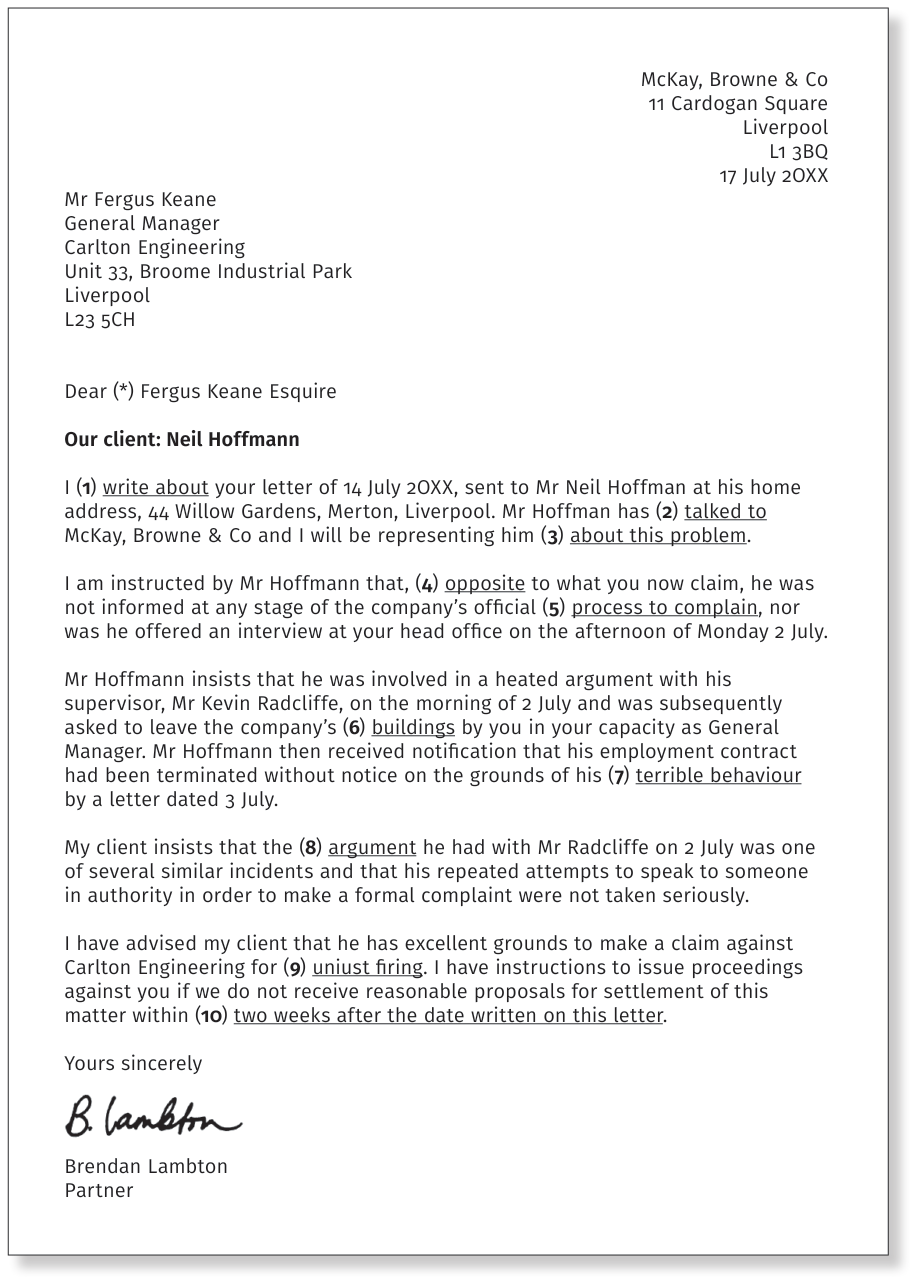
McKay, Browne & Co 11 Cardogan Square Liverpool L1 3BQ 17 July 2OXX Mr Fergus Keane General Manager Carlton Engineering Unit 33, Broome Industrial Park Liverpool L23 5CH Dear (*) Fergus Keane Esquire Our client: Neil Hoffmann I (1) write about your letter of 14 July 2OXX, sent to Mr Neil Hoffman at his home address, 44 Willow Gardens, Merton, Liverpool. Mr Hoffman has (2) talked to McKay, Browne & Co and I will be representing him (3) about this problem.
I am instructed by Mr Hoffmann that, (4) opposite to what you now claim, he was not informed at any stage of the company’s official (5) process to complain, nor was he offered an interview at your head office on the afternoon of Monday 2 July.
Mr Hoffmann insists that he was involved in a heated argument with his supervisor, Mr Kevin Radcliffe, on the morning of 2 July and was subsequently asked to leave the company’s (6) buildings by you in your capacity as General Manager. Mr Hoffmann then received notification that his employment contract had been terminated without notice on the grounds of his (7) terrible behaviour by a letter dated 3 July.
My client insists that the (8) argument he had with Mr Radcliffe on 2 July was one of several similar incidents and that his repeated attempts to speak to someone in authority in order to make a formal complaint were not taken seriously.
I have advised my client that he has excellent grounds to make a claim against Carlton Engineering for (9) uniust firing. I have instructions to issue proceedings against you if we do not receive reasonable proposals for settlement of this matter within (10) two weeks after the date written on this letter.
Yours sincerely
Brendan Lambton Partner (*) Mr Keane
(10)
Speaking & Writing for this topic
Two short tasks scored against TOEFL rubrics. The prompt is generated for this topic — use the vocabulary you have just studied.
Suggested structureclick to expand
- In my experience…
- From what I have seen…
- My honest view is that…
- The principal reason is that…
- This matters because…
- What makes (AA) of decisive here is…
- For instance, when I…
- A clear example is…
- Consider the case where (A) upon was involved…
- On the other hand,…
- Furthermore,…
- That said, one should not forget that…
- Overall, this shows that…
- The lesson, then, is…
- For these reasons, I believe…
- Aim for 4–5 keywords woven naturally into your answer.
- Use at least two linking phrases (Furthermore, On the other hand, As a result…).
- Avoid filler words like "basically" or "like".
Suggested structureclick to expand
- The most important point in (E) to is …
- My position is that …
- The principal reason is that (AA) of …
- This is supported by …
- A concrete illustration is …
- For instance, …
- However, some argue that …
- On the other hand, …
- In conclusion, …
- Taken together, …
- Aim for 4–5 keywords used in natural context.
- Use 3+ linking words across the answer.
- Vary sentence length to avoid monotony.