
The Language of Contract Law
WHERE DOES CONTRACT LAW COME FROM? ~41 min
Jack Winter and Shelley Hirst are first-year law students at the University of Chatsworth. Their studies will begin with contract law. The head of the law faculty has asked first-year students to read a book called ‘An Introduction to English Contract Law’ before they come to their first lecture. The first section of the book that Jack and Shelley have to read is about the sources of English law. This page is on the subject of statute. Fill the gaps in the text with a word or phrase from the box below.
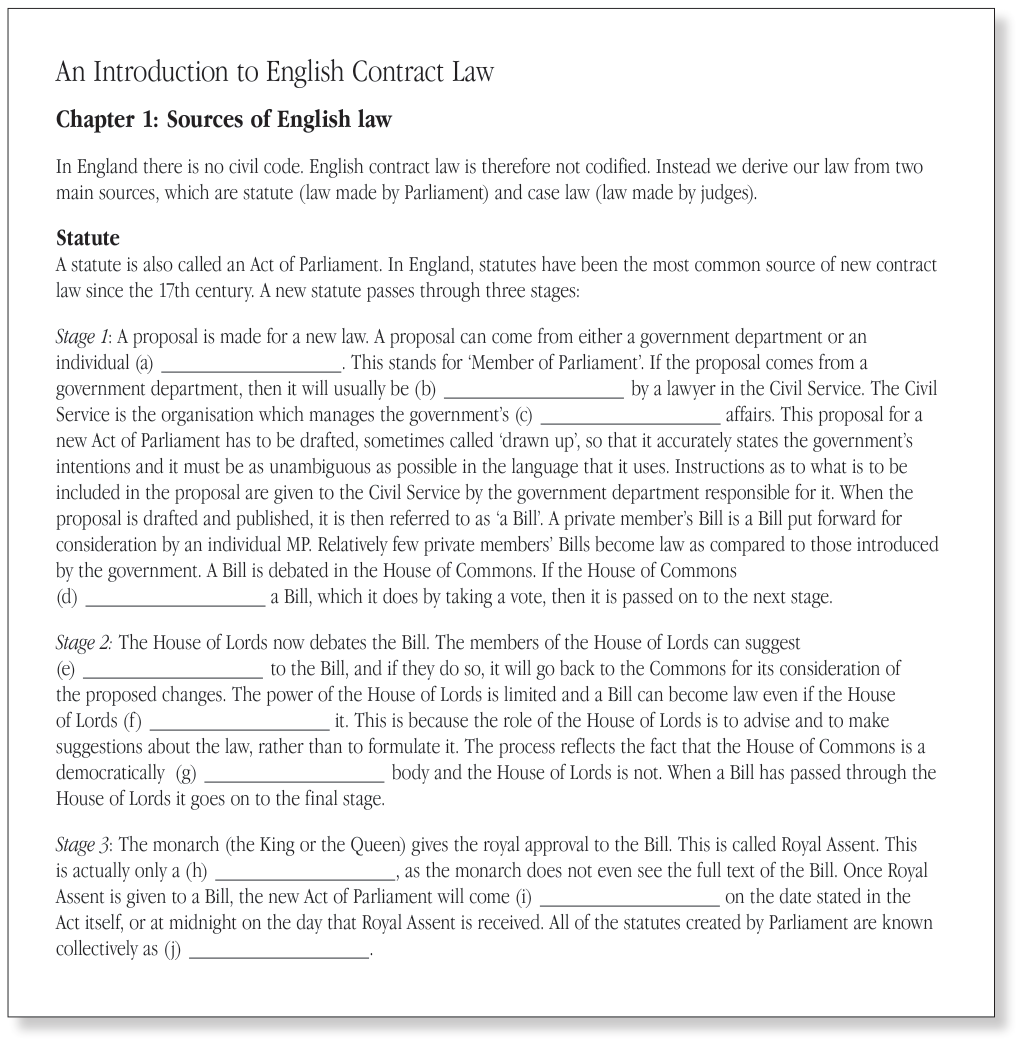
An Introduction to English Contract Law
Chapter 1: Sources of English law
In England there is no civil code. English contract law is therefore not codified. Instead we derive our law from two main sources, which are statute (law made by Parliament) and case law (law made by judges).
Statute A statute is also called an Act of Parliament. In England, statutes have been the most common source of new contract law since the 17th century. A new statute passes through three stages:
Stage 1: A proposal is made for a new law. A proposal can come from either a government department or an individual (a) . This stands for ‘Member of Parliament’. If the proposal comes from a government department, then it will usually be (b) by a lawyer in the Civil Service. The Civil Service is the organisation which manages the government’s (c) affairs. This proposal for a new Act of Parliament has to be drafted, sometimes called ‘drawn up’, so that it accurately states the government’s intentions and it must be as unambiguous as possible in the language that it uses. Instructions as to what is to be included in the proposal are given to the Civil Service by the government department responsible for it. When the proposal is drafted and published, it is then referred to as ‘a Bill’. A private member’s Bill is a Bill put forward for consideration by an individual MP. Relatively few private members’ Bills become law as compared to those introduced by the government. A Bill is debated in the House of Commons. If the House of Commons (d) a Bill, which it does by taking a vote, then it is passed on to the next stage.
Stage 2: The House of Lords now debates the Bill. The members of the House of Lords can suggest (e) to the Bill, and if they do so, it will go back to the Commons for its consideration of the proposed changes. The power of the House of Lords is limited and a Bill can become law even if the House of Lords (f) it. This is because the role of the House of Lords is to advise and to make suggestions about the law, rather than to formulate it. The process reflects the fact that the House of Commons is a democratically (g) body and the House of Lords is not. When a Bill has passed through the House of Lords it goes on to the final stage.
Stage 3: The monarch (the King or the Queen) gives the royal approval to the Bill. This is called Royal Assent. This is actually only a (h) , as the monarch does not even see the full text of the Bill. Once Royal Assent is given to a Bill, the new Act of Parliament will come (i) on the date stated in the Act itself, or at midnight on the day that Royal Assent is received. All of the statutes created by Parliament are known collectively as (j) .
A note about the USA The process is very similar in the United States. In the USA a new Bill has to be passed by Congress. Congress is constituted of two chambers. These are the House of Representatives and the Senate. Both chambers must approve the Bill. It then needs the signature of the President to become law.
The second page of the book that Jack and Shelley have to read contains information on the subject of case law. Fill the gaps in the text with a word from the box below.
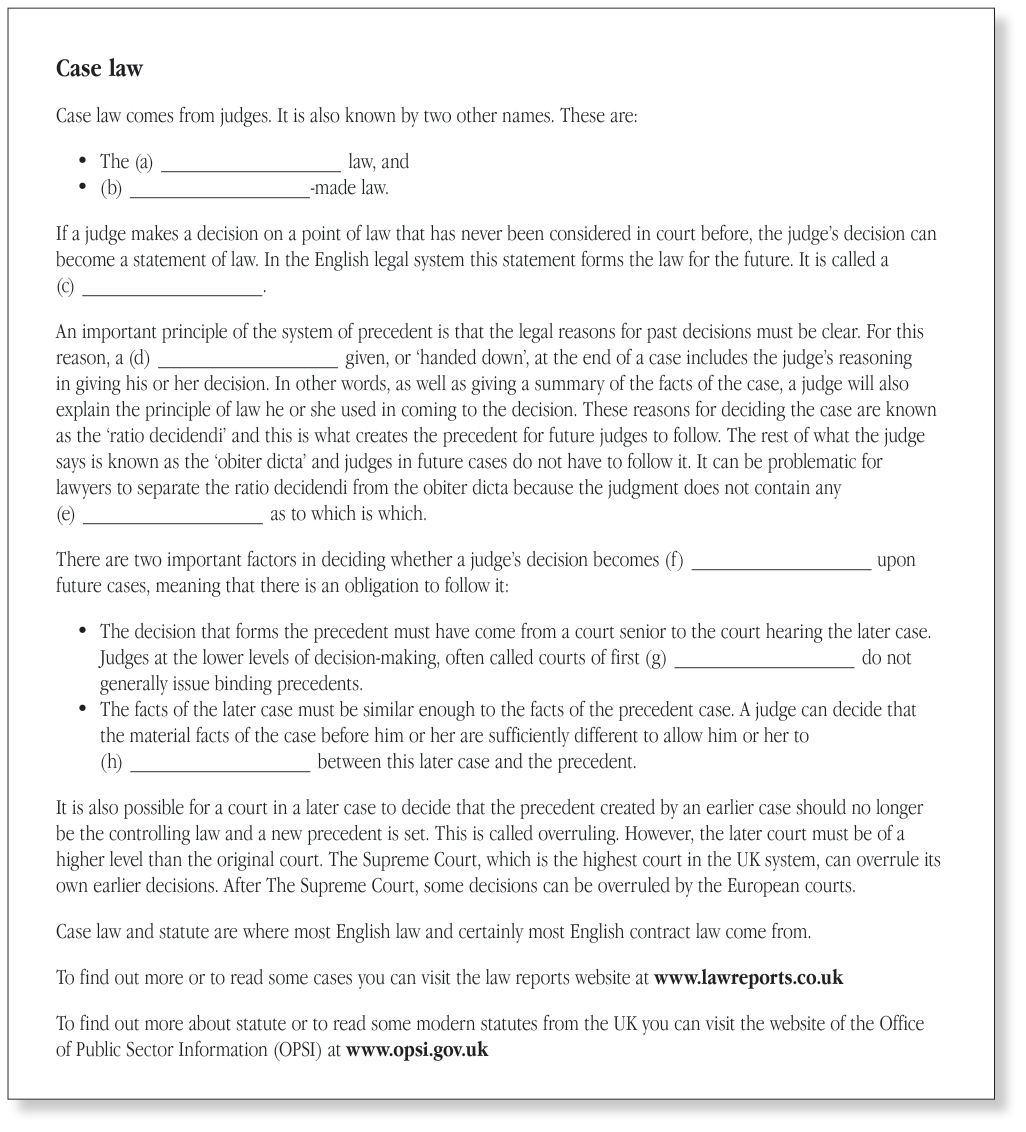
Case law
Case law comes from judges. It is also known by two other names. These are:
• The (a) law, and • (b) -made law.
If a judge makes a decision on a point of law that has never been considered in court before, the judge’s decision can become a statement of law. In the English legal system this statement forms the law for the future. It is called a (c) .
An important principle of the system of precedent is that the legal reasons for past decisions must be clear. For this reason, a (d) given, or ‘handed down’, at the end of a case includes the judge’s reasoning in giving his or her decision. In other words, as well as giving a summary of the facts of the case, a judge will also explain the principle of law he or she used in coming to the decision. These reasons for deciding the case are known as the ‘ratio decidendi’ and this is what creates the precedent for future judges to follow. The rest of what the judge says is known as the ‘obiter dicta’ and judges in future cases do not have to follow it. It can be problematic for lawyers to separate the ratio decidendi from the obiter dicta because the judgment does not contain any (e) as to which is which.
There are two important factors in deciding whether a judge’s decision becomes (f) upon future cases, meaning that there is an obligation to follow it:
• The decision that forms the precedent must have come from a court senior to the court hearing the later case.
Judges at the lower levels of decision-making, often called courts of first (g) do not generally issue binding precedents. • The facts of the later case must be similar enough to the facts of the precedent case. A judge can decide that the material facts of the case before him or her are sufficiently different to allow him or her to (h) between this later case and the precedent.
It is also possible for a court in a later case to decide that the precedent created by an earlier case should no longer be the controlling law and a new precedent is set. This is called overruling. However, the later court must be of a higher level than the original court. The Supreme Court, which is the highest court in the UK system, can overrule its own earlier decisions. After The Supreme Court, some decisions can be overruled by the European courts.
Case law and statute are where most English law and certainly most English contract law come from.
To find out more or to read some cases you can visit the law reports website at www.lawreports.co.uk To find out more about statute or to read some modern statutes from the UK you can visit the website of the Office of Public Sector Information (OPSI) at www.opsi.gov.uk Collocation bank
‘Legislation is the UK’s most important source of law.’ • to be drafted by a lawyer ‘This Bill was drafted by a lawyer in the Civil Service.’ • to put an idea forward for consideration ‘This idea was put forward for consideration by the Department of Health.’ • to suggest an amendment to something ‘The House of Lords is suggesting two significant amendments to this Bill.’
‘The new Act of Parliament will come into force at midnight tonight.’ • a precedent is binding on/upon lower courts ‘A precedent from 1908 is binding upon the court in this type of situation.’ • to be made by someone or something ‘This decision was made by a judge in 1985.’ • to pass through a stage (that is one of several stages) ‘The proposal for a new Education Act is still passing through the early stages.’
Here is a short text about statute. Complete the gaps in the text with the correct preposition from the box below.
The UK does not have a civil code. Its laws therefore come (a) alternative sources. Until the 17th century, the common law was the most important source (b) law. After that, Acts of Parliament, otherwise known (c) statutes, became the primary source of law.
A Bill is the name given to a proposal for a new statute. A Bill is put forward (d) Parliament’s consideration by an MP or by a government department. A Bill has to pass (e) several stages before it becomes law. The first of these stages is usually the House of Commons. A vote is taken (f) the Bill and if it is approved it will pass to the House of Lords. The House of Lords can suggest amendments (g) the Bill but it cannot prevent the Bill from becoming law. The final stage is Royal Assent. After this, the new Act of Parliament can come (h) force.
Speaking & Writing for this topic
Two short tasks scored against TOEFL rubrics. The prompt is generated for this topic — use the vocabulary you have just studied.
Suggested structureclick to expand
- In my experience…
- From what I have seen…
- My honest view is that…
- The principal reason is that…
- This matters because…
- What makes amendments decisive here is…
- For instance, when I…
- A clear example is…
- Consider the case where drafted was involved…
- On the other hand,…
- Furthermore,…
- That said, one should not forget that…
- Overall, this shows that…
- The lesson, then, is…
- For these reasons, I believe…
- Aim for 4–5 keywords woven naturally into your answer.
- Use at least two linking phrases (Furthermore, On the other hand, As a result…).
- Avoid filler words like "basically" or "like".
Suggested structureclick to expand
- The most important point in MP is …
- My position is that …
- The principal reason is that amendments …
- This is supported by …
- A concrete illustration is …
- For instance, …
- However, some argue that …
- On the other hand, …
- In conclusion, …
- Taken together, …
- Aim for 4–5 keywords used in natural context.
- Use 3+ linking words across the answer.
- Vary sentence length to avoid monotony.
READING A STATUTE ~27 min
You are now going to read part of a statute that deals with contract law. The complete statute has ten sections and is six pages long. This is part of Section 1, which forms the first page of the statute. It deals with the rights of people who are not one of the parties to a contract but who may have rights under that contract in certain circumstances.
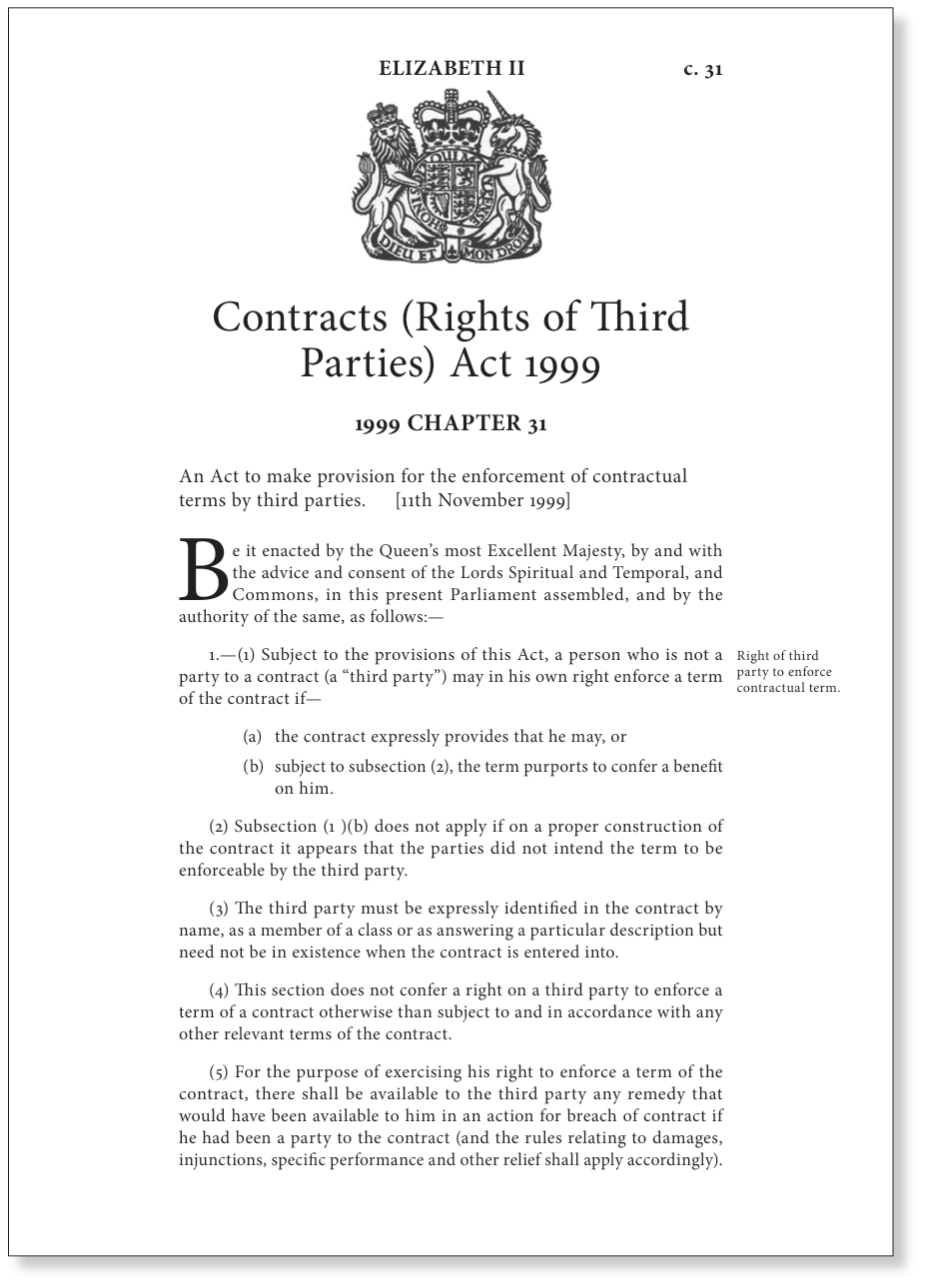
ELIZABETH II c. 31

1999 CHAPTER 31
An Act to make provision for the enforcement of contractual terms by third parties. [11th November 1999] B
e it enacted by the Queen’s most Excellent Majesty, by and with the advice and consent of the Lords Spiritual and Temporal, and Commons, in this present Parliament assembled, and by the authority of the same, as follows:—
1.—(1) Subject to the provisions of this Act, a person who is not a party to a contract (a “third party”) may in his own right enforce a term of the contract if—
(a) the contract expressly provides that he may, or
(b) subject to subsection (2), the term purports to confer a benefit
on him.
(2) Subsection (1 )(b) does not apply if on a proper construction of the contract it appears that the parties did not intend the term to be enforceable by the third party.
(3) The third party must be expressly identified in the contract by name, as a member of a class or as answering a particular description but need not be in existence when the contract is entered into.
(4) This section does not confer a right on a third party to enforce a term of a contract otherwise than subject to and in accordance with any other relevant terms of the contract.
(5) For the purpose of exercising his right to enforce a term of the contract, there shall be available to the third party any remedy that would have been available to him in an action for breach of contract if he had been a party to the contract (and the rules relating to damages, injunctions, specific performance and other relief shall apply accordingly).
Read the page from the statute, Contracts (Rights of Third Parties) Act 1999, on the previous page. Some of the words and expressions used in the statute are explained below to help you.
a contract provision is a term contained in a contract.
a third party to a contract is a person who has not signed the contract but may be affected by it.
to enforce a term is to make sure that the term is obeyed.
to expressly confer a right or a benefit upon someone is to write in a contract that a person definitely has that right or benefit.
the construction of a contract is the interpretation of it. The verb is to construe, meaning to interpret.
an enforceable term or an enforceable contract is a term or a contract that a court will recognise as valid and will give a solution, known as a remedy, to the injured party if the term or contract is breached.
to be a member of a class is to be a member of an identifiable group of people.
a remedy for breach of contract is a solution provided to an injured party in cases of breach. It is sometimes called ‘relief’. The remedy is usually damages but there are other solutions, or relief, available at the discretion of the court.
an injunction is a court order that orders the party in breach to stop behaving in a way that breaches the contract. It is generally an order to stop doing something.
specific performance is a order from the court that obliges the party in breach to do what they promised to do under the terms of the contract.
Match each explanation below with the correct subsection of the statute. The statute has five subsections, which are clearly numbered 1-5.
a This subsection says that a third party may not enforce a right if a correct interpretation of the contract concludes that the parties did not actually intend that the third party should be able to enforce that right.
This describes subsection
b This subsection says that the third party who wishes to enforce a right must be clearly named in the contract or be a member of a group of people that is clearly named in the contract. This section also says that the third party does not need to exist at the time the contract is made. This gives rights to third parties such as unborn children or future husbands or wives of the contracting parties.
This describes subsection
c This subsection says that a third party can enforce a right if the contract clearly states that he or she may do so. This section also says that if a contract term clearly gives a benefit to a third party, then he or she can enforce that term.
This describes subsection
d This subsection says that if a term is enforced the court can give the third party any of the usual remedies available to any person who brings a claim for breach of contract. This section also says that the normal rules of law that apply to remedies will apply in the normal way to third party claims.
This describes subsection
e This subsection says that if a third party wishes to enforce a contract term he or she can only do so subject to any other term in the contract that is relevant. This means that the parties to the contract can limit or place conditions on the third party’s right. There may be another term, for example, that says that any dispute must be resolved by mediation. The third party would have to comply with this term when enforcing his or her right.
This describes subsection4You are now going to read two short extracts from another statute. They are from The Unfair Contract Terms Act (UCTA) 1977. In this statute, Parliament states what is acceptable to include in a contract and what is not acceptable. This part of the contract deals with the situation where one of the parties tries to limit his or her liability for a breach of duty.
Here is a summary of a short extract from UCTA, followed by the extract itself. The summary says the same thing as the statute, but it uses less complicated language. Read the summary to help you understand the meaning of the extract from the statute, and then complete the extract by choosing a phrase from the blue box below.
Summary of paragraph 16 (subsection 1) of UCTA This subsection says that if, in a contract, one of the parties attempts to prevent or limit his or her liability for breach of duty of care in situations connected with doing business or using a building for business purposes, then:
• the term will always be void if one of the parties tries to prevent or limit his or her liability for death or injury of the other party; and
• in any situation except death or injury, the term will be void if it was unfair or unreasonable to allow it in the contract.
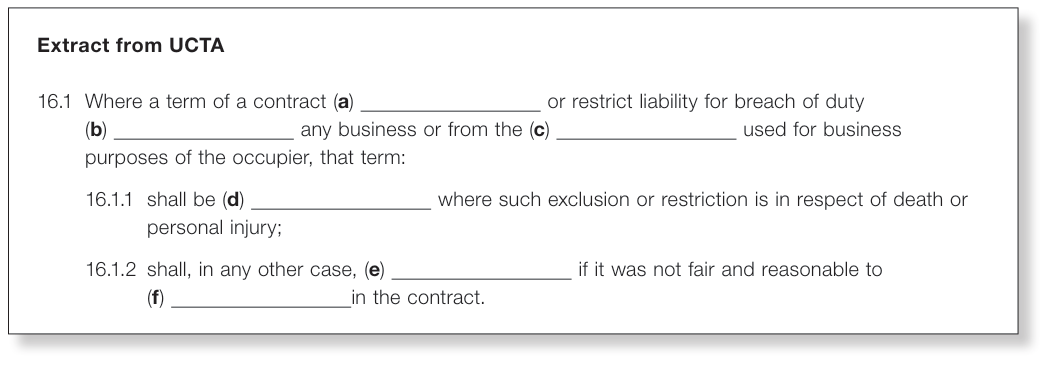
Extract from UCTA 16.1 Where a term of a contract (a) purports to excludeor restrict liability for breach of duty (b) arising in the course ofany business or from the (c) occupation of any premisesused for business purposes of the occupier, that term:
16.1.1 shall be (d) void in any casewhere such exclusion or restriction is in respect of death or personal injury;
16.1.2 shall, in any other case, (e) have no effectif it was not fair and reasonable to (f) incorporate the termin the contract.
On the next page is another extract from the same statute, The Unfair Contract Terms Act. Below, you can see a summary of this extract. Choose a preposition from the blue box and put it in the correct gap in the extract.
Summary of paragraph 16 (subsection 3) of UCTA If according to subsection 1 (the part of this statute that you have already read), a term of a contract is void, then it is not important whether the person who signed the contract knew about that term. Knowing about a term, or even agreeing to that term, does not necessarily mean that the person who signed the contract agreed to take any risk.
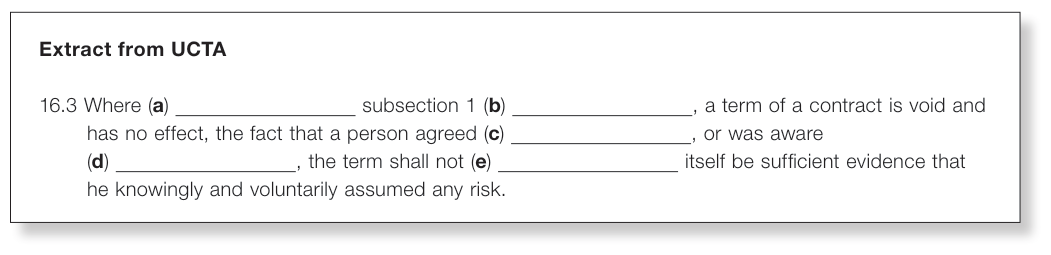
Extract from UCTA 16.3 Where (a) undersubsection 1 (b) above, a term of a contract is void and has no effect, the fact that a person agreed (c) to, or was aware (d) of, the term shall not (e) ofitself be sufficient evidence that he knowingly and voluntarily assumed any risk.
| # | Phrase | Definition |
|---|---|---|
| • | of • to • above | • under • of |
Speaking & Writing for this topic
Two short tasks scored against TOEFL rubrics. The prompt is generated for this topic — use the vocabulary you have just studied.
Suggested structureclick to expand
- In my experience…
- From what I have seen…
- My honest view is that…
- The principal reason is that…
- This matters because…
- What makes void in any case decisive here is…
- For instance, when I…
- A clear example is…
- Consider the case where purports to exclude was involved…
- On the other hand,…
- Furthermore,…
- That said, one should not forget that…
- Overall, this shows that…
- The lesson, then, is…
- For these reasons, I believe…
- Aim for 4–5 keywords woven naturally into your answer.
- Use at least two linking phrases (Furthermore, On the other hand, As a result…).
- Avoid filler words like "basically" or "like".
Suggested structureclick to expand
- The most important point in incorporate the term is …
- My position is that …
- The principal reason is that void in any case …
- This is supported by …
- A concrete illustration is …
- For instance, …
- However, some argue that …
- On the other hand, …
- In conclusion, …
- Taken together, …
- Aim for 4–5 keywords used in natural context.
- Use 3+ linking words across the answer.
- Vary sentence length to avoid monotony.
THE ELEMENTS OF A CONTRACT ~7 min
Jack Winter went to his first lecture on contract law at the University of Chatsworth this morning. He learned something about how a contract is formed. Look at Jack’s lecture notes below and give each paragraph a heading from the box.
• Intention to create a legal relationship • Consideration • Acceptance • Offer Lecture notes on contract There are basic elements to every contract. In English law we usually need four essential things (elements) to make a legal contract. In each country around the world the list of elements needed to make a contract will be different. In English law there are four elements. If all four elements are present, a contract is formed. If one or more of them is missing then there is no valid contract.
The four elements of a contract
- aGenerally in English law, there can be no contract unless this exists. It is the name given to what the parties exchange under the contract. It is usually money, goods or services.
- bIt is something that a party says or writes to another person. It is a statement that suggests that they make a contract on very certain terms. The person who makes this statement wants it to be legally binding when the other party agrees to it.
- cThe courts judge this objectively. The English case of Smith v Hughes (1871) tells us that the important thing is not a party’s real purpose or aim but how a reasonable person would look at the situation. The precedent cases tell us that parties who are in business are usually considered to have this but that parties who make an agreement in a domestic or social situation usually do not.
- dIt can be defined as, ‘a final and clear agreement to terms that have been offered’.
Speaking & Writing for this topic
Two short tasks scored against TOEFL rubrics. The prompt is generated for this topic — use the vocabulary you have just studied.
Suggested structureclick to expand
- In my experience…
- From what I have seen…
- My honest view is that…
- The principal reason is that…
- This matters because…
- What makes elements decisive here is…
- For instance, when I…
- A clear example is…
- Consider the case where contract was involved…
- On the other hand,…
- Furthermore,…
- That said, one should not forget that…
- Overall, this shows that…
- The lesson, then, is…
- For these reasons, I believe…
- Aim for 4–5 keywords woven naturally into your answer.
- Use at least two linking phrases (Furthermore, On the other hand, As a result…).
- Avoid filler words like "basically" or "like".
Suggested structureclick to expand
- The most important point in this concept is …
- My position is that …
- The principal reason is that elements …
- This is supported by …
- A concrete illustration is …
- For instance, …
- However, some argue that …
- On the other hand, …
- In conclusion, …
- Taken together, …
- Aim for 4–5 keywords used in natural context.
- Use 3+ linking words across the answer.
- Vary sentence length to avoid monotony.
READING A CONTRACT CASE ~8 min
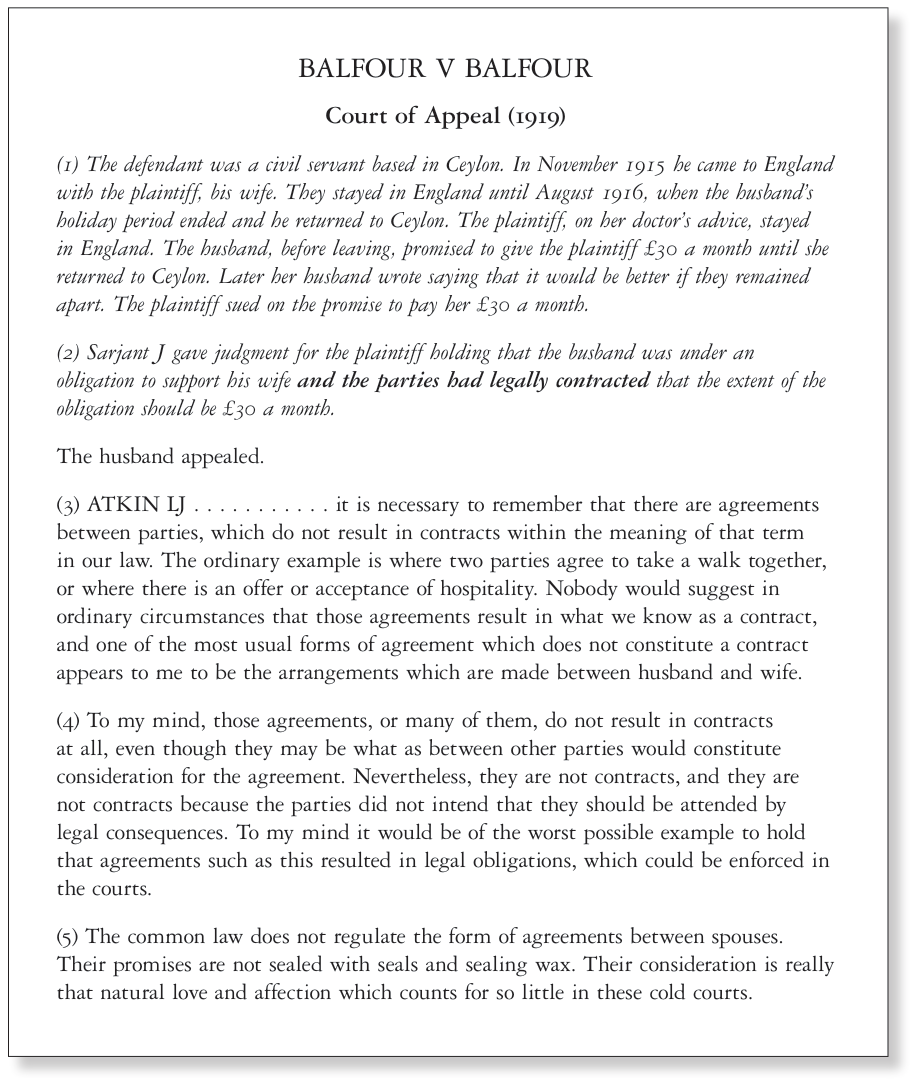
Jack and Shelley are learning about case law. Their textbook gives them an example of an important case in English contract law. It is a case on intention, one of the four elements of a contract. It is a precedent case from the year 1919, concerning whether or not a husband and wife can form an oral contract. The claimant is referred to as ‘the plaintiff’ because the case is an old one. The extract is an example of the ratio of a common law contract case. The ratio is the legal reasoning that forms the law for the future. The first part of the text below is explanatory notes. The case begins with the words of the judge, Lord Justice Atkin.
Read this extract from the case very carefully and answer the questions that follow using a full sentence.
Speaking & Writing for this topic
Two short tasks scored against TOEFL rubrics. The prompt is generated for this topic — use the vocabulary you have just studied.
Suggested structureclick to expand
- In my experience…
- From what I have seen…
- My honest view is that…
- The principal reason is that…
- This matters because…
- What makes reading decisive here is…
- For instance, when I…
- A clear example is…
- Consider the case where contract was involved…
- On the other hand,…
- Furthermore,…
- That said, one should not forget that…
- Overall, this shows that…
- The lesson, then, is…
- For these reasons, I believe…
- Aim for 4–5 keywords woven naturally into your answer.
- Use at least two linking phrases (Furthermore, On the other hand, As a result…).
- Avoid filler words like "basically" or "like".
Suggested structureclick to expand
- The most important point in this concept is …
- My position is that …
- The principal reason is that reading …
- This is supported by …
- A concrete illustration is …
- For instance, …
- However, some argue that …
- On the other hand, …
- In conclusion, …
- Taken together, …
- Aim for 4–5 keywords used in natural context.
- Use 3+ linking words across the answer.
- Vary sentence length to avoid monotony.
BALFOUR V BALFOUR ~22 min
Court of Appeal (1919)
(1) The defendant was a civil servant based in Ceylon. In November 1915 he came to England with the plaintiff, bis wife. They stayed in England until August 1916, when the husband’s holiday period ended and he returned to Ceylon. The plaintiff, on her doctor’s advice, stayed in England. The husband, before leaving, promised to give the plaintiff £30 a month until she returned to Ceylon. Later her husband wrote saying that it would be better if they remained apart. The plaintiff sued on the promise to pay her £30 a month.
(2) Sarjant J gave judgment for the plaintiff holding that the busband was under an obligation to support his wife and the parties had legally contracted that the extent of the obligation should be £30 a month.
The husband appealed.
(3) ATKIN LJ . . . . . . . . . . . it is necessary to remember that there are agreements between parties, which do not result in contracts within the meaning of that term in our law. The ordinary example is where two parties agree to take a walk together, or where there is an offer or acceptance of hospitality. Nobody would suggest in ordinary circumstances that those agreements result in what we know as a contract, and one of the most usual forms of agreement which does not constitute a contract appears to me to be the arrangements which are made between husband and wife.
(4) To my mind, those agreements, or many of them, do not result in contracts at all, even though they may be what as between other parties would constitute consideration for the agreement. Nevertheless, they are not contracts, and they are not contracts because the parties did not intend that they should be attended by legal consequences. To my mind it would be of the worst possible example to hold that agreements such as this resulted in legal obligations, which could be enforced in the courts.
(5) The common law does not regulate the form of agreements between spouses. Their promises are not sealed with seals and sealing wax. Their consideration is really that natural love and affection which counts for so little in these cold courts.
a In which court was this case heard?
b What was Mr Balfour’s occupation at the time of the case?
c Why did the claimant not return to Ceylon with her husband?
d What did the judge in the court of first instance decide?
e What was the name of the judge in the Court of Appeal?
In each paragraph of the case find a word that matches the definitions provided for you.
Paragraph (1)
a A word meaning started legal action.
The word is Paragraph (2)
b A word meaning the amount of something.
The word is Paragraph (3)
c A more formal word that means ‘word’.
The word is Paragraph (4)
d A word meaning to decide in a legal way.
The word is Paragraph (5)
e An old-fashioned word, meaning husbands or wives.
The word is
Say whether the following statements about the case are true or false.
a The judge says that it is possible to have agreements that are not contracts.
b The judge says that accepting an offer to have a meal with someone, for example, is usually a contract.
c The judge says that what is consideration between other parties might not be consideration between spouses.
d The judge says that there is generally no contract when a husband and wife make an agreement because they don’t mean it to be a legal agreement.
Collocation bank to give judgment for the
to do something on someone’s advice ‘On my solicitor’s advice I decided not to sue.’ • to continue to do something until a certain date ‘Your husband will be obliged to continue to support your children until they have all finished their education.’ • to sue on a promise ‘She sued him on his promise to deliver the goods on time.’
Speaking & Writing for this topic
Two short tasks scored against TOEFL rubrics. The prompt is generated for this topic — use the vocabulary you have just studied.
Suggested structureclick to expand
- In my experience…
- From what I have seen…
- My honest view is that…
- The principal reason is that…
- This matters because…
- What makes the extent of an obligation decisive here is…
- For instance, when I…
- A clear example is…
- Consider the case where to constitute consideration was involved…
- On the other hand,…
- Furthermore,…
- That said, one should not forget that…
- Overall, this shows that…
- The lesson, then, is…
- For these reasons, I believe…
- Aim for 4–5 keywords woven naturally into your answer.
- Use at least two linking phrases (Furthermore, On the other hand, As a result…).
- Avoid filler words like "basically" or "like".
Suggested structureclick to expand
- The most important point in this concept is …
- My position is that …
- The principal reason is that the extent of an obligation …
- This is supported by …
- A concrete illustration is …
- For instance, …
- However, some argue that …
- On the other hand, …
- In conclusion, …
- Taken together, …
- Aim for 4–5 keywords used in natural context.
- Use 3+ linking words across the answer.
- Vary sentence length to avoid monotony.
OFFER AND ACCEPTANCE ~13 min
• to give judgment for the claimant/defendant ‘I’m sorry but the judge gave judgment for the other side.’ • to be under a legal obligation ‘You are under a legal obligation to carry out your obligations.’ • an agreement between two parties ‘There was a clear agreement between us that you would provide half of the finance for this project.’
Jack and Shelley are doing their homework. The subject is offer and acceptance in contract law. Offer and acceptance are two of the essential elements of a contract. Jack and Shelley have decided to do half of the homework each.
Look at Shelley’s homework. It is about the ways in which an offer can come to an end before acceptance can take place. Match the words or phrases in the list with the statements that follow.
How can an offer come to an end?
Susan Clarke offers to sell Holly Quinn two tickets to a music festival. The price is £100 for each ticket. There are five ways in which this offer can come to an end. These are:
a ‘I’ll give you £85 instead of £100 for each ticket.’
The word/phrase is
b ‘You know those tickets you offered to sell to me four months ago? I’ve decided to take them.’
The word/phrase is
c ‘I’ve changed my mind. The offer is no longer open. I’ve decided to go to the festival myself.’
The word/phrase is
d ‘I know Susan offered to sell some tickets to you but I’m afraid she has passed away.’
The word/phrase is
e ‘No thank you. The price is much too high. Forget it.’
The word/phrase isrejectionIn all of these situations no contract can be formed because the offer has come to an end and therefore it cannot be accepted. This means that two of the elements that are essential to the formation of a contract are missing.
Look at Jack’s homework. It is about how acceptance of an offer must be communicated. Match the statements of law in this list with the situations below.
How must acceptance of an offer be communicated?
Holly Quinn agrees to buy two tickets to a music festival from Susan Clarke. To make her acceptance of the offer legally binding, how must the offer be accepted?
1 The acceptance must be made to the offeror and not to anyone else unless the offeror has authorised it.
2 The acceptance must be communicated. Acceptance cannot be by silence.
3 The acceptance must be actually heard or received in writing to be effective.
4 If the offer specifies a method of acceptance you must accept it using a method that is no less effective than the method specified.
5 A request for more information is not the same as a counter-offer and will not have the effect of rejecting the original offer.
a ‘My offer clearly said that acceptance must be by sms text message or email. I did not receive your letter of acceptance by post until after I’d sold the goods to someone else.’
The relevant statement of law is
b ‘You told my brother that you wanted to buy the tickets but you didn’t tell me. I’m afraid he was not in a position to accept this.’
The relevant statement of law is
c ‘You say that you accepted my offer by email. It never arrived.’
The relevant statement of law is
d ‘In answer to your question, the tickets offered for sale are for the lower stand on the right-hand side of the stadium.’
The relevant statement of law is5continued
e ‘If you do not hear from me by five o’clock tomorrow please assume that I want to go ahead and buy the tickets.’
The relevant statement of law is2If any of these situations arise then there has been no acceptance and therefore there is no contract between the parties.
Speaking & Writing for this topic
Two short tasks scored against TOEFL rubrics. The prompt is generated for this topic — use the vocabulary you have just studied.
Suggested structureclick to expand
- In my experience…
- From what I have seen…
- My honest view is that…
- The principal reason is that…
- This matters because…
- What makes revocation decisive here is…
- For instance, when I…
- A clear example is…
- Consider the case where rejection was involved…
- On the other hand,…
- Furthermore,…
- That said, one should not forget that…
- Overall, this shows that…
- The lesson, then, is…
- For these reasons, I believe…
- Aim for 4–5 keywords woven naturally into your answer.
- Use at least two linking phrases (Furthermore, On the other hand, As a result…).
- Avoid filler words like "basically" or "like".
Suggested structureclick to expand
- The most important point in this concept is …
- My position is that …
- The principal reason is that revocation …
- This is supported by …
- A concrete illustration is …
- For instance, …
- However, some argue that …
- On the other hand, …
- In conclusion, …
- Taken together, …
- Aim for 4–5 keywords used in natural context.
- Use 3+ linking words across the answer.
- Vary sentence length to avoid monotony.
CONSIDERATION ~23 min
Why is it important to understand consideration? It is important because consideration is not just an academic part of law. The word ‘consideration’ will appear in contracts that you will have to understand or translate. Look for example, at this clause from a contract between a writer and a film company. The company is buying the rights to make the writer’s book into a film.
In consideration of the rights granted under this Agreement the Media Company shall pay to the Author the Licence Fee as follows:
1.1 £25,000 upon signature of this Agreement 1.2 £25,000 upon the first release of the film to the public in the UK This is a good example of how the word consideration is used in contracts.
As part of her homework, Shelley must write a short essay about consideration in contract law. Complete her essay by putting a word from the box into the gaps.
The final element of a contract is consideration. An English case from 1875, Currie v Misa, gave a definition of consideration which is still used today in the contract law of England, the USA and Canada. The judge in that case defined consideration as:
‘some right, interest, (a) profitor benefit accruing to the one party or some forbearance, (b) detriment, loss or responsibility given, suffered or undertaken by the other.’
In other words, the parties must gain some benefit from what is exchanged or (c) suffersome loss. Consideration is usually goods, money, work or services but it can be other things. In a very simple example, if I sell my gardening business to you for £50,000, my consideration is the business and your consideration is the money.
Motive is not the same as consideration. Your motive for contracting is your personal (d) reasonfor contracting. It may not coincide with the consideration you are giving, or receiving, as part of the contract.
Under contract law, there is no contract if there is no consideration. It is one of the four necessary elements of a contract. The consideration must be (e) reciprocal, with both parties providing consideration. The consideration cannot be an act or a thing which is illegal, immoral or (f) contraryto public policy. If a certain act is punishable by some law, then it is described as illegal. An example would be a contract to employ an (g) unqualifiedpilot to fly a plane.
continued There is one type of contract that is an exception to the requirement of consideration and that is a deed, which is also sometimes known as a contract under seal. Many years ago, people entering into a contract would put hot wax on the bottom of the paper and press a family ring into it. This seal was a sign of (h) consentto the (i) termsof the contract. In modern times, deeds are used mostly in contracts that involve land. If a contract is a deed, then no consideration is required. This means that if, for example, (j) donationsto charity are made under seal, they are valid contracts, even though there is no valid consideration.
The clause below is from a contract. It deals with consideration. Complete the contract clause by putting the words from the blue box below into the correct gap.
In (a) considerationof all of the Services (b) providedby ALT Services Ltd the Company shall pay the (c) sumof £10,000 subject to the (d) provisionof the Services and satisfactory completion of work.
to be contrary to public policy or to the law in general to gain a benefit to reject an offer to suffer a loss Preposition bank to buy tickets to/for an event ‘We want to look after our new client very well. Let’s get him some tickets to the opera.’
to accept something by post/email ‘I sent the cheque by post.’
to put something in writing ‘If you have evidence in writing it will help us to persuade the judge.’
a case/new law from a particular year ‘In defence of my client I cited a case from 1995.’
• to do something by a particular time in the future ‘We need to have this document ready by five o’clock.’
to enter into a contract or agreement ‘You should not have entered into this loan agreement unless you were sure you could make the repayments.’
to make a donation to charity ‘She made a donation to a charity for homeless people when she won the lottery.’
LISTENING
Today Jack and Shelley are going to a contract law lecture. Listen to the lecture and answer these questions.
a Do contracts involving large amounts of money need to be in writing in order to be valid?
b In which American state was Pennzoil based?
c In the example case of Pennzoil buying Getty Oil there was no written contract. How did they agree the deal?
d A few weeks after Getty Oil had agreed to sell to Pennzoil, another company announced that it had bought Getty Oil. What was the name of the other company?
e How much money was Pennzoil awarded by the court in damages?
f What type of contract does the lecturer say that her students will most often encounter in their careers as lawyers?
g What used to be necessary in order to make a deed valid?
h What type of contract does the lecturer say must take the form of a deed?
i Which does the lecturer say is more common, bilateral or unilateral contracts?
j Is a reward contract bilateral or unilateral?
Speaking & Writing for this topic
Two short tasks scored against TOEFL rubrics. The prompt is generated for this topic — use the vocabulary you have just studied.
Suggested structureclick to expand
- In my experience…
- From what I have seen…
- My honest view is that…
- The principal reason is that…
- This matters because…
- What makes contrary decisive here is…
- For instance, when I…
- A clear example is…
- Consider the case where consent was involved…
- On the other hand,…
- Furthermore,…
- That said, one should not forget that…
- Overall, this shows that…
- The lesson, then, is…
- For these reasons, I believe…
- Aim for 4–5 keywords woven naturally into your answer.
- Use at least two linking phrases (Furthermore, On the other hand, As a result…).
- Avoid filler words like "basically" or "like".
Suggested structureclick to expand
- The most important point in suffer is …
- My position is that …
- The principal reason is that contrary …
- This is supported by …
- A concrete illustration is …
- For instance, …
- However, some argue that …
- On the other hand, …
- In conclusion, …
- Taken together, …
- Aim for 4–5 keywords used in natural context.
- Use 3+ linking words across the answer.
- Vary sentence length to avoid monotony.
CONTRACT LAW IN PRACTICE ~3 min
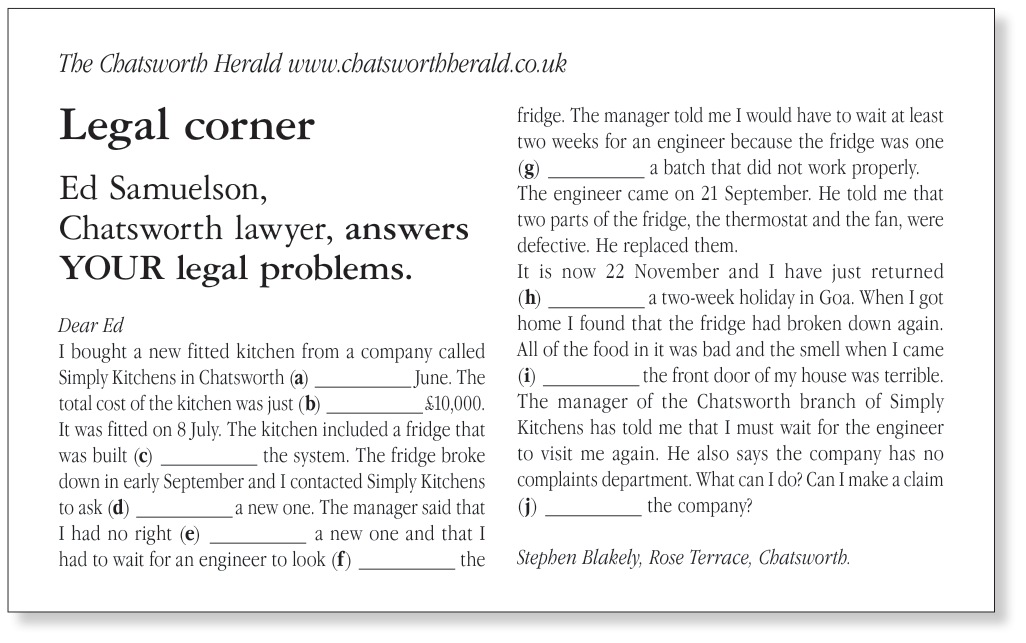
Look at this letter taken from a newspaper. The letter is from the newspaper’s legal problem page. Complete the gaps in the letter with the correct preposition. Choose the preposition from the box below.
Speaking & Writing for this topic
Two short tasks scored against TOEFL rubrics. The prompt is generated for this topic — use the vocabulary you have just studied.
Suggested structureclick to expand
- In my experience…
- From what I have seen…
- My honest view is that…
- The principal reason is that…
- This matters because…
- What makes of decisive here is…
- For instance, when I…
- A clear example is…
- Consider the case where in was involved…
- On the other hand,…
- Furthermore,…
- That said, one should not forget that…
- Overall, this shows that…
- The lesson, then, is…
- For these reasons, I believe…
- Aim for 4–5 keywords woven naturally into your answer.
- Use at least two linking phrases (Furthermore, On the other hand, As a result…).
- Avoid filler words like "basically" or "like".
Suggested structureclick to expand
- The most important point in for is …
- My position is that …
- The principal reason is that of …
- This is supported by …
- A concrete illustration is …
- For instance, …
- However, some argue that …
- On the other hand, …
- In conclusion, …
- Taken together, …
- Aim for 4–5 keywords used in natural context.
- Use 3+ linking words across the answer.
- Vary sentence length to avoid monotony.
The Chatsworth Herald www.chatsworthherald.co.uk Legal corner ~27 min
Dear Ed I bought a new fitted kitchen from a company called Simply Kitchens in Chatsworth (a) June. The total cost of the kitchen was just (b) 10,000. It was fitted on 8 July. The kitchen included a fridge that was built (c) the system. The fridge broke down in early September and I contacted Simply Kitchens to ask (d) a new one. The manager said that I had no right (e) a new one and that I had to wait for an engineer to look (f) the fridge. The manager told me I would have to wait at least two weeks for an engineer because the fridge was one (g) a batch that did not work properly. The engineer came on 21 September. He told me that two parts of the fridge, the thermostat and the fan, were defective. He replaced them. It is now 22 November and I have just returned (h) a two-week holiday in Goa. When I got home I found that the fridge had broken down again. All of the food in it was bad and the smell when I came (i) the front door of my house was terrible. The manager of the Chatsworth branch of Simply Kitchens has told me that I must wait for the engineer to visit me again. He also says the company has no complaints department. What can I do? Can I make a claim (j) the company?
Stephen Blakely, Rose Terrace, Chatsworth.
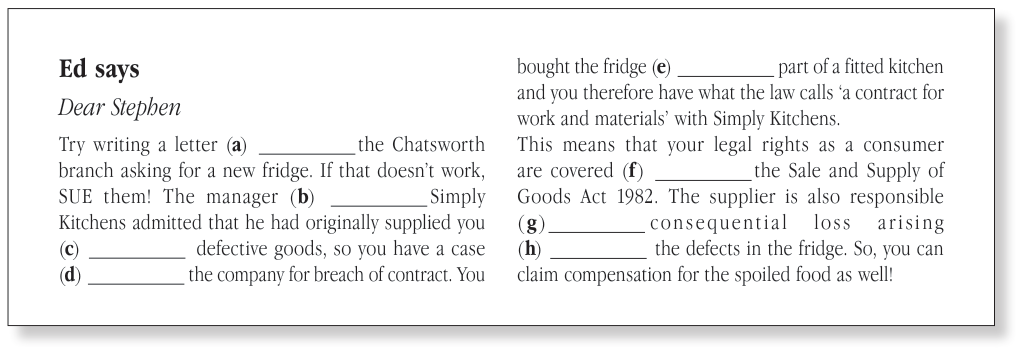
Here is Ed Samuelson’s answer to Stephen’s letter. Complete the gaps in the letter with the correct preposition.
Ed says Dear Stephen
Try writing a letter (a) the Chatsworth branch asking for a new fridge. If that doesn’t work, SUE them! The manager (b) Simply Kitchens admitted that he had originally supplied you (c) defective goods, so you have a case (d) the company for breach of contract. You bought the fridge (e) part of a fitted kitchen and you therefore have what the law calls ‘a contract for work and materials’ with Simply Kitchens. This means that your legal rights as a consumer are covered (f) the Sale and Supply of Goods Act 1982. The supplier is also responsible (g) consequential loss arising (h) the defects in the fridge. So, you can claim compensation for the spoiled food as well!
Stephen Blakely has followed Ed’s advice and he has written this letter to the manager of Simply Kitchens. The words that have been underlined are too informal. Replace these words by choosing the correct word or phrase from the blue box below. Write your answers in the box on the next page. There is an example at the beginning (*).
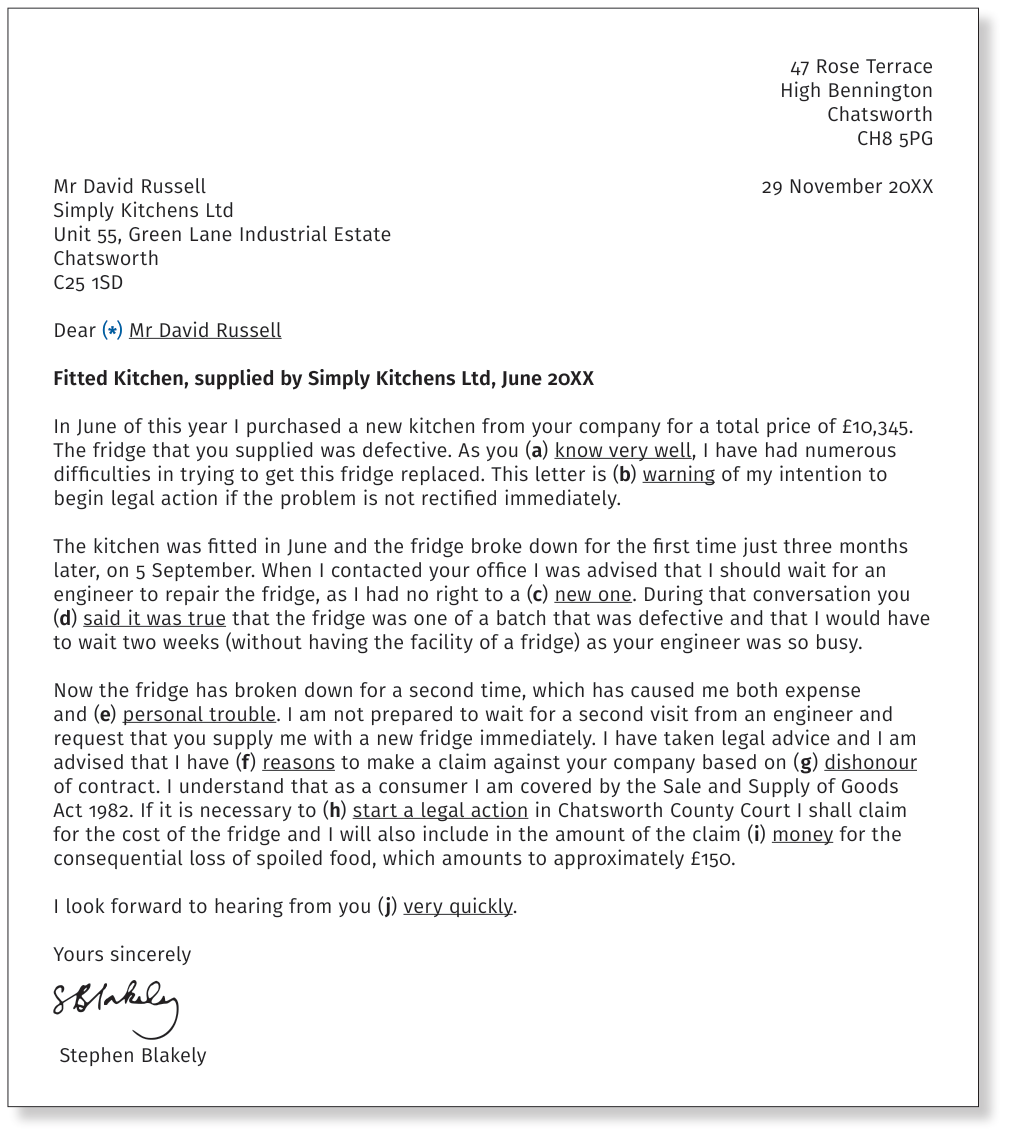
47 Rose Terrace High Bennington Chatsworth CH8 5PG Mr David Russell 29 November 20XX Simply Kitchens Ltd Unit 55, Green Lane Industrial Estate Chatsworth C25 1SD Dear (*) Mr David Russell Fitted Kitchen, supplied by Simply Kitchens Ltd, June 20XX In June of this year I purchased a new kitchen from your company for a total price of £10,345. The fridge that you supplied was defective. As you (a) know very well, I have had numerous difficulties in trying to get this fridge replaced. This letter is (b) warning of my intention to begin legal action if the problem is not rectified immediately.
The kitchen was fitted in June and the fridge broke down for the first time just three months later, on 5 September. When I contacted your office I was advised that I should wait for an engineer to repair the fridge, as I had no right to a (c) new one. During that conversation you (d) said it was true that the fridge was one of a batch that was defective and that I would have to wait two weeks (without having the facility of a fridge) as your engineer was so busy.
Now the fridge has broken down for a second time, which has caused me both expense and (e) personal trouble. I am not prepared to wait for a second visit from an engineer and request that you supply me with a new fridge immediately. I have taken legal advice and I am advised that I have (f) reasons to make a claim against your company based on (g) dishonour of contract. I understand that as a consumer I am covered by the Sale and Supply of Goods Act 1982. If it is necessary to (h) start a legal action in Chatsworth County Court I shall claim for the cost of the fridge and I will also include in the amount of the claim (i) money for the consequential loss of spoiled food, which amounts to approximately £150.
I look forward to hearing from you (j) very quickly.
Yours sincerely Stephen Blakely (*) Mr Russell
e
j Collocation bank to announce the acquisition the performance of a of a company • to create a legally binding to grant someone a right to contract • to fail to perform your duties contract • to be awarded damages do something • to be covered by a particular under a contract • to rectify a problem Preposition bank a contract between two companies ‘There was an oral contract between the two oil companies.’ • to be awarded an amount of money in damages ‘The judge awarded us $10,000 in damages.’ • in exchange for something ‘I gave him my car in exchange for his van.’ • to give notice of something ‘In his letter he gave us notice of his intention to sue us.’
law • a batch of goods to buy goods from someone ‘We buy most of our electrical goods from King Electrics.’ • to supply someone with a replacement ‘When my car broke down last month my insurance company supplied me with a replacement.’ • to sue someone on the grounds of something ‘We sued them on the grounds of breach of contract.’
Speaking & Writing for this topic
Two short tasks scored against TOEFL rubrics. The prompt is generated for this topic — use the vocabulary you have just studied.
Suggested structureclick to expand
- In my experience…
- From what I have seen…
- My honest view is that…
- The principal reason is that…
- This matters because…
- What makes as decisive here is…
- For instance, when I…
- A clear example is…
- Consider the case where of was involved…
- On the other hand,…
- Furthermore,…
- That said, one should not forget that…
- Overall, this shows that…
- The lesson, then, is…
- For these reasons, I believe…
- Aim for 4–5 keywords woven naturally into your answer.
- Use at least two linking phrases (Furthermore, On the other hand, As a result…).
- Avoid filler words like "basically" or "like".
Suggested structureclick to expand
- The most important point in for is …
- My position is that …
- The principal reason is that as …
- This is supported by …
- A concrete illustration is …
- For instance, …
- However, some argue that …
- On the other hand, …
- In conclusion, …
- Taken together, …
- Aim for 4–5 keywords used in natural context.
- Use 3+ linking words across the answer.
- Vary sentence length to avoid monotony.
STARTING A CLAIM FOR BREACH OF CONTRACT ~12 min
Stephen Blakely has received no answer to his letter to the manager of Simply Kitchens. He has decided to follow Ed Samuelson’s advice and sue the company.
On the next page you will see the first page of a claim form. This is the form that a claimant needs to fill in to start a claim in court. Stephen Blakely has decided to make the claim without the help of a solicitor.
The information below is for the claim form. There are some words missing from part of the information. Fill the gaps with an appropriate word so that the information for the claim form is completed. The first letter of each word is provided for you.
The value of the claim is £650.
The claimant’s name and address is:
Stephen Blakely 47 Rose Terrace High Bennington Chatsworth CH8 5PG 6QZ070C2 is the claim number.
• The brief details of the claim are as follows:
The defendant (a) ccontractedto fit a kitchen in June of this year. The defendant admits that the fridge that was supplied as part of the kitchen was (b) ddefective.
The fridge has broken down twice and the defendant refuses to supply a new one. The claim is to (c) cdefectivethe cost of a second company supplying and fitting a new fridge and for the cost of food that was spoiled during the (d) dcontractedwith the defendant.
The court fee is £70.
14 December 20XX is the issue date.
There is no solicitor’s fee.
The defendant’s name and address is:
Simply Kitchens Ltd (registered office) Fratton Park Industrial Estate High Boldon Bradford BR40 1DD £720 is the total amount.
The information in Exercise 1 needs to be put onto the claim form below. Decide where the information needs to go and then complete the claim form for Stephen.
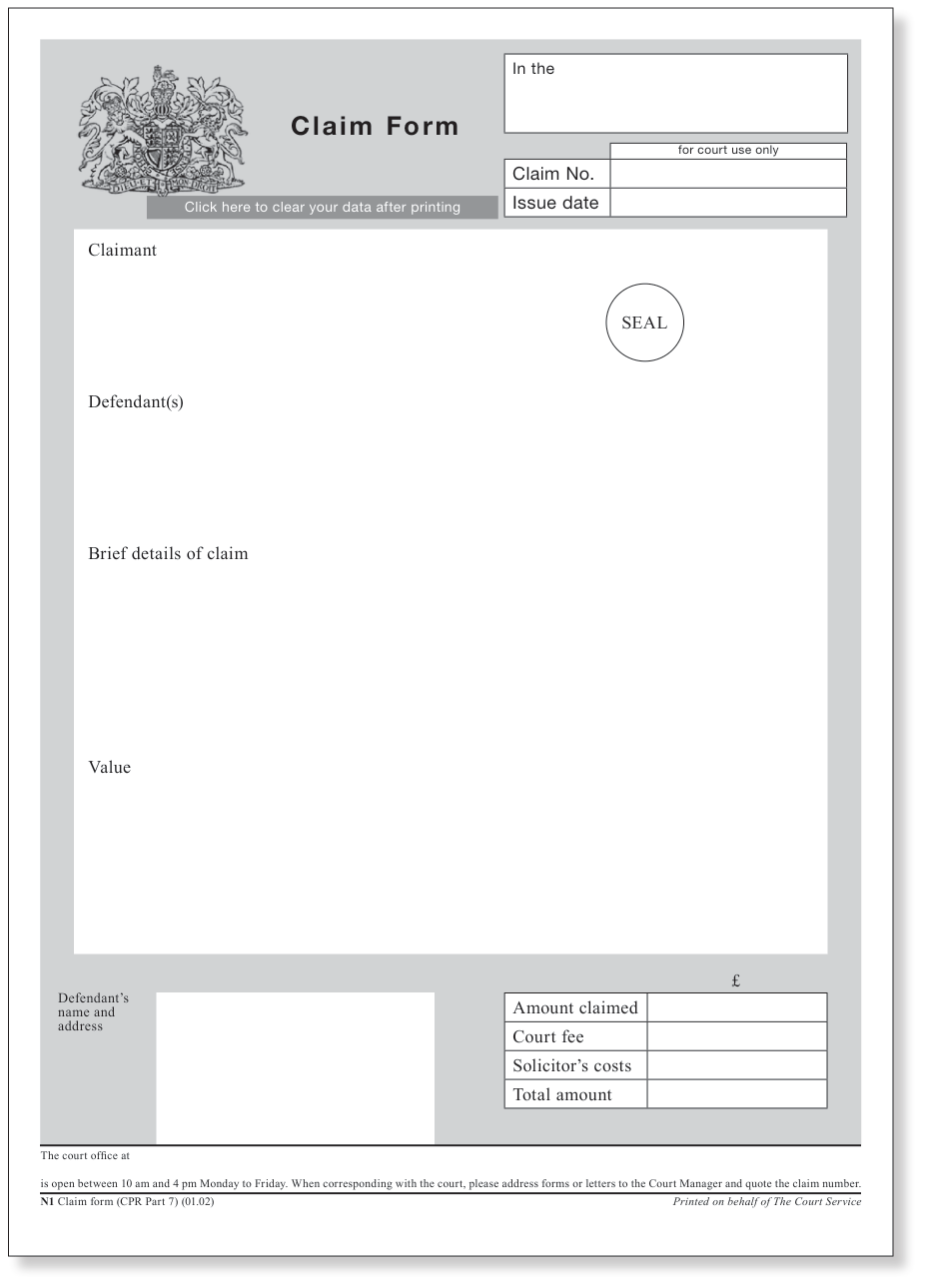

In the
Claim Form
Issue date
Claimant
Defendant(s)
Brief details of claim
Value
Amount claimed
Court fee
Solicitor’s costs
Total amount
Speaking & Writing for this topic
Two short tasks scored against TOEFL rubrics. The prompt is generated for this topic — use the vocabulary you have just studied.
Suggested structureclick to expand
- In my experience…
- From what I have seen…
- My honest view is that…
- The principal reason is that…
- This matters because…
- What makes starting decisive here is…
- For instance, when I…
- A clear example is…
- Consider the case where claim was involved…
- On the other hand,…
- Furthermore,…
- That said, one should not forget that…
- Overall, this shows that…
- The lesson, then, is…
- For these reasons, I believe…
- Aim for 4–5 keywords woven naturally into your answer.
- Use at least two linking phrases (Furthermore, On the other hand, As a result…).
- Avoid filler words like "basically" or "like".
Suggested structureclick to expand
- The most important point in this concept is …
- My position is that …
- The principal reason is that starting …
- This is supported by …
- A concrete illustration is …
- For instance, …
- However, some argue that …
- On the other hand, …
- In conclusion, …
- Taken together, …
- Aim for 4–5 keywords used in natural context.
- Use 3+ linking words across the answer.
- Vary sentence length to avoid monotony.
USING YOUR KNOWLEDGE ~10 min
Collocation review Complete these sentences with a collocation that you have seen.
a I would like to one or two amendments to the document that you have sent to me.
b In England a statute has to pass through three before it becomes law.
c If a judge makes a decision it may become on other courts of the same level and on lower courts.
d Your client has to perform her duties under the contract and therefore we will start legal action.
e Case law is also sometimes known as the law.
f To make an enforceable contract both parties must consideration.
g The judge down his decision at four o’clock this afternoon.
h In which court is your case being this morning?
i The judge damages of £5000.
j We wish to against the decision of the court of first instance.
Vocabulary review Complete these sentences with a word that you have seen.
a My offer to you was made months ago and you can no longer accept due to of time.
b A -offer suggests alternative terms and has the effect of cancelling the original offer.
c An contract is a spoken agreement.
d Another name for an Act of Parliament is a .
e When a contract is being formed, the two parties are known as the and the offeree.
f The judge in the Court of Appeal the decision of the court of first instance and reversed the result of the case.
g Consideration must be , meaning that if only one party provides it there is no contract.
h The opposite of benefit is .
i Most contracts involve both parties making a promise and they are therefore described as and not unilateral.
j A contract that must be in a written form in order to be legally valid is called a , sometimes known as a contract under seal.
Preposition review Complete these sentences with the correct preposition.
a Please put your complaints writing and send them to our manager.
b In England and the USA much of the law is made judges due to the common law system.
c You are a legal obligation to sell the house now that you have signed the contract of sale.
d We all need to stay in the office 8pm to finish this important project.
e The new Bill has passed the debate stage and the members of the House of Commons will vote on it next week.
f The construction company was sued its promise to finish building the hotel by December as it wasn’t finished until the following July.
g I am acting my barrister’s advice and not taking my claim any further.
h The agreement Charles and Michael was made two years ago.
i I didn’t email my acceptance to you, as my server was down. I sent it post instead.
j I have forgotten the name of an important contract case and I will need to look it up in the law library. I remember it is the year 1995.
Speaking & Writing for this topic
Two short tasks scored against TOEFL rubrics. The prompt is generated for this topic — use the vocabulary you have just studied.
Suggested structureclick to expand
- In my experience…
- From what I have seen…
- My honest view is that…
- The principal reason is that…
- This matters because…
- What makes using decisive here is…
- For instance, when I…
- A clear example is…
- Consider the case where your was involved…
- On the other hand,…
- Furthermore,…
- That said, one should not forget that…
- Overall, this shows that…
- The lesson, then, is…
- For these reasons, I believe…
- Aim for 4–5 keywords woven naturally into your answer.
- Use at least two linking phrases (Furthermore, On the other hand, As a result…).
- Avoid filler words like "basically" or "like".
Suggested structureclick to expand
- The most important point in this concept is …
- My position is that …
- The principal reason is that using …
- This is supported by …
- A concrete illustration is …
- For instance, …
- However, some argue that …
- On the other hand, …
- In conclusion, …
- Taken together, …
- Aim for 4–5 keywords used in natural context.
- Use 3+ linking words across the answer.
- Vary sentence length to avoid monotony.
HIGHER LEVEL PRACTICE ~19 min
There is a word or phrase missing from the following sentences. For each sentence, circle the word which best fits into the space from the options provided. Do not mark more than one answer for each sentence. There is an example at the beginning (*).
Example In the English legal system a precedent is (*) upon similar future cases.
1 The case you mention from 1976 is very similar to the current case but I think it is possible to
(1) between them.
2 The claimant was (2) damages of £100,000.
3 The decision of the first judge was (3) by the judges in the Court of Appeal.
4 An offer can come to an end due to (4) of time. It means that too much time has passed since the offer was made.
5 When a person who makes an offer withdraws it before it can be accepted we can say that the offer has been (5) .
6 According to English contract law, acceptance must be (6) and cannot be by silence.
7 Consideration in contract law requires the parties to gain a benefit or suffer a (7) .
8 When a lawyer refers to the (8) he or she puts upon a contract term it is a more formal way of referring to his or her interpretation or understanding of that term.
9 Specific (9) is an order from a court that tells a party in breach to carry out his or her obligations under a contract.
10 According to English contract law consideration must be (10) , which means that both parties must give or receive something and not just one of them.
| # | Phrase | Definition |
|---|---|---|
| (*) | A enforceable B unavoidable | C binding D obligatory |
| (1) | A differ B distinguish | C separate D discriminate |
| (2) | A ordered B handed | C awarded D granted |
| (3) | A overruled B annulled | C refused D rejected |
| (4) | A conclusion B ending | C lapse D disappearance |
| (5) | A revoked B cancelled | C negated D invalidated |
| (6) | A said B contributed | C given D communicated |
| (7) | A difficulty B detriment | C injury D disadvantage |
| (8) | A meaning B elucidation | C version D construction |
| (9) | A action B execution | C performance D completion |
(10) A reciprocal B joint C common D shared
Read the text below and think of the word that best fits each space. Use only one word in each space. Write your answers in the box below. There is an example at the beginning (*).
The elements of a contract A contract is an agreement between two or more people or companies who are known as the (*)bindingto the contract. However, in order for a contract to be recognised as legally (1)writingupon the parties, certain conditions must be met. According to English law there is no requirement that a contract is in (2)Intentionin order for it to be valid. Many high-value contracts are made orally. What is important is that the agreement contains the four essential elements of a contract. These are:
• (3)Intentionto create a legal relationship Offer Acceptance Consideration An offer is an indication from one person that he or she is prepared to contract with one or more other people on (4)bindingwhich are certain. This means that the most important provisions of the agreement such as price, quality and date must be fixed. If, for example, an offer is made and the (5)writing(the person to whom the offer is made) suggests changes to that offer then no contract will have been formed. This is because the effect of any suggested change to an original offer is to cancel it. The offer will no longer be open to acceptance because a (6)terms-offer has been made.
There are also some important rules governing acceptance. There are, for example, several common law (7)terms, which are decisions taken by judges in previous cases, that tell us that acceptance can be made by conduct but that it cannot be made by silence. There are other rules about acceptance by post or email. These objective rules tell us when acceptance is considered to have been received by the offeror when a particular means of acceptance, for example, email, is used. Acceptance cannot, as we have already stated, contain any suggested changes to the original offer. Acceptance must be absolute.
According to English law (8)termsmust be exchanged by the parties in order to form a binding contract. This means that there has to be something of value passing in both directions between the parties. The (9)bindingto this is where the parties agree to form a contract despite the absence of this normally vital element. This requires the parties to sign a special document known as a (10)writing. It is sometimes also known as a contract under seal.
Example (*) parties
(1) (6)
(2) (7)
(3) (8)
(4) (9)
(5) (10)
LISTENING
Listen to the seminar given by a professor of law to two students. Decide if the following statements are true or false.
1 The professor asked her students to read 285 pages of contract law for homework.
2 The law students at this seminar have already studied some of the elements of a contract.
3 Mr Brown’s event is called ‘Save the Planet Day.’
4 Mr Brown decides to hold the event in two parks in London and Manchester.
5 Mr Brown promises the manager of Sellfast UK an extra £1000 if he can persuade the Ethical Food Company to attend his event.
6 In the case of Stilk v Myrick the captain of the ship offered the men on board his ship a bonus if they would sail the ship safely back to England.
7 The case of Stilk v Myrick is from 1890.
8 The claimant in the case of Stilk v Myrick was one of the sailors.
9 The claimant won in the case of Stilk v Myrick.
10 The professor thinks that a court would oblige Mr Brown to pay Sellfast UK the extra £1000 based on the case of Williams v Roffey.
True or false?
| # | Phrase | Definition |
|---|---|---|
| (1) | (2) (3) | (4) (5) |
| (6) | (7) (8) | (9) (10) |
Speaking & Writing for this topic
Two short tasks scored against TOEFL rubrics. The prompt is generated for this topic — use the vocabulary you have just studied.
Suggested structureclick to expand
- In my experience…
- From what I have seen…
- My honest view is that…
- The principal reason is that…
- This matters because…
- What makes higher decisive here is…
- For instance, when I…
- A clear example is…
- Consider the case where level was involved…
- On the other hand,…
- Furthermore,…
- That said, one should not forget that…
- Overall, this shows that…
- The lesson, then, is…
- For these reasons, I believe…
- Aim for 4–5 keywords woven naturally into your answer.
- Use at least two linking phrases (Furthermore, On the other hand, As a result…).
- Avoid filler words like "basically" or "like".
Suggested structureclick to expand
- The most important point in this concept is …
- My position is that …
- The principal reason is that higher …
- This is supported by …
- A concrete illustration is …
- For instance, …
- However, some argue that …
- On the other hand, …
- In conclusion, …
- Taken together, …
- Aim for 4–5 keywords used in natural context.
- Use 3+ linking words across the answer.
- Vary sentence length to avoid monotony.