
The Language of the Law of Tort
AN INTRODUCTION TO THE LAW OF TORT ~20 min
Ann Edington is a professor in the law department at the University of Chatsworth. She is giving a lecture to the first-year law students on the subject of the law of tort. Here are Ann’s notes for her lecture. Fill in the gaps in the text with a word from the box below.
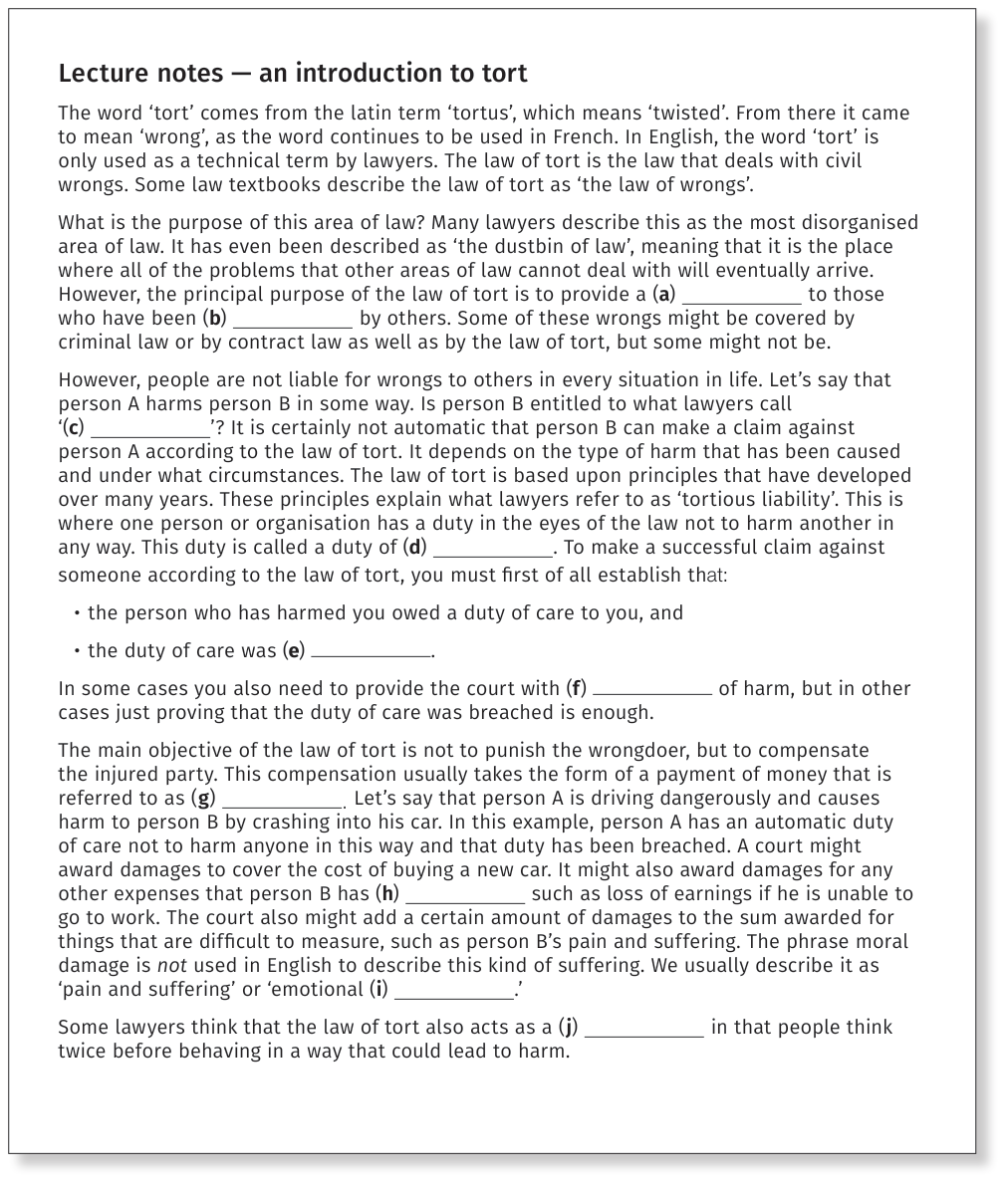
Lecture notes — an introduction to tort The word ‘tort’ comes from the latin term ‘tortus’, which means ‘twisted’. From there it came to mean ‘wrong’, as the word continues to be used in French. In English, the word ‘tort’ is only used as a technical term by lawyers. The law of tort is the law that deals with civil wrongs. Some law textbooks describe the law of tort as ‘the law of wrongs’.
What is the purpose of this area of law? Many lawyers describe this as the most disorganised area of law. It has even been described as ‘the dustbin of law’, meaning that it is the place where all of the problems that other areas of law cannot deal with will eventually arrive. However, the principal purpose of the law of tort is to provide a (a) to those who have been (b) by others. Some of these wrongs might be covered by criminal law or by contract law as well as by the law of tort, but some might not be.
However, people are not liable for wrongs to others in every situation in life. Let’s say that person A harms person B in some way. Is person B entitled to what lawyers call ‘(c) ’? It is certainly not automatic that person B can make a claim against person A according to the law of tort. It depends on the type of harm that has been caused and under what circumstances. The law of tort is based upon principles that have developed over many years. These principles explain what lawyers refer to as ‘tortious liability’. This is where one person or organisation has a duty in the eyes of the law not to harm another in any way. This duty is called a duty of (d) . To make a successful claim against someone according to the law of tort, you must first of all establish that:
• the person who has harmed you owed a duty of care to you, and
• the duty of care was (e) .
In some cases you also need to provide the court with (f) of harm, but in other cases just proving that the duty of care was breached is enough.
The main objective of the law of tort is not to punish the wrongdoer, but to compensate the injured party. This compensation usually takes the form of a payment of money that is referred to as (g) . Let’s say that person A is driving dangerously and causes harm to person B by crashing into his car. In this example, person A has an automatic duty of care not to harm anyone in this way and that duty has been breached. A court might award damages to cover the cost of buying a new car. It might also award damages for any other expenses that person B has (h) such as loss of earnings if he is unable to go to work. The court also might add a certain amount of damages to the sum awarded for things that are difficult to measure, such as person B’s pain and suffering. The phrase moral damage is not used in English to describe this kind of suffering. We usually describe it as ‘pain and suffering’ or ‘emotional (i) .’
Some lawyers think that the law of tort also acts as a (j) in that people think twice before behaving in a way that could lead to harm.
Complete the sentences below with the correct words from the box in Exercise 1.
a My client was seriouslyduty of careby the story that you printed about her in your magazine and she is considering legal action against you.
b According to English law you have a duty oftortious liabilityto every citizen not to harm them in any way.
c The grounds of our claim against you are that you havetrespass to landyour duty of care to my client.
d The court awarded my clientomissionin the amount of £15,000 in her libel case against Gossip magazine.
e The judge said that he hoped the amount awarded would act as avicarious liabilityto any journalists in future who are thinking about publishing a story that might not be true.
f Libel does not requirenegligencethat any damage has occurred as a result of the tort. It is actionable in court per se.
g My client admits that his conduct was a breach of the duty of care that he owes to your client. He also acknowledges that your client is entitled to some kind ofstrict liability, probably in the form of damages, to compensate her for her loss.
h My client hastortfeasorexpenses totalling £8,500 as a result of your client’s negligent driving. This amount includes my client’s loss of earnings for the period in question.
i We will be claiming damages totalling £12,000, which includes an amount to cover the emotionalremotethat my client has suffered as a result of your breach of duty.
j Your client was at fault in this situation and the law will provide my client with alibelif you do not settle the matter out of court.
Collocation bank
to be liable for something ‘You are liable for the results of your breach of duty of care.’ • to depend on something ‘The amount of damages awarded will depend on the amount of earnings you have lost.’ • under certain circumstances ‘Under the circumstances your client is at fault.’
to be entitled to something ‘My client is entitled to redress.’ • to have a duty to another person ‘You have an automatic duty to every other citizen not to cause them harm because of your conduct.’ • to cause harm to someone.
‘Your client’s negligent conduct was the cause of the harm to my client.’
Speaking & Writing for this topic
Two short tasks scored against TOEFL rubrics. The prompt is generated for this topic — use the vocabulary you have just studied.
Suggested structureclick to expand
- In my experience…
- From what I have seen…
- My honest view is that…
- The principal reason is that…
- This matters because…
- What makes remedy decisive here is…
- For instance, when I…
- A clear example is…
- Consider the case where damages was involved…
- On the other hand,…
- Furthermore,…
- That said, one should not forget that…
- Overall, this shows that…
- The lesson, then, is…
- For these reasons, I believe…
- Aim for 4–5 keywords woven naturally into your answer.
- Use at least two linking phrases (Furthermore, On the other hand, As a result…).
- Avoid filler words like "basically" or "like".
Suggested structureclick to expand
- The most important point in deterrent is …
- My position is that …
- The principal reason is that remedy …
- This is supported by …
- A concrete illustration is …
- For instance, …
- However, some argue that …
- On the other hand, …
- In conclusion, …
- Taken together, …
- Aim for 4–5 keywords used in natural context.
- Use 3+ linking words across the answer.
- Vary sentence length to avoid monotony.
WHAT IS TORTIOUS LIABILITY? ~28 min
Ann Edington’s second lecture on the law of tort is about tortious liability. Here are the notes that Ann has prepared for her lecture. Read what Ann is planning to say to her students about tortious liability and decide whether the statements that follow are true or false.
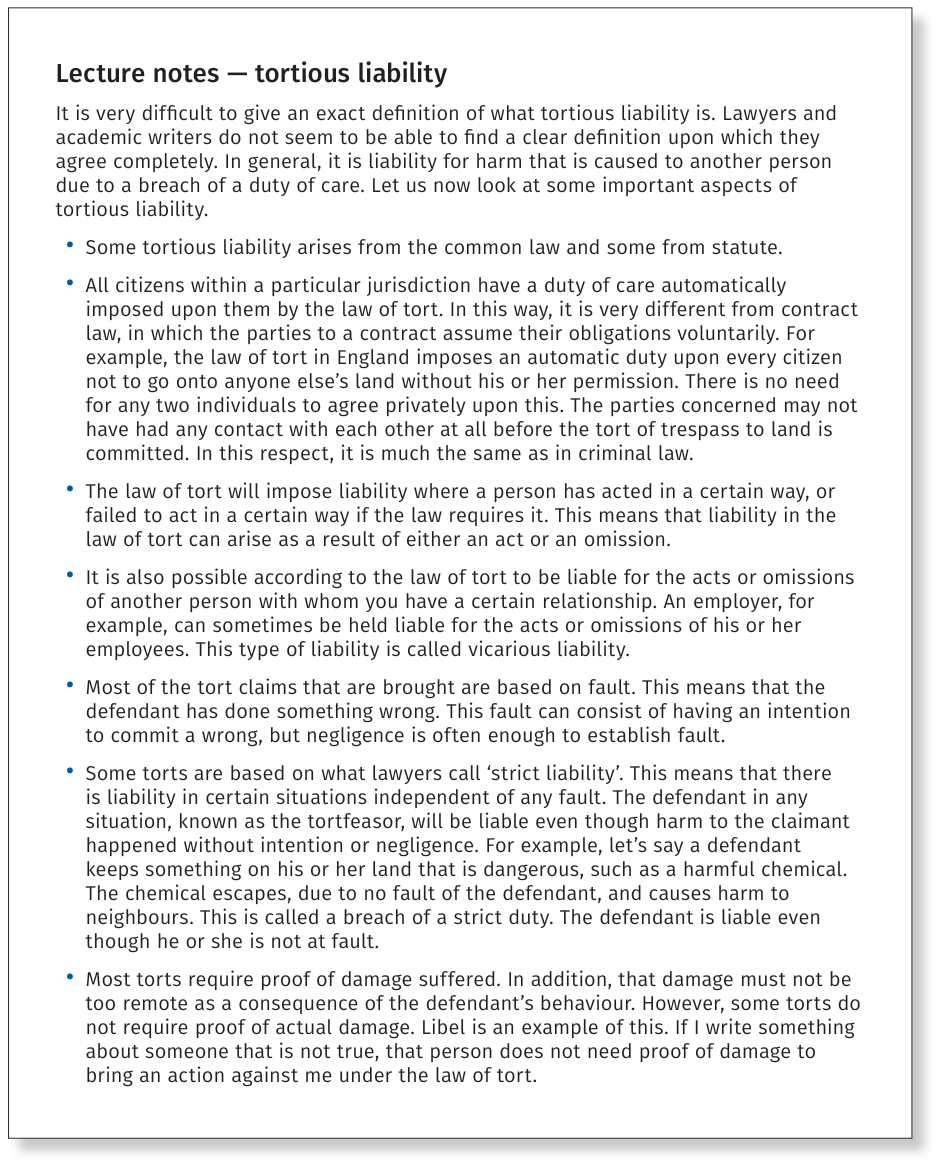
Lecture notes — tortious liability It is very difficult to give an exact definition of what tortious liability is. Lawyers and academic writers do not seem to be able to find a clear definition upon which they agree completely. In general, it is liability for harm that is caused to another person due to a breach of a duty of care. Let us now look at some important aspects of tortious liability.
• Some tortious liability arises from the common law and some from statute. • All citizens within a particular jurisdiction have a duty of care automatically imposed upon them by the law of tort. In this way, it is very different from contract law, in which the parties to a contract assume their obligations voluntarily. For example, the law of tort in England imposes an automatic duty upon every citizen not to go onto anyone else’s land without his or her permission. There is no need for any two individuals to agree privately upon this. The parties concerned may not have had any contact with each other at all before the tort of trespass to land is committed. In this respect, it is much the same as in criminal law. • The law of tort will impose liability where a person has acted in a certain way, or failed to act in a certain way if the law requires it. This means that liability in the law of tort can arise as a result of either an act or an omission. • It is also possible according to the law of tort to be liable for the acts or omissions of another person with whom you have a certain relationship. An employer, for example, can sometimes be held liable for the acts or omissions of his or her employees. This type of liability is called vicarious liability. • Most of the tort claims that are brought are based on fault. This means that the defendant has done something wrong. This fault can consist of having an intention to commit a wrong, but negligence is often enough to establish fault. • Some torts are based on what lawyers call ‘strict liability’. This means that there is liability in certain situations independent of any fault. The defendant in any situation, known as the tortfeasor, will be liable even though harm to the claimant happened without intention or negligence. For example, let’s say a defendant keeps something on his or her land that is dangerous, such as a harmful chemical. The chemical escapes, due to no fault of the defendant, and causes harm to neighbours. This is called a breach of a strict duty. The defendant is liable even though he or she is not at fault. • Most torts require proof of damage suffered. In addition, that damage must not be too remote as a consequence of the defendant’s behaviour. However, some torts do not require proof of actual damage. Libel is an example of this. If I write something about someone that is not true, that person does not need proof of damage to bring an action against me under the law of tort.
a According to English law the liability that arises in the law of tort comes from both statute and the common law.
b It is possible to bring a case against someone under the law of tort without having any kind of private agreement or contract with that person.
c It is impossible to be liable under the law of tort because you haven’t done something.
d It is impossible to be liable for the actions of another person under the law of tort.
e It is not always necessary to be guilty of some fault to be liable for a tort.
Look at Ann Edington’s lecture notes on tortious liability again. Find the words or phrases in the notes that match each of the following meanings.
a The duty that every citizen owes to every other citizen, according to the law of tort.
The word or phrase is
b The name for the general responsibility for harm caused to other people according to the law of tort.
The word or phrase is
c The tort of entering onto someone else’s land or property without that person’s permission.
The word or phrase is
d A word that means a failure to do something that it is your duty to do.
The word or phrase is
e The name of the particular responsibility that one person might have for another person’s acts or omissions according to the law of tort.
The word or phrase is
f A lack of proper care or not fulfilling a duty that it is your obligation to fulfil which results in harm to another.
The word or phrase is
g The name of the particular responsibility that every citizen owes to every other citizen regardless of whether he or she is guilty of any intention or negligence when causing harm.
The word or phrase is
h A person who has breached the duty of care and has caused harm to another person as a result of that breach.
The word or phrase is
i A word meaning ‘distant’ or ‘far away’.
The word or phrase is
j A published statement that is not true and which damages someone’s reputation as a result of being published.
The word or phrase is Collocation bank to impose a duty of care to assume an obligation upon someone • to commit a tort to be held liable for voluntarily • remote damage Preposition bank
• to arise from the common law or statute ‘Many of the principles of the law of tort arise from the common law.’ • a duty imposed upon someone ‘Statute imposes a duty upon you concerning your liability for any products that you sell to the public.’
Speaking & Writing for this topic
Two short tasks scored against TOEFL rubrics. The prompt is generated for this topic — use the vocabulary you have just studied.
Suggested structureclick to expand
- In my experience…
- From what I have seen…
- My honest view is that…
- The principal reason is that…
- This matters because…
- What makes what decisive here is…
- For instance, when I…
- A clear example is…
- Consider the case where tortious was involved…
- On the other hand,…
- Furthermore,…
- That said, one should not forget that…
- Overall, this shows that…
- The lesson, then, is…
- For these reasons, I believe…
- Aim for 4–5 keywords woven naturally into your answer.
- Use at least two linking phrases (Furthermore, On the other hand, As a result…).
- Avoid filler words like "basically" or "like".
Suggested structureclick to expand
- The most important point in this concept is …
- My position is that …
- The principal reason is that what …
- This is supported by …
- A concrete illustration is …
- For instance, …
- However, some argue that …
- On the other hand, …
- In conclusion, …
- Taken together, …
- Aim for 4–5 keywords used in natural context.
- Use 3+ linking words across the answer.
- Vary sentence length to avoid monotony.
SOME CATEGORIES OF TORT ~19 min
something • to owe someone a duty the tort of trespass to land ‘Going onto someone’s land without their permission is known as trespass to land.’ • to have proof of something ‘Some torts are actionable without proof of damage.’
Several different types of tort exist in the UK and the USA. Some of these categories of tort are listed in the box below, together with areas of liability arising under the law of tort. Match each type of tort or area of liability with the situations that follow.
occupier’s liability (1) defamation (5)
vicarious liability (2) employer’s liability (6)
product liability (3) trespass to land (7)
nuisance (4) false imprisonment (8)
a ‘I own a factory where bread and cakes are manufactured. I did not provide my workers with the special gloves that they need when they are taking things out of the ovens. One of my workers has suffered very serious burns to his hands and arms as a result.’
b ‘My neighbour has started to keep animals in her garden. She has some hens and a small pig. The noise and the smell are terrible.’
c ‘I own a company that transports goods by lorry. Last week one of my drivers was in a petrol station during his working hours. He lit a cigarette and threw away a lighted match, which caused an explosion.’
d ‘I bought my son a toy from a company on the Internet. The toy is a battery-operated train. When the train was switched on the batteries became extremely hot and my son burnt his hand when he was playing with it.’
e ‘I own a magazine that contains a lot of gossip about celebrities. Last month my magazine printed a story that said a local footballer here in Chatsworth had kept some money raised at a charity event for homeless people. I now know that the story was completely untrue.’
f ‘I study geography at the University of Chatsworth. Last week the whole class had very bad results on a test. The professor was furious. He locked the door of the lecture room and he refused to let anyone out of the room until he had finished speaking to us. He kept us there for one hour after our usual time.’
g ‘I went into a bar last week with some friends and I slipped on some beer that was on the floor. When I fell I cut my hand on some broken glass. Another customer in the bar told me that a man had dropped a bottle of beer there about 20 minutes earlier. The bar staff had been told that there was beer and broken glass on the floor, but they had been too busy to clean it up.’
h ‘My neighbour walks across my land as a shortcut to the shops. I have been asking him to stop doing this for months now, but he doesn’t listen to me.’
LISTENING
Listen to this professor who is giving her students a lecture. It is an introduction to the law of tort. Listen to the lecture and answer the following questions.
a The professor says that some people give the law of tort a different name. What is it?
Answer:
b What is the meaning of the word ‘redress’?
Answer:
c What do the majority of claimants want when they bring an action to court under the law of tort?
Answer:
d The professor says that damages are one form of redress that the courts can offer to an injured party. What is the other remedy that she mentions?
Answer:
e How does the professor define the tort of nuisance?
Answer:
f What does the professor say is the correct term for a person’s liability in the law of tort?
Answer:
g The professor mentions an automatic duty that the law imposes upon everyone. What is the name of this duty?
Answer:
h The professor mentions two ways in which a person has a duty under the law of tort not to harm another.
One duty is not to harm a person physically. What is the other duty that she mentions?
Answer:
i The professor mentions that the law of tort and the law of contract overlap in some ways. She gives an example of a company supplying something to a group of consumers that will lead to concurrent liability in tort and criminal law. In the professor’s example, what did the company supply to the consumers?
Answer:
j How does the professor say that some legal commentators have described the law of tort?
Answer:
Speaking & Writing for this topic
Two short tasks scored against TOEFL rubrics. The prompt is generated for this topic — use the vocabulary you have just studied.
Suggested structureclick to expand
- In my experience…
- From what I have seen…
- My honest view is that…
- The principal reason is that…
- This matters because…
- What makes some decisive here is…
- For instance, when I…
- A clear example is…
- Consider the case where categories was involved…
- On the other hand,…
- Furthermore,…
- That said, one should not forget that…
- Overall, this shows that…
- The lesson, then, is…
- For these reasons, I believe…
- Aim for 4–5 keywords woven naturally into your answer.
- Use at least two linking phrases (Furthermore, On the other hand, As a result…).
- Avoid filler words like "basically" or "like".
Suggested structureclick to expand
- The most important point in this concept is …
- My position is that …
- The principal reason is that some …
- This is supported by …
- A concrete illustration is …
- For instance, …
- However, some argue that …
- On the other hand, …
- In conclusion, …
- Taken together, …
- Aim for 4–5 keywords used in natural context.
- Use 3+ linking words across the answer.
- Vary sentence length to avoid monotony.
THE TORT OF NEGLIGENCE ~20 min
Most tort cases in England and the USA are based upon the tort of negligence. Read the following text about the tort of negligence. Fill the gaps in the text with a verb from the blue box.
Under what circumstances is a person or organisation guilty of the tort of negligence? Unfortunately, the definition of the legal term ‘negligence’ varies according to which book or legal dictionary you are reading. The legal term ‘negligence’ has a much more complex meaning than the general English meaning of the word. However, most lawyers (a) Trueupon the idea that in order to establish negligence in a particular situation we must (b) Falsethree fundamental questions. These are:
• Did the defendant (c) Truethe claimant a duty of care? • Was that duty of care breached? • Did the defendant’s breach cause, or materially (d) Trueto, the damage suffered by the claimant?
If the answer to all three questions is ‘yes’, then the defendant has been negligent in the legal sense of the word.
To whom do I owe a duty of care? The case law in this area is complicated. However, there is a principle of English law that says that I owe a duty of care to anyone in situations where it is reasonably foreseeable that my act or omission might cause harm to another person. In other words, it is a defence to an allegation of negligence to (e) Falsethat no reasonable person would have anticipated that my act or omission would cause harm.
Assuming that I can reasonably anticipate the result of my act or omission, what standard of care does the law (f) expectfrom me? How do I know when I have breached my duty of care? To answer this question, most English law students are asked to remember the general principle of negligence provided by a judge named Alderson in the case of Blyth v Birmingham Waterworks (1856). The judge said:
‘Negligence is the omission to (g) dosomething which a reasonable man, guided upon those considerations which ordinarily regulate the conduct of human affairs, would do or doing something which a prudent and reasonable man would not do.’
Again, the question of whether or not I have breached my duty of care has been decided by an objective test. What would an ordinary, reasonable person do under the same circumstances?
Finally, in order to firmly (h) establish Exerclse2 (p104)negligence, the claimant must demonstrate that the negligent act of the defendant was the main cause of the damage complained of. A court will often ask:
• Was the chain of causation broken at any time? • Would the harm that the claimant suffered have happened anyway, even if the defendant had not acted in a particular way? • Even where there is a clear chain of causation, was the damage too remote, in other words, not reasonably foreseeable by the defendant?
In conclusion, establishing that someone has been negligent is not as straightforward as the general public might imagine.
Collocation bank
to act in a way ‘Your client acted in a particular way that caused harm to my client.’ • in order to do something ‘In order to establish negligence we must show that the defendant breached his duty of care to you.’
‘The damage was reasonably foreseeable by your client.’ • to be guilty of something ‘The defendant was guilty of committing this tort.’
Read the text in Exercise 1 again and decide if the following statements are true or false.
a The legal meaning of the word ‘negligence’ is more complicated than the general, dictionary meaning as the public would understand it.
b According to English law, I owe a duty of care to all other citizens in all situations.
c The test of whether or not one person owes another person a duty of care is an objective one.
d The definition of negligence in this text from the year 1856 comes from the common law.
e In cases where there is a clear chain of causation between the defendant’s conduct and the claimant’s harm, the defendant will always be guilty of negligence.
Complete the following sentences on the subject of negligence with a preposition from the box below.
a Do we agreeuponthe fact that your client owed my client a duty of care?
b We must ask ourselves what a reasonable person would have doneunderthose circumstances.
c The defendant did not take reasonable care when using dangerous chemicals and so he is guiltyofbehaving negligently.
d The damage caused to the claimant was not reasonably foreseeablebythe defendant.
eAtwhat point do you think that the chain of causation was broken?
Speaking & Writing for this topic
Two short tasks scored against TOEFL rubrics. The prompt is generated for this topic — use the vocabulary you have just studied.
Suggested structureclick to expand
- In my experience…
- From what I have seen…
- My honest view is that…
- The principal reason is that…
- This matters because…
- What makes expect decisive here is…
- For instance, when I…
- A clear example is…
- Consider the case where do was involved…
- On the other hand,…
- Furthermore,…
- That said, one should not forget that…
- Overall, this shows that…
- The lesson, then, is…
- For these reasons, I believe…
- Aim for 4–5 keywords woven naturally into your answer.
- Use at least two linking phrases (Furthermore, On the other hand, As a result…).
- Avoid filler words like "basically" or "like".
Suggested structureclick to expand
- The most important point in contribute is …
- My position is that …
- The principal reason is that expect …
- This is supported by …
- A concrete illustration is …
- For instance, …
- However, some argue that …
- On the other hand, …
- In conclusion, …
- Taken together, …
- Aim for 4–5 keywords used in natural context.
- Use 3+ linking words across the answer.
- Vary sentence length to avoid monotony.
THE MOST FAMOUS TORT CASE ~18 min
Read this text about a very famous case in the law of tort and answer the questions that follow using a full sentence.
There is a particular case that almost every lawyer in every common law system in the world is familiar with. This is the famous case of Donoghue v Stevenson. The facts of the case are as follows:
On 26 August 1928, Mrs May Donoghue of Glasgow left her home to make the short journey into Paisley, a neighbouring town. Upon arriving in Paisley, Mrs Donoghue met a friend at Minchella’s cafe at 1 Wellmeadow Street. Her friend ordered and paid for a pear, an ice-cream and a bottle of ginger beer, which is a drink that was very popular at that time. In doing so they began the events that would change legal history forever.
The ginger beer was manufactured by Mr David Stevenson of Paisley. It came in what was described as an ‘opaque’ bottle, so unfortunately no one was able to see what was in the bottle until the contents were poured out. The cafe’s proprietor, Mr Francis Minchella, poured part of the ginger beer onto Mrs Donoghue’s ice-cream to make what is known as ‘an ice-cream float’. Mrs Donoghue apparently began to eat with enthusiasm.
What happened next was the basis for the entire case. It is said that when Mrs Donoghue’s friend was pouring out the rest of the contents of the bottle into a glass, he or she saw floating out of the bottle what seemed to be the partly decomposed remains of a snail. Mrs Donoghue claimed she was made ill by what she had seen. Certainly, she had medical treatment from her doctor three days later for gastroenteritis, and again three weeks later, on 16 September 1928, at the Glasgow Royal Infirmary.
a Where was Mrs Donoghue from?
Answer: She also claimed that she had suffered from ‘nervous shock’.
If it had been Mrs Donoghue’s mysterious friend, (he or she was never named), rather than Mrs Donoghue herself who had suffered the effects of the ginger beer, then the legal world would probably have heard nothing about it. The friend could have sued Mr Minchella because there was a contract of sale between them, of which Mr Minchella was clearly in breach. However, there was no contractual relationship between Mr Minchella and Mrs Donoghue. The only person she could possibly sue was David Stevenson, the manufacturer of the ginger beer. The question was, on what grounds?
Mrs Donoghue was advised by a remarkable solicitor, Walter Leechman, of Leechman and Co, Glasgow. Mr Leechman decided to proceed with Mrs Donoghue’s case, even though there was no legal precedent for such an action. The basis of the claim was simple. It was that any manufacturer of a product intended for human consumption must be liable to the consumer for any damage resulting from a lack of reasonable care to ensure that the product is fit for consumption.
The case proceeded through various appeals to the highest court in the land, the House of Lords. The Lords decided in favour of Mrs Donoghue, and so it happened that a new precedent was established and a lady who said she was ‘not worth five pounds in all the world’ became the reason why, these days, millions of pounds and dollars have been won by claimants based on the tort of negligence.
b What was the address of the cafe where the incident happened?
Answer:
c Why was no one able to see the contents of the bottle of ginger beer before it was poured out?
Answer:
d What did Mrs Donoghue’s friend claim to have found in the bottle of ginger beer?
Answer:
e What physical illness was Mrs Donoghue treated for soon after her visit to the café?
Answer:
f What was the name of the hospital where Mrs Donoghue was treated?
Answer:
g What second serious effect did Mrs Donoghue claim the incident had caused?
Answer:
h Why could Mrs Donoghue’s friend have sued Mr Minchella if he or she had drunk the ginger beer?
Answer:
i Why was it so surprising that Mr Leechman decided to take this case to court?
Answer:
j This case established that a duty of care exists in English and Scottish law between manufacturers and which other general group of people?
Answer:
Speaking & Writing for this topic
Two short tasks scored against TOEFL rubrics. The prompt is generated for this topic — use the vocabulary you have just studied.
Suggested structureclick to expand
- In my experience…
- From what I have seen…
- My honest view is that…
- The principal reason is that…
- This matters because…
- What makes most decisive here is…
- For instance, when I…
- A clear example is…
- Consider the case where famous was involved…
- On the other hand,…
- Furthermore,…
- That said, one should not forget that…
- Overall, this shows that…
- The lesson, then, is…
- For these reasons, I believe…
- Aim for 4–5 keywords woven naturally into your answer.
- Use at least two linking phrases (Furthermore, On the other hand, As a result…).
- Avoid filler words like "basically" or "like".
Suggested structureclick to expand
- The most important point in this concept is …
- My position is that …
- The principal reason is that most …
- This is supported by …
- A concrete illustration is …
- For instance, …
- However, some argue that …
- On the other hand, …
- In conclusion, …
- Taken together, …
- Aim for 4–5 keywords used in natural context.
- Use 3+ linking words across the answer.
- Vary sentence length to avoid monotony.
USING YOUR KNOWLEDGE ~13 min
Collocation review Complete these sentences with a collocation that you have seen.
a The judge the claimant damages of £12,000.
b As my client has been unable to work, she will be making a claim based on her of earnings. This amounts to £3,500.
c Some legal professionals think that the law of tort as a deterrent in that it makes people think very hard about the consequences of their actions and may stop some people from doing potentially damaging things.
d The law a duty of care on all employers to make sure that their employees work in a safe environment.
e The judge decided that the defendant a duty of care to the claimant and that the defendant had breached that duty.
f Each party to a contract his or her obligations voluntarily, but in the law of tort obligations exist whether people want to have them or not.
g In order to that there has been negligence, the claimant must first satisfy the court that the duty of care has been breached.
h My client damage to her health as a result of your client’s negligence.
i My client could not have anticipated the result of her conduct and we deny that the harm that she caused was reasonably .
j My client’s conduct was not the direct cause of the damage to your client’s financial loss, as the of causation was broken by several other events.
Vocabulary review Complete these sentences with a word that you have seen.
a English speakers do not use the phrase ‘moral damage’ to describe a claimant’s suffering but describe this type of suffering as emotional .
b The name of the general liability that people have according to the law of tort is liability.
c The name of the liability that one person might have for the acts and omissions of another person is called liability.
d The name of the liability that requires no proof of harm but is actionable per se is known as liability.
e The person or organisation that has committed a tort is formally known as a .
f The tort of interfering with someone’s enjoyment of his or her land by, for example, making a lot of noise, is known as .
g Libel and slander are collectively known as the tort of .
h The tort of going onto someone’s land without his or her permission is known as to land.
i The usual that is available to the claimant in tort cases is an award of damages, which must be paid by the defendant.
j If the damage caused to the claimant by the defendant’s conduct was not reasonably foreseeable then a court might describe this as damage.
Preposition review Complete these sentences with the correct preposition.
a Each citizen within a particular jurisdiction is liable any breach of his or her duty of care.
b If you cause harm someone as a result of a breach of the duty of care then you will probably be ordered to pay damages to that person.
c The amount of damages that you have to pay will be dependant the circumstances of the case.
d My client is entitled redress for the harm that she has suffered.
e Many of the principles of the modern law of tort arose the facts of the case of Donoghue v Stevenson.
f Many of the obligations that we have under the law of tort are imposed upon us statute.
g Do we agree the fact that your client was liable for this accident?
h There was no break in the chain causation and your client was directly responsible for my client’s loss.
i Mrs Donoghue met her friend at a cafe the town of Paisley.
j When Mrs Donoghue’s case went to court there was no legal precedent such an action.
Speaking & Writing for this topic
Two short tasks scored against TOEFL rubrics. The prompt is generated for this topic — use the vocabulary you have just studied.
Suggested structureclick to expand
- In my experience…
- From what I have seen…
- My honest view is that…
- The principal reason is that…
- This matters because…
- What makes using decisive here is…
- For instance, when I…
- A clear example is…
- Consider the case where your was involved…
- On the other hand,…
- Furthermore,…
- That said, one should not forget that…
- Overall, this shows that…
- The lesson, then, is…
- For these reasons, I believe…
- Aim for 4–5 keywords woven naturally into your answer.
- Use at least two linking phrases (Furthermore, On the other hand, As a result…).
- Avoid filler words like "basically" or "like".
Suggested structureclick to expand
- The most important point in this concept is …
- My position is that …
- The principal reason is that using …
- This is supported by …
- A concrete illustration is …
- For instance, …
- However, some argue that …
- On the other hand, …
- In conclusion, …
- Taken together, …
- Aim for 4–5 keywords used in natural context.
- Use 3+ linking words across the answer.
- Vary sentence length to avoid monotony.
HIGHER LEVEL PRACTICE ~17 min
There is a word or phrase missing from the following sentences. For each sentence circle the word which best fits into the space from the options provided. Do not mark more than one answer for each sentence. There is an example at the beginning (*).
Example As well as compensating people who have suffered a loss, the law of tort is intended to act as a (*) to harmful conduct.
1 According to English law, each citizen has a duty of (1) to other citizens under certain circumstances.
2 The liability that people have under the law of tort in situations where no proof of damage is required, is known as (2) liability.
3 The main objective of the law of tort is to compensate the (3) party for the harm that he or she has suffered.
4 The phrase ‘emotional (4) ’ is used by lawyers in England to describe a client’s mental pain and suffering.
5 The law of tort (5) liability on people.
6 A claimant can only be compensated for reasonably (6) harm.
7 In some negligence cases the claimant is refused a remedy on the grounds that the harm he or she has suffered is too (7) .
8 The liability that people have in the law of tort in situations where one person can be liable for the acts and
(8) of another is known as vicarious liability.
9 The act of going onto someone’s land without their permission is known as the tort of (9) .
10 The tort of defamation has two forms, which are slander and (10) .
| # | Phrase | Definition |
|---|---|---|
| (*) | A prevention B deterrent | C warning D caution |
| (1) | A carefulness B caution | C care D watchfulness |
| (2) | A absolute B total | C definite D strict |
| (3) | A injured B damaged | C defective D hurt |
| (4) | A damage B misery | C torture D distress |
| (5) | A puts B imposes | C forces D compels |
| (6) | A anticipated B foreseeable | C probable D predictable |
| (7) | A distant B isolated | C far D remote |
| (8) | A errors B failures | C omissions D oversights |
| (9) | A intrusion B trespass | C invasion D disturbance |
(10) A criticism B falsehood C libel D fiction
Read the following sentences that have a preposition missing from them. For each sentence circle the preposition that best fits into the space from the options provided below. Do not mark more than one answer for each sentence. There is an example at the beginning (*).
Example My client was seriously harmed by your conduct and he is entitled to sue you (*) the grounds of negligence.
1 The court awarded damages to the hotel (1) the amount of £10,000 after the magazine published a defamatory story about events that happened in its kitchen.
2 The grounds of our claim (2) your client are that your client’s story in the Daily Journal amounted to defamation.
3 My client will be claiming for his loss (3) earnings for the entire period that he could not work.
4 In some cases an employer is liable (4) his employees’ acts and omissions.
5 A manufacturer of goods is liable (5) the consumer for the safety of those goods.
6 My client has suffered emotional distress (6) a result of your client’s conduct.
7 The amount of damages that you are awarded will depend (7) the amount of harm that you have suffered.
8 An omission is a failure to act (8) a certain way.
9 The law of tort says that you have a duty (9) other people.
10 Several of my neighbours walk (10) my land as a shortcut and I would like them to stop.
| # | Phrase | Definition |
|---|---|---|
| (*) | A on B for | C with D to |
| (1) | A for B on | C in D into |
| (2) | A with B against | C of D to |
| (3) | A from B to | C in D of |
| (4) | A to B with | C by D for |
| (5) | A to B with | C by D for |
| (6) | A with B for | C as D for |
| (7) | A by B on | C into D to |
| (8) | A in B for | C to D on |
| (9) | A for B with | C to D by |
(10) A across B to C in D against Listening
Listen to this conversation between a lawyer and her client. Decide if the following statements are true or false.
1 A friend of Mr Kelly recommended Miss Reay because she has a good reputation in defamation cases.
2 Mr Kelly and his wife have moved to France to escape from the terrible rumours about his life.
3 FriendsAgain.com is a website where old school friends can chat.
4 Most of Mr Kelly’s pupils were French and German.
5 Gary Hetherington’s father was angry with Mr Kelly when Gary was expelled from the school.
6 Mr Kelly has emailed the untrue comments from the website to Miss Reay.
7 Mr Kelly was dismissed from his job at St Bernadette’s school.
8 Jim Murray was libelled on the same website as Mr Kelly.
9 The defendant in the case that Jim Murray brought in 2002 is now also a teacher.
10 If Mr Kelly wins damages from Gary Hetherington he is going to use the money to pay for a holiday.
True or false?
| # | Phrase | Definition |
|---|---|---|
| (1) | (2) (3) | (4) (5) |
| (6) | (7) (8) | (9) (10) |
Speaking & Writing for this topic
Two short tasks scored against TOEFL rubrics. The prompt is generated for this topic — use the vocabulary you have just studied.
Suggested structureclick to expand
- In my experience…
- From what I have seen…
- My honest view is that…
- The principal reason is that…
- This matters because…
- What makes higher decisive here is…
- For instance, when I…
- A clear example is…
- Consider the case where level was involved…
- On the other hand,…
- Furthermore,…
- That said, one should not forget that…
- Overall, this shows that…
- The lesson, then, is…
- For these reasons, I believe…
- Aim for 4–5 keywords woven naturally into your answer.
- Use at least two linking phrases (Furthermore, On the other hand, As a result…).
- Avoid filler words like "basically" or "like".
Suggested structureclick to expand
- The most important point in this concept is …
- My position is that …
- The principal reason is that higher …
- This is supported by …
- A concrete illustration is …
- For instance, …
- However, some argue that …
- On the other hand, …
- In conclusion, …
- Taken together, …
- Aim for 4–5 keywords used in natural context.
- Use 3+ linking words across the answer.
- Vary sentence length to avoid monotony.