
Understanding Contracts 1
THE DIFFERENT PARTS OF A WRITTEN CONTRACT ~7 min
Here are six headings that are used by lawyers to describe different parts of a contract. Match the descriptions below with the correct heading.
the delivery of the operative goods/services provisions
a The part of a contract that sets out the most important things that the parties have agreed to do under the contract.
The heading is
b The part of a contract that gives the background information to the contract. It often states why the parties are entering into an agreement.
The heading is
c The part of the contract that gives a precise explanation of how the parties will interpret certain words used in the contract.
The heading is
d An extra document that is attached to the contract giving information that is too detailed to be included in the body of the contract.
The heading is
e The part of the contract containing the names of the people or companies who are entering into the contract.
The heading is
f The part of the contract that gives a specific time and date for when certain obligations must be carried out.
It might also specify where these obligations will be carried out.
The heading isthe delivery of goods/servicesUK lawyers often refer to the parts of a contract as clauses. For example, ‘I would like to suggest some amendments to clause 4 of this contract’. However, there are other words that lawyers often use in the same way:
Internationally, lawyers use the words as synonyms — they all have the same meaning.
• ‘Can I draw your attention to section 5’ • ‘If we can just look at paragraph 5 for a moment’ • ‘If you wouldn’t mind looking at clause 5’ • ‘Let’s look at article 5’
Speaking & Writing for this topic
Two short tasks scored against TOEFL rubrics. The prompt is generated for this topic — use the vocabulary you have just studied.
Suggested structureclick to expand
- In my experience…
- From what I have seen…
- My honest view is that…
- The principal reason is that…
- This matters because…
- What makes the parties decisive here is…
- For instance, when I…
- A clear example is…
- Consider the case where the defined terms was involved…
- On the other hand,…
- Furthermore,…
- That said, one should not forget that…
- Overall, this shows that…
- The lesson, then, is…
- For these reasons, I believe…
- Aim for 4–5 keywords woven naturally into your answer.
- Use at least two linking phrases (Furthermore, On the other hand, As a result…).
- Avoid filler words like "basically" or "like".
Suggested structureclick to expand
- The most important point in paragraph is …
- My position is that …
- The principal reason is that the parties …
- This is supported by …
- A concrete illustration is …
- For instance, …
- However, some argue that …
- On the other hand, …
- In conclusion, …
- Taken together, …
- Aim for 4–5 keywords used in natural context.
- Use 3+ linking words across the answer.
- Vary sentence length to avoid monotony.
PARTIES AND RECITALS ~20 min
You need to know about...
Parties A contract will always name the parties to the agreement. It is necessary to identify the parties so that everyone concerned is sure who the agreement is between. The addresses of the parties are usually included. This is important in case you want to serve a notice on the other party. With a company it is usual to give the address of its registered office, which is often not the same as the business address.
Recitals Most contracts include a recitals section, although many lawyers say it is not absolutely necessary. The recitals give the background information to the contract. It is useful because it usually says why the parties are entering into the contract. The recitals often start with the word WHEREAS and in some contracts every sentence in the recitals will begin with the word WHEREAS. It is a very old-fashioned word meaning something like ‘Taking the following facts into consideration’ or ‘The situation is as follows’.
Read the following extract from a contract. Complete each gap with the correct word from the blue box below.
This AGREEMENT is made on this third day of April 20XX between CLADDAGH FURNITURE & DÉCOR Ltd a company incorporated in Ireland under number 1000576 having its registered office at 30 King Charles Crescent, Galway City, Republic of Ireland hereinafter (a) referredto as ‘the Supplier’, (b) andALL THINGS IRISH Ltd a company incorporated in England under number 2297103 having its registered office at 1 Montgomery Square, Birmingham, England hereinafter referred to as ‘the (c) Buyer’
RECITALS WHEREAS the Supplier is (d) engagedin the manufacture and distribution of handmade furniture and various other household goods for sale and distribution to retailers WHEREAS the Buyer is a (e) retailerwho operates a chain of retail outlets around the UK and wishes to purchase a selection of furniture and other goods from the Supplier for sale to the public via said outlets WHEREAS the Supplier agrees to supply specified furniture and other goods to the Buyer (f) subjectto the terms and conditions set out in this Agreement.
A client has telephoned you to ask for an explanation of some of the words in the extract in Exercise 1. Match the highlighted word or phrase with the definitions provided.
(*) Incorporated means… …people or companies who sell things in their shops directly to the public. (1)
a Hereinafter means… …written. (2)
b Manufacture means… …runs or manages a business. (3)
c Retailers are… …number of shops or offices run by the same business or company. (4)
d Operates means… …to be formed into a registered company.
e A chain is a… …later in this document. (5)
f Outlets are… …to make or produce something. (6)
g Said means… …somewhere where goods or services are sold, such as shops. (7)
h Set out means… …already mentioned. (8)
Here is another introduction to a contract. It is very similar to the example that you saw in Exercise 1. Fill each gap in the text with the correct preposition from the blue box below.
This AGREEMENT is made (a) onthis eleventh day of August 20XX between COMPUHIRE Ltd a company incorporated (b) inEngland under number 9998113 having its registered office (c) at55 Maple Court Lane, Manchester, England hereinafter referred to as ‘the Owner’ and ONLINE COUNTRY GIFTS Ltd a company incorporated in England under number 7890123 having its registered office at 60 Vale Arbour, Birmingham, England hereinafter referred to as ‘the Hirer’
RECITALS WHEREAS the Owner is engaged in the hire and maintenance (d) ofoffice computer systems to online business operations WHEREAS the Hirer is a business which operates an online gift purchasing facility for use (e) bythe general public WHEREAS the Owner agrees to supply specified computer hire and maintenance services to the Hirer subject (f) tothe terms and conditions set out in this Agreement.
Complete the following introduction to a contract using the information from the blue box.
• DATE: 19/07/20XX • PARTIES: BPP Distribution Ltd (known as the Distributor), company number 3456789 and The English Educational Press Ltd (known as the Publisher), company number 6789012 This AGREEMENT is made on this (a) nineteenth/19day of (b) July20XX between (c) BPP Distribution Ltda company incorporated in England under number (d) 3456789having its registered office at 15 Regent Street, Liverpool, England hereinafter referred to as ‘the Distributor’ and (e) The English Educational Press Ltda company incorporated in England under number (f)nineteenth/19having its registered office at Princess Diana House, York, England hereinafter referred to as ‘the (g) Publisher’.
RECITALS WHEREAS the Distributor is engaged in the distribution of academic and educational textbooks for sale and distribution to schools, universities and other educational establishments.
WHEREAS the Publisher produces academic and educational textbooks for use in educational establishments within the United Kingdom.
WHEREAS the Distributor agrees to distribute specified titles to educational establishments subject to the terms and conditions set out in this Agreement.
Complete the following sentences with a word or words that you have seen in Exercises 1-4.
a The company was incorporated in 20XX and has itsregisteredoffice at 10 Admiralty Square, London.
b The Distributor agrees to the terms and conditionsset outin this agreement.
c COMPUHIRE ishereinafterknown as ‘the Owner’.
d He runs achainof 15 retail outlets in the south of England.
e In the recitals section of a contract you often see at least one sentence beginning with the word.
f The Hirer isengagedin the business of the distribution of educational textbooks.
Collocation bank to serve notice/a notice on
someone • the terms and conditions set out in an agreement
the parties to an agreement/contract ‘Who are the parties to this contract?’ • subject to terms and conditions ‘The Company agrees to supply the Buyer with goods subject to the terms and conditions set out in this Agreement.’ • to suggest an amendment to a document ‘I suggest an amendment to clause 6.’
Speaking & Writing for this topic
Two short tasks scored against TOEFL rubrics. The prompt is generated for this topic — use the vocabulary you have just studied.
Suggested structureclick to expand
- In my experience…
- From what I have seen…
- My honest view is that…
- The principal reason is that…
- This matters because…
- What makes referred decisive here is…
- For instance, when I…
- A clear example is…
- Consider the case where subject was involved…
- On the other hand,…
- Furthermore,…
- That said, one should not forget that…
- Overall, this shows that…
- The lesson, then, is…
- For these reasons, I believe…
- Aim for 4–5 keywords woven naturally into your answer.
- Use at least two linking phrases (Furthermore, On the other hand, As a result…).
- Avoid filler words like "basically" or "like".
Suggested structureclick to expand
- The most important point in Buyer is …
- My position is that …
- The principal reason is that referred …
- This is supported by …
- A concrete illustration is …
- For instance, …
- However, some argue that …
- On the other hand, …
- In conclusion, …
- Taken together, …
- Aim for 4–5 keywords used in natural context.
- Use 3+ linking words across the answer.
- Vary sentence length to avoid monotony.
DEFINED TERMS ~34 min
You need to know about...
to enter into a contract ‘Did you enter into this contract voluntarily?’ • an agreement between two parties ‘This agreement is between the Publisher and the Distributor.’ • to draw someone’s attention to something ‘Can I draw your attention to what you said in your email?’
This section of a contract usually comes after the parties and recitals. However, some contracts have this section at the end of the agreement. The purpose of this section of a contract is to give a precise definition of important words as they are used in that particular contract. It is important because the parties need to know for sure what words mean. For example, look at this very precise definition of the word ‘Goods’.
‘Goods’ shall mean any goods or services that are the subject of the contract and shall include components and any part(s) of components supplied and any materials incorporated in them.’
You will see that it is different from the normal dictionary definition. That is because the parties have agreed on the meaning of the word ‘Goods’ in this particular contract.
A word or expression that has been defined is called a defined term. Often, a defined term is only one word, for example ‘Goods’. However, a defined term may be made up of more than one word, for example, ‘Final Repayment Date’. In the definitions section, each word of the defined term must be given a capital letter, as in our example. Then, every time a defined term is used in the contract it also starts with a capital letter. This is to remind anyone reading the contract that these words are defined and have a special meaning. The first time a defined word is used it is put in inverted commas like this, ‘Goods’ means.... After the first time the defined term is used without inverted commas.
The section of the contract that begins after the recitals often begins with the words ‘Now it is agreed as follows’ or ‘It is hereby agreed’. This means that the definitions section is the start of the legally binding part of the agreement.
In the blue box there are four defined terms from a contract. Match each defined term with its definition below.
‘Company’ (1)3‘Contract’ (3)
‘Buyer’ (2)3‘Goods’ (4)
a the agreement dated 5 March 20XX entered into between the Company and the Buyer to supply goods/services to the Buyer.
b the person/company or the person’s/company’s servants or agents purchasing goods/services from the Company.
c any goods/services that are the subject of this contract and shall include components and any part(s) of components supplied and any materials incorporated in them.
d THE ANNE HARTIS COOKIE COMPANY LTD, of 25 Station Lane, Cuthbert Road, Durham DH15 8HK.
Exercise 1 contained the following definition:
‘Buyer’ means the person/company or the person’s/company’s servants or agents purchasing goods/services from the Company What do the words ‘servant’ or ‘agent’ mean when used in this way?
In the case of Malcolm v University of Oxford (2002) the Court of Appeal spoke about the meaning of these two words.
From Malcolm v University of Oxford (2002) ‘The term “servant” means an employee under a contract of service. The term “agent” means a person entrusted with the fulfilment of a role or performance of a task on behalf of his principal, usually involving or affecting the legal relations of the principal with a third party.’
Here is a simplified version of the judge’s explanation. Complete the explanation of what ‘servant’ and ‘agent’ mean by filling the gaps in the text with a word from the box below.
The word (a) ‘ ’ means an employee who has a contract of employment with your company. A good example of the legal meaning of the word ‘servant’ would be a ‘servant’ of a university. This would include any (b) employeewho has a contract to work for the university but not, for example, a visiting (c) professorwho was paid a fee to give a talk to the students.
The word (d) agentmeans a person who the party to the contract, known as the (e) principalor the master, trusts to act on his behalf when dealing with a third party.
Here is the definitions section from another contract. Fill each gap with the correct preposition from the blue box below.
(a) Inthese terms and conditions the following words shall have the following meanings:
‘the Supplier’ means Peterson Electrics Ltd trading under the title appearing on any invoice (b) forthe Goods ‘the Goods’ means any product, articles or things supplied by or subject to negotiations for supply (c) bythe Supplier (d) tothe Buyer ‘the Buyer’ means any corporate entity, firm or person to whom the Supplier supplies or (e) withwhom the Supplier enters negotiations for the supply (f) ofGoods.
Look at this information from the definitions section of another contract. The information refers to how certain words in the contract will be interpreted. This is common to many commercial contracts. Match each piece of information with the correct explanation given below.
In these conditions, unless a contrary intention appears:
a reference to the singular includes a reference to the plural and vice versa
b reference to a gender includes a reference to the opposite gender
c reference to a party includes a reference to its servants and agents
d headings are used for the purpose of reference only and do not form part of these conditions.
If the word he/him/man is used in this contract, that word also means she/her/woman. (1)
If the contract refers to one of something, such as a component of a machine, that word includes components — the contract doesn’t need to use both words each time that term is used. (2)
Collocation bank
• to provide a precise definition of a word Preposition bank to be the subject of a contract ‘Goods shall mean the goods that are the subject of any contract between the parties.’ • to refer to something ‘Where the masculine is referred to in this contract it shall include the feminine.’ • to supply goods/services to someone ‘Our company supplies electricity to the London area.’ • to be a person who is under a contract of employment/service ‘He is under a contract of employment to a big recording company in Los Angeles for the next six months.’ • to work for a company or organisation ‘I work for an international law firm in Hong Kong.’
The title of a contract clause, for example, payment terms or termination is not included as part of the terms and conditions of the contract. (3)
Every time one of the parties to the contract is mentioned, for example, the Company, the name of that party will be understood to include all of that party’s employees. (4)
to act on behalf of someone else ‘Any servant or agent who is authorised to act on behalf of the principal.’ • to trade under a particular name ‘That company went out of business last year but they are now trading under a new name.’ • goods/services supplied by a company ‘Any goods supplied by your company must meet European Union safety regulations.’ • to be subject to something ‘The price of the Goods is not subject to negotiation.’ • to be entrusted with doing something or dealing with a person ‘I am entrusting you with a very important new client.’
Look at the text below. It is from the definitions section of a procurement contract. Procurement contracts are usually used by governments or large corporations to buy the things that they need from outside companies. Read the text and explain the meaning of the underlined words or phrases. You can use one word or a short sentence. There is an example at the beginning.
Terms and conditions of purchase DEFINITIONS 1.1 ‘Buyer’ shall mean the United Kingdom Department of Health, their servants or (*) agents.
1.2 ‘Seller’ shall mean the person, firm or company (a) issued with an Order and any (b) servants, agents or authorised sub-contractors of any such person, firm or company.
1.3 ‘Order’ shall mean a purchase order as may be varied by a Change Order.
1.4 ‘Change Order’ shall mean an order varying or cancelling an Order as described in clause 4
(c) hereof.
1.5 ‘Work’ shall mean any equipment, goods or services or part thereof to be provided under the Order.
1.6 ‘Price’ shall mean all (d) sums payable to the Seller for performance of the Work.
1.7 ‘Intellectual Property Rights’ shall mean all copyright, all other rights in relation to registered and unregistered trademarks, inventions and all other rights resulting from intellectual activity in the industrial, scientific and artistic (e) fields.
(*) Agents are the people who are authorised to act on behalf of a principal. The principal is one of the parties to the contract.
- a
- b
- c
- d
- e
Complete the following sentences with a word or words that you have seen in Exercises 1-5.
a In these conditions, unless acontraryintention appears, a reference to the singular includes a reference to the plural.
b Any reference to the Company shall include all authorised sub-contractors,servantsor agents of the Company.
c Throughout this agreementheadingssuch as ‘NOTICE’ or ‘TERMINATION’ are for reference only and do not form part of the contract.
d An agent usually works on behalf of one of the parties to the contract. This party is known as the agent’sprincipal. Continued
e She is an expert in her chosenfieldof law, which is the protection of intellectual property rights.
Speaking & Writing for this topic
Two short tasks scored against TOEFL rubrics. The prompt is generated for this topic — use the vocabulary you have just studied.
Suggested structureclick to expand
- In my experience…
- From what I have seen…
- My honest view is that…
- The principal reason is that…
- This matters because…
- What makes professor decisive here is…
- For instance, when I…
- A clear example is…
- Consider the case where principal was involved…
- On the other hand,…
- Furthermore,…
- That said, one should not forget that…
- Overall, this shows that…
- The lesson, then, is…
- For these reasons, I believe…
- Aim for 4–5 keywords woven naturally into your answer.
- Use at least two linking phrases (Furthermore, On the other hand, As a result…).
- Avoid filler words like "basically" or "like".
Suggested structureclick to expand
- The most important point in In is …
- My position is that …
- The principal reason is that professor …
- This is supported by …
- A concrete illustration is …
- For instance, …
- However, some argue that …
- On the other hand, …
- In conclusion, …
- Taken together, …
- Aim for 4–5 keywords used in natural context.
- Use 3+ linking words across the answer.
- Vary sentence length to avoid monotony.
THE OPERATIVE PROVISIONS ~25 min
You need to know about...
After the recitals and the defined terms there are clauses giving a detailed description of what each party promises to do. This part of the contract could be a short paragraph or it could be several pages and contain a very exact description. Depending on the type of contract it is, it might contain diagrams, drawings or graphs to explain the nature of the obligations more clearly. Additional information like this may be included here, although it is usually contained in attachments to the contract known as schedules.
Here is the first clause from the operative provisions section of a contract. It is a contract between a wine importing company and an exclusive hotel. The company wants to hold its New Year party for 1000 employees at the hotel. Match the underlined words from the clause with the meanings below.
In consideration of the sum stated in paragraph 1 of the Schedule hereto to be paid by the Hirer to the Owner, the Hirer is hereby authorised to enter upon and use for the purpose only of holding a private social function between the hours and on the date set out in paragraph 2 of the Schedule hereto, the following rooms of the London Bridge Hotel together with the right of access thereto by the usual routes. The said rooms are hereinafter known as ‘the Hired Premises’:
(i) The King Henry VIII Ballroom
(ii) The Thames Cocktail Lounge (iii) The Westminster View Bar.
a A person who pays money in exchange for permission to use something for a certain period of time.
The word or phrase is
b A document attached to a contract. It forms part of the contract and contains specific information about what the parties are agreeing to do.
The word or phrase is
c Written or stated.
The word or phrase is
d A building or a part of a building that is used for something in particular.
The word or phrase is
e An amount of money.
The word or phrase issumcontinued
f What the parties exchange under the contract, such as goods, services or money.
The word or phrase is
g To this contract.
The word or phrase is
h By this contract.
The word or phrase is
i Later in this document.
The word or phrase is
Here is the clause again. Read it carefully using your answers from Exercise 1 to help you to understand it. Answer the questions that follow using a full sentence.
In consideration of the sum stated in paragraph 1 of the Schedule hereto to be paid by the Hirer to the Owner, the Hirer is hereby authorised to enter upon and use for the purpose only of holding a private social function between the hours and on the date set out in paragraph 2 of the Schedule hereto, the following rooms of the London Bridge Hotel together with the right of access thereto by the usual routes. The said rooms are hereinafter known as ‘the Hired Premises’:
(i) The King Henry VIII Ballroom
(ii) The Thames Cocktail Lounge (iii) The Westminster View Bar.
a Why do the names of the parties have a capital letter whenever they are used in this contract?
b What term has been given to the wine importing company in the definitions section of this contract?
c What term has been given to the hotel in the definitions section of this contract?
d Where should the Hirer look to find out how much the hire of the rooms in the hotel will cost?
e What else does the Hirer have the right to use in addition to the three rooms that it has hired?
f What term is used to describe the three rooms in later clauses of this contract?
Collocation bank to hold a party or an event somewhere Preposition bank in consideration of something ‘In consideration of the sum specified in Schedule A.’ • to get to a place by a certain route ‘I get to London by the M1 Motorway.’ • in exchange for something ‘I will give you £1000 in exchange for your car.’
• to agree to do something/exchange something under a contract ‘You agreed to buy my car under the terms of our contract.’ • to do something between certain hours or days ‘You may use these rooms between 8pm and 2am.’
Here are four short clauses from the same contract. Two of the clauses are obligations of the Owner and two are obligations of the Hirer. Put the clauses under the correct heading below.
a to ensure that during the aforesaid period of occupation the Hired Premises shall be heated and lighted by means of existing or additional heating and lighting apparatus.
b to deposit with the manager at least seven days prior to the execution of this agreement the sum of £1000 to be applied in case of any damage to the Hired Premises howsoever caused.
c at the expiration of the period of occupation to remove any property including that belonging to any servants or agents and to leave the Hired Premises in a clean and orderly condition.
d to have available on the Hired Premises adequate staff to serve the needs of the occupiers of the Hired Premises.
1. The Hirer undertakes as follows 2. The Owner undertakes as follows
Here are the clauses again. Match the highlighted words from the clauses with the definitions below.
• to ensure that during the aforesaid period of occupation the Hired Premises shall be heated and lighted by means of existing or additional heating and lighting apparatus.
• to deposit with the manager at least 7 days prior to the execution of this agreement the sum of £1000 to be applied in case of any damage to the Hired Premises howsoever caused.
• at the expiration of the period of occupation to remove any property including that belonging to any servants or agents and to leave the Hired Premises in a clean and orderly condition.
• to have available on the Hired Premises adequate staff to serve the needs of the occupiers of the Hired Premises.
a in any way The word is
b performance/the parties carrying out their obligations The word is
c already mentioned The word is
d used The word is
e end The word is
f leave, put, give The word is
Look at this clause from a contract. It is from a contract between a business that offers a computer consultancy service and its customers. Read the clause and find the words that have the same meaning as the words listed below.
Speaking & Writing for this topic
Two short tasks scored against TOEFL rubrics. The prompt is generated for this topic — use the vocabulary you have just studied.
Suggested structureclick to expand
- In my experience…
- From what I have seen…
- My honest view is that…
- The principal reason is that…
- This matters because…
- What makes operative decisive here is…
- For instance, when I…
- A clear example is…
- Consider the case where provisions was involved…
- On the other hand,…
- Furthermore,…
- That said, one should not forget that…
- Overall, this shows that…
- The lesson, then, is…
- For these reasons, I believe…
- Aim for 4–5 keywords woven naturally into your answer.
- Use at least two linking phrases (Furthermore, On the other hand, As a result…).
- Avoid filler words like "basically" or "like".
Suggested structureclick to expand
- The most important point in this concept is …
- My position is that …
- The principal reason is that operative …
- This is supported by …
- A concrete illustration is …
- For instance, …
- However, some argue that …
- On the other hand, …
- In conclusion, …
- Taken together, …
- Aim for 4–5 keywords used in natural context.
- Use 3+ linking words across the answer.
- Vary sentence length to avoid monotony.
SERVICES PROVIDED BY TECH1 CONSULTING ~39 min
During the Term of this Agreement TECH1 Consulting shall at the request of the Customer provide the following services for the aggregate number of hours specified in Schedule A:
provide a remote diagnosis service during Office Hours visit the Customer’s Premises to diagnose the exact nature and cause of malfunctions and advise as to the repair or replacement of defective equipment advise as to the choice and procurement of new equipment inclusive of software provide additional services at the extra charges specified in Schedule B be available 350 days per annum and to notify the Customer in writing of any period of unavailability greater than 3 days.
| # | Phrase | Definition |
|---|---|---|
| a | duration | d obtaining or purchase |
| b | total | e year |
c faulty
The contract clause in Exercise 5 contains eight words/names that are included in the defined terms section of the contract. Look at the clause carefully and then list the words that are defined terms.
Here is another clause from the same contract. There are some prepositions missing. Read the clause carefully and fill each gap with the correct preposition.
CUSTOMER’S OBLIGATIONS During the Term (a) this Agreement the Customer shall:
make available to TECH1 Consulting free of any charge whatsoever any operating manuals, program information or any other technical information required (b) TECH1 Consulting to perform its duties under this Agreement provide TECH1 Consulting with adequate working space and facilities to enable it to carry out its duties under this Agreement without charge to TECH1 Consulting where possible to provide TECH1 Consulting with staff familiar (c) the Customer’s programs databases and computer records in order to co-operate in the diagnosis of any malfunction or fault in the system.
Here are the two schedules mentioned in the contract. Some of the words are missing. Fill each gap in the schedules with the correct word from the blue box below.
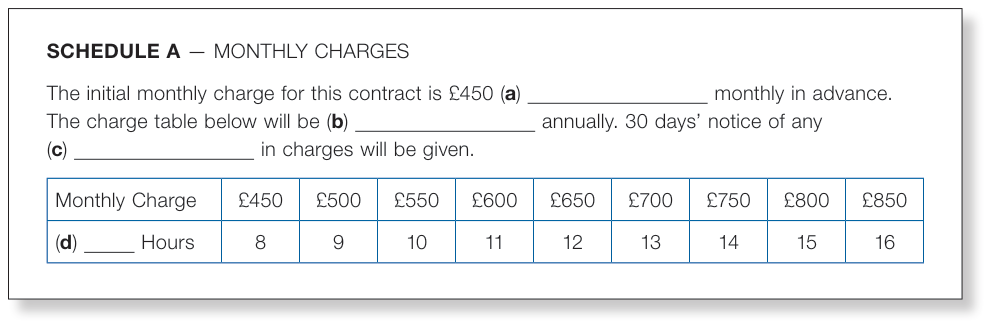
SCHEDULE A — MONTHLY CHARGES The initial monthly charge for this contract is £450 (a) monthly in advance. The charge table below will be (b) annually. 30 days’ notice of any (c) in charges will be given.
Monthly Charge £450 £500 £550 £600 £650 £700 £750 £800 £850
(d) Hours
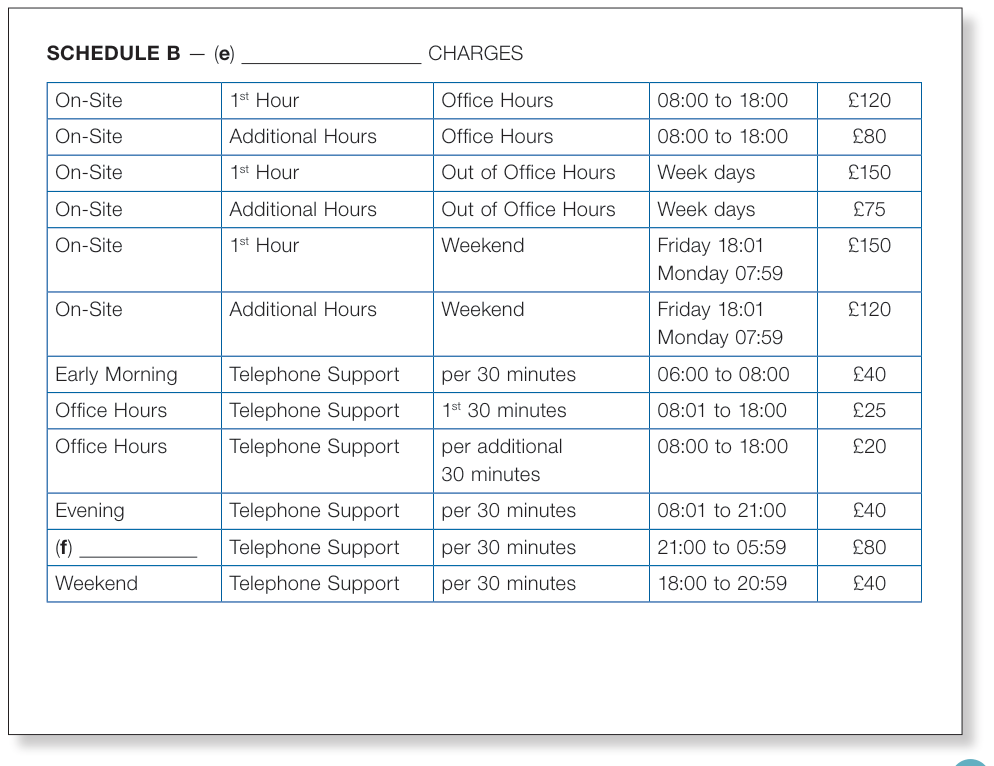
SCHEDULE B — (e) CHARGES On-Site 1st Hour Office Hours 08:00 to 18:00 £120 On-Site Additional Hours Office Hours 08:00 to 18:00 £80 On-Site 1st Hour Out of Office Hours Week days £150 On-Site Additional Hours Out of Office Hours Week days £75 On-Site 1st Hour Weekend Friday 18:01 Monday 07:59 £150 On-Site Additional Hours Weekend Friday 18:01 Monday 07:59 £120 Early Morning Telephone Support per 30 minutes 06:00 to 08:00 £40 Office Hours Telephone Support 1st 30 minutes 08:01 to 18:00 £25 Office Hours Telephone Support per additional 30 minutes 08:00 to 18:00 £20 Evening Telephone Support per 30 minutes 08:01 to 21:00 £40
(f) Telephone Support per 30 minutes 21:00 to 05:59 £80 Weekend Telephone Support per 30 minutes 18:00 to 20:59 £40 Collocation bank defective equipment or goods Preposition bank to do something by certain means ‘My house is heated by means of solar power.’ • to have/perform duties under an agreement/ contract ‘Under the terms of this agreement you are obliged to give 14 days’ notice of termination.’ • during/throughout the term of an agreement ‘During the Term of this agreement the Hirer will pay £450 per month.’ • to advise/enquire as to the reason for something ‘Can I enquire as to your reasons for starting litigation?’
to be on the premises ‘How many people work on the premises?’ • to be inclusive of something ‘Is this price inclusive of tax?’ • to do something in writing ‘Either party may terminate this contract by giving 14 days’ notice in writing.’ • the be the hirer of something ‘The Hirer of the equipment must pay a deposit.’ • pay for something in advance ‘I paid for the hotel conference room three months in advance.’
Here is another example of some key obligations from a contract. It is a contract between a company and a builder who is going to do some maintenance work on the company’s offices. Fill each gap in the clauses with the correct preposition from the blue box below.
1 COMMENCEMENT AND DURATION
| # | Phrase | Definition |
|---|---|---|
| (i) | The Builder shall commence the Building Work (a) | 25 April 20XX. |
(ii) The Builder shall complete the Building Work (b) 20 December 20XX at the very latest or suffer the late completion penalty stated in Schedule B hereto.
2 THE BUILDING WORK The Builder will carry out the Building Work specified in Schedule A hereto.
3 PRICE AND PAYMENT ARRANGEMENTS
(i) The Company shall pay the Builder the sum agreed in Schedule B hereto.
(ii) The Builder shall invoice the Company (c) the end (d) every quarterly period (e) the Date of Commencement. (f) no event shall any payment be made prior to the Date of Commencement.
(iii) The Company shall pay the Builder the amounts invoiced (g) 30 days of receipt of the Builder’s invoice.
Complete the following sentences with a word or words that you have seen in Exercises 1-9.
a During the of this agreement the Customer shall pay £500 per month to the Company.
b The building specifications for the Work are listed in A hereto.
c In of the sum stated in clause 8 below the Hirer is hereby authorised to use the Premises between 8pm and 1am.
d I am returning the goods to you because none of them work properly. Every computer that you provided is .
e Please the sum of £300 at least seven days prior to the execution of this agreement. The sum is returnable if there is no damage to the premises at the end of the agreement.
Speaking & Writing for this topic
Two short tasks scored against TOEFL rubrics. The prompt is generated for this topic — use the vocabulary you have just studied.
Suggested structureclick to expand
- In my experience…
- From what I have seen…
- My honest view is that…
- The principal reason is that…
- This matters because…
- What makes payable decisive here is…
- For instance, when I…
- A clear example is…
- Consider the case where reviewed was involved…
- On the other hand,…
- Furthermore,…
- That said, one should not forget that…
- Overall, this shows that…
- The lesson, then, is…
- For these reasons, I believe…
- Aim for 4–5 keywords woven naturally into your answer.
- Use at least two linking phrases (Furthermore, On the other hand, As a result…).
- Avoid filler words like "basically" or "like".
Suggested structureclick to expand
- The most important point in Additional is …
- My position is that …
- The principal reason is that payable …
- This is supported by …
- A concrete illustration is …
- For instance, …
- However, some argue that …
- On the other hand, …
- In conclusion, …
- Taken together, …
- Aim for 4–5 keywords used in natural context.
- Use 3+ linking words across the answer.
- Vary sentence length to avoid monotony.
DELIVERY OF GOODS OR SERVICES ~31 min
You need to know about...
The agreed date of delivery of the goods or services in the contract is important for several reasons. These reasons include:
• the date sets a deadline for performance of contractual obligations. If one of the parties does not keep to the agreed date he or she will be in breach of contract • the date sometimes decides when the legal ownership of goods passes from the seller to the buyer • the date of delivery of the goods or services sometimes decides when the seller/supplier gets paid.
The delivery clause includes:
• When the goods or services will be delivered • When they will be supplied (if it is necessary to state it)
and perhaps
• What will happen if the delivery clause is breached for any reason.
To make sure that the other party knows that the date/time of delivery is extremely important many business and commercial contracts contain a phrase like this:
‘Time of delivery shall be of the essence in this agreement.’
If something is ‘of the essence’ it is of the greatest importance.
Here is a clause dealing with delivery. There are some words missing from the clause. Fill each gap in the clause with the correct word from the four choices on the next page.
The (*) agree that all dates (a) in this Agreement regarding delivery, completion and payment are a (b) part of the Agreement. Failure by either party to (c) with the dates shall amount to a fundamental breach of this Agreement. In the (d) that either party agrees to a later date this will not entitle the defaulting party to consider that any subsequent date may also be delayed and such dates will remain of the (e) in this Agreement.
| # | Phrase | Definition |
|---|---|---|
| (*) | A parts B traders | C parties D people |
| (1) | A said B made | C specified D written |
| (2) | A significant B principal | C material D huge |
| (3) | A comply B obey | C fulfil D meet |
| (4) | A case B situation | C event D occasion |
| (5) | A importance B key | C essence D meaning |
Here is another clause dealing with delivery. It is from a shipping contract to transport goods from Ireland to England. Read the clause carefully and answer the questions that follow using a full sentence. One of the terms used in the clause is explained below to help you.
5. The carriage and transport of the Goods specified in Schedule 1 to this Agreement shall be free on board which shall mean that all costs of any nature whatsoever incurred in placing the Goods upon the Queen Of The Liffey shall be borne by the Seller. The Seller acknowledges that it will be liable for any and all export duty. Until such time as the Goods are loaded on board all property rights, risks and liabilities shall remain with the Seller.
• free on board is a term known as an ‘Incoterm’. An Incoterm is a term used in international trade contracts and its meaning is internationally agreed. The term ‘free on board’ is only used in contracts for shipping. It means that the seller of the goods is liable for them until the moment the goods pass over the rail of the ship when they are being loaded. From the moment the goods pass over the rail they become the buyer’s liability.
a Where in the contract will I find the list of goods that are being sold under this agreement?
b What is the name of the ship that is carrying the goods from Ireland to England?
c Who is responsible for the cost of transporting the goods from the factory where they are made to the ship?
d Who is liable for any taxes that must be paid when the goods leave Ireland?
e If the goods are dropped and some are broken when they are being removed from a lorry to be loaded onto the ship who will suffer the loss?
f If goods are dropped and some are broken a few moments after they are loaded onto the ship who will suffer the loss?
This clause also deals with delivery. However, it does not use the term ‘free on board’. Fill each gap in the clause with the correct word from the blue box below.
| # | Phrase | Definition |
|---|---|---|
| (i) | The (a) shall only accept (b) listed in the delivery note and/or damage to the Goods caused in transit provided that written (c) is provided to the Seller within 7 days of (d) Goods by the Customer. | for non-delivery of any item of the |
(ii) The Seller shall at its sole (e) optionrepair or replace the Goods lost or damaged prior to (f) deliveryto the Customer.
Here is another clause dealing with delivery. Fill each gap in the clause with the correct preposition from the blue box below.
The delivery date provided (a) bythe Seller is (b) forguidance only and is subject to final confirmation by the Seller. Delivery times and/or dates shall not be (c) ofthe essence of the Agreement. The Seller shall not be liable for any loss or damage (d) tothe Buyer arising (e) fromlate delivery or failure to deliver. The Buyer shall notify the Seller in writing (f) within14 days of delivery of any claim in respect of deficit or damage in respect of the Goods that form the delivery.
Here is another clause dealing with delivery. Fill each gap in the clause with a phrase from the blue box.
| # | Phrase | Definition |
|---|---|---|
| 1. | The Company shall (a) of transit including shipping costs, import/export duties, storage, customs duties, security checks and any other cost (b) with the laws of any country. | compliance |
2. (c) In the event thatthe Company fails to deliver the Goods in accordance with the terms of this Agreement the Customer shall have the right to terminate this Agreement forthwith in writing and no further obligations shall (d) be binding uponthe Customer. In the event that this Agreement is terminated on the grounds of non-delivery the Company shall be liable to the Customer for all direct loss (e) incurred by the Customeras a result.
3. The Company will replace free of charge any Goods proved to the satisfaction of the Company to have been damaged in transit provided that the Customer provides notification in writing of any such damage within (f) 48 hours of receiptof the Goods.
Complete the following sentences with a word that you have seen in Exercises 1-5.
a Any costs incurred in the transport of the Goods will beborneby the Seller.
b The Seller acknowledges that it will beliablefor any and all export duty.
c The Seller shall at its soleoptionrepair or replace Goods lost or damaged prior to delivery to the Customer.
d The carriage and transport of the Goods by ship shall be free onboard.
e The Seller shall replace free of charge any Goods damaged intransitprovided that the Customer provides notification of any such damage in writing within three working days of receipt.
Collocation bank
regulations/rules • to load goods onto a ship/ plane/lorry Preposition bank
• failure by either party to do something ‘Failure by either party to comply with this clause will result in termination of the contract.’ • to agree to something ‘The parties agree to the following terms and conditions.’ • transport of goods ‘Transport of all Goods specified in Schedule A will be by rail.’ • the costs incurred in doing something ‘Any costs incurred in importing the Goods will be borne by the Customer.’ • to be liable for something ‘The Supplier will not be liable for any loss caused by late delivery of the Goods.’
to be on board a ship ‘The Goods will be transported on board The Pride of Norway.’ • damage caused to goods in transit ‘The Company will be liable for any damage caused to Goods in transit.’ • to be for guidance ‘This information does not form part of the contract but is for guidance only.’ • arising from an event ‘The Company will be liable for any direct loss arising from late delivery.’ • to do something within a certain time period ‘The Customer shall notify the Company of any damage to Goods within 48 hours of delivery.’
Speaking & Writing for this topic
Two short tasks scored against TOEFL rubrics. The prompt is generated for this topic — use the vocabulary you have just studied.
Suggested structureclick to expand
- In my experience…
- From what I have seen…
- My honest view is that…
- The principal reason is that…
- This matters because…
- What makes Seller decisive here is…
- For instance, when I…
- A clear example is…
- Consider the case where option was involved…
- On the other hand,…
- Furthermore,…
- That said, one should not forget that…
- Overall, this shows that…
- The lesson, then, is…
- For these reasons, I believe…
- Aim for 4–5 keywords woven naturally into your answer.
- Use at least two linking phrases (Furthermore, On the other hand, As a result…).
- Avoid filler words like "basically" or "like".
Suggested structureclick to expand
- The most important point in notice is …
- My position is that …
- The principal reason is that Seller …
- This is supported by …
- A concrete illustration is …
- For instance, …
- However, some argue that …
- On the other hand, …
- In conclusion, …
- Taken together, …
- Aim for 4–5 keywords used in natural context.
- Use 3+ linking words across the answer.
- Vary sentence length to avoid monotony.
USING YOUR KNOWLEDGE ~13 min
Collocation review Complete these sentences with a collocation that you have seen.
a The Owner agrees to supply Equipment to the Hirer subject to the terms and conditions in this Agreement.
b A commercial contract will usually provide one of the parties with an address at which any notices must be upon the other party.
c Each party should think very carefully before into a contract, as it will give rise to binding duties and obligations.
d Your client failed to his obligations under the contract, in that he did not do as he promised.
e The electrical goods that you provided to my client did not work properly. As the whole batch of goods was , my client returned them to you without delay.
f My boss has a very strict deadline to finish this work. He wants it on his desk by 5pm.
g Does this agreement with contract law in your country? Or is it contrary to the law in some way?
h In clause 11 of this contract your client expressly agrees to the cost of any duty that is required when the goods arrive in the USA.
i My client has significant costs in transporting the goods to you, which he did not agree to do in the contract. My client requests that you reimburse these costs immediately.
j We have been informed that when the goods were being onto the lorry at our factory, some of them were damaged. Please return these goods to us and we will replace them at once.
Vocabulary review Complete these sentences with a word that you have seen.
a The section of a contract provides the general background to the contract. Often each sentence in this section begins with the word ‘WHEREAS’.
b A is a person or company that sells goods directly to the public.
c You may see the word ‘ ’ in a very formal contract. It does not have the usual, dictionary definition. When used in a formal contract, this word means ‘employee’.
d An is someone that the other party to the contract, known as a ‘principal’, authorises to act on his or her behalf.
e The money, goods or services that the parties exchange under a contract is referred to in the contract by the term .
f When a written contract refers to the of the agreement it means the duration of the agreement.
g In contracts where one party is providing a service to the other, there is often a reference to the number of hours or days for which the service will last. This is a more formal way of referring to the total number.
h The verb to is a more formal word that means ‘to obtain’ or ‘to get’.
i If goods are described as being in it means that the goods are in the process of being moved from one place to another.
j When a contract uses the phrase ‘time is of the ’, it means that the time agreed for doing something under the contract is extremely important.
Preposition review Complete these sentences with the correct preposition.
a This Agreement is made this twentieth day of September 20XX.
b The Owner agrees to hire the Equipment to the Hirer subject the terms and conditions set out in the Agreement.
c Who are the parties this contract?
d Where the masculine is referred in this contract it shall include the feminine.
e I work a law firm that is based in London.
f What name does your company trade ?
g An agent acts behalf of his or her principal.
h Use of the Equipment is limited and may not be used 8pm and 9pm each evening for maintenance reasons.
i the terms of this Agreement the Hirer agrees to pay £600 per month to the Owner.
j The costs for the Work are specified Schedule 1 hereto.
Speaking & Writing for this topic
Two short tasks scored against TOEFL rubrics. The prompt is generated for this topic — use the vocabulary you have just studied.
Suggested structureclick to expand
- In my experience…
- From what I have seen…
- My honest view is that…
- The principal reason is that…
- This matters because…
- What makes using decisive here is…
- For instance, when I…
- A clear example is…
- Consider the case where your was involved…
- On the other hand,…
- Furthermore,…
- That said, one should not forget that…
- Overall, this shows that…
- The lesson, then, is…
- For these reasons, I believe…
- Aim for 4–5 keywords woven naturally into your answer.
- Use at least two linking phrases (Furthermore, On the other hand, As a result…).
- Avoid filler words like "basically" or "like".
Suggested structureclick to expand
- The most important point in this concept is …
- My position is that …
- The principal reason is that using …
- This is supported by …
- A concrete illustration is …
- For instance, …
- However, some argue that …
- On the other hand, …
- In conclusion, …
- Taken together, …
- Aim for 4–5 keywords used in natural context.
- Use 3+ linking words across the answer.
- Vary sentence length to avoid monotony.
HIGHER LEVEL PRACTICE ~3 min
Read the following contract clause. The missing words are in the list below. For each gap choose the word which best fits into the space from the options provided. Use each option only once. Write your answers in the box below. There is an example at the beginning (*).
Speaking & Writing for this topic
Two short tasks scored against TOEFL rubrics. The prompt is generated for this topic — use the vocabulary you have just studied.
Suggested structureclick to expand
- In my experience…
- From what I have seen…
- My honest view is that…
- The principal reason is that…
- This matters because…
- What makes higher decisive here is…
- For instance, when I…
- A clear example is…
- Consider the case where level was involved…
- On the other hand,…
- Furthermore,…
- That said, one should not forget that…
- Overall, this shows that…
- The lesson, then, is…
- For these reasons, I believe…
- Aim for 4–5 keywords woven naturally into your answer.
- Use at least two linking phrases (Furthermore, On the other hand, As a result…).
- Avoid filler words like "basically" or "like".
Suggested structureclick to expand
- The most important point in this concept is …
- My position is that …
- The principal reason is that higher …
- This is supported by …
- A concrete illustration is …
- For instance, …
- However, some argue that …
- On the other hand, …
- In conclusion, …
- Taken together, …
- Aim for 4–5 keywords used in natural context.
- Use 3+ linking words across the answer.
- Vary sentence length to avoid monotony.
FROM A CLAUSE DEALING WITH THE DELIVERY OF GOODS ~9 min
3.1 The Seller shall only accept (*) for non-delivery of any item listed on the delivery note and/or damage caused to Goods in (1) if the Customer provides written (2) of any such non-delivery and/or damage to the Seller within 7 days of (3) of the Goods.
3.2 In the event that the Seller accepts liability under clause 3.1 it shall at its sole option, repair or
(4) the Goods concerned which are proved to the Seller’s satisfaction to have been lost or damaged (5) to delivery to the Customer.
(AA) liability (B) transit (D) receipt (A) replace (C) prior (E) notice (*) AA (1) (2) (3) (4) (5)
Read the following contract clause. The missing prepositions are in the list below. For each gap choose the preposition which best fits into the space from the options provided. Use each option only once. Write your answers in the box below. There is an example at the beginning (*).
Speaking & Writing for this topic
Two short tasks scored against TOEFL rubrics. The prompt is generated for this topic — use the vocabulary you have just studied.
Suggested structureclick to expand
- In my experience…
- From what I have seen…
- My honest view is that…
- The principal reason is that…
- This matters because…
- What makes from decisive here is…
- For instance, when I…
- A clear example is…
- Consider the case where clause was involved…
- On the other hand,…
- Furthermore,…
- That said, one should not forget that…
- Overall, this shows that…
- The lesson, then, is…
- For these reasons, I believe…
- Aim for 4–5 keywords woven naturally into your answer.
- Use at least two linking phrases (Furthermore, On the other hand, As a result…).
- Avoid filler words like "basically" or "like".
Suggested structureclick to expand
- The most important point in goods is …
- My position is that …
- The principal reason is that from …
- This is supported by …
- A concrete illustration is …
- For instance, …
- However, some argue that …
- On the other hand, …
- In conclusion, …
- Taken together, …
- Aim for 4–5 keywords used in natural context.
- Use 3+ linking words across the answer.
- Vary sentence length to avoid monotony.
FROM A DEFINITIONS SECTION ~4 min
(*) this Agreement, the following terms and expressions shall have the following meanings:
‘the Company’ shall mean ARJ Computer Technology Ltd, which may from time to time act (1) an authorised Agent.
‘the Buyer’ shall mean the person, firm, company or other organisation who or which has agreed (2) purchase Equipment (3) the Company.
‘a Contract’ shall mean a contract (4) the sale and purchase of Equipment between the Company and the Buyer.
‘Equipment’ shall mean all items manufactured or supplied (5) the Company including without limitation, instruments, computers, printers, and accessories/spare parts.
(AA) In (B) through (D) to (A) by (C) from (E) for (*) AA (1) (2) (3) (4) (5)
Speaking & Writing for this topic
Two short tasks scored against TOEFL rubrics. The prompt is generated for this topic — use the vocabulary you have just studied.
Suggested structureclick to expand
- In my experience…
- From what I have seen…
- My honest view is that…
- The principal reason is that…
- This matters because…
- What makes from decisive here is…
- For instance, when I…
- A clear example is…
- Consider the case where definitions was involved…
- On the other hand,…
- Furthermore,…
- That said, one should not forget that…
- Overall, this shows that…
- The lesson, then, is…
- For these reasons, I believe…
- Aim for 4–5 keywords woven naturally into your answer.
- Use at least two linking phrases (Furthermore, On the other hand, As a result…).
- Avoid filler words like "basically" or "like".
Suggested structureclick to expand
- The most important point in this concept is …
- My position is that …
- The principal reason is that from …
- This is supported by …
- A concrete illustration is …
- For instance, …
- However, some argue that …
- On the other hand, …
- In conclusion, …
- Taken together, …
- Aim for 4–5 keywords used in natural context.
- Use 3+ linking words across the answer.
- Vary sentence length to avoid monotony.