
The Language of Company Law
PEOPLE CONNECTED WITH A COMPANY ~9 min
Look at this list of people. They are all connected with a company. Match each person in the list with the correct description below.
directors (1) accountant (5)
shareholders (2) employees (6)
company secretary (3) creditors (7)
auditor (4) debtors (8)
a All of the people who are employed by a company.
b The people or companies that a company owes money to.
c The owners of a company. They are also called the members of a company.
d A person who checks the financial records of a company to verify that the accounts are a true reflection of the company’s financial position.
e The people who run and manage a company.
f A person who deals with a company’s finances. This person usually has professional qualifications in accountancy.
g The people or companies who owe a company some money.
h The person who is responsible for making sure that a company’s statutory obligations are complied with.
Use the correct words from Exercise 1 to fill the gaps in the following text.
‘My name is Louise Nichols. I own 40% of the issued shares in Sanders & Nichols Ltd. The other (a) shareholdersare Dennis Sanders and Kit Neilson. As well as being members of the company, we are responsible for running the company, as we are the (b) directorsof the company. Kit Neilson has an additional responsibility as he is the (c) company secretary. He has to make sure that all the legal requirements in connection with filing documents at Companies House are complied with.
We have three (d) employeeswho work in our shop in Chatsworth. We use the services of an (e) accountantto keep our financial records up-to-date. We have regular meetings with her and each month we look at the list of people who haven’t paid our invoices. Of these (f) debtors, we look to see if there is a good reason why they haven’t paid us. If there is no reason, we contact them to ask them to pay us immediately. In the same way, we look at the people that we owe money to. These are our (g) creditors. We pay most of these, but if we have a query we will raise that with them. Once a year it is necessary for an (h) auditorto check the financial records and accounts of our company. This is an independent check, to make sure that our annual accounts show the true financial position of Sanders & Nichols Ltd.’
Speaking & Writing for this topic
Two short tasks scored against TOEFL rubrics. The prompt is generated for this topic — use the vocabulary you have just studied.
Suggested structureclick to expand
- In my experience…
- From what I have seen…
- My honest view is that…
- The principal reason is that…
- This matters because…
- What makes people decisive here is…
- For instance, when I…
- A clear example is…
- Consider the case where connected was involved…
- On the other hand,…
- Furthermore,…
- That said, one should not forget that…
- Overall, this shows that…
- The lesson, then, is…
- For these reasons, I believe…
- Aim for 4–5 keywords woven naturally into your answer.
- Use at least two linking phrases (Furthermore, On the other hand, As a result…).
- Avoid filler words like "basically" or "like".
Suggested structureclick to expand
- The most important point in this concept is …
- My position is that …
- The principal reason is that people …
- This is supported by …
- A concrete illustration is …
- For instance, …
- However, some argue that …
- On the other hand, …
- In conclusion, …
- Taken together, …
- Aim for 4–5 keywords used in natural context.
- Use 3+ linking words across the answer.
- Vary sentence length to avoid monotony.
WORKING IN COMPANY LAW ~22 min
Greg Harrison is a partner in the law firm Taylor Wallis. He works in the company and commercial department. Today Greg Harrison is speaking to a group of trainee lawyers and giving them his opinion about working as a solicitor in company law. Fill the gaps in the text with the words from the blue box below.
‘I have always wanted to work in the area of company law because it is so interesting and there is so much variety. You have to deal with non-contentious work, such as (a) incorporatinga new company, and contentious work, such as acting for a company which is in (b) disputewith its suppliers. We work closely with the other departments within the law firm. For example, if a company needs a service agreement for a new director, we will ask the (c) employmentdepartment for assistance. If the matter involves a company which is experiencing financial difficulties, we will ask for advice from one of our lawyers in the banking and (d) insolvencydepartment. If we are dealing with a situation where one company is taking over another company, then we will involve a tax lawyer.
I have been with this firm for 14 years and in that time I have dealt with many aspects of company law. These include:
• Dealing with company (e) formationsand restructuring a company • Drawing up and advising on shareholders’ agreements • Drafting directors’ service agreements • Advising on methods of (f) raisingfinance • Giving advice on complying with new legislation • Dealing with mergers and (g) acquisitions• Giving advice on voting procedures at meetings and drafting (h) resolutions• Advising on company insolvency procedures • Dealing with joint ventures.
So as you see, company law is a huge area of law, with many varied aspects. Some of the law regulating companies is (i) statutoryand some comes from the common law. In 2006 a new Act of Parliament was passed, called the Companies Act 2006. This new legislation affects existing and new companies and all company lawyers have a lot of work to do in becoming familiar with the legislation and advising their corporate clients on complying with it.’
In Exercise 1, Greg Harrison gave a list of different aspects of company law that he has dealt with during his 14 years at his law firm. Look at the following statements and match each statement with the correct aspect of company law mentioned by Greg.
Example statement: ‘A new statute has been passed which will fully come into force in 20XX. This will have a huge effect on company law and we must make sure that our clients are aware of the changes in the law and how it affects their company.’
Aspect of law: Giving advice on complying with new legislation.
a ‘If a company needs money, there are a number of ways the company can obtain it. However, it is important to consider both the short-term and long-term effects of each option and choose the one that best suits the purpose and needs of the company.’
Aspect of law:
b ‘You have instructed me in connection with the sale of your shares in Happy Times Ltd children’s nursery.
I need to see a copy of the contract that you signed, which deals with the arrangements between all the members of Happy Times Ltd.’
Aspect of law:
c ‘During the lifetime of a company, many decisions will be made and lots of formalities must be followed when taking those decisions.’
Aspect of law:
d ‘You would like to appoint Janice Longman as your new Financial Director and you have instructed me to draw up a document clearly setting out the terms and conditions of this appointment.’
Aspect of law:
e ‘Sadly, many companies do not succeed in trading profitably and they make substantial losses. Some of these companies have to close down, others may benefit from an experienced person taking control of the company. There are a number of ways to help a company which is in financial difficulties.’
Aspect of law:
f ‘I am often involved in situations where two companies are joining together or where one company wants to gain control of another company.’
Aspect of law:
g ‘At the moment I am working on a project which involves two independent companies working closely together on a particular project for a specified period of time.’
Aspect of law:
h ‘It is very important, when setting up a new company or changing the structure of an existing company, to think about the consequences, both in terms of finance and the balance of power between the shareholders.’
Aspect of law: Collocation bank
to be in dispute with someone ‘Our clients have been in dispute for a long time.’ • to advise on something ‘I am currently advising on the sale of a pub in Manchester.’ • in connection with something ‘Please call me in connection with the proposed transaction.’ • to succeed in doing something ‘Good news. We have succeeded in raising £500,000 for the project.’
to work on a project ‘Sally and Jacob are going to work on the NewStar project tomorrow.’ • to think about something ‘I’ll think about that and give you an answer on Tuesday.’ • to be familiar with something ‘I started work here two weeks ago and I’m just beginning to be familiar with the company’s computer system.’
Speaking & Writing for this topic
Two short tasks scored against TOEFL rubrics. The prompt is generated for this topic — use the vocabulary you have just studied.
Suggested structureclick to expand
- In my experience…
- From what I have seen…
- My honest view is that…
- The principal reason is that…
- This matters because…
- What makes statutory decisive here is…
- For instance, when I…
- A clear example is…
- Consider the case where raising was involved…
- On the other hand,…
- Furthermore,…
- That said, one should not forget that…
- Overall, this shows that…
- The lesson, then, is…
- For these reasons, I believe…
- Aim for 4–5 keywords woven naturally into your answer.
- Use at least two linking phrases (Furthermore, On the other hand, As a result…).
- Avoid filler words like "basically" or "like".
Suggested structureclick to expand
- The most important point in insolvency is …
- My position is that …
- The principal reason is that statutory …
- This is supported by …
- A concrete illustration is …
- For instance, …
- However, some argue that …
- On the other hand, …
- In conclusion, …
- Taken together, …
- Aim for 4–5 keywords used in natural context.
- Use 3+ linking words across the answer.
- Vary sentence length to avoid monotony.
DIRECTORS ~40 min
Greg Harrison, one of the partners of Taylor Wallis, is preparing a seminar on the role and duties of directors. Greg has written the following notes, which will be given to all clients who attend the seminar. Find the words in the notes that match each of the meanings given below.
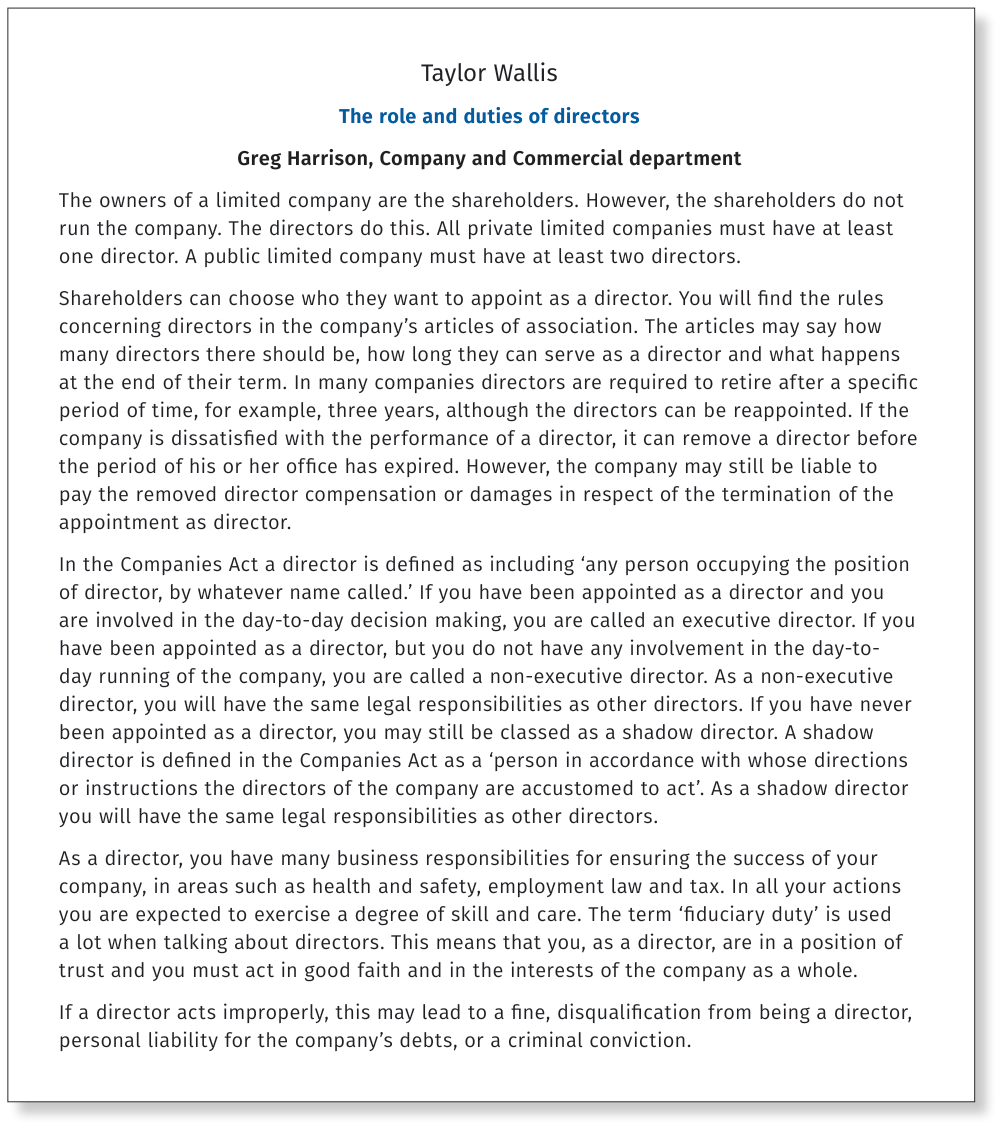
Taylor Wallis The role and duties of directors Greg Harrison, Company and Commercial department The owners of a limited company are the shareholders. However, the shareholders do not run the company. The directors do this. All private limited companies must have at least one director. A public limited company must have at least two directors.
Shareholders can choose who they want to appoint as a director. You will find the rules concerning directors in the company’s articles of association. The articles may say how many directors there should be, how long they can serve as a director and what happens at the end of their term. In many companies directors are required to retire after a specific period of time, for example, three years, although the directors can be reappointed. If the company is dissatisfied with the performance of a director, it can remove a director before the period of his or her office has expired. However, the company may still be liable to pay the removed director compensation or damages in respect of the termination of the appointment as director.
In the Companies Act a director is defined as including ‘any person occupying the position of director, by whatever name called.’ If you have been appointed as a director and you are involved in the day-to-day decision making, you are called an executive director. If you have been appointed as a director, but you do not have any involvement in the day-to- day running of the company, you are called a non-executive director. As a non-executive director, you will have the same legal responsibilities as other directors. If you have never been appointed as a director, you may still be classed as a shadow director. A shadow director is defined in the Companies Act as a ‘person in accordance with whose directions or instructions the directors of the company are accustomed to act’. As a shadow director you will have the same legal responsibilities as other directors.
As a director, you have many business responsibilities for ensuring the success of your company, in areas such as health and safety, employment law and tax. In all your actions you are expected to exercise a degree of skill and care. The term ‘fiduciary duty’ is used a lot when talking about directors. This means that you, as a director, are in a position of trust and you must act in good faith and in the interests of the company as a whole.
If a director acts improperly, this may lead to a fine, disqualification from being a director, personal liability for the company’s debts, or a criminal conviction.
a To formally choose someone for a particular job or position.
The word is
b To be in the position of a director and to perform the duties required by that position.
The word is
c To dismiss a director from his or her job or position.
The word is
d Regarded as belonging to a particular group.
The word is
e To have become used to something.
The word is
f To use, to put something into effect.
The word is
g Dishonestly or illegally.
The word is
h The state of being stopped from being in a particular job, or from taking part in a particular activity.
The word is
Greg has invited the participants at the seminar to ask any questions that they have. Read the notes in Exercise 1 again and answer the participants’ questions below using a full sentence.
a ‘We’re thinking about setting up a private limited company. How many directors must we have?’
Answer:
b ‘Our company is unhappy with one of our directors and we want to fire him. Will the company have to pay him any money?’
Answer:
c ‘My father is a director of a company. He doesn’t make decisions for the company, or have any say in the running of the company, but he does give advice. He’s more like a consultant, really. What sort of director is he, and does he have any legal responsibilities to the company?’
Answer:
d ‘I’ve got a friend called Fred. He isn’t officially a director of a company, but he tells the official directors what to do and basically he’s the person that runs the company. Is he a sort of director?’
Answer:
e ‘Can you please explain again what fiduciary duty means?’
Answer:
More of the participants have asked questions. Match the following questions with Greg’s advice in the blue box below.
d ‘I’m a director of Linx Ltd. I also own a lot of shares in Freshthought Ltd. The two companies have entered into a contract and as a result I expect to make quite a lot of money from Freshthought Ltd. Can I keep that money and not tell anyone?’
b ‘I’m the director of Marsh Ltd. I also own 76% of the shares in the company. Surely I can do what I want with regard to decision-making?’
a ‘We are the directors of Fixit Ltd. We want to keep our shareholders happy by declaring a large dividend. Is that always OK?’
c ‘I own three houses. I want to sell one of them to the company. Is that allowed?’
Greg’s advice ‘Well, even though you are the majority
e ‘I am currently negotiating a new director’s service agreement with the company. I would like the agreement to be for a fixed-term period of eight years. Is that OK?’
‘By law, you must declare any potential conflict of interest. You have to tell the other directors about your interest in the other company and you mustn’t vote on the deal. Also, you mustn’t use your position to make private profits in a way that means the company loses money. If you do, you may have to hand that profit over to the company.’ (4) ‘Yes, but remember that any director’s contract shareholder as well as a director, you have to give equal consideration to all of the company’s shareholders. You must consider the interests of the shareholders as a whole, including the minority shareholders.’ (1)
of employment with a term of two years or over has to be approved by the shareholders.’ (2)
‘Yes, a company is permitted to purchase property from a director of that company. However, substantial deals of that sort have to be approved by the shareholders.’ (3)
LISTENING
‘It isn’t always the best option, attractive though it may seem. You must remember that the company is a separate legal entity from its directors, shareholders and employees. What may be the best for the members, may not be the same as what is in the best interests of the company. Your action may lead to a cash shortage, which would conflict with the interests of the company.’ (5)
Listen to Greg Harrison. He is giving the second part of his seminar about directors. In this part of the seminar, Greg is outlining the duties of directors. Answer the following questions.
a Greg Harrison says that the role of a director developed from two sources. One was statute. What was the other source?
Answer:
b Why do directors have a fiduciary duty to the company?
Answer:
c In what year were the duties of a director codified?
Answer:
d Why did the new Companies Act include a statutory statement of directors’ duties?
Answer:
e How many duties for directors are specified in the new legislation?
Answer:
f According to section 172, what do the directors have a duty to promote?
Answer:
g What is the factor which decides how much skill and care that directors must exercise in carrying out their duties?
Answer:
h The fifth duty is contained in section 175. What must directors avoid?
Answer:
i In section 177, what must a director declare in relation to a proposed transaction?
Answer:
j What is the possible punishment for failing to comply with the duty contained in section 177?
Answer: Collocation bank
to have at least a particular number ‘A public limited company must have at least two directors.’ • to appoint someone as a director ‘They decided to appoint Bella Martin as the new director.’ • to be satisfied/dissatisfied with something ‘The shareholders were dissatisfied with the explanation given by the directors.’ • to be classed as something ‘Truepaint Ltd is classed as a medium-sized enterprise.’
to act in the interests of someone ‘We are acting in the interests of the company.’ • to lead to something ‘If you are late in filing your tax return, this may lead to a fine.’ • to be disqualified from something ‘He was disqualified from driving for two years.’ • to act in good faith ‘Directors must always act in good faith.’
Speaking & Writing for this topic
Two short tasks scored against TOEFL rubrics. The prompt is generated for this topic — use the vocabulary you have just studied.
Suggested structureclick to expand
- In my experience…
- From what I have seen…
- My honest view is that…
- The principal reason is that…
- This matters because…
- What makes to appoint a director decisive here is…
- For instance, when I…
- A clear example is…
- Consider the case where to remove a director was involved…
- On the other hand,…
- Furthermore,…
- That said, one should not forget that…
- Overall, this shows that…
- The lesson, then, is…
- For these reasons, I believe…
- Aim for 4–5 keywords woven naturally into your answer.
- Use at least two linking phrases (Furthermore, On the other hand, As a result…).
- Avoid filler words like "basically" or "like".
Suggested structureclick to expand
- The most important point in a conflict of interest is …
- My position is that …
- The principal reason is that to appoint a director …
- This is supported by …
- A concrete illustration is …
- For instance, …
- However, some argue that …
- On the other hand, …
- In conclusion, …
- Taken together, …
- Aim for 4–5 keywords used in natural context.
- Use 3+ linking words across the answer.
- Vary sentence length to avoid monotony.
COMPANY MEETINGS ~22 min
Ellson Garwood solicitors have written some briefing notes for their corporate clients. The notes deal with company meetings. The first page of the briefing notes appears below. Fill each of the gaps in the notes with the correct word from the list in the blue box.
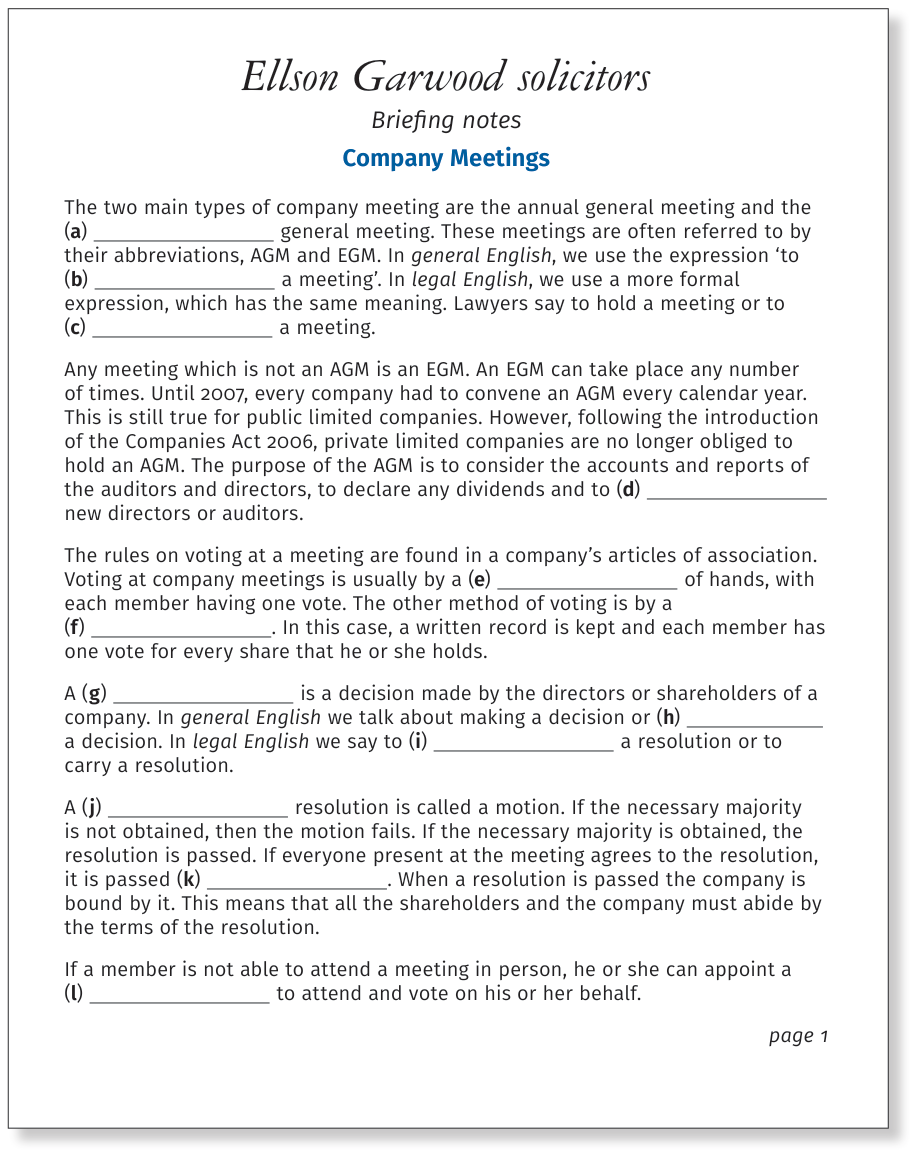
Briefing notes
Company Meetings
The two main types of company meeting are the annual general meeting and the (a) extraordinarygeneral meeting. These meetings are often referred to by their abbreviations, AGM and EGM. In general English, we use the expression ‘to (b) havea meeting’. In legal English, we use a more formal expression, which has the same meaning. Lawyers say to hold a meeting or to (c) convenea meeting.
Any meeting which is not an AGM is an EGM. An EGM can take place any number of times. Until 2007, every company had to convene an AGM every calendar year. This is still true for public limited companies. However, following the introduction of the Companies Act 2006, private limited companies are no longer obliged to hold an AGM. The purpose of the AGM is to consider the accounts and reports of the auditors and directors, to declare any dividends and to (d) electnew directors or auditors.
The rules on voting at a meeting are found in a company’s articles of association. Voting at company meetings is usually by a (e) showof hands, with each member having one vote. The other method of voting is by a (f) poll. In this case, a written record is kept and each member has one vote for every share that he or she holds.
A (g) resolutionis a decision made by the directors or shareholders of a company. In general English we talk about making a decision or (h) takinga decision. In legal English we say to (i) passa resolution or to carry a resolution.
A (j) proposedresolution is called a motion. If the necessary majority is not obtained, then the motion fails. If the necessary majority is obtained, the resolution is passed. If everyone present at the meeting agrees to the resolution, it is passed (k) unanimously. When a resolution is passed the company is bound by it. This means that all the shareholders and the company must abide by the terms of the resolution.
If a member is not able to attend a meeting in person, he or she can appoint a (l) proxyto attend and vote on his or her behalf.
page 1
Here is the second page of the briefing notes about meetings. Read the information and decide if the statements that follow are true or false.
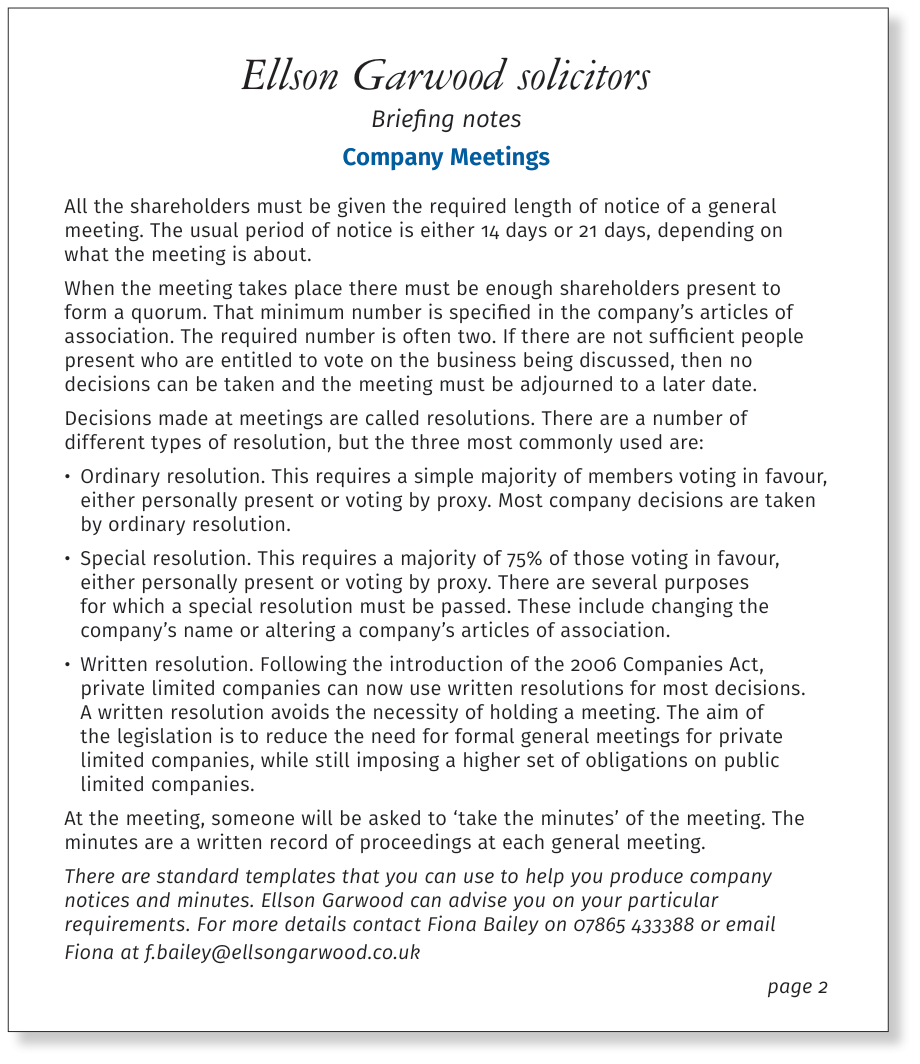
Briefing notes
Company Meetings
All the shareholders must be given the required length of notice of a general meeting. The usual period of notice is either 14 days or 21 days, depending on what the meeting is about.
When the meeting takes place there must be enough shareholders present to form a quorum. That minimum number is specified in the company’s articles of association. The required number is often two. If there are not sufficient people present who are entitled to vote on the business being discussed, then no decisions can be taken and the meeting must be adjourned to a later date.
Decisions made at meetings are called resolutions. There are a number of different types of resolution, but the three most commonly used are:
• Ordinary resolution. This requires a simple majority of members voting in favour, either personally present or voting by proxy. Most company decisions are taken by ordinary resolution.
• Special resolution. This requires a majority of 75% of those voting in favour, either personally present or voting by proxy. There are several purposes for which a special resolution must be passed. These include changing the company’s name or altering a company’s articles of association.
• Written resolution. Following the introduction of the 2006 Companies Act, private limited companies can now use written resolutions for most decisions. A written resolution avoids the necessity of holding a meeting. The aim of the legislation is to reduce the need for formal general meetings for private limited companies, while still imposing a higher set of obligations on public limited companies.
At the meeting, someone will be asked to ‘take the minutes’ of the meeting. The minutes are a written record of proceedings at each general meeting.
There are standard templates that you can use to help you produce company notices and minutes. Ellson Garwood can advise you on your particular requirements. For more details contact Fiona Bailey on 07865 433388 or email Fiona at f.bailey@ellsongarwood.co.uk page 2
a The notice period for a company meeting is always at least 21 days.
b The minimum number of members who must be at the meeting so that the meeting can take place is always two.
c If there is no quorum, the meeting has to be postponed.
d There are just three types of resolution.
e An ordinary resolution requires over 50% of people who are voting to vote in favour of the resolution.
f The new companies legislation in the UK tries to reduce the necessity of holding meetings for private limited companies.
g The minutes of the meeting explain how long the meeting lasted.
Booktell Ltd is a private limited company that distributes educational books around the world. The shareholders of Booktell Ltd have each received this notice of the company’s annual general meeting. Fill the gaps in the notice with the correct word from the box below.
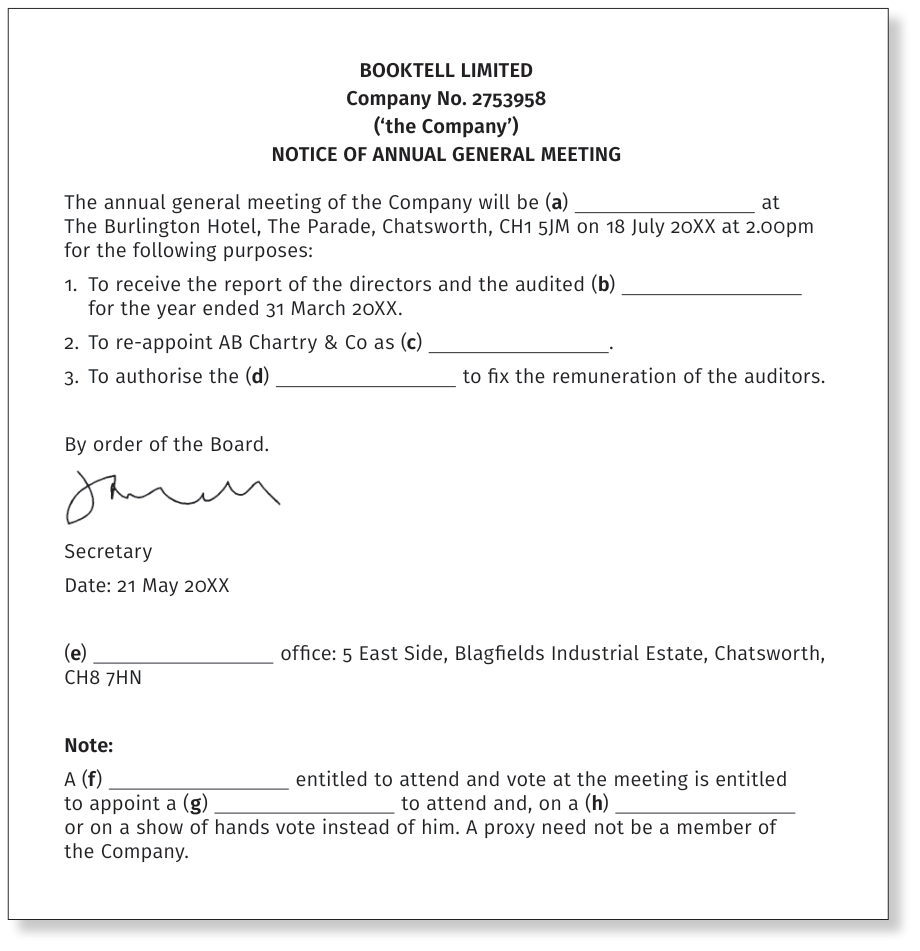
BOOKTELL LIMITED Company No. 2753958 (‘the Company’) NOTICE OF ANNUAL GENERAL MEETING The annual general meeting of the Company will be (a) heldat The Burlington Hotel, The Parade, Chatsworth, CH1 5JM on 18 July 20XX at 2.00pm for the following purposes:
1. To receive the report of the directors and the audited (b) accountsfor the year ended 31 March 20XX.
2. To re-appoint AB Chartry & Co as (c) auditors.
3. To authorise the (d) directorsto fix the remuneration of the auditors.
By order of the Board.
Secretary Date: 21 May 20XX
(e) Registeredoffice: 5 East Side, Blagfields Industrial Estate, Chatsworth, CH8 7HN Note:
A (f) memberentitled to attend and vote at the meeting is entitled to appoint a (g) proxyto attend and, on a (h) pollor on a show of hands vote instead of him. A proxy need not be a member of the Company.
Collocation bank
to have a meeting with someone ‘We need to have a meeting with our accountant soon.’ • the rules on/about something ‘You must comply with the rules on voting at company meetings.’ • a show of hands ‘We’ll vote on this motion by a show of hands.’ • to attend in person ‘I’m afraid I can’t attend the meeting in person as I will be in Canada.’
Speaking & Writing for this topic
Two short tasks scored against TOEFL rubrics. The prompt is generated for this topic — use the vocabulary you have just studied.
Suggested structureclick to expand
- In my experience…
- From what I have seen…
- My honest view is that…
- The principal reason is that…
- This matters because…
- What makes pass decisive here is…
- For instance, when I…
- A clear example is…
- Consider the case where extraordinary was involved…
- On the other hand,…
- Furthermore,…
- That said, one should not forget that…
- Overall, this shows that…
- The lesson, then, is…
- For these reasons, I believe…
- Aim for 4–5 keywords woven naturally into your answer.
- Use at least two linking phrases (Furthermore, On the other hand, As a result…).
- Avoid filler words like "basically" or "like".
Suggested structureclick to expand
- The most important point in proxy is …
- My position is that …
- The principal reason is that pass …
- This is supported by …
- A concrete illustration is …
- For instance, …
- However, some argue that …
- On the other hand, …
- In conclusion, …
- Taken together, …
- Aim for 4–5 keywords used in natural context.
- Use 3+ linking words across the answer.
- Vary sentence length to avoid monotony.
INSOLVENCY ~21 min
‘I can’t attend the meeting so I’ll vote by proxy.’ • to give notice of something ‘The members were given notice of the EGM.’ • to vote in favour of something ‘Would all those people voting in favour of the motion please raise their hands?’ • to take the minutes of a meeting ‘Harry, please will you take the minutes of this meeting?’
On the next two pages you can see some notices which have been published in a newspaper. These notices refer to a number of companies that are in financial difficulties. In the box below are some words that are used in the notices. Match each of the words in the box with the correct meaning provided below.
preventLiquidator (1)collectAdministration Order (4)sellOfficial Receiver (7)
sellMembers’ voluntary liquidation (2)preventAdministrator (5)collect Compulsory liquidation (8)
collectReceiver (3)prevent Winding-up Order (6)
a This is when the shareholders of a company decide to close the company and there are enough assets to pay all the debts of the company.
b This is when the shareholders of a company decide that they must close the company, because there are not enough assets to pay all the debts of the company.
c This is an order made by a court for a company to be closed.
d This is an order made by a court that gives a company some time to try to resolve its financial difficulties or sell its assets in order to pay its creditors.
e This is a person who supervises companies which are in administration. This person has passed special examinations to become an authorised insolvency practitioner.
f This is a person who supervises the closing of a company which is in liquidation.
g This is a person who is appointed by a creditor of a company to take control of that company in order to sell its assets and pay the money it owes to that creditor.
h This person is a government official who is appointed to close a company which is in financial difficulties.
Find a word in the notices that matches each of the following meanings.
a The type or category of something.
The word is
b An abbreviation that means ‘insolvency practitioner’.
The word is
c An abbreviation that means ‘number’.
The word is
d An abbreviation that means ‘care of’.
The word is Appointment of Liquidators Company Number: 099974622.
Name of Company: LANCO LIMITED.
Nature of Business: Manufacture of food products.
Type of Liquidation: Members’ voluntary liquidation.
Address of Registered Office: Fine House, Sharpes Road, Linchester LN32 7BA.
Appointment of Receivers Company Number: 085743.
Name of Company: BARTSON LIMITED.
Nature of Business: Manufacture of paper products.
Address of Registered Office: Unit 3, Frosham Industrial Estate, Chatsworth, CH5 4KM.
Administration Orders In the High Court of Justice No 1221 of 20XX MODEL RAIL LIMITED (Company Number 888564732)
Registered Office: Hanover Hall, 6 Reginald Street, Oxton, Hapshire OX1 6QD.
Nature of Business: Educational Toys.
e A formal application made to a court to request a specific legal action. Here, the action asked for is to put a company into liquidation.
The word is
f An old-fashioned word that means the things that belong to someone.
The word is
g A formal phrasal verb that means to give to someone.
The word is Liquidators’ Names and Addresses: Nigel Orm, 1 Station Road, Linchester, LN3 7VX and Alistair Dean, 3 Prince Street, Linchester, LN1 4FP. Office Holder Numbers: 97983 and 97291.
Date of Appointment: 2 August 20XX.
By whom Appointed: Members.
Receivers’ Names and Addresses: Helen Woods and Simon Allen of Jackson LLP, 4 Arcade House, Chatsworth, CH1 9DV. IP Numbers: 97983 and 97291.
Date of Appointment: 2 August 20XX.
By whom Appointed: Royal Chatsworth Bank.
Administration Order made: 29 July 20XX.
P B Norris (Office Holder No 87699), Taylor Wallis, Newater Street, London EC5 9HN, and SJ Pederson (Office Holder No 36528), 21 Footgate Park, London EC9 6PP, Joint Administrators.
Appointment of Administrators In the High Court of Justice (Chancery Division)
Chatsworth District Registry No 111 of 20XX Comp Professional Limited (Company Number 2727164)
Registered Office of Company: c/o Hedgsons LLP, 1 High Street, Chatsworth, CH1 6GT.
Winding-up Orders Name of Company: Yeloo Services Ltd. Company Number - 1827540385.
Address of Registered Office - 4 Gover Way, Ellerton, EL8 6EJ.
Court - High Court Of Justice.
Notice to Creditors Treeland Property Services Limited (in Compulsory Liquidation)
In accordance with Rule 4.106, I, Kim Watts, of Hedgsons LLP, 1 High Street, Chatsworth, CH1 6GT, give notice that I was appointed Liquidator of the Company on 23 July 20XX. All persons having in their possession any of the effects or Nature of Business: Computer Related Activities.
Date of Appointment: 7 August 20XX.
Joint Administrators’ Names and Address: Kim Watts and Keith Price (IP Nos 6103P and 7583H), both of Hedgsons LLP, 1 High Street, Chatsworth, CH1 6GT.
9 August 20XX.
Date of Filing Petition - 18 May 20XX. No. of Matter - 0003958 of 20XX.
Date of Winding-up Order - 25 July 20XX.
Official Receiver - 4th Floor, Tower House, 4 The Parade, Oxton, Hapshire OX6 7RX.
assets of the Company must deliver them up to me and all debts due to the Company must be paid to me. Creditors who have not yet proved their debts must do so by 10 August. K Watts, Liquidator.
3 August 20XX.
Read the notices again and decide if the following statements are true or false.
a Lanco Ltd is insolvent.
b The Royal Chatsworth Bank is a creditor of Bartson Ltd.
c Two people have been appointed to supervise Model Rail Ltd.
d The petition to wind up Yeloo Services Ltd was presented on 25 July 20XX.
e Anyone who thinks that Treeland Property Services Ltd owes money to them must inform Kim Watts.
In or into. It is sometimes difficult to know which of these prepositions to use when you are talking about liquidation or administration. To help you to decide, we usually use ‘in’ to describe the state of the company which is in liquidation or administration and ‘into’ to describe the procedure of putting the company into liquidation.
Complete the following sentences with in or into.
a I am writing in connection with Groves Ltd, which isinadministration.
b I am writing to notify you that Justex plc has been placedintoadministration.
c It was announced yesterday that Beans Ltd has goneintoliquidation.
d I am acting for the creditors of a company called Larkson Ltd, which isinreceivership.
e Sound Music Ltd wentintocompulsory liquidation last year following a series of bad decisions taken by the directors.
f The members of Highfold Ltd have decided to put the companyinto WHO GETS THE ASSETS?liquidation.
Speaking & Writing for this topic
Two short tasks scored against TOEFL rubrics. The prompt is generated for this topic — use the vocabulary you have just studied.
Suggested structureclick to expand
- In my experience…
- From what I have seen…
- My honest view is that…
- The principal reason is that…
- This matters because…
- What makes to form a quorum decisive here is…
- For instance, when I…
- A clear example is…
- Consider the case where a simple majority was involved…
- On the other hand,…
- Furthermore,…
- That said, one should not forget that…
- Overall, this shows that…
- The lesson, then, is…
- For these reasons, I believe…
- Aim for 4–5 keywords woven naturally into your answer.
- Use at least two linking phrases (Furthermore, On the other hand, As a result…).
- Avoid filler words like "basically" or "like".
Suggested structureclick to expand
- The most important point in this concept is …
- My position is that …
- The principal reason is that to form a quorum …
- This is supported by …
- A concrete illustration is …
- For instance, …
- However, some argue that …
- On the other hand, …
- In conclusion, …
- Taken together, …
- Aim for 4–5 keywords used in natural context.
- Use 3+ linking words across the answer.
- Vary sentence length to avoid monotony.
WHO GETS THE ASSETS? ~21 min
Read the following summary of the liquidation process. Fill each of the gaps in the text with the correct word from the box below.
The effect of the liquidation of a company is to (a) that company from trading as a commercial entity. The liquidator has to (b) all the company’s assets and then (c) them. The aim is to (d) as much money as possible. This process is called realisation of the assets. The proceeds of the sale of the assets are then used to (e) as many people as possible who are entitled to this money. It is often the case that not everyone will get the money that they are owed. The liquidator pays people in a particular order of priority.
This order of priority is:
• the costs of winding-up (including the liquidator’s own fees and expenses) • creditors with fixed charges • preferential creditors (for example, wages and salaries owed to employees, and money due to the government in respect of tax) • other secured creditors • unsecured creditors • interest on debts • shareholders When the winding-up is complete, the company is dissolved and it does not (f) any longer as a legal entity.
Here is the liquidator’s list of people or costs that the liquidator must pay. Match each category of people or costs with the correct definition in the blue box below.
a The costs of winding-up
e Unsecured creditors
b Creditors with fixed charges
f Interest on debts
c Preferential creditors
g Shareholders
d Other secured creditors These are the people who own the company. (1)
These are people or other companies who the These are people or other companies who the company which is in liquidation owes money to. However, these people or companies did not take any security from the company which is in liquidation to guarantee payment of the money. (5)
company which is in liquidation owes money to, usually because the company borrowed money from them. These people or companies took security (for example, a mortgage) from the company which is in liquidation to guarantee repayment of the loan. This security was secured against the fixed assets owned by the company, for example real estate or machinery. (2)
This is the amount of money that you have to These include people who are owed money by the company which is in liquidation and who are considered to have priority over other creditors, even though they have no security to guarantee payment. It includes money due to the government in respect of tax, and wages owed to employees. (6)
pay as a fee or a sort of penalty for money that you owe to someone. It is usually expressed as a percentage. (3)
This includes the liquidator’s fees and expenses as well as any legal costs. (4)
Collocation bank to go into liquidation/ These are people or other companies who the company which is in liquidation owes money to. These people or companies took some sort of security from the company which is in liquidation to guarantee payment of the money. However, the security was not secured against the fixed assets owned by the company. (7)
to put/place a company receivership /administration • to be in liquidation/
into liquidation/receivership/ administration • to present a petition receivership/administration Preposition bank
• to go into liquidation/receivership/administration ‘Have you heard? Lextext Ltd has gone into administration.’ • the proceeds of sale ‘What are you going to do with the proceeds of the sale of your house?’
creditors • to dissolve a company
• to be in liquidation/receivership/administration ‘I regret to inform you that Vantage Ltd is now in liquidation.’
Speaking & Writing for this topic
Two short tasks scored against TOEFL rubrics. The prompt is generated for this topic — use the vocabulary you have just studied.
Suggested structureclick to expand
- In my experience…
- From what I have seen…
- My honest view is that…
- The principal reason is that…
- This matters because…
- What makes exist decisive here is…
- For instance, when I…
- A clear example is…
- Consider the case where raise was involved…
- On the other hand,…
- Furthermore,…
- That said, one should not forget that…
- Overall, this shows that…
- The lesson, then, is…
- For these reasons, I believe…
- Aim for 4–5 keywords woven naturally into your answer.
- Use at least two linking phrases (Furthermore, On the other hand, As a result…).
- Avoid filler words like "basically" or "like".
Suggested structureclick to expand
- The most important point in collect is …
- My position is that …
- The principal reason is that exist …
- This is supported by …
- A concrete illustration is …
- For instance, …
- However, some argue that …
- On the other hand, …
- In conclusion, …
- Taken together, …
- Aim for 4–5 keywords used in natural context.
- Use 3+ linking words across the answer.
- Vary sentence length to avoid monotony.
USING YOUR KNOWLEDGE ~11 min
Collocation review Complete these sentences with a collocation that you have seen.
a We are a meeting, which will be held on 5 October.
b At the company meeting the members a resolution to change the name of the company to Jedexpress Ltd.
c We need to look at ways of finance, as we need more money if we want to go ahead with this project.
d The creditors presented a requesting that the company be wound up.
e The chairperson asked me to the minutes of the meeting.
f The shareholders no longer want Mr Fox as a director of the company. They think that Mr Fox is not performing his duties properly. They will discuss the motion to this director at the meeting next week.
g I am unable to attend the meeting next week, so I have a proxy to go to the meeting and vote on my behalf.
h I am sorry but we will have to this meeting to Monday of next week.
i Kingsford Electronics Ltd was into administration last week.
j The Official Receiver is the liquidator and he is in charge of the assets of the company. That means he must sell the assets and use the money from the sale to pay the creditors.
Vocabulary review Complete these sentences with a word that you have seen.
a A proposal which is being discussed at a meeting is called a .
b The of a meeting provide the details of what happened at that meeting.
c The of sale of something means the money that you get when you sell that thing.
d Can the meeting go ahead? How many people are here? Do we have a present?
e The are coming next week to check the financial records of the company. You will need to be here in case they have any questions.
f One of the methods of voting at a company is by way of a written vote. This is called a .
g This person has not been appointed as a director. However, he is the person who tells everyone what to do.
He is known as a director.
h A situation in which two companies decide to join together permanently is a .
i A formal word for the purchase of a company is an . Informally, people often refer to it as a takeover.
j Directors who are closely involved in the day-to-day decision-making of a company are known as directors.
Preposition review Complete these sentences with the correct preposition.
a After six years of trading, Baxters Ltd went liquidation.
b Caroline Thomson has been disqualified being a director of any company for five years.
c We need least five shareholders to attend the meeting in order to form a quorum.
d I can’t attend the meeting person, so I will vote by proxy.
e I am a lawyer in the corporate department. At the moment I am advising a new joint venture project.
f We will need to arrange a meeting a tax specialist soon.
g Directors have a duty to act the best interests of the company.
h How many people are favour of this deal?
i Well done everyone. Our client will be extremely satisfied the outcome of the negotiation.
j This action may lead a claim being made by our suppliers.
Speaking & Writing for this topic
Two short tasks scored against TOEFL rubrics. The prompt is generated for this topic — use the vocabulary you have just studied.
Suggested structureclick to expand
- In my experience…
- From what I have seen…
- My honest view is that…
- The principal reason is that…
- This matters because…
- What makes using decisive here is…
- For instance, when I…
- A clear example is…
- Consider the case where your was involved…
- On the other hand,…
- Furthermore,…
- That said, one should not forget that…
- Overall, this shows that…
- The lesson, then, is…
- For these reasons, I believe…
- Aim for 4–5 keywords woven naturally into your answer.
- Use at least two linking phrases (Furthermore, On the other hand, As a result…).
- Avoid filler words like "basically" or "like".
Suggested structureclick to expand
- The most important point in this concept is …
- My position is that …
- The principal reason is that using …
- This is supported by …
- A concrete illustration is …
- For instance, …
- However, some argue that …
- On the other hand, …
- In conclusion, …
- Taken together, …
- Aim for 4–5 keywords used in natural context.
- Use 3+ linking words across the answer.
- Vary sentence length to avoid monotony.
HIGHER LEVEL PRACTICE ~28 min
There is a word or phrase missing from the following sentences. For each sentence circle the word which best fits into the space from the options provided below. There is an example at the beginning (*).
Example: Each year, our company’s financial records are checked by an independent accountant called an (*) .
1 Directors have to act in the best interests of the company as a whole. This is known as their
(1) duty.
2 At the extraordinary general meeting last week, the shareholders (2) a resolution to change the company’s name.
3 There was no quorum present, so the meeting was (3) . It will take place on 14 October.
4 Following his failure to submit the company’s annual return to Companies House or respond to any letters, he was finally (4) from being a director for two years.
5 The directors and shareholders agreed that the company was making huge losses and they had no other choice but to put the company into (5) .
6 The shareholders voted to (6) William Ashby as a new company director for a fixed term of five years.
7 Jane Abbots formally declared that she had a personal interest in the transaction that was being discussed, which may (7) with the interests of the company. She did not vote on that transaction.
8 An (8) director is actively involved with the day-to-day decision making of the company.
9 There is a lot of work in the mergers and (9) department at the moment. I am currently acting for a corporate client which is buying all the shares in another company.
10 After payment of the secured creditors, the liquidator must pay the (10) creditors, for example any tax owed to the government.
| # | Phrase | Definition |
|---|---|---|
| (*) | A examiner B assessor | C auditor D inspector |
| (1) | A goodwill B fiduciary | C loyalty D good faith |
| (2) | A voted B decided | C passed D agreed |
| (3) | A delayed B suspended | C stopped D adjourned |
| (4) | A disqualified B stopped | C prevented D unauthorised |
| (5) | A liquidation B winding up | C ruin D insolvency |
| (6) | A select B hire | C employ D appoint |
| (7) | A dispute B conflict | C clash D contradict |
| (8) | A managing B exclusive | C executive D non-executive |
| (9) | A acquisitions B takeovers | C purchases D companies |
(10) A special B preferred C guaranteed D preferential
Read the following minutes of a meeting of a company. The missing words are in the list below. For each gap choose the word which best fits into the space from the options provided. Use each option only once. Write your answers in the box below. There is an example at the beginning (*).
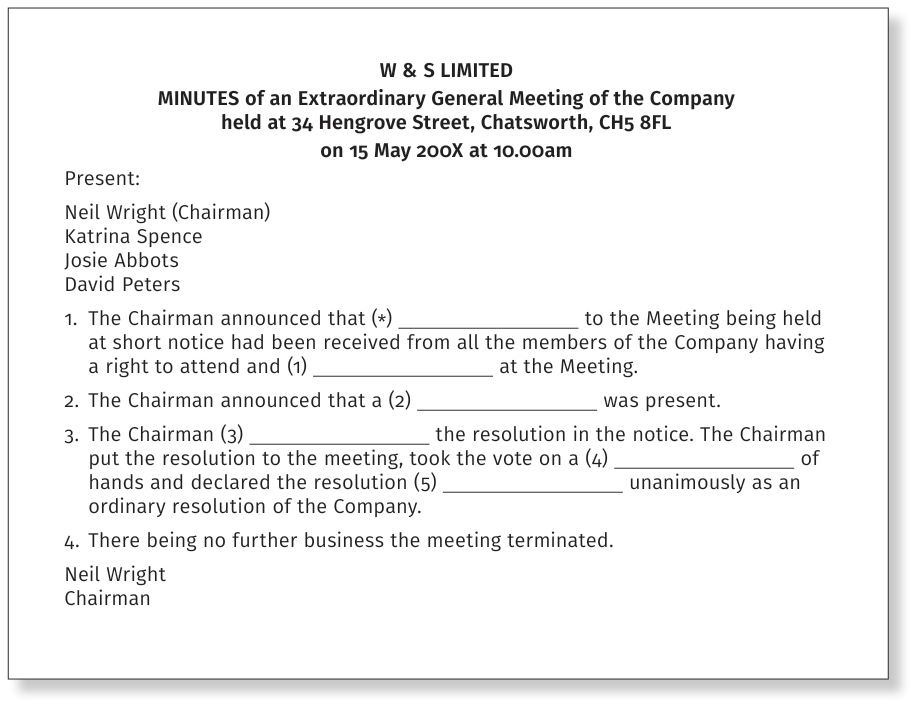
W & S LIMITED MINUTES of an Extraordinary General Meeting of the Company held at 34 Hengrove Street, Chatsworth, CH5 8FL on 15 May 200X at 10.00am Present:
Neil Wright (Chairman) Katrina Spence Josie Abbots David Peters 1. The Chairman announced that (*)(D)to the Meeting being held at short notice had been received from all the members of the Company having a right to attend and (1)(B)at the Meeting.
2. The Chairman announced that a (2)(B)was present.
3. The Chairman (3)(B)the resolution in the notice. The Chairman put the resolution to the meeting, took the vote on a (4)(D)of hands and declared the resolution (5)(E)unanimously as an ordinary resolution of the Company.
4. There being no further business the meeting terminated.
Neil Wright Chairman (AA) consent (B) quorum (D) vote (A) show (C) carried (E) proposed (*) AA (1) (2) (3) (4) (5)
Listening
A lawyer is speaking to a group of trainee solicitors, who are starting their work experience in her department. Some of the words are missing. Listen carefully and fill in the missing words. Write your answers in the box below.
‘Hello and welcome to the Banking and Insolvency department. My name is Kim Watts and I’m very pleased to meet you all.
This is quite a large department, doing a lot of varied work. I specialise in insolvency. Most of our clients are either banks or companies. The banks have generally made a large loan to a company, often secured by a debenture, and now the company is failing to make its repayments on the loan, because it is in financial (1)difficulties. The bank instructs us to assist with the recovery of the debt. Our other clients represent the other side of the coin. They are companies who are facing insolvency and they come to us for advice on the best way forward.
The most common description of insolvency is that a company cannot pay its debts when they become due. There are various insolvency procedures that are available to companies. I’d like now to briefly outline these procedures, as they often cause confusion until you become more familiar with them.
First is the compulsory liquidation of a company. This is when the court orders the company to be wound up. Winding up usually starts by a creditor making a petition on the (2)difficultiesthat the company cannot pay its debts. The Official Receiver, who is an officer of the court, becomes the liquidator of the company and he or she has a duty to investigate the company’s affairs and the causes of its failure, including the conduct of the directors. A director can be disqualified from acting as a director for a period of time if, for example, he or she made the position of the creditors worse by continuing to trade when the company was insolvent. When the winding up is complete, the company is formally (3)groundsand it no longer exists.
Next is administration. This is a court order made to appoint an administrator to (4)groundsthe company’s affairs. A court may make an administration order when the company is unable to pay its debts and the court considers that by making an administration order, the whole or part of the company may be saved as a going (5)difficulties. The company, its directors or its creditors start the procedure by making a petition against the company. While an administration order is in force, the company cannot be wound up and legal proceedings against the company cannot be started except with the approval of the court. The administrator takes control of all the property of the company and makes proposals for the creditors to consider. The administration order continues until the court decides that the order is no longer needed and formally discharges it.
Another insolvency procedure is receivership or administrative receivership. A receiver is appointed by the holder of a debenture of the company secured by a floating charge. Usually this is a bank. The company is said to be “in receivership”. The receiver has the power to sell the assets covered by the floating charge and give the (6)difficultiesto the charge-holder.
A further procedure is a company voluntary arrangement. We call this a CVA. This is when a company makes an agreement with its creditors in order to (7)difficultiesits debts over an agreed period of time. The agreement has to be approved by the court. Meetings of the company and creditors are called to approve the proposed arrangement. Once approved, all creditors who had notice of the meeting and were entitled to vote are bound by the terms of the arrangement. The company can continue trading during the CVA and afterwards.
Finally, there are two types of voluntary liquidation. Members’ voluntary liquidation means that the directors have made a statutory declaration of solvency — in other words, the directors believe that a company is solvent. This happens when a family business is sold off, for example, or if the purposes of the company have come to an end. The liquidation starts when the members, in a general meeting, (8)difficultiesa resolution to wind up the company voluntarily. Remember, if it is a voluntary liquidation, the company is not insolvent.
In the case of a creditors’ voluntary liquidation, the company cannot pay its debts. The process is started by the directors, not the creditors. The company carries an extraordinary resolution to say that it cannot continue in business because of its liabilities and that it is advisable to wind up. A liquidator is appointed to wind up the company’s affairs. The liquidator does this by (9)difficultiesthe company’s assets and paying its creditors. If anything is left over, the members of the company receive it.
In both types of voluntary liquidation, when the company’s affairs are fully wound up, the formal dissolution of the company occurs and it (10)difficultiesto exist.
Well, I hope that this helps just a little. I am sure that you will gain some experience of all these procedures during your six-month period with this department. We have a great team here and everyone will be very happy to answer any questions you have, so please feel free to come to any of us at any time.’
| # | Phrase | Definition |
|---|---|---|
| (1) | (2) (3) | (4) (5) |
| (6) | (7) (8) | (9) (10) |
Speaking & Writing for this topic
Two short tasks scored against TOEFL rubrics. The prompt is generated for this topic — use the vocabulary you have just studied.
Suggested structureclick to expand
- In my experience…
- From what I have seen…
- My honest view is that…
- The principal reason is that…
- This matters because…
- What makes higher decisive here is…
- For instance, when I…
- A clear example is…
- Consider the case where level was involved…
- On the other hand,…
- Furthermore,…
- That said, one should not forget that…
- Overall, this shows that…
- The lesson, then, is…
- For these reasons, I believe…
- Aim for 4–5 keywords woven naturally into your answer.
- Use at least two linking phrases (Furthermore, On the other hand, As a result…).
- Avoid filler words like "basically" or "like".
Suggested structureclick to expand
- The most important point in this concept is …
- My position is that …
- The principal reason is that higher …
- This is supported by …
- A concrete illustration is …
- For instance, …
- However, some argue that …
- On the other hand, …
- In conclusion, …
- Taken together, …
- Aim for 4–5 keywords used in natural context.
- Use 3+ linking words across the answer.
- Vary sentence length to avoid monotony.