
Modern Letter Writing
THE LAYOUT OF A LETTER ~5 min
Look at the layout of the letter below. This layout is used when you are writing a letter on a blank sheet of paper. Identify these parts:
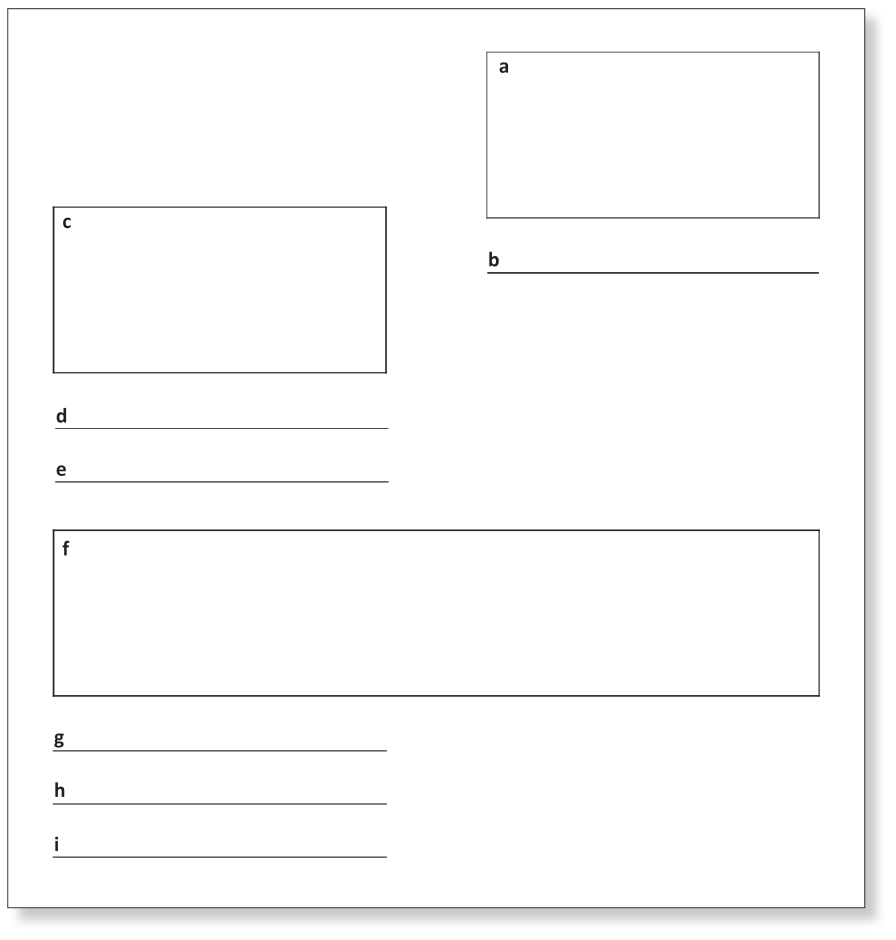
Notes to remember Sender’s address: you don’t need to include your name here, just your address. Recipient: this is the person you are writing to. Recipient’s details: you should include the person’s name, job title and address, or as many of these details as you know.
Look at the layout of the letter below. This layout is used when you are writing a letter using your own headed paper, or your company’s headed paper. Identify these parts:
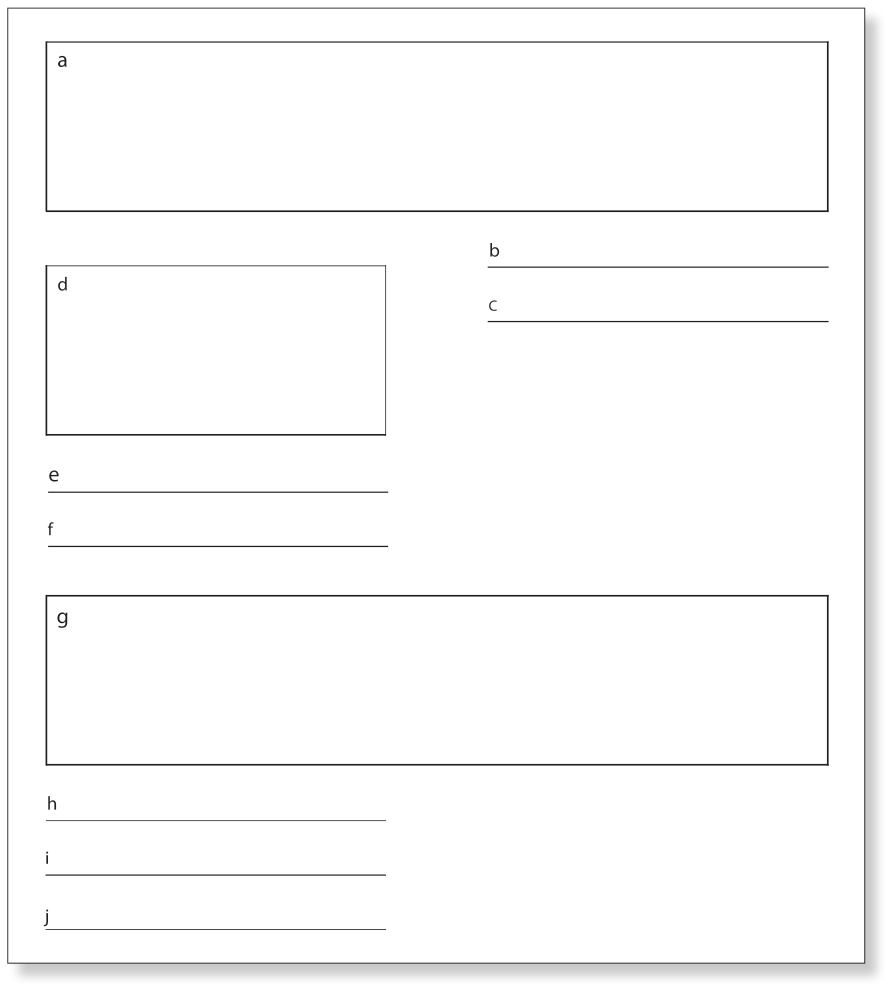
Notes to remember Letterhead: this is already printed on the paper. Recipient’s details: you should include the name, job title and address, or as many of these details as you know.
Speaking & Writing for this topic
Two short tasks scored against TOEFL rubrics. The prompt is generated for this topic — use the vocabulary you have just studied.
Suggested structureclick to expand
- In my experience…
- From what I have seen…
- My honest view is that…
- The principal reason is that…
- This matters because…
- What makes The salutation decisive here is…
- For instance, when I…
- A clear example is…
- Consider the case where The body of the letter was involved…
- On the other hand,…
- Furthermore,…
- That said, one should not forget that…
- Overall, this shows that…
- The lesson, then, is…
- For these reasons, I believe…
- Aim for 4–5 keywords woven naturally into your answer.
- Use at least two linking phrases (Furthermore, On the other hand, As a result…).
- Avoid filler words like "basically" or "like".
Suggested structureclick to expand
- The most important point in Sender’s address is …
- My position is that …
- The principal reason is that The salutation …
- This is supported by …
- A concrete illustration is …
- For instance, …
- However, some argue that …
- On the other hand, …
- In conclusion, …
- Taken together, …
- Aim for 4–5 keywords used in natural context.
- Use 3+ linking words across the answer.
- Vary sentence length to avoid monotony.
DATES ~7 min
Dates can lead to problems. There isn’t a right or wrong way of writing the date — you can choose the style that you prefer. But you must remember that American writers write the date with the month first, then the day, then the year. English writers put the day first, then the month, then the year.
US — MM/DD/YY UK — DD/MM/YY So for example, let’s say that today’s date is 8 May 20XX. This can cause a lot of confusion when using abbreviated dates:
US — MM/DD/YY 05.08.XX UK — DD/MM/YY 08.05.XX They are both the same date, but they look completely different.
Look at the following ways this date (8 May 20XX) can be written and decide whether it has been written in the American format (US) or the English format (UK).
| # | Phrase | Definition |
|---|---|---|
| a | 8/5/20XX | US UK |
| b | 05/08/XX | US UK |
| c | May 08, 20XX | US UK |
| d | 08/05/XX | US UK |
| e | 05.08.20XX | US UK |
| f | 08 May XX | US UK |
| g | 8th May 20XX | US UK |
| h | May 8th, 20XX | US UK |
| i | May 20XX | US UK |
| j | 08.05.20XX | US UK |
| k | May 8th 20XX | US UK |
All of them are exactly the same date but if you don’t know that the US and UK have different ways of writing then problems may occur. Our advice to you is to always write the name of the month in full. For example, 8 May 20XX. Abbreviated dates can cause real confusion.
In the UK, the modern format of writing dates no longer includes any punctuation. For example, modern writers put 8 May 20XX instead of 8th May, 20XX.
Speaking & Writing for this topic
Two short tasks scored against TOEFL rubrics. The prompt is generated for this topic — use the vocabulary you have just studied.
Suggested structureclick to expand
- In my experience…
- From what I have seen…
- My honest view is that…
- The principal reason is that…
- This matters because…
- What makes dates decisive here is…
- For instance, when I…
- A clear example is…
- Consider the case where this concept was involved…
- On the other hand,…
- Furthermore,…
- That said, one should not forget that…
- Overall, this shows that…
- The lesson, then, is…
- For these reasons, I believe…
- Aim for 4–5 keywords woven naturally into your answer.
- Use at least two linking phrases (Furthermore, On the other hand, As a result…).
- Avoid filler words like "basically" or "like".
Suggested structureclick to expand
- The most important point in this concept is …
- My position is that …
- The principal reason is that dates …
- This is supported by …
- A concrete illustration is …
- For instance, …
- However, some argue that …
- On the other hand, …
- In conclusion, …
- Taken together, …
- Aim for 4–5 keywords used in natural context.
- Use 3+ linking words across the answer.
- Vary sentence length to avoid monotony.
SALUTATIONS ~14 min
This is the part of the letter that always starts with the word ‘Dear’. This should be the easiest part of your letter but it often causes real problems.
Rules You must learn these rules to make sure that you use the correct salutation.
Recipient Salutation A law firm, company or institution Dear Sir or Madam Dear Sirs Man, name unknown Dear Sir Woman, name unknown Dear Madam A person, name and sex unknown Dear Sir or Madam Man, name known Dear Mr Thorley Woman, name known, married* Dear Mrs Ratcliffe Woman, name known, single* Dear Miss Singh Woman, name known, marital status unknown* Dear Ms Pinto Married or unmarried couple, name unknown Dear Sir and Madam Married couple, name known Dear Mr and Mrs Clarkson Unmarried couple, names known Dear Mr Rice and Ms Matthews 2 men, names unknown Dear Sirs 2 women, names unknown Dear Mesdames A person, name and particular title known Dear Dr Gregson Dear Judge Fox Dear Professor Silvestri Friend or colleague Dear Alison *A warning about writing to women! The use of Mrs, Ms and Miss It is sometimes difficult to know how to address a woman. You have to think about the person you are writing to. Unfortunately, there are no exact rules about this. Many married women like to be addressed as Mrs (Name). However, it is not correct to assume that you can use this title for all women. Single women may be offended by this. Also, it is often the case that women qualify as lawyers or in some other profession under their maiden name (that is the name they used before getting married) and continue to practise under this name, although they use their married name outside their professional life. So, a woman may be Ms Carruthers at work and Mrs Marston in her private life.
Similarly, it is wrong to use Miss for all women as this is thought by many women to be unsuitable for their age and status. The modern title of Ms is the preferred form of address by many women in the UK and the USA and is a safe form of title to use if you don’t know much about the recipient.
AMERICAN ENGLISH
American English follows the same rules as above, but when writing to a law firm or company, the salutation ‘Gentlemen:’ is often used. If you use this, do not put ‘Dear’ before ‘Gentlemen:’
Gentlemen:
Dear Gentlemen
EMAIL LANGUAGE
American English includes a period, which is called a full stop in British English, after most titles (but not after Miss), like this:
Your first email to a person should follow the salutation rules that you have learned. After that, if you are having an email conversation, you don’t need to continue using a salutation as it is not necessary and sounds unnecessarily formal.
In some countries the salutation ‘Dear Colleagues’ is used when writing to a law firm. However, don’t use ‘Dear Colleagues’ when writing a formal letter to UK recipients because it is not considered to be acceptable. You can use this in an email if you want to, as it is more informal.
Write the correct salutation to start your letter to each of the following recipients.
Example: John Smith (a new client)
DearMs SlaterMr. SmithSir or Madam/Sirs
a Deborah Slater (a new client — you don’t know if she is married)
Dear
b Lowe and Steele solicitors (you don’t know which solicitor is going to be dealing with this case)
Dear
c Mattheis Schmit (a familiar client — you are on good terms with him)
Dear
d Maria Gabanna (a lawyer in America)
Dear
e Rebecca Wallis and Patrick Donaghue (new clients, brother and sister)
Dear
f Martin Barley (a doctor)
Dear
g RSGK Bank plc (you want to write to their legal department)
DearSir or Madam/Sirs
h The ToolHire Company (you want to write to its Managing Director)
Dear
j Jeremy and Patricia Simpson (new clients, they are a married couple)
Dear
j Bella Robson (you know she is married and she uses her married name)
Dear
k Owner of Links Ltd (you know it is a woman, but you don’t know anything else about her)
Dear
Speaking & Writing for this topic
Two short tasks scored against TOEFL rubrics. The prompt is generated for this topic — use the vocabulary you have just studied.
Suggested structureclick to expand
- In my experience…
- From what I have seen…
- My honest view is that…
- The principal reason is that…
- This matters because…
- What makes Dear Mr. Adams decisive here is…
- For instance, when I…
- A clear example is…
- Consider the case where Dear Mrs. Berkely was involved…
- On the other hand,…
- Furthermore,…
- That said, one should not forget that…
- Overall, this shows that…
- The lesson, then, is…
- For these reasons, I believe…
- Aim for 4–5 keywords woven naturally into your answer.
- Use at least two linking phrases (Furthermore, On the other hand, As a result…).
- Avoid filler words like "basically" or "like".
Suggested structureclick to expand
- The most important point in Dear Miss Kingston is …
- My position is that …
- The principal reason is that Dear Mr. Adams …
- This is supported by …
- A concrete illustration is …
- For instance, …
- However, some argue that …
- On the other hand, …
- In conclusion, …
- Taken together, …
- Aim for 4–5 keywords used in natural context.
- Use 3+ linking words across the answer.
- Vary sentence length to avoid monotony.
COMPLIMENTARY CLOSE ~7 min
It is important that you match the complimentary close with the salutation that you use.
Rules You must learn these rules to make sure you use the correct close to your letter. An easy way of remembering is to check if you are using the recipient’s name. If you are, you must end with ‘Yours sincerely’. If you don’t know the recipient’s name, you have to end with ‘Yours faithfully’.
Recipient Salutation Dear Sirs Dear Sir or Madam Yours faithfully Dear Sir Yours faithfully Dear Madam Yours faithfully Dear Sir or Madam Yours faithfully Dear Sir and Madam Yours faithfully Dear Mesdames Yours faithfully Dear Mr Thorley Yours sincerely Dear Mrs Ratcliffe Yours sincerely Dear Miss Singh Yours sincerely Dear Ms Pinto Yours sincerely Dear Mr and Mrs Clarkson Yours sincerely Dear Mr Rice and Ms Matthews Yours sincerely Dear Dr Gregson Yours sincerely Dear Judge Fox Yours sincerely Dear Professor Silvestri Yours sincerely Dear Alison Yours sincerely
Write the correct complimentary close to end your letter to each of the following recipients. Remember, if you know their name you need to end ‘Yours sincerely’. If you don’t know their name, you must end ‘Yours faithfully’.
Example: Dear Mr Smith
d Dear Ms GabannaYours sincerelyYours sincerelyYours sincerely
a Dear Ms Slater
b Dear Sir or Madam
c Dear Mattheis
e Dear Sir
f Dear Sirs
g Dear Mr and Mrs Simpson
h Dear Judge Barley
i Dear Madam
AMERICAN ENGLISH
In American English the close to the letter often depends on how formal the letter is.
• Very formal — Respectfully yours, Yours respectfully
EMAIL LANGUAGE
You don’t need to use such a formal way of ending your email. Polite, acceptable ways of closing your email are:
Speaking & Writing for this topic
Two short tasks scored against TOEFL rubrics. The prompt is generated for this topic — use the vocabulary you have just studied.
Suggested structureclick to expand
- In my experience…
- From what I have seen…
- My honest view is that…
- The principal reason is that…
- This matters because…
- What makes complimentary decisive here is…
- For instance, when I…
- A clear example is…
- Consider the case where close was involved…
- On the other hand,…
- Furthermore,…
- That said, one should not forget that…
- Overall, this shows that…
- The lesson, then, is…
- For these reasons, I believe…
- Aim for 4–5 keywords woven naturally into your answer.
- Use at least two linking phrases (Furthermore, On the other hand, As a result…).
- Avoid filler words like "basically" or "like".
Suggested structureclick to expand
- The most important point in this concept is …
- My position is that …
- The principal reason is that complimentary …
- This is supported by …
- A concrete illustration is …
- For instance, …
- However, some argue that …
- On the other hand, …
- In conclusion, …
- Taken together, …
- Aim for 4–5 keywords used in natural context.
- Use 3+ linking words across the answer.
- Vary sentence length to avoid monotony.
REFERENCES ~3 min
• Formal — Yours truly, Truly yours, Very truly yours • Less formal/more personal — Yours sincerely, Sincerely yours, Sincerely
What’s a reference? Most law firms include a reference on their letters so that they can quickly and easily identify the lawyer dealing with that particular matter and the corresponding file.
For example, Riccardo Callini may use his initials and a number to identify his files like this:
Speaking & Writing for this topic
Two short tasks scored against TOEFL rubrics. The prompt is generated for this topic — use the vocabulary you have just studied.
Suggested structureclick to expand
- In my experience…
- From what I have seen…
- My honest view is that…
- The principal reason is that…
- This matters because…
- What makes Kind regards decisive here is…
- For instance, when I…
- A clear example is…
- Consider the case where Regards was involved…
- On the other hand,…
- Furthermore,…
- That said, one should not forget that…
- Overall, this shows that…
- The lesson, then, is…
- For these reasons, I believe…
- Aim for 4–5 keywords woven naturally into your answer.
- Use at least two linking phrases (Furthermore, On the other hand, As a result…).
- Avoid filler words like "basically" or "like".
Suggested structureclick to expand
- The most important point in this concept is …
- My position is that …
- The principal reason is that Kind regards …
- This is supported by …
- A concrete illustration is …
- For instance, …
- However, some argue that …
- On the other hand, …
- In conclusion, …
- Taken together, …
- Aim for 4–5 keywords used in natural context.
- Use 3+ linking words across the answer.
- Vary sentence length to avoid monotony.
RC 112 RC 113 ~3 min
In his correspondence with other lawyers he will include his reference like this:
My ref: RC 112 This will usually appear under the date block in the letter.
If you receive a letter from a lawyer which states a reference you must remember to use this on your reply. You can also include your own reference. Let’s say that Francesca Sanitta is replying to Riccardo. The references on her letter might look like this:
Your ref: RC 112 My ref: FS 3.4R
Speaking & Writing for this topic
Two short tasks scored against TOEFL rubrics. The prompt is generated for this topic — use the vocabulary you have just studied.
Suggested structureclick to expand
- In my experience…
- From what I have seen…
- My honest view is that…
- The principal reason is that…
- This matters because…
- What makes this concept decisive here is…
- For instance, when I…
- A clear example is…
- Consider the case where this concept was involved…
- On the other hand,…
- Furthermore,…
- That said, one should not forget that…
- Overall, this shows that…
- The lesson, then, is…
- For these reasons, I believe…
- Aim for 4–5 keywords woven naturally into your answer.
- Use at least two linking phrases (Furthermore, On the other hand, As a result…).
- Avoid filler words like "basically" or "like".
Suggested structureclick to expand
- The most important point in this concept is …
- My position is that …
- The principal reason is that this concept …
- This is supported by …
- A concrete illustration is …
- For instance, …
- However, some argue that …
- On the other hand, …
- In conclusion, …
- Taken together, …
- Aim for 4–5 keywords used in natural context.
- Use 3+ linking words across the answer.
- Vary sentence length to avoid monotony.
SUBJECT LINES ~9 min
Read these questions and answers and try to memorise the information.
• What is a subject line? It is like a heading to a letter.
• Do I have to include a subject line? Yes. The modern style of writing always includes a subject line.
• Why do I have to include a subject line? The purpose of a subject line is that when the recipient picks up the letter, he or she will immediately know what the letter is about.
• Where does it go? The subject line can go either:
a above the salutation, for example:
Sale of shares in Moon Ltd Dear Mr Price or;
b between the salutation and the first paragraph of the letter, for example:
Dear Mr Price Sale of shares in Moon Ltd
• I have sometimes seen ‘RE:’ before the subject line. Should I use ‘RE:’?
No. ‘RE:’ here means ‘regarding’. The modern style of writing does not use ‘RE:’ before the subject line. It is a little old-fashioned now. Make your type bold font instead.
Contract between Mrs Bracken and Mrs Orders RE: Contract between Mrs Bracken and Mrs Orders
• How much detail do I need to include in the subject line?
Very little. The subject line should be short and concise with just enough detail to allow the reader to know what the letter is about.
Catering contract between Mrs Bracken and Mrs Orders Catering contract (too little information)
Contract between Mrs Bracken and Mrs Orders concerning the catering arrangements for a reception on 8 July, which was not fulfilled (too much information)
Here are three subject lines. Look at the first paragraph of the following letters and write in the correct subject line.
a Outstanding invoice dated 2 June 20XX
b My client: G Harrison Your client: R Dickens
c 46 Nightingale Way, Birmingham, BH5 4RF Letter 1 Dear Ms Hargreaves I have been instructed by Guy Harrison in connection with a dispute between Mr Harrison and Richard Dickens. I understand from my client that you act for Mr Dickens.
Letter 2 Dear Mr and Mrs Rojas I am pleased to inform you that HFRC Bank has now formally confirmed its mortgage offer and we are now in a position to proceed with your purchase of the above property.
Letter 3 Dear Mr Lancaster I note from our records that our invoice (number 422) in respect of website design services remains unpaid. The sum of £763.50 was due on 2 August 20XX.
EMAIL LANGUAGE
The subject line should go in the subject box at the top of your email. Use the same amount of detail as you would in a formal letter.
Speaking & Writing for this topic
Two short tasks scored against TOEFL rubrics. The prompt is generated for this topic — use the vocabulary you have just studied.
Suggested structureclick to expand
- In my experience…
- From what I have seen…
- My honest view is that…
- The principal reason is that…
- This matters because…
- What makes subject decisive here is…
- For instance, when I…
- A clear example is…
- Consider the case where lines was involved…
- On the other hand,…
- Furthermore,…
- That said, one should not forget that…
- Overall, this shows that…
- The lesson, then, is…
- For these reasons, I believe…
- Aim for 4–5 keywords woven naturally into your answer.
- Use at least two linking phrases (Furthermore, On the other hand, As a result…).
- Avoid filler words like "basically" or "like".
Suggested structureclick to expand
- The most important point in this concept is …
- My position is that …
- The principal reason is that subject …
- This is supported by …
- A concrete illustration is …
- For instance, …
- However, some argue that …
- On the other hand, …
- In conclusion, …
- Taken together, …
- Aim for 4–5 keywords used in natural context.
- Use 3+ linking words across the answer.
- Vary sentence length to avoid monotony.
THE BODY OF THE LETTER ~11 min
Read these questions and answers and try to memorise the information.
Why are you writing this letter?
What is the purpose of your letter? You should think about this throughout your letter and make sure that it is clear to the person who will read your letter.
• Am I using the appropriate style and language for the recipient?
Always think about the person who is going to be reading your letter. The ‘register’ of the letter is important. Register means the tone and grade of language. If you are writing to another lawyer, the register of your letter will be different to a letter you are writing to a client who has no legal knowledge at all. Whatever style you choose for your letter, you must remember to use the same style throughout the letter. Don’t mix the style in the same letter, as this is confusing. Be consistent. We will look at register in more detail later in this unit.
• Have I included the right amount of detail?
Again, think about the person who will be reading the letter. If you are writing to a client with no legal knowledge, you will need to explain any legal vocabulary that you use. You should not need to do this if you are writing to another lawyer.
• Is all the information relevant, accurate and clear?
If you are writing a letter of advice, check whether you have covered all the main points. Have you answered any questions that have been raised? Your letter should be clear and unambiguous. Don’t include a lot of unimportant details.
• Am I using the appropriate tone? For example, is the letter friendly, formal, helpful, forceful?
This is another part of register. In the same way as you use different tones of voice when you speak to someone, depending on whether you are pleased, angry, disappointed, informative etc, so the tone of your letters will vary. You have to make sure that you are using the right tone for the purpose of your letter.
• Have I set out my letter in short, concise blocks?
If you just write one or two long blocks of information, this is difficult to read. It is much better to divide the information into short paragraphs, with one main idea to each paragraph.
• Am I using a logical order of sentences and paragraphs?
You need to check that there is a natural flow throughout the letter. There should be logical links between the sentences and paragraphs.
Are my sentences the right length?
If your sentences are too long, the reader will lose some of the detail. You should aim to use a maximum of 25 words in each sentence.
• Have I used accurate grammar and punctuation?
Remember to check your letter carefully before it is sent. Accuracy is very important for lawyers. Look for spelling errors, correct use of prepositions, accurate tenses. It is very important in a formal letter not to use contractions or short forms, for example, I’m, don’t, isn’t, etc. Always write the two separate words in full.
I’m Don’t Didn’t I’ve I am Do not Did not I have Remember this as a checklist for your letter:
Purpose
Register
Order
Clarity
Accuracy
Layout
Length PROCALL To help you remember your checklist:
People
Rarely
Order
Champagne
After
Losing
Litigation!
Speaking & Writing for this topic
Two short tasks scored against TOEFL rubrics. The prompt is generated for this topic — use the vocabulary you have just studied.
Suggested structureclick to expand
- In my experience…
- From what I have seen…
- My honest view is that…
- The principal reason is that…
- This matters because…
- What makes body decisive here is…
- For instance, when I…
- A clear example is…
- Consider the case where letter was involved…
- On the other hand,…
- Furthermore,…
- That said, one should not forget that…
- Overall, this shows that…
- The lesson, then, is…
- For these reasons, I believe…
- Aim for 4–5 keywords woven naturally into your answer.
- Use at least two linking phrases (Furthermore, On the other hand, As a result…).
- Avoid filler words like "basically" or "like".
Suggested structureclick to expand
- The most important point in this concept is …
- My position is that …
- The principal reason is that body …
- This is supported by …
- A concrete illustration is …
- For instance, …
- However, some argue that …
- On the other hand, …
- In conclusion, …
- Taken together, …
- Aim for 4–5 keywords used in natural context.
- Use 3+ linking words across the answer.
- Vary sentence length to avoid monotony.
PUTTING A LETTER TOGETHER ~6 min
Here are the parts of a letter which have been jumbled up. It is a letter to a bank from one of the bank’s customers. Put them into the correct order.
a It appears that this amount of £389.92 has been incorrectly debited from my account. This resulted in my being overdrawn on my account at the end of the month. You have then charged me a fee of £25 for an unauthorised overdraft.
b 27 Limetree Avenue Chatsworth CH4 7JL
c G Hardwick
d It shows a debit of £389.92 on 2 May 20XX. This transaction did not take place. However, I did use my debit card on that date to pay for a shirt which cost £38.99. I enclose a copy of the debit card receipt, which clearly shows this transaction.
e Yours faithfully
f 5 June 20XX
g I am not pleased about this. Please rectify this error immediately and refund the £25 overdraft fee to my account.
h Dear Sir My Account number 6387290
i I look forward to hearing from you with confirmation that this error has been corrected.
j The Manager HBCR Bank Plc 1 High Street Chatsworth, CH1 4GP continued
k Gary Hardwick
l I am writing with reference to my bank statement dated 31 May 20XX, which shows the account as being overdrawn. However, on checking the statement it is clear that it contains an error.
Speaking & Writing for this topic
Two short tasks scored against TOEFL rubrics. The prompt is generated for this topic — use the vocabulary you have just studied.
Suggested structureclick to expand
- In my experience…
- From what I have seen…
- My honest view is that…
- The principal reason is that…
- This matters because…
- What makes putting decisive here is…
- For instance, when I…
- A clear example is…
- Consider the case where letter was involved…
- On the other hand,…
- Furthermore,…
- That said, one should not forget that…
- Overall, this shows that…
- The lesson, then, is…
- For these reasons, I believe…
- Aim for 4–5 keywords woven naturally into your answer.
- Use at least two linking phrases (Furthermore, On the other hand, As a result…).
- Avoid filler words like "basically" or "like".
Suggested structureclick to expand
- The most important point in this concept is …
- My position is that …
- The principal reason is that putting …
- This is supported by …
- A concrete illustration is …
- For instance, …
- However, some argue that …
- On the other hand, …
- In conclusion, …
- Taken together, …
- Aim for 4–5 keywords used in natural context.
- Use 3+ linking words across the answer.
- Vary sentence length to avoid monotony.
THE REGISTER OF LETTER WRITING ~19 min
Register refers to the style and tone of your letter. The register that you use will change depending on who you are writing to. If you are writing to another lawyer, you will use legal vocabulary in your letter and write in a more formal style. If you are writing to a client who has no legal knowledge, you will use a different register. In this case, you will need to explain any legal vocabulary and perhaps use a more personal style.
Whoever you are writing to, remember to use a modern style of English.
Look at these three sentences. A lawyer is writing a letter to another lawyer about the sale of a house. The sentences each contain the same information, expressed in different ways. Match each sentence with the different styles listed in the blue box.
a I have the pleasure of enclosing herewith the draft sale and purchase agreement in respect of the property hereinafter known as 25 Laurel Way, Chatsworth, for your perusal.
b With this letter I have included the first version of the sale document regarding the house 25 Laurel Way, Chatsworth.
c I am pleased to enclose the draft contract in respect of 25 Laurel Way, Chatsworth (the Property).
Modern, plain English as used by professional lawyers (1)
Simple, unprofessional sentence (2)
Old-fashioned, overlong sentence (3)
In the following examples, which is the modern, professional style of writing?
| # | Phrase | Definition |
|---|---|---|
| a | I act for Frank Edmunds. | |
I’m working for Frank Edmunds. I have been appointed to represent Mr Frank Edmunds.
| # | Phrase | Definition |
|---|---|---|
| b | I’m writing to ask you about the cost of your accountancy services. | |
The purpose of this letter is to make enquiries about the level of the fees that you charge pertaining to accountancy services rendered.
I am writing to enquire about your fees in respect of accountancy services.
| # | Phrase | Definition |
|---|---|---|
| c | Please provide me with the following documents: | |
Kindly furnish me with the following documents: Can you send these documents:
d Regarding your letter written on 15 November that’s setting out accusations about my client.
With reference to your communication of 15 inst, which pertains to alleged activities by my client.
I refer to your letter of 15 November 20XX, which contains various allegations against my client.
| # | Phrase | Definition |
|---|---|---|
| e | I await hearing from you with all expedition. | |
Please contact me as soon as possible. Can you call me please?
Read the following letter which contains a mix of styles. Look at the underlined phrases. Some phrases are too informal and others are too old-fashioned. Replace each of the underlined phrases with one of the phrases from the blue box so that the register of the letter is a consistent, modem style. There is an example at the beginning (*).
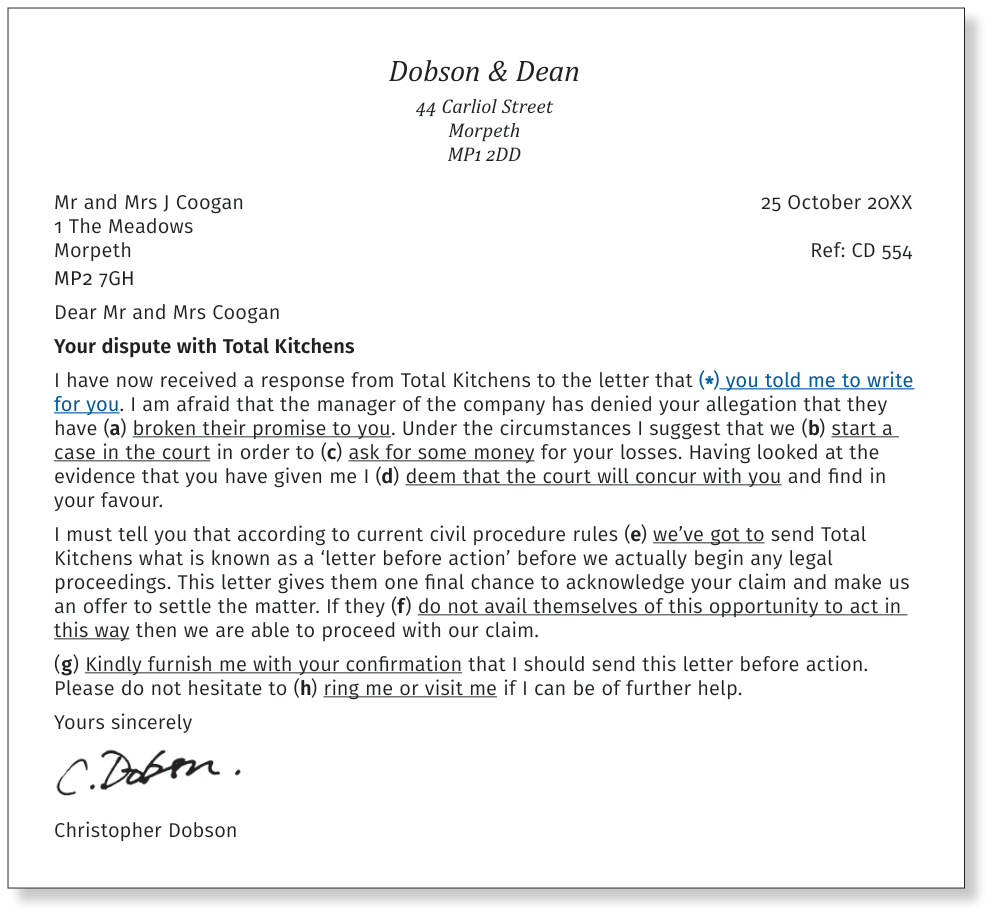
Dobson & Dean 44 Carliol Street Morpeth MP1 2DD Mr and Mrs J Coogan 25 October 20XX 1 The Meadows Morpeth Ref: CD 554 MP2 7GH Dear Mr and Mrs Coogan Your dispute with Total Kitchens I have now received a response from Total Kitchens to the letter that (*) you told me to write for you. I am afraid that the manager of the company has denied your allegation that they have (a) broken their promise to you. Under the circumstances I suggest that we (b) start a case in the court in order to (c) ask for some money for your losses. Having looked at the evidence that you have given me I (d) deem that the court will concur with you and find in your favour.
I must tell you that according to current civil procedure rules (e) we’ve got to send Total Kitchens what is known as a ‘letter before action’ before we actually begin any legal proceedings. This letter gives them one final chance to acknowledge your claim and make us an offer to settle the matter. If they (f) do not avail themselves of this opportunity to act in this way then we are able to proceed with our claim.
(g) Kindly furnish me with your confirmation that I should send this letter before action. Please do not hesitate to (h) ring me or visit me if I can be of further help.
Yours sincerely
Christopher Dobson
| # | Phrase | Definition |
|---|---|---|
| a | b c d | e f g h |
Look at these sentences which are from letters written by a lawyer. The underlined word or phrase in each sentence is too old-fashioned. Replace it with a good alternative.
a We deem that you are not acting in accordance with your undertakings.
b The parties named hereinbefore agree as follows:
c I am writing pertaining to your letter dated 15 July 20XX.
d We respectfully request that you telephone us.
e I have received a letter from the solicitors acting for the vendees confirming that their clients can now proceed with the purchase of your property.
f Please contact me with all due haste.
Now look at these sentences which are from letters written by another lawyer. The underlined word or phrase in each sentence is too informal. Replace it with a good alternative.
a My client says that this point is true.
b In your letter of 10 December you definitely gave up your right to repayment.
c Your actions amount to an unequivocal break of the contract.
d You haven’t paid any money in the last three months and your mortgage account is now in arrears of £2400.
e The total sum due to people that you owe money to is £6527.
f We consider that you are fully to blame for the injury suffered by our client.
Speaking & Writing for this topic
Two short tasks scored against TOEFL rubrics. The prompt is generated for this topic — use the vocabulary you have just studied.
Suggested structureclick to expand
- In my experience…
- From what I have seen…
- My honest view is that…
- The principal reason is that…
- This matters because…
- What makes I wrote on your behalf (*) decisive here is…
- For instance, when I…
- A clear example is…
- Consider the case where we must (3) was involved…
- On the other hand,…
- Furthermore,…
- That said, one should not forget that…
- Overall, this shows that…
- The lesson, then, is…
- For these reasons, I believe…
- Aim for 4–5 keywords woven naturally into your answer.
- Use at least two linking phrases (Furthermore, On the other hand, As a result…).
- Avoid filler words like "basically" or "like".
Suggested structureclick to expand
- The most important point in claim damages (2) is …
- My position is that …
- The principal reason is that I wrote on your behalf (*) …
- This is supported by …
- A concrete illustration is …
- For instance, …
- However, some argue that …
- On the other hand, …
- In conclusion, …
- Taken together, …
- Aim for 4–5 keywords used in natural context.
- Use 3+ linking words across the answer.
- Vary sentence length to avoid monotony.
THE CONTENT OF THE LETTER ~9 min
Often the hardest part is thinking how to start each sentence of your letter.
Look at the following extracts from sentences. Complete each phrase with appropriate words.
a Starting the main body of a letter We writing confirm that…
you for letter 12 June.
reference our telephone conversation…
b Giving the recipient some good news We are to you that…
am to you that…
c Giving the recipient some bad news …
We to you that…
am …
d Asking the recipient to do something We be if …
I would it you could…
e Apologising for something that you have done, or failed to do I about the delay replying.
We for any .
Please our .
f Enclosing documents with your letter I …
find …
g Ending the letter and referring to future contact, either a meeting or a reply to your letter you have any , please to us.
If we help way, let .
I look to you.
Speaking & Writing for this topic
Two short tasks scored against TOEFL rubrics. The prompt is generated for this topic — use the vocabulary you have just studied.
Suggested structureclick to expand
- In my experience…
- From what I have seen…
- My honest view is that…
- The principal reason is that…
- This matters because…
- What makes content decisive here is…
- For instance, when I…
- A clear example is…
- Consider the case where letter was involved…
- On the other hand,…
- Furthermore,…
- That said, one should not forget that…
- Overall, this shows that…
- The lesson, then, is…
- For these reasons, I believe…
- Aim for 4–5 keywords woven naturally into your answer.
- Use at least two linking phrases (Furthermore, On the other hand, As a result…).
- Avoid filler words like "basically" or "like".
Suggested structureclick to expand
- The most important point in this concept is …
- My position is that …
- The principal reason is that content …
- This is supported by …
- A concrete illustration is …
- For instance, …
- However, some argue that …
- On the other hand, …
- In conclusion, …
- Taken together, …
- Aim for 4–5 keywords used in natural context.
- Use 3+ linking words across the answer.
- Vary sentence length to avoid monotony.
TYPICAL SENTENCES IN LEGAL LETTERS ~10 min
The following phrases are useful when you are writing a letter on behalf of your client. You should try to memorise them.
Opening Lines
• We are instructed by Joseph Adams and understand that you act for Elliot Fletcher.
• Thank you for your letter of 7 July. We confirm that we act for Elliot Fletcher.
I act on behalf of…
• I refer to your letter dated 16 August.
Explain why you are writing I am instructed that…
• We have seen your letter of 14 September to our client…
I am writing to…
• We will take our client’s instructions and will contact you again soon.
Explain what you want the recipient to do
• Please sign the enclosed agreement in the place marked with a cross, and return it to me by 21 June.
• We would be grateful if you will take your client’s instructions as soon as possible.
Refer to future contact
• If I do not hear from you within 14 days of the date of this letter, I am instructed to start legal proceedings immediately.
• I look forward to hearing from you as soon as possible.
• If you have any questions, please do not hesitate to contact me.
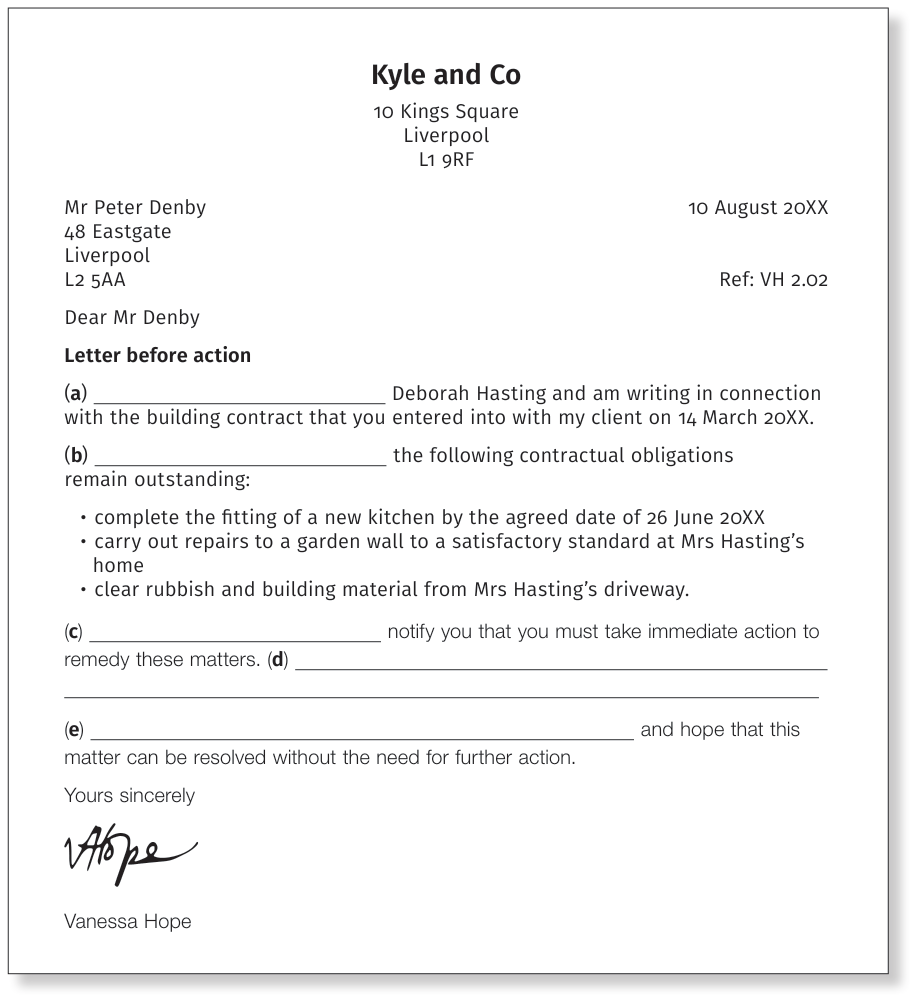
Put one of the phrases that you have learned on the previous page into each space in this letter.
Speaking & Writing for this topic
Two short tasks scored against TOEFL rubrics. The prompt is generated for this topic — use the vocabulary you have just studied.
Suggested structureclick to expand
- In my experience…
- From what I have seen…
- My honest view is that…
- The principal reason is that…
- This matters because…
- What makes typical decisive here is…
- For instance, when I…
- A clear example is…
- Consider the case where sentences was involved…
- On the other hand,…
- Furthermore,…
- That said, one should not forget that…
- Overall, this shows that…
- The lesson, then, is…
- For these reasons, I believe…
- Aim for 4–5 keywords woven naturally into your answer.
- Use at least two linking phrases (Furthermore, On the other hand, As a result…).
- Avoid filler words like "basically" or "like".
Suggested structureclick to expand
- The most important point in this concept is …
- My position is that …
- The principal reason is that typical …
- This is supported by …
- A concrete illustration is …
- For instance, …
- However, some argue that …
- On the other hand, …
- In conclusion, …
- Taken together, …
- Aim for 4–5 keywords used in natural context.
- Use 3+ linking words across the answer.
- Vary sentence length to avoid monotony.
Kyle and Co ~6 min
10 Kings Square Liverpool L1 9RF Mr Peter Denby 10 August 20XX 48 Eastgate Liverpool L2 5AA Ref: VH 2.02 Dear Mr Denby Letter before action
(a) Deborah Hasting and am writing in connection with the building contract that you entered into with my client on 14 March 20XX.
(b) the following contractual obligations remain outstanding:
• complete the fitting of a new kitchen by the agreed date of 26 June 20XX • carry out repairs to a garden wall to a satisfactory standard at Mrs Hasting’s home • clear rubbish and building material from Mrs Hasting’s driveway.
(c) notify you that you must take immediate action to remedy these matters. (d)
(e) and hope that this matter can be resolved without the need for further action.
Yours sincerely Vanessa Hope Collocation bank
proceedings (no article ‘the’ before legal proceedings) • Lawyers commence legal clients • Lawyers take clients’
instructions action (uncountable noun — no article ‘the’ or ‘a’ before legal action)
Preposition bank to act for someone ‘I am acting for Ms Francesca Peroni.’ • to act on behalf of someone ‘We act on behalf of Treadmill plc.’ • to be instructed by someone ‘We are instructed by Mr and Mrs Ross.’ • to do something by a date (to impose a deadline) ‘Please return the agreement to me by 2 November.’
Speaking & Writing for this topic
Two short tasks scored against TOEFL rubrics. The prompt is generated for this topic — use the vocabulary you have just studied.
Suggested structureclick to expand
- In my experience…
- From what I have seen…
- My honest view is that…
- The principal reason is that…
- This matters because…
- What makes Clients consult lawyers decisive here is…
- For instance, when I…
- A clear example is…
- Consider the case where Clients instruct lawyers was involved…
- On the other hand,…
- Furthermore,…
- That said, one should not forget that…
- Overall, this shows that…
- The lesson, then, is…
- For these reasons, I believe…
- Aim for 4–5 keywords woven naturally into your answer.
- Use at least two linking phrases (Furthermore, On the other hand, As a result…).
- Avoid filler words like "basically" or "like".
Suggested structureclick to expand
- The most important point in this concept is …
- My position is that …
- The principal reason is that Clients consult lawyers …
- This is supported by …
- A concrete illustration is …
- For instance, …
- However, some argue that …
- On the other hand, …
- In conclusion, …
- Taken together, …
- Aim for 4–5 keywords used in natural context.
- Use 3+ linking words across the answer.
- Vary sentence length to avoid monotony.
LETTER WRITING CLINIC ~28 min
within a period of time ‘If we do not hear from you within 14 days of the date of this letter...’ • until a date (to set out a timescale)
‘You have until 12 January to file a response.’ • to look forward to something ‘I look forward to meeting you.’ • to hear from someone ‘I look forward to hearing from you.’
The ten most common problems when non-native speakers of English write letters in English Some mistakes are common to almost every nationality when people write in English. When you write a letter, you can improve it by asking yourself if some parts of it are:
1 Too informal. A letter should be professional even when written in a plain English style. The more informal style of an email for example, is not acceptable in a letter.
2 Too old-fashioned. A letter should be formal but this does not mean using language that is out-ofdate.
Out-of-date language includes what a native English speaker might refer to as ‘flowery’ phrases from previous centuries.
3 Too abrupt. Most languages are more direct than English. You can improve a letter by being sensitive to the way that certain things are expressed when they are written in English.
4 Using archaic words. Modern letters should not include words such as ‘hereunder’ or ‘abovementioned’.
5 Using contract vocabulary. Some formal, general English words are acceptable in contracts and other legal documents but are not natural when used in letters.
6 Using uncountable nouns incorrectly, or even inventing nouns that don’t exist at all. Be aware of which nouns in English are uncountable. If you are unsure of a noun, check your dictionary.
7 Confusing a verb with a noun. Are you sure, for example, of the difference between ‘advice’ and ‘advise’?
A computer will not necessarily correct this type of mistake for you.
8 Using articles incorrectly or not at all. Make sure that ‘a’ and ‘the’ are used correctly, especially if your own language does not use articles.
9 Using the wrong collocation. For example, a lawyer ‘acts for’ a client and does not ‘work for’ a client. This is an example of accurate verb/noun collocation.
10 Using the wrong preposition. A normal, one-page letter can contain 50 or more prepositions. If lots of the prepositions are wrong, unfortunately it will give a very bad impression to the reader.
THE DOS AND DON’TS OF LETTER WRITING
Do use plain English be consistent in style be formal but not old-fashioned keep your sentences short check your grammar and punctuation.
Don’t use unnecessarily difficult words or phrases mix different styles, for example, change from formal to informal use long sentences or long paragraphs use language appropriate to written contracts in letters be too abrupt. It can be considered impolite to be very direct about some subjects, particularly when writing in English.
Look at the letter on the next page. Some parts of the letter are underlined. Read the letter and match the underlined parts of it with the problems listed below.
Mistake with uncountable noun. (1)
Mistake with preposition. (2)
Mistake of confusing a verb with a noun. (3)
Mistake of using language that is too informal. (4)
Mistake with collocation. (5)
Mistake of using an archaic word. (6)
Mistake of using a very ‘flowery’, old-fashioned phrase. (7)
Mistake with an article. (8)
Mistake of using a word that is appropriate in a contract. (9)
Mistake of being too direct or abrupt. (10)
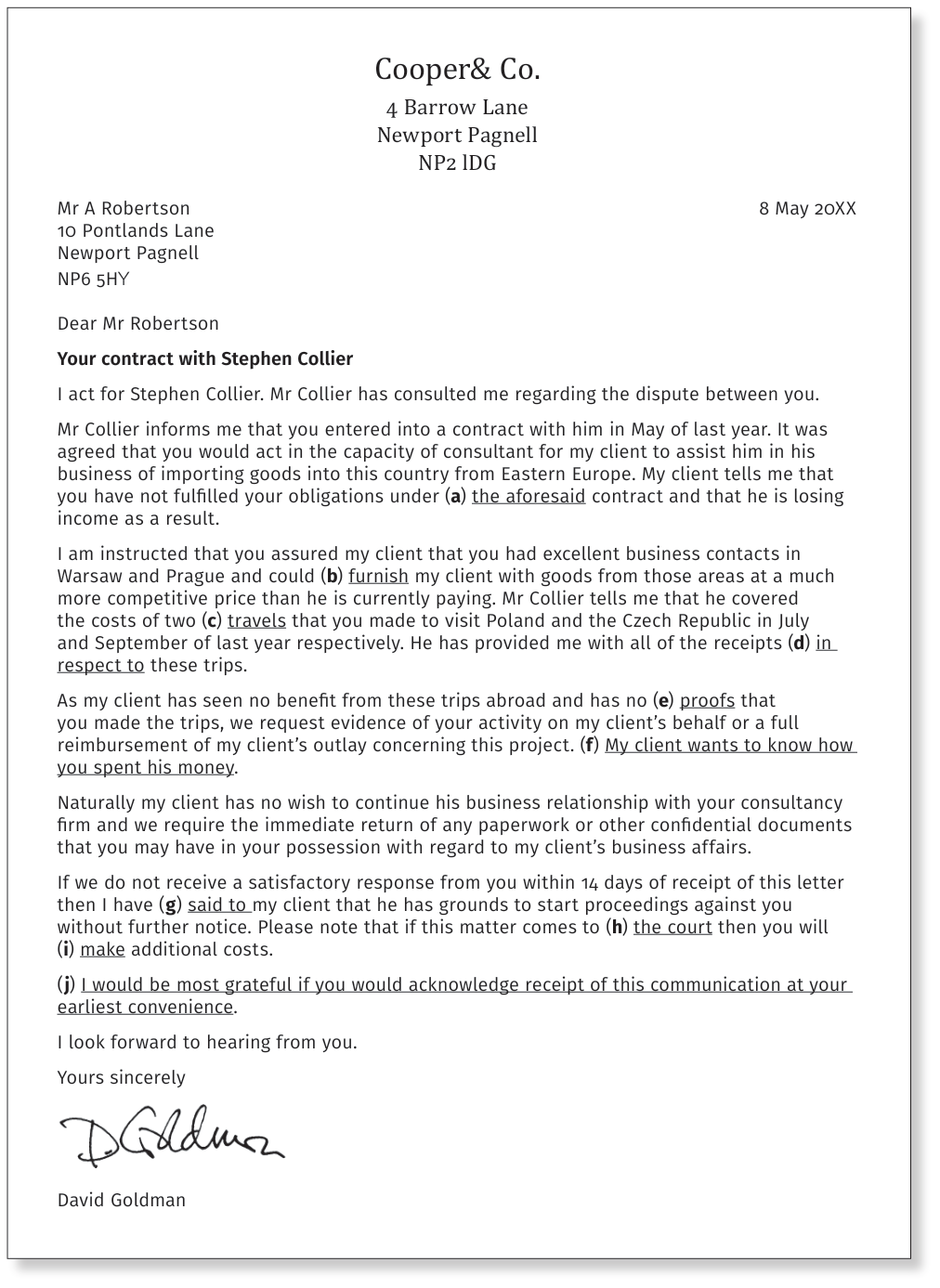
Cooper& Co.
4 Barrow Lane Newport Pagnell NP2 lDG Mr A Robertson 8 May 20XX 10 Pontlands Lane Newport Pagnell NP6 5HY Dear Mr Robertson Your contract with Stephen Collier I act for Stephen Collier. Mr Collier has consulted me regarding the dispute between you.
Mr Collier informs me that you entered into a contract with him in May of last year. It was agreed that you would act in the capacity of consultant for my client to assist him in his business of importing goods into this country from Eastern Europe. My client tells me that you have not fulfilled your obligations under (a) the aforesaid contract and that he is losing income as a result.
I am instructed that you assured my client that you had excellent business contacts in Warsaw and Prague and could (b) furnish my client with goods from those areas at a much more competitive price than he is currently paying. Mr Collier tells me that he covered the costs of two (c) travels that you made to visit Poland and the Czech Republic in July and September of last year respectively. He has provided me with all of the receipts (d) in respect to these trips.
As my client has seen no benefit from these trips abroad and has no (e) proofs that you made the trips, we request evidence of your activity on my client’s behalf or a full reimbursement of my client’s outlay concerning this project. (f) My client wants to know how you spent his money.
Naturally my client has no wish to continue his business relationship with your consultancy firm and we require the immediate return of any paperwork or other confidential documents that you may have in your possession with regard to my client’s business affairs.
If we do not receive a satisfactory response from you within 14 days of receipt of this letter then I have (g) said to my client that he has grounds to start proceedings against you without further notice. Please note that if this matter comes to (h) the court then you will (i) make additional costs.
(j) I would be most grateful if you would acknowledge receipt of this communication at your earliest convenience.
I look forward to hearing from you.
Yours sincerely
David Goldman
Improving the letter. Think about what you know about common mistakes in letter writing and complete the same letter below in a more appropriate way. There are sample phrases in the answer key, which give you one way of completing this exercise. However, there is more than one possible correct answer
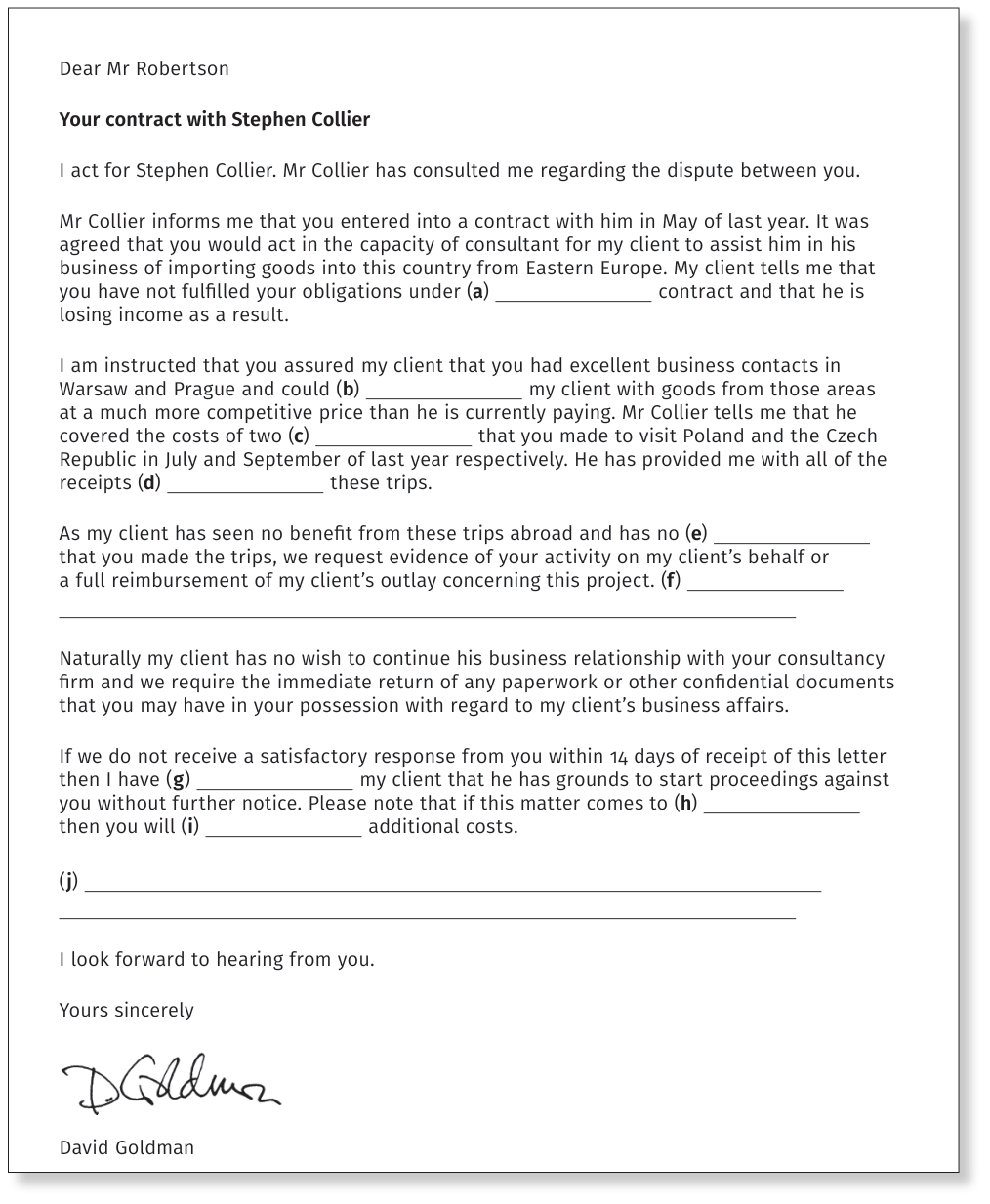
Dear Mr Robertson Your contract with Stephen Collier I act for Stephen Collier. Mr Collier has consulted me regarding the dispute between you.
Mr Collier informs me that you entered into a contract with him in May of last year. It was agreed that you would act in the capacity of consultant for my client to assist him in his business of importing goods into this country from Eastern Europe. My client tells me that you have not fulfilled your obligations under (a) contract and that he is losing income as a result.
I am instructed that you assured my client that you had excellent business contacts in Warsaw and Prague and could (b) my client with goods from those areas at a much more competitive price than he is currently paying. Mr Collier tells me that he covered the costs of two (c) that you made to visit Poland and the Czech Republic in July and September of last year respectively. He has provided me with all of the receipts (d) these trips.
As my client has seen no benefit from these trips abroad and has no (e) that you made the trips, we request evidence of your activity on my client’s behalf or a full reimbursement of my client’s outlay concerning this project. (f) Naturally my client has no wish to continue his business relationship with your consultancy firm and we require the immediate return of any paperwork or other confidential documents that you may have in your possession with regard to my client’s business affairs.
If we do not receive a satisfactory response from you within 14 days of receipt of this letter then I have (g) my client that he has grounds to start proceedings against you without further notice. Please note that if this matter comes to (h) then you will (i) additional costs.
(j) I look forward to hearing from you.
Yours sincerely
David Goldman
Speaking & Writing for this topic
Two short tasks scored against TOEFL rubrics. The prompt is generated for this topic — use the vocabulary you have just studied.
Suggested structureclick to expand
- In my experience…
- From what I have seen…
- My honest view is that…
- The principal reason is that…
- This matters because…
- What makes letter decisive here is…
- For instance, when I…
- A clear example is…
- Consider the case where writing was involved…
- On the other hand,…
- Furthermore,…
- That said, one should not forget that…
- Overall, this shows that…
- The lesson, then, is…
- For these reasons, I believe…
- Aim for 4–5 keywords woven naturally into your answer.
- Use at least two linking phrases (Furthermore, On the other hand, As a result…).
- Avoid filler words like "basically" or "like".
Suggested structureclick to expand
- The most important point in this concept is …
- My position is that …
- The principal reason is that letter …
- This is supported by …
- A concrete illustration is …
- For instance, …
- However, some argue that …
- On the other hand, …
- In conclusion, …
- Taken together, …
- Aim for 4–5 keywords used in natural context.
- Use 3+ linking words across the answer.
- Vary sentence length to avoid monotony.
CORRECTING COMMON MISTAKES IN LETTER WRITING ~39 min
Too informal Look at the following sentences. They are all too informal to be included in a professional letter. Match each sentence with the more formal alternative from the blue box below.
a I was hired by Mr Felton as his lawyer.
b My thanks for your letter of 6 May 20XX. Our client has now told us what he wants to do.
c I think the judge will agree to what we suggest.
d Mr Felton wants to have back the money that he has spent on hiring lawyers for this case.
e Tell me if you agree to do what we say we want in this letter.
Please confirm that you are in agreement with this course of action. (1)
Thank you for your letter of 6 May 20XX. We have now had the opportunity of taking our client’s instructions. (2)
The court is likely to be sympathetic to our proposal. (3)
My client will be seeking costs. (4)
I am instructed by Mr Felton. (5)
Too old-fashioned Look at the following sentences. They are all too out-of-date to be included in a professional letter. Complete the more modern alternative that follows each sentence by filling each gap with a suitable word.
a To my most distinguished colleague, Ms Booth.
Ms Booth.
b I am most honoured to write to you as the legal representative of James Black, Esquire.
I aminstructed, MrbyDearJames Black.
c My client laments that his two previous letters have not received response nor payment.
Despite two lettersrequesting, received, responsepayment my client hasDearnoinstructed, Mr.
d I would be grateful if you would kindly acknowledge receipt of the documents enclosed herewith.
Please confirm that you havereceived, enclosedtheDeardocuments.
e I advise that we initiate negotiations at your earliest convenience to resolve this issue in an amicable fashion.
I suggest that this matter can beresolved/settled, startthrough negotiation and that weDearthis process as soon as possible.
Too abrupt Look at the following sentences. They are all too abrupt (impolite) to be included in a professional letter. Each sentence also contains a mistake, which is highlighted. Some of the mistakes are from the list of common mistakes and some are not. First of all, correct the mistake that each sentence contains.
a I need you to send me more informations about this.
b If you do not pay us now, we will take you before the court.
c I don’t think what you told about my client’s behaviour in this situation is correct.
d I have more things that I want you to explain me.
e Your client definitely said that my client could starting building on this land.
Below there are some polite alternatives to the sentences in Exercise 3. Match each sentence with the correct polite alternative sentence.
I need further information and would be grateful if you could forward the following: (1)
I am writing with some additional enquiries. (2)
We cannot accept your interpretation of our client’s conduct in this matter. (3)
Your client gave his express permission for building work to begin. (4)
If we do not receive payment immediately we will issue proceedings without further notice. (5)
The following sentences all use archaic words. It is not appropriate to include words like this in a modern letter. It used to be true to say that archaic words made letters more formal. However, in the twenty-first century, modern law firms don’t use archaic words in correspondence with other law firms or clients. Underline the archaic word or words in each sentence.
a I hereby advise you that I am instructed by Mrs Shirley Malloy.
b My client informs me that you have failed to respond to the abovementioned letter.
c Due to your conduct in this matter, we have no option but to issue proceedings forthwith.
d I attach a copy of the contract hereto.
e Please supply me with the information that I request hereunder.
Archaic words can often be deleted and it will make no difference to the meaning of the sentence. Sometimes it is necessary to write the sentence in a slightly different way to make sure it is polite and grammatically correct. Write the sentences in Exercise 5 again by filling each gap in the sentences below with an appropriate word.
a Iacton behalf of Mrs Shirley Malloy.
b My client informs me that you have not responded tohis/her/theletter.
c Yourconduct, immediatelyleaves us with no choice but to issue proceedingsact.
d I haveattached/encloseda copy of the contract.
e Please supply me with the informationrequestedin this letter.
Lawyers often use very formal words when drafting contracts. However, many of these words are not appropriate when writing a letter. The underlined words in the following sentences can be replaced with a word or phrase from the box below. Choose the correct word or phrase for each sentence and write it in the space provided.
a Kindly furnish me with the following information.
Answer:
b In the event that I am unable to attend the meeting on 4 January, I will inform you by email at least 24 hours in advance.
Answer:
c Pursuant to the local planning regulations, I do not think that you will get permission to build on land that is so close to the river.
Answer:
d My client will procure all necessary documents by the end of this month.
Answer:
e Your client has failed to execute his obligations under the contract.
Answer:
f This case has had a negative effect upon a great many persons.
Answer:peoplecontinued
g We deem it necessary to carry out an independent audit of the company accounts.
Answer:
h Your client determined the contract on the 28 July.
Answer:
i Mr Smith undertook to complete the building work within three weeks.
Answer:
j We will instigate legal action without further notice.
Answer:
k Please send me a copy of all documents pertaining to this matter.
Answer:
l Your client gave his express consent to allow my client access to all of the partnership’s financial information.
Answer:
Uncountable nouns The following sentences contain nouns that are used incorrectly because they are uncountable. Underline the uncountable noun in each sentence.
a My client has suffered many damages due to this breach of contract.
b I am writing to request advices about starting a new business in the USA.
c You should buy an insurance in case you are sued under the indemnity clause of the contract.
d She doesn’t have many evidences to support her case.
e My client has a valuable evidence to support her case.
f My client requests compensations for the earnings that she has lost as a result of the breach of her employment contract.
g Do you have any proofs to support what you are alleging?
h I have carried out many researches into this matter on your behalf.
Here are the sentences from Exercise 8 again. Complete each sentence with the correct word or phrase from the blue box below.
a My client has suffereda lot ofdamage due to this breach of contract.
b I am writing to requestsomeadvice about starting a new business in the USA.
c You should buy an insurancepolicyin case you are sued under the indemnity clause of the contract.
d She doesn’t havemuchevidence to support her case.
e My client has a valuablepiece ofevidence to support her case.
f My client requestscompensationfor the earnings that she has lost as a result of the breach of her employment contract.
g Do you have anyproofto support what you are alleging?
h I have carried outa great dealof research on your behalf.
Some nouns are more difficult to remember than others. Look at this list of verbs and circle the correct noun for each verb.
Example: verb: allege noun: allegation/allegement
a verb: disturb noun: disturbment/disturbance
b verb: admit noun: admittation/admission
c verb: amend noun: amendance/amendment
d verb: dismiss noun: dismission/dismissal
e verb: respond noun: response/respondment
f verb: abate noun: abatement/abation
g verb: distinguish noun: distinction/distinguishment
h verb: lose noun: losement/loss
Confusing a verb with a noun The following sentences use a verb when they should use a noun. For each sentence write the correct noun in the space provided.
a Please send me your advise about this problem.
Answer:
b I look forward to your respond.
Answer:
c My travel to England was by plane.
Answer:
d The euro is weak against the dollar at the moment and this has had a bad affect on business.
Answer:
e Do you have prove of what you say?
Answer:
Using articles incorrectly Look at the following sentences. Each sentence contains an article. Decide if each sentence is correct or incorrect.
| # | Phrase | Definition |
|---|---|---|
| a | How long was the yesterday’s meeting? | |
| b | I have an appointment with Anthony Costello in the morning. | |
| c | The clause 5 of this contract deals with termination. | |
| d | The force majeure clause is at the end of the contract. | |
| e | The court in Dobson Street was built in 1855. | |
| f | If you do not pay my bill I will see you in the court! | |
| g | The damages awarded to my client amounted to £15,000. | |
| h | My client was awarded £15,000 in the damages. | |
Using the wrong collocation Look at the following sentences. Each sentence contains two collocations that are not correct. Choose the correct words from the box below to complete each sentence with accurate collocations.
a What interest level can you offer us if we borrow the loan?
What interestrate, take outcan you offer us if wewaste, incurthe loan?
b My client does not wish to lose more time on this matter, nor to spend any further expense.
My client does not wish towaste, incurmore time on this matter, nor torate, take outany further expense.
c Payment for these goods was owed on 21 April and we request payment of the late amount immediately.
Payment for these goods wasdue, outstandingon 21 April and we request payment of therate, take outamount immediately.
d The legal quarrel between your client and the bank arose because your client did not reimburse his debt.
The legaldispute, paybetween your client and the bank arose because your client did notrate, take outhis debt.
e My client refuses your allegations and if you pursue this matter further we think the court will judge in our favour.
My clientdenies, findyour allegations and if you pursue this matter further we think the court willrate, take outin our favour.
Using the wrong preposition The sentences below each contain a mistake in the use of prepositions. Each sentence contains one mistake. Underline the preposition that is not correct in each sentence.
a Thank you for instructing Morton and Partners to act for your behalf.
b I am a partner in this firm and will have overall responsibility of your case.
c We are obliged to add VAT to our charges, currently of the rate of 20%.
d All payments you make to this firm will be placed at a client account in your name.
e This firm is audited from external auditors from time to time.
f We cannot accept responsibility of intercepted emails or viruses and we will assume safe arrival of emails 24 hours after they are sent.
Complete the sentences below with the correct preposition.
a Thank you for your letterof10 December.
b Furthertoour telephone conversation this morning I am pleased to confirm my client’s acceptance of your offer.
c Our client will also be seeking compensationforhis loss of salary calculated from the date of the accident.
d You will be able to claim certain other expenses incurredasa result of the accident.
e Perhaps you could let me know if our proposal is acceptabletoyou.
In the sentences below circle the correct preposition from the two options offered.
a The most important provisions in/for the agreement are as follows:
b Clause 7 covers the sale for/of partnership assets.
c Clause 8 covers partnerships at/with other entities.
d Clause 9 covers restrictions on transferring shares to/for third parties.
e Please let me know if there are any other matters for/on which you require advice.
Speaking & Writing for this topic
Two short tasks scored against TOEFL rubrics. The prompt is generated for this topic — use the vocabulary you have just studied.
Suggested structureclick to expand
- In my experience…
- From what I have seen…
- My honest view is that…
- The principal reason is that…
- This matters because…
- What makes consider decisive here is…
- For instance, when I…
- A clear example is…
- Consider the case where start was involved…
- On the other hand,…
- Furthermore,…
- That said, one should not forget that…
- Overall, this shows that…
- The lesson, then, is…
- For these reasons, I believe…
- Aim for 4–5 keywords woven naturally into your answer.
- Use at least two linking phrases (Furthermore, On the other hand, As a result…).
- Avoid filler words like "basically" or "like".
Suggested structureclick to expand
- The most important point in agreed is …
- My position is that …
- The principal reason is that consider …
- This is supported by …
- A concrete illustration is …
- For instance, …
- However, some argue that …
- On the other hand, …
- In conclusion, …
- Taken together, …
- Aim for 4–5 keywords used in natural context.
- Use 3+ linking words across the answer.
- Vary sentence length to avoid monotony.
HIGHER LEVEL PRACTICE ~3 min
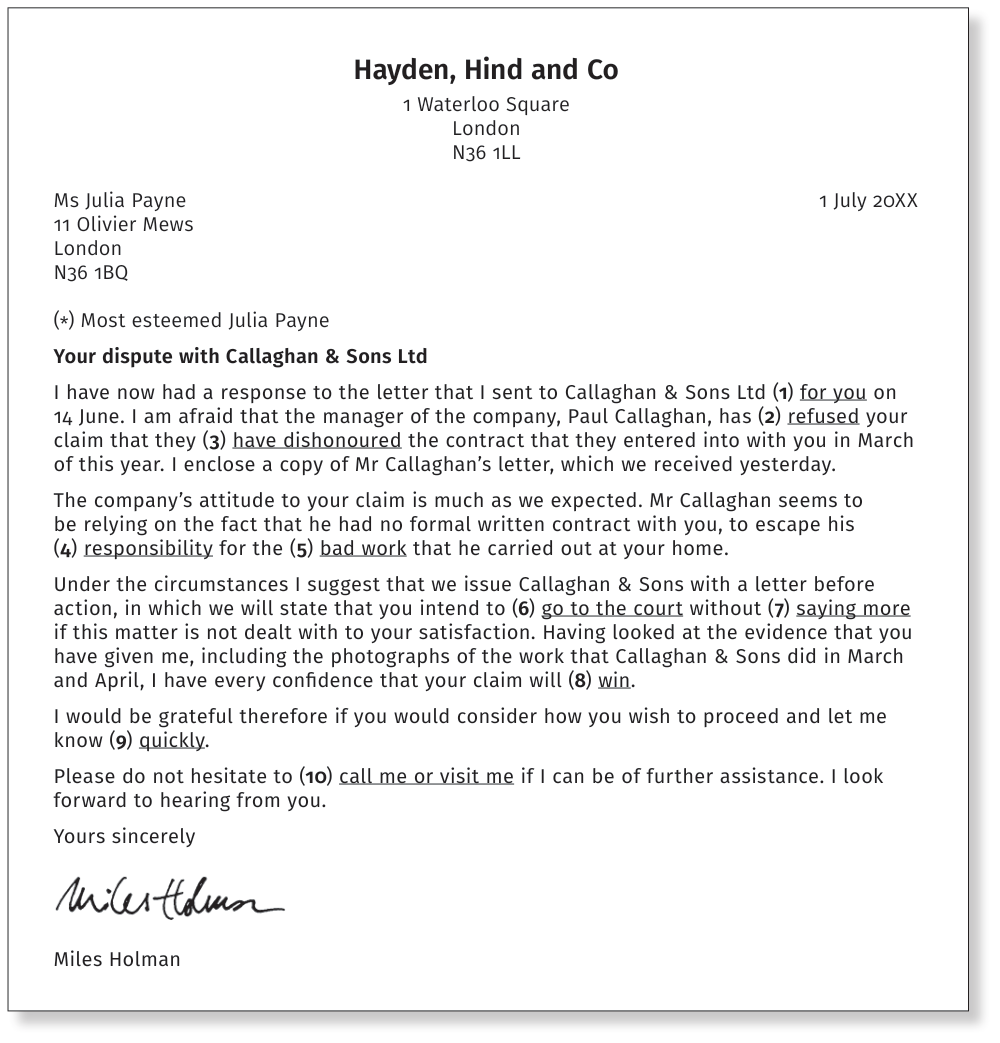
Look at the letter below. A lawyer has written it to his client. Parts of the letter are written in an inappropriate way. They are underlined. Rewrite the underlined words in a more appropriate way. There is an example at the beginning (*).
Speaking & Writing for this topic
Two short tasks scored against TOEFL rubrics. The prompt is generated for this topic — use the vocabulary you have just studied.
Suggested structureclick to expand
- In my experience…
- From what I have seen…
- My honest view is that…
- The principal reason is that…
- This matters because…
- What makes higher decisive here is…
- For instance, when I…
- A clear example is…
- Consider the case where level was involved…
- On the other hand,…
- Furthermore,…
- That said, one should not forget that…
- Overall, this shows that…
- The lesson, then, is…
- For these reasons, I believe…
- Aim for 4–5 keywords woven naturally into your answer.
- Use at least two linking phrases (Furthermore, On the other hand, As a result…).
- Avoid filler words like "basically" or "like".
Suggested structureclick to expand
- The most important point in this concept is …
- My position is that …
- The principal reason is that higher …
- This is supported by …
- A concrete illustration is …
- For instance, …
- However, some argue that …
- On the other hand, …
- In conclusion, …
- Taken together, …
- Aim for 4–5 keywords used in natural context.
- Use 3+ linking words across the answer.
- Vary sentence length to avoid monotony.
Hayden, Hind and Co ~12 min
1 Waterloo Square London N36 1LL Ms Julia Payne 1 July 20XX 11 Olivier Mews London N36 1BQ (*) Most esteemed Julia Payne Your dispute with Callaghan & Sons Ltd I have now had a response to the letter that I sent to Callaghan & Sons Ltd (1) for you on 14 June. I am afraid that the manager of the company, Paul Callaghan, has (2) refused your claim that they (3) have dishonoured the contract that they entered into with you in March of this year. I enclose a copy of Mr Callaghan’s letter, which we received yesterday.
The company’s attitude to your claim is much as we expected. Mr Callaghan seems to be relying on the fact that he had no formal written contract with you, to escape his (4) responsibility for the (5) bad work that he carried out at your home.
Under the circumstances I suggest that we issue Callaghan & Sons with a letter before action, in which we will state that you intend to (6) go to the court without (7) saying more if this matter is not dealt with to your satisfaction. Having looked at the evidence that you have given me, including the photographs of the work that Callaghan & Sons did in March and April, I have every confidence that your claim will (8) win.
I would be grateful therefore if you would consider how you wish to proceed and let me know (9) quickly.
Please do not hesitate to (10) call me or visit me if I can be of further assistance. I look forward to hearing from you.
Yours sincerely
Miles Holman (*) Dear Ms Payne
(1) (6)
(2) (7)
(3) (8)
(4) (9)
(5) (10)
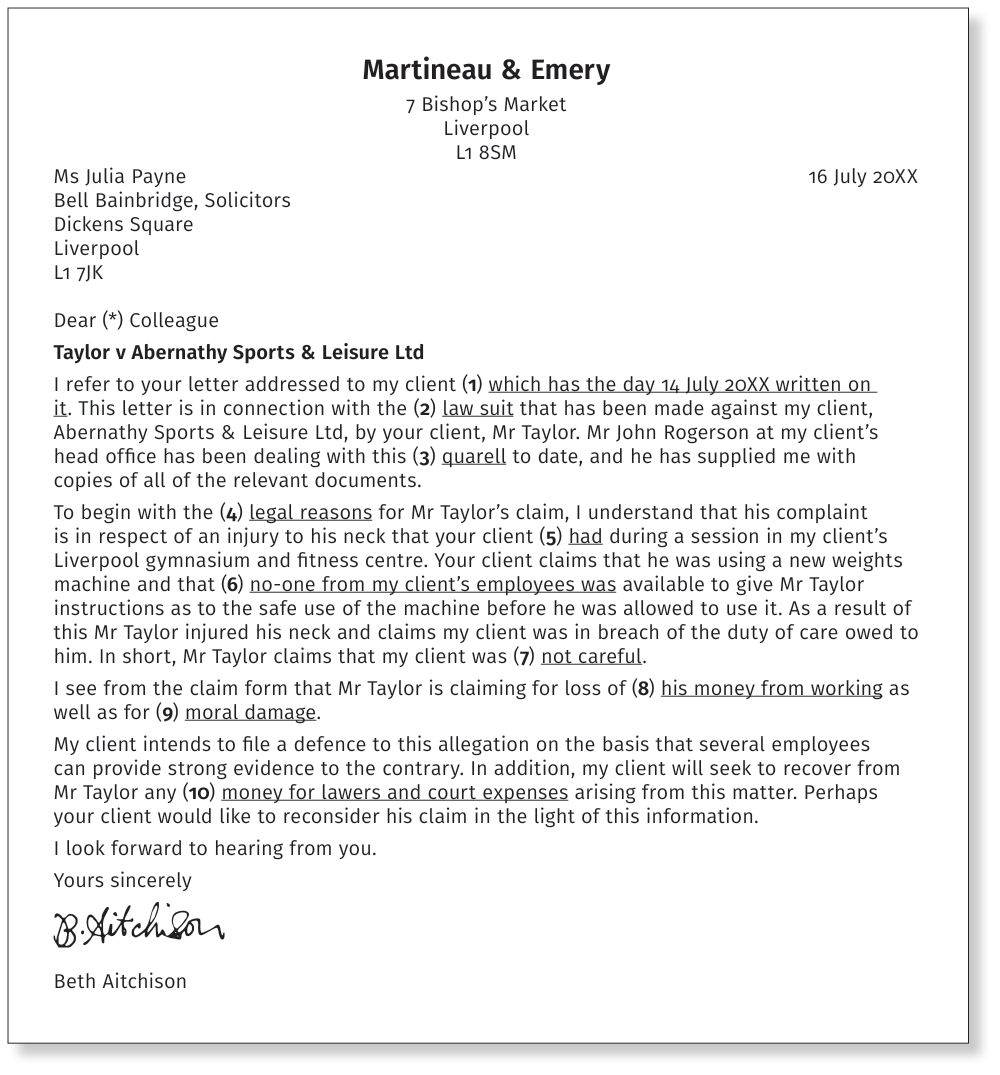
Look at the letter below. A lawyer has written it to another lawyer. Parts of the letter are written in an inappropriate way. They are underlined. Rewrite the underlined words in a more appropriate way. There is an example at the beginning (*).
Speaking & Writing for this topic
Two short tasks scored against TOEFL rubrics. The prompt is generated for this topic — use the vocabulary you have just studied.
Suggested structureclick to expand
- In my experience…
- From what I have seen…
- My honest view is that…
- The principal reason is that…
- This matters because…
- What makes hayden decisive here is…
- For instance, when I…
- A clear example is…
- Consider the case where hind was involved…
- On the other hand,…
- Furthermore,…
- That said, one should not forget that…
- Overall, this shows that…
- The lesson, then, is…
- For these reasons, I believe…
- Aim for 4–5 keywords woven naturally into your answer.
- Use at least two linking phrases (Furthermore, On the other hand, As a result…).
- Avoid filler words like "basically" or "like".
Suggested structureclick to expand
- The most important point in this concept is …
- My position is that …
- The principal reason is that hayden …
- This is supported by …
- A concrete illustration is …
- For instance, …
- However, some argue that …
- On the other hand, …
- In conclusion, …
- Taken together, …
- Aim for 4–5 keywords used in natural context.
- Use 3+ linking words across the answer.
- Vary sentence length to avoid monotony.
Martineau & Emery ~8 min
7 Bishop’s Market Liverpool L1 8SM Ms Julia Payne 16 July 20XX Bell Bainbridge, Solicitors Dickens Square Liverpool L1 7JK Dear (*) Colleague Taylor v Abernathy Sports & Leisure Ltd I refer to your letter addressed to my client (1) which has the day 14 July 20XX written on it. This letter is in connection with the (2) law suit that has been made against my client, Abernathy Sports & Leisure Ltd, by your client, Mr Taylor. Mr John Rogerson at my client’s head office has been dealing with this (3) quarell to date, and he has supplied me with copies of all of the relevant documents.
To begin with the (4) legal reasons for Mr Taylor’s claim, I understand that his complaint is in respect of an injury to his neck that your client (5) had during a session in my client’s Liverpool gymnasium and fitness centre. Your client claims that he was using a new weights machine and that (6) no-one from my client’s employees was available to give Mr Taylor instructions as to the safe use of the machine before he was allowed to use it. As a result of this Mr Taylor injured his neck and claims my client was in breach of the duty of care owed to him. In short, Mr Taylor claims that my client was (7) not careful.
I see from the claim form that Mr Taylor is claiming for loss of (8) his money from working as well as for (9) moral damage.
My client intends to file a defence to this allegation on the basis that several employees can provide strong evidence to the contrary. In addition, my client will seek to recover from Mr Taylor any (10) money for lawers and court expenses arising from this matter. Perhaps your client would like to reconsider his claim in the light of this information.
I look forward to hearing from you.
Yours sincerely Beth Aitchison (*) Mr Lowe
(1) (6)
(2) (7)
(3) (8)
(4) (9)
(5) (10)
Speaking & Writing for this topic
Two short tasks scored against TOEFL rubrics. The prompt is generated for this topic — use the vocabulary you have just studied.
Suggested structureclick to expand
- In my experience…
- From what I have seen…
- My honest view is that…
- The principal reason is that…
- This matters because…
- What makes martineau decisive here is…
- For instance, when I…
- A clear example is…
- Consider the case where emery was involved…
- On the other hand,…
- Furthermore,…
- That said, one should not forget that…
- Overall, this shows that…
- The lesson, then, is…
- For these reasons, I believe…
- Aim for 4–5 keywords woven naturally into your answer.
- Use at least two linking phrases (Furthermore, On the other hand, As a result…).
- Avoid filler words like "basically" or "like".
Suggested structureclick to expand
- The most important point in this concept is …
- My position is that …
- The principal reason is that martineau …
- This is supported by …
- A concrete illustration is …
- For instance, …
- However, some argue that …
- On the other hand, …
- In conclusion, …
- Taken together, …
- Aim for 4–5 keywords used in natural context.
- Use 3+ linking words across the answer.
- Vary sentence length to avoid monotony.